Evidence-first notes on bioscience and deep tech, at the edge of the lab and the market. Information only — not investment advice, not medical advice.
The 30-second version
- What. In 2025–26 big pharma bought its way into in-vivo gene editing and in-vivo CAR-T (Eli Lilly–Verve up to $1.3B; AbbVie–Capstan up to $2.1B). But the bet is not on the editing modality (nuclease / base / prime) — it is on the delivery platform and the precision spectrum. And on the capital axis, the most precise modality (prime editing) is the most vulnerable: runway divides Beam > Intellia [HOLD] > Prime. The Lilly–Verve deal structure itself (a contingent value right, CVR, tied to reaching US Phase 3) is an admission that the outcome evidence is not yet mature. No program of any kind has started a hard-outcome cardiovascular trial (CVOT). One factual correction inherited from an earlier part: Capstan was acquired by AbbVie, not Amgen.
- So what. The same window that delivered the acquisition rush also delivered the Intellia MAGNITUDE participant death and FDA hold. Capital expanded its bet at exactly the moment the clinic exposed the modality’s structural bottlenecks — irreversibility, liver toxicity, delivery, and zero hard outcomes. The market did not deny the bottleneck; it priced it in (the CVR, pipeline cuts, a post-hold revaluation). Market enthusiasm and the skeptic frame are two sides of the same fact.
- Now what. The headline “one-shot edit = permanent cure” has reached the top of the cardio-kidney-metabolic (CKM) narrative and won capital’s validation — but not one of the real bottlenecks (delivery, hepatotoxicity, irreversibility, off-target, zero hard outcome, a death event) has been resolved. The unifying thesis across the series: the true rate-limiting step is the outcome layer.
The five-minute read
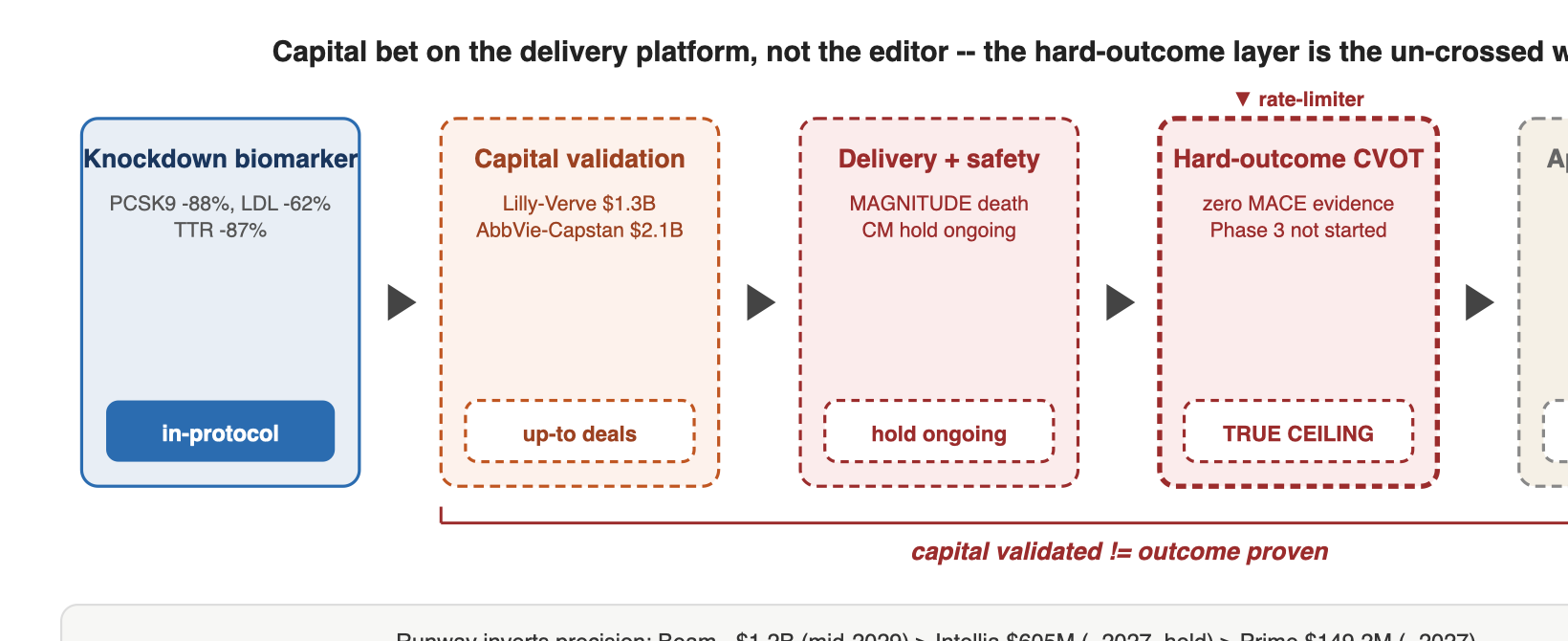
Capital bet on delivery, not on the editor
Where earlier parts of this series covered the science and clinical axis, this final part asks how capital read that axis. The 2025–26 facts split two ways. On one side, commercial validation: in a single year big pharma opened its wallet for in-vivo editing and in-vivo CAR-T — Eli Lilly for Verve at up to $1.3B (announced 2025-06-17) and AbbVie for Capstan at up to $2.1B (2025-06-30), with AstraZeneca and (per trade reports) Lilly–Orna also taking positions in in-vivo cell engineering. The “one-shot procedure” story won the capital market’s endorsement.
On the other side, an exposed bottleneck: in the same window (2025-10 to -11) the Intellia MAGNITUDE Phase 3 saw a participant death and an FDA hold. At the very moment capital scaled its bet, the clinic revealed this modality’s irreversibility, hepatotoxicity, delivery dependence and zero hard outcomes in the most severe possible form.
Through the series’ recurring lens (“the headline is the starting point; the real bottleneck lies elsewhere”), the core observation of this part is that big pharma is not betting on the editing modality itself but on the delivery platform (GalNAc-LNP, targeted LNP, circular-RNA-LNP). What Lilly bought in Verve was PCSK9-knockout data and a GalNAc-LNP delivery technology that opens the door to re-dosing; what AbbVie bought in Capstan was not the CAR but the targeted LNP (tLNP) that aims T cells inside the body. The market is agreeing, with capital, to the thesis that “delivery is the rate-limiting step.”
The precision spectrum is inverted on the capital axis
Among the three listed editing companies, runway diverges: Beam (about $1.2B, into mid-2029) > Intellia (about $605M, to roughly 2027, plus a hold) > Prime (about $149M, to roughly 2027). Prime, which sits at the top of the precision spectrum (prime editing), is the most capital-constrained — it deprioritized its ex-vivo CGD program to concentrate on an in-vivo liver franchise. In other words, “highest precision but last into the clinic” (an earlier part’s finding) is reproduced on the capital axis as “highest precision, most financially exposed.”
The MAGNITUDE shock: priced, not denied
One analyst cut a price target on Intellia after the hold (attributed to the publishing analyst, not this firm’s view). Regulatory outcomes then diverged: the ATTRv polyneuropathy hold (MAGNITUDE-2) was lifted on 2026-01-27, while the ATTR cardiomyopathy hold (MAGNITUDE) remains in place. The cardiomyopathy phenotype is the CKM heart-failure program — the one most directly relevant to this firm’s focus — and it is still on hold. Whether this is Intellia-specific or a class signal for LNP delivery is undetermined.
[diagram placeholder: two-axis map — x = capital runway (Prime < Intellia < Beam), y = editing precision (nuclease < base < prime); annotate MAGNITUDE hold on Intellia and the CVR on the Lilly–Verve deal]
Deep dive
1. Background — capital’s reading of a “validated” modality
Parts 0–4 of this series covered the scientific and clinical axis and set a central tension: “the knockdown magnitude is solved; the bottlenecks are delivery, safety and outcomes.” Part 5 widens the view to how capital, competition and commerce read that same axis. Two facts sit in tension. First, big pharma validated the field through acquisitions in 2025–26. Second, in the same window the flagship safety event (a death and a hold) exposed the modality’s structural limits. This synthesis argues those are not contradictory: they are the two faces of one reality.
2. What this synthesis establishes — capital bets on the platform, structure admits immaturity
Two anchor deals (editing vs. cell engineering).
| Deal | Announced | Size (attributed to disclosure / reporting) | Structure | Core asset |
|---|---|---|---|---|
| Lilly ← Verve | 2025-06-17 | up to $1.3B | $10.50/share upfront (about $1B) + CVR $3.00/share (if a lead reaches US Phase 3 within 10 years) | VERVE-102 (PCSK9), -201 (ANGPTL3), -301 (LPA / Lp(a)) |
| AbbVie ← Capstan | 2025-06-30 | up to $2.1B | attributed to disclosure | CPTX2309 (in-vivo CAR-T, tLNP-mRNA, autoimmunity) — correction: the acquirer is AbbVie, not Amgen |
The in-vivo CAR-T parallel wave. In-vivo CAR-T is not editing (transient mRNA expression) but shares the same delivery bottleneck (LNP / tLNP). By 2026 the competitive structure splits into an LNP-mRNA camp (AbbVie–Capstan; per trade reports Lilly–Orna, circular-RNA-LNP, about $2.4B, 2026-02 — attributed to trade reporting, primary disclosure unverified) versus a lentiviral / viral-free camp (AstraZeneca–EsoBiotec, up to $1B, 2025-03; BMS–Umoja). At least five large pharmas moved into in-vivo cell engineering in 2023–26, signaling a strategic conviction that in-vivo platforms can replace autologous CAR-T economics (attributed to industry review). The CKM / editing read-through: capital treats “in-body delivery” itself as the platform asset, because the bottleneck is the same whether the payload edits or expresses a CAR.
3. Method strengths and limits — capital divergence among the three listed editors
| Company | Cash (latest disclosure) | Runway | Lead in-vivo | Status |
|---|---|---|---|---|
| Beam (BEAM) | about $1.2B (Q1 2026) | mid-2029 | BEAM-302 (SERPINA1 correction) | pivotal H2 2026, accelerated-approval (biomarker) path; risto-cel BLA end-2026 |
| Intellia (NTLA) | $605M (Q4 2025) | about 2027 | nex-z (TTR), lonvo-z (KLKB1) | MAGNITUDE (CM) hold ongoing; MAGNITUDE-2 (PN) hold lifted 2026-01-27 |
| Prime (PRME) | $149.2M (2026-03-31) | about 2027 | PM577 (ATP7B, preclinical) | PM359 (CGD) deprioritized; focus on in-vivo liver franchise; headcount cut |
The MAGNITUDE sector question. Verve already switched delivery vehicles after LNP hepatotoxicity in VERVE-101 to -102 (an earlier part), so a hypothesis follows that hepatotoxicity may be a class signal of the LNP platform rather than a single-program issue — attractive, but with no confirming evidence (unverified). Whether the hold stays confined to Intellia or spreads as a shared LNP-delivery risk is undetermined and is the next fork for capital.
4. Connections to neighbouring domains — the firm’s CKM series
4-1. The Lp(a) series: same target, a reversible descent versus an irreversible one. This part resolves a previously unverified item: VERVE-301 exists, designed to permanently knock out the LPA gene in the liver (GalNAc-LNP plus a new editor) — but it is preclinical, with Lilly funding through Phase 1; a clinical-stage in-vivo Lp(a) edit has not started as of 2026-07. That sets up a head-to-head contrast with the Lp(a) series on the identical target (LPA): siRNA/ASO (olpasiran, pelacarsen) achieves periodic suppression (reversible, with CVOTs reading out), while VERVE-301 aims at a permanent knockout (irreversible, preclinical, zero outcome evidence). Where the Lp(a) series argued that “Lp(a)’s causal role is itself still being proven by outcomes,” editing touches that unproven target in a permanent, non-reversible way — the extreme combination of “earliest evidence × highest safety threshold.”
4-2. GLP-1 and finerenone: the two poles of the CKM paradigm. The GLP-1 / finerenone series established the CKM standard: “manage chronic disease with lifelong medication, but prove it on hard outcomes (MACE, heart-failure hospitalization, renal progression)” (SELECT, FLOW, FIGARO/FIDELIO). In-vivo editing stands at the opposite pole. The drug axis is reversible, titratable and holds hard outcomes, with adherence as its weakness; the editing axis is one-shot, erases adherence and has zero hard outcome, with irreversibility as its weakness. The two axes have exactly complementary weaknesses. VERVE-102 is slated to start Phase 2 late in 2026 (Fast Track), but a MACE Phase 3 CVOT has not started — editing has not yet crossed the bridge GLP-1 and finerenone already crossed.
4-3. Bio-foundation models: upstream tools that reduce off-target. The modality bottlenecks (nuclease indels, base-editor bystander edits, off-target) can be attacked at the design stage with AI: guide-RNA / editor design (CRISPR-GPT-type assistants; Evo 2 unifying genome-scale edit proposal and variant prioritization in one foundation model) and protein engineering for editor specificity (attributed to computational / preclinical work). The directionality matters: AI targets the bottleneck (off-target, bystander), not the knockdown magnitude — consistent with the firm’s lens. There is, however, no evidence yet that these tools have actually reduced clinical off-target events (unverified).
5. Commercialization and investment context (TRL, companies) — headline versus the six bottlenecks
The tension that ran through the whole series, compressed (inherited from Parts 0–4):
| # | Headline | True bottleneck | Status (2026-07) |
|---|---|---|---|
| 1 | “PCSK9 −88%, LDL −62%, TTR −87%” | knockdown ≠ outcome — zero MACE evidence | Phase 3 CVOT not started |
| 2 | “one procedure, done” | irreversible — a late signal cannot be undone | structural |
| 3 | “just an IV infusion” | delivery (LNP hepatotoxicity; extrahepatic unsolved) | VERVE-101, MAGNITUDE |
| 4 | “durable 18–44 months” | very-long-term durability unproven | under observation |
| 5 | “favourable safety” | MAGNITUDE death (causality undetermined) | CM hold ongoing |
| 6 | “big pharma validated it” | capital bets on the delivery platform, hedges outcome via CVR | deal structure admits immaturity |
Maturity (TRL). No in-vivo editing program has an approved cardiovascular indication; the lead (VERVE-102) is heading into Phase 2 with a knockdown biomarker, and a hard-outcome CVOT is not open. The in-vivo CAR-T neighbours are Phase 1. In TRL terms this remains mid-stage clinical for biomarkers and pre-outcome for hard endpoints. The listed sponsors — Intellia (NTLA), Beam (BEAM), Prime (PRME), Eli Lilly (LLY), AbbVie (ABBV), AstraZeneca (AZN) — are described here neutrally; acquisition, runway and pipeline statements are not buy/sell signals.
6. The opposing view (skeptic block)
Gate verdict: proceed-with-caveats (conditional) — the same as the series. Mandatory, Tier-1-level exposures at publication:
- Do not read commercial validation as clinical validation. A big-pharma acquisition is a platform bet, not proof of outcome. That the Lilly CVR is conditioned on Phase 3 is itself the evidence of “not yet.”
- Analyst price targets are attributed to the publishing analyst. The Intellia target cut reflects a specific analyst’s view, not this firm’s, and carries no security implication.
- Do not assert a causal death. The MAGNITUDE (CM) death remains unverified for causality — it cannot be called “the edit killed the patient” nor “unrelated.” The only confirmed fact is that the CM hold has not been lifted.
- Keep the class-signal claim a hypothesis. That LNP hepatotoxicity is a sector-wide class risk is a plausible reading with no confirming evidence.
- Deal-figure precision. Some numbers (e.g. the Orna deal, about $2.4B, 2026-02) are attributed to trade reporting, primary disclosure unverified.
- Escalation stands. Listed-company implications (NTLA, BEAM, PRME, LLY, ABBV, AZN) plus a death event require Principal confirmation of neutral framing.
7. What to watch (indicators)
- MAGNITUDE (ATTR-CM) hold: the regulatory conclusion and any causality determination. Prediction (falsifiable): resolution comes conditioned on dose / monitoring changes, or is delayed, and nuclease off-target (genome cutting) being confirmed as the primary cause is unlikely.
- First hard-outcome CVOT: which in-vivo editing program opens a MACE Phase 3 first. Prediction: PCSK9 (Lilly / VERVE-102), after its late-2026 Phase 2. (Falsified if another target/company enters a CVOT first, or Lilly pursues biomarker approval without a CVOT.)
- VERVE-301 (LPA) clinical entry: when, if ever, a clinical-stage in-vivo Lp(a) edit begins.
- LNP hepatotoxicity as a class signal: whether the risk stays program-specific or spreads across the sector.
- Listed-editor consolidation: prediction — by 2028 at least one of the three listed editors undergoes further pipeline cuts, restructuring or an acquisition (Prime’s roughly-2027 runway is the nearest term). (Falsified if all three stay independent with pipelines intact and self-extended runway.)
References
- Intellia Therapeutics. 2026. “Intellia Announces FDA Lift of MAGNITUDE-2 Clinical Hold.” Investor Relations (2026-01-27). MAGNITUDE-2 (PN) hold lifted; MAGNITUDE (CM) hold ongoing. https://ir.intelliatx.com/news-releases/news-release-details/intellia-therapeutics-announces-fda-lift-clinical-hold-magnitude
- Intellia Therapeutics. 2025. “Fourth Quarter and Full-Year 2025 Financial Results.” Cash $605M (Q4 2025), runway to about 2027. https://www.stocktitan.net/news/NTLA/intellia-therapeutics-announces-fourth-quarter-and-full-year-2025-5cuz8qa157eg.html
- CNBC. 2025. “Eli Lilly to acquire Verve Therapeutics for up to $1.3 billion.” (2025-06-17). Upfront $10.50/share plus CVR $3.00/share. https://www.cnbc.com/2025/06/17/eli-lilly-to-acquire-verve-therapeutics-for-1point3-billion.html
- CRISPR Medicine News. 2025. “Eli Lilly to Acquire Verve Therapeutics to Advance One-Time Cardiovascular Treatments.” VERVE-102 (PCSK9), -201 (ANGPTL3), -301 (LPA). https://crisprmedicinenews.com/news/eli-lilly-to-acquire-verve-therapeutics-to-advance-one-time-cardiovascular-treatments/
- AbbVie. 2025. “AbbVie to Acquire Capstan Therapeutics.” News release (2025-06-30). Up to $2.1B; CPTX2309 (in-vivo CAR-T, tLNP-mRNA). Acquirer is AbbVie (correction to an earlier “Amgen”). https://news.abbvie.com/2025-06-30-AbbVie-to-Acquire-Capstan-Therapeutics
- Nature Reviews Drug Discovery. 2025. In-vivo CAR-T consolidation and camp analysis (industry review). Nature d41573-025-00131-w. https://www.nature.com/articles/d41573-025-00131-w
- Beam Therapeutics. 2026. “First Quarter 2026 Financial Results.” Cash about $1.2B, runway mid-2029; BEAM-302 pivotal H2 2026; risto-cel BLA end-2026. https://investors.beamtx.com/news-releases/news-release-details/beam-therapeutics-reports-first-quarter-2026-financial-results
- Prime Medicine. 2026. “First Quarter 2026 Financial Results and Business Updates.” Cash $149.2M (2026-03-31), runway about 2027; PM359 (CGD) deprioritized; in-vivo liver focus. https://www.stocktitan.net/news/PRME/prime-medicine-reports-first-quarter-2026-financial-results-and-7kp98535jq5y.html
- Eli Lilly / Verve Therapeutics. “Single dose of Lilly’s PCSK9 base editor VERVE-102 reduced PCSK9 by 88%.” Investor Relations. VERVE-102 Heart-2 data (PCSK9 −88% at 1.0 mg/kg, LDL −62%, 18 months). https://investor.lilly.com/news-releases/news-release-details/single-dose-lillys-pcsk9-base-editor-verve-102-reduced-pcsk9-88
- VERVE-102 Heart-2 peer-reviewed report. PubMed 42187087. https://pubmed.ncbi.nlm.nih.gov/42187087/
Disclosure
This post is for information only and is not investment advice, and not medical advice. Treatment decisions should always be made with your own clinician.
COI note: this post describes listed and private gene-editing / in-vivo CAR-T companies — Intellia (NTLA), Beam (BEAM), Prime (PRME), Verve (acquired by Eli Lilly, LLY), Capstan (acquired by AbbVie, ABBV), Orna (reported Lilly acquisition, attributed to reporting), EsoBiotec (acquired by AstraZeneca, AZN) — and their sponsored trials in a descriptive, neutral context. Acquisition amounts and terms are attributed to company disclosures or reporting; items not confirmed against primary disclosure are marked unverified. Analyst price targets are attributed to their publishing sources and are not this firm’s view. The MAGNITUDE participant death and hold are attributed to the regulator / source material, with causality undetermined — this is not a statement that in-vivo editing killed a patient. Quantitative claims (knockdown magnitudes, deal sizes) are attributed to vendor, author, sponsor or preprint sources. Competitive, capital-runway and pipeline statements are factual, neutral descriptions and are not buy/sell implications for any security. The author holds no position in, and has no financial interest in, the companies named.


Leave a Reply