Evidence-first notes on bioscience and deep tech, at the edge of the lab and the market. Information only — not investment advice, not medical advice.
The 30-second version
- What. Lipoprotein(a), or Lp(a), is a largely genetically fixed particle that Mendelian randomization (MR) has established as a causal axis of residual cardiovascular risk — the part of risk that remains after LDL is driven as low as statins, ezetimibe and PCSK9 inhibitors allow (those drugs barely move Lp(a)). A new class of siRNA and antisense (ASO) drugs already lowers Lp(a) by roughly 90–100%, an unusually large biomarker effect.
- So what. Read the axes separately, because the biomarker win is not the outcome win. The causal genetics and the 90%+ lowering are on solid ground, but whether “lowering Lp(a) actually reduces cardiovascular events (MACE)” is not yet demonstrated by any Phase 3 hard-outcome trial — as of writing, not a single hard readout has been published. MR also implies the effect per unit is small: matching LDL’s 20% relative risk reduction would require lowering Lp(a) by about 101.5 mg/dL versus only about 38.67 mg/dL of LDL — which is precisely why 90%+ lowering is needed.
- Now what. This is the earliest-stage story in this CKM series — earlier than GLP-1 or finerenone. The pivotal question is the surrogate-to-hard-outcome translation, and the first answer (Novartis’ pelacarsen HORIZON trial) is imminent/overdue but not yet public — its actual topline result is [unverified] and is not reported here. Watch that readout: it is the rudder for the entire Lp(a) hypothesis.
The five-minute read
Why Lp(a) is called “genetically fixed”
Lp(a) is an LDL-like particle (it contains apoB-100) to which a second protein, apolipoprotein(a) [apo(a)], is covalently attached. apo(a) evolved from a duplication of the plasminogen gene, and it carries kringle domains that resemble plasminogen’s — the structural basis for a pro-thrombotic (anti-fibrinolytic) mechanism. One kringle subtype, KIV-2, varies in copy number from roughly 2 to more than 40 repeats between individuals, and that repeat number is inversely correlated with blood Lp(a): smaller isoforms (≤22 KIV repeats) are secreted more efficiently and produce 4–5 times higher Lp(a). Because roughly 70–90% of the blood level is set by the LPA gene alone, Lp(a) barely responds to diet, exercise or existing lipid drugs — which is why guidelines recommend measuring it once in a lifetime, and why pharmacological lowering is the only real intervention lever.
The pathology runs on three axes: atherosclerosis (Lp(a) is a major carrier of oxidized phospholipids that inflame the vessel wall), thrombosis (plasminogen homology competitively blunts fibrinolysis), and valve calcification (Lp(a) is a causal factor in aortic stenosis). Those axes lead to different outcomes — myocardial infarction and stroke versus venous thromboembolism versus aortic stenosis — which directly shapes how the outcome trials are designed and read.
What is proven, and the one thing that is not
Causality is established not by observational epidemiology but by MR, which is robust to reverse causation and confounding because LPA variants are randomly assigned at birth. In the key quantitative estimate (Burgess et al., JAMA Cardiology 2018), a genetically 10 mg/dL lower Lp(a) corresponds to a coronary heart disease odds ratio of 0.942 (95% CI 0.933–0.951), about a 5.8% risk reduction — versus an odds ratio of 0.855 for the same 10 mg/dL of LDL. The 2022 EAS consensus names Lp(a) as a causal factor for ASCVD and aortic stenosis and estimates that a clinically meaningful short-term event reduction would require an absolute lowering of more than 50–100 mg/dL, which is why the outcome trials enrol high-baseline patients (≥70 mg/dL / ≥175 nmol/L). One correction carried from Part 1: the widely quoted ≥125 nmol/L (about 50 mg/dL) “high-risk threshold” is a practical cutoff / trial-enrolment line, not a biological threshold — MR and UK Biobank show risk rising continuously with no threshold (roughly HR 1.07–1.11 per 50 nmol/L).
The biomarker-lowering itself is no longer the unmet need. The gap is the translation to hard events, and it is entirely open.
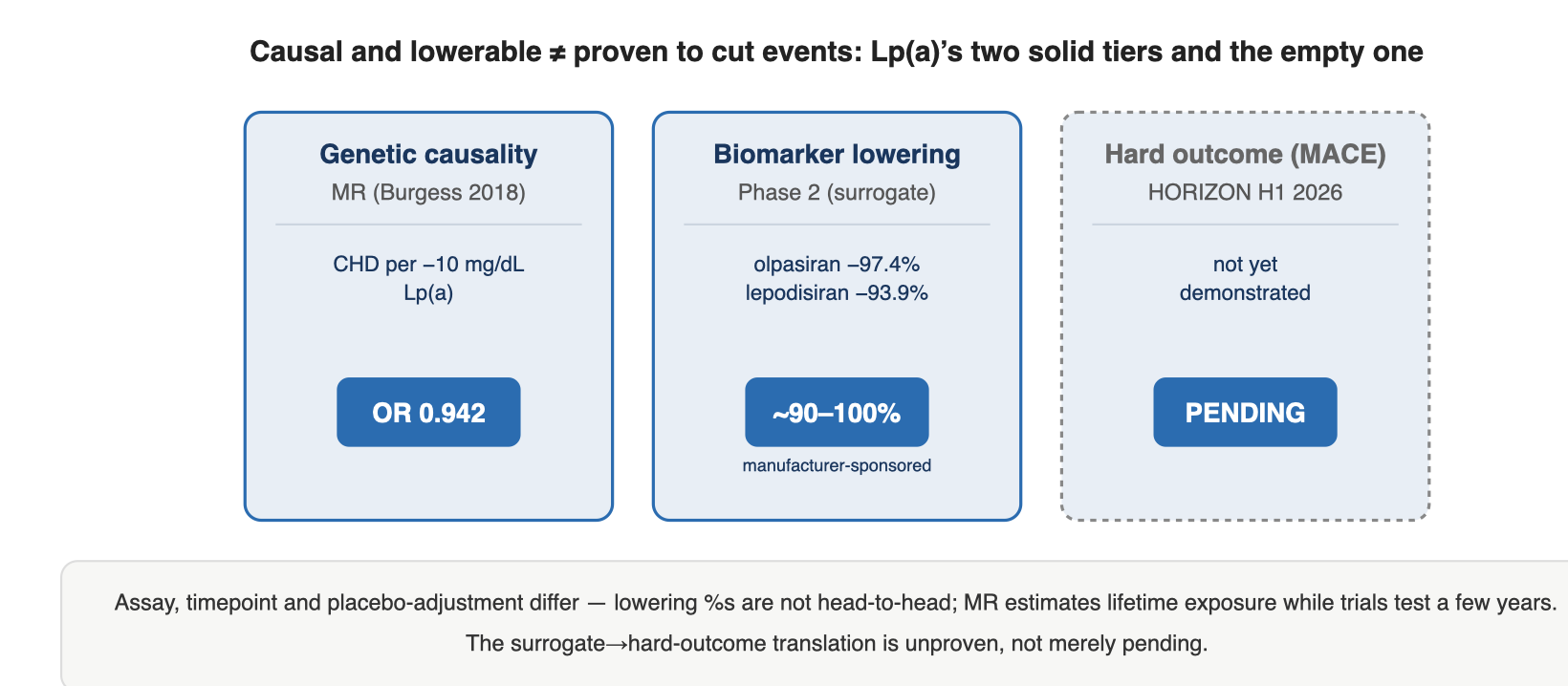
| Genetic causality | Biomarker lowering (surrogate) | Hard outcome (MACE) | |
|---|---|---|---|
| Status | Established — MR (Burgess 2018), EAS 2022 consensus; step-change genetic evidence | Established — siRNA/ASO lower Lp(a) roughly 90–100% in Phase 2 (attributed to sponsored trials) | Not yet demonstrated — no Phase 3 hard-outcome readout published; the central gap of this chapter |
The efficiency gap: why 90%+ lowering is the entry ticket
The decisive number from MR is not the direction of effect but its efficiency. To achieve the same 20% relative risk reduction, Lp(a) must fall by about 101.5 mg/dL whereas LDL need fall only about 38.67 mg/dL — Lp(a) has to be lowered “a lot” before a clinical benefit should appear. That is the quantitative reason the whole field converged on drugs that shut off apo(a) production at the source, and it is also the reason the outcome trials select high-baseline patients: only there is a large absolute lowering achievable.
Deep dive
1. Background — biology and genetics of a fixed baseline
Lp(a) is an LDL-like particle carrying apoB-100, to which apo(a) is bound by a single disulfide bond. apo(a) arose from a duplication of the plasminogen gene (roughly 33–40 million years ago) and comprises kringle IV subtypes 1–10, a kringle V, and an inactive protease-like domain. Only KIV-2 shows copy-number variation (2 to more than 40 repeats), inversely correlated with blood Lp(a); isoforms with ≤22 KIV repeats are secreted efficiently and produce 4–5 times higher Lp(a). Because roughly 70–90% of the level is genetically determined by LPA, Lp(a) is best framed as a non-modifiable genetic baseline risk — hence the “once in a lifetime” measurement recommendation.
A measurement caveat (developed in Part 3): Lp(a) is reported both in mg/dL (mass) and nmol/L (particle number), and isoform-size heterogeneity makes simple conversion inaccurate; an “intact Lp(a) assay” and an “apo(a) assay” also give different values (85.8% versus 70.0% lowering for muvalaplin, below). Assay non-standardization is a structural source of noise in thresholds and lowering percentages.
2. What the causal evidence establishes — and where MR stops
Principle: odds ratios and confidence intervals are reported exactly as in the source; genetic (MR) evidence is separated from pharmacological-intervention evidence; the biomarker (Lp(a) lowering) is separated from the hard outcome (MACE).
- Burgess et al. 2018 (JAMA Cardiology): a genetically 10 mg/dL lower Lp(a) gives coronary heart disease OR 0.942 (95% CI 0.933–0.951), versus OR 0.855 (0.818–0.893) for the same 10 mg/dL of LDL. The efficiency gap: Lp(a) must fall about 101.5 mg/dL to match the 20% relative risk reduction obtained from about 38.67 mg/dL of LDL.
- EAS 2022 consensus (Eur Heart J 43:3925): Lp(a) is named a causal factor for ASCVD (CHD, MI, stroke, PAD, heart failure) and aortic stenosis; an MR-based estimate implies that seeing a significant ASCVD reduction in a short (<5-year) trial would require an absolute lowering of more than 50–100 mg/dL — hence high-baseline enrolment.
- Measurement/threshold guidance: ESC/EAS 2019 recommend at least one lifetime measurement (genetic fixity); the ≥125 nmol/L (about 50 mg/dL) high-risk line is a practical/enrolment cutoff, with risk in fact continuous and threshold-free per MR and UK Biobank. NLA (US) recommends measurement in early ASCVD, LDL ≥190 and family history, with discussion of expanding to a one-time measurement in all adults.
- The boundary of MR: MR strongly establishes causality (step-change genetic evidence), but it does not directly prove that pharmacological lowering reverses that causal path — that is the job of the RCTs. MR is a lifetime-exposure effect; a several-year intervention on already-formed plaque may yield a smaller magnitude.
3. The pipeline — lowering %, phase, trials (attributed, no fabrication)
All percentages below are biomarker (Lp(a) concentration) lowering, not hard outcomes, and are attributed to manufacturer-sponsored trials. Assays, timepoints and placebo-adjustment differ, so direct cross-trial comparison warrants caution.
| Drug | Company | Modality | Phase 2 lowering (as reported) | Phase 3 outcome trial |
|---|---|---|---|---|
| olpasiran | Amgen | siRNA (GalNAc, SC) | OCEAN(a)-DOSE, N=281; wk36 placebo-adjusted −70.5% (10 mg) / −97.4% (75 mg) / −101.1% (225 mg q12w) / −100.5% (225 mg q24w) (NEJM 2022) | OCEAN(a)-OUTCOMES (NCT05581303) |
| pelacarsen | Novartis (orig. Ionis) | ASO (GalNAc, SC 80 mg monthly) | Phase 2 up to ~80% | Lp(a)-HORIZON (NCT04023552, N=8,323) |
| lepodisiran | Eli Lilly | siRNA (long-acting, SC) | ALPACA, N=320; day60–180 93.9% (400 mg) / 75.2% (96 mg) / 40.8% (16 mg) vs baseline (NEJM 2025-03-30) | ACCLAIM-Lp(a) (NCT06292013) |
| zerlasiran | Silence Therapeutics | siRNA (SC q16–24w) | ALPACAR-360, N=178; 36-wk time-averaged placebo-adjusted >80% (max >90%) (JAMA 2024) | Phase 3-ready but not started pending a partner (per Part 5) |
| muvalaplin | Eli Lilly | Oral small molecule (apo(a)–apoB binding inhibitor) | KRAKEN, N=233; placebo-adjusted up to 85.8% (intact assay) / 68.9–70.0% (apo(a) assay) (JAMA 2024-11-18) | MOVE-Lp(a) (NCT07157774, N=10,450, started 2025-09) |
4. The pivotal open question — outcome-trial readout status
Principle: does 90%+ lowering translate into MACE reduction? The whole chapter turns on this, and no trial has yet reported a hard result.
- Lp(a)-HORIZON (NCT04023552, pelacarsen, N=8,323): established CVD plus Lp(a) ≥70 mg/dL (secondary prevention); primary is an expanded 4-point MACE (including stroke). Readout was pushed from 2025 to H1 2026 (slower blinded event accrual), with regulatory submission signalled for H2 2026. As the first and leading readout, this result is the rudder for the entire Lp(a) hypothesis. However, the actual topline is not publicly confirmed as of writing and is quarantined as [unverified] — “imminent/overdue” — and no result is invented or implied here.
- OCEAN(a)-OUTCOMES (NCT05581303, olpasiran, N=7,297 enrolment confirmed): ASCVD plus high Lp(a); a 3-point primary (CHD death, MI, urgent coronary revascularization; stroke not included). Expected readout 2028-03-31 — a replication trial finishing about two years after HORIZON.
- OCEAN(a)-PreEvent (NCT07136012, olpasiran, ~11,000): a primary-prevention trial (recruiting), roughly 2031 — Amgen entering primary prevention too.
- ACCLAIM-Lp(a) (NCT06292013, lepodisiran, ~12,500 in press / 17,300 estimated in registry — discrepancy noted): ASCVD or high-risk primary prevention; primary is CV death, nonfatal MI, nonfatal stroke, urgent revascularization; roughly 2029. The only program that includes primary prevention — success would materially expand the addressable population, but it finishes latest.
- MOVE-Lp(a) (NCT07157774, oral muvalaplin, N=10,450): high risk; roughly 2031, the latest in the class.
The bottom line: none of the outcome trials has produced a hard result. The Lp(a) chapter is at a “lowering is proven, events are unproven” stage that is considerably earlier than GLP-1 or finerenone.
5. Commercialization and competitive context
- Maturity (TRL ~7): the class is in large Phase 3 outcome trials with the biomarker endpoint demonstrated; but because the “therapeutic purpose = event reduction” is not yet demonstrated, the move to TRL 8–9 (approval, real-world use) is conditional on HORIZON/OCEAN(a) results. On lowering alone the class would rate TRL 8; it is held at 7 on the outcome standard.
- siRNA/ASO trio in the lead: olpasiran (Amgen), pelacarsen (Novartis, originally Ionis) and lepodisiran (Eli Lilly) combine ~90% lowering with outcome trials underway. Delivery leans on liver-targeted GalNAc — a cross-domain hook to the broader RNA-therapeutics (siRNA/ASO) platform expanding from rare disease into chronic cardiovascular disease.
- Oral optionality: muvalaplin (Eli Lilly) is the only oral small molecule; potential differentiation on adherence and access, offset by a lower, assay-dependent lowering.
- zerlasiran (Silence Therapeutics) markets dosing convenience (q16–24w) but its Phase 3 start/partner status is not confirmed.
- Company statements here are neutral, trial-attributed descriptions; competitive or efficacy-ranking statements are not buy/sell implications for any security.
A second cross-domain hook: quantifying KIV-2 copy-number variation is a blind spot for short-read next-generation sequencing and depends on long-read and optical-mapping genomics — a genomics/AI dependency underneath the whole Lp(a) diagnostic story.
6. The skeptic’s bottom line
- Surrogate risk (top of the list): Lp(a) lowering is a surrogate. The history of “good-looking lipid biomarkers” that failed to translate — or caused harm — in outcome trials (niacin, the CETP inhibitors such as torcetrapib) is the cautionary frame: 90% lowering does not automatically mean a MACE reduction.
- MR ≠ RCT magnitude: MR is a lifetime-exposure effect; a several-year intervention late in life acts on already-formed plaque and may be much smaller. Even with high-baseline, high-risk enrolment, the absolute benefit could be modest.
- Assay/unit noise: mg/dL versus nmol/L and intact versus apo(a) assays disagree, introducing systematic error into thresholds, lowering percentages and patient selection. Cross-trial comparison is fragile until standardization.
- COI: every Phase 2/3 trial is manufacturer-sponsored (Amgen, Novartis/Ionis, Lilly, Silence); lowering percentages are stated only with trial attribution.
- Verdict — proceed with caveats (conditional): causality and lowering are near verified-clean, but the therapeutic benefit (MACE) is unverified to a degree that borders on “hold.” The knowledge-asset stage keeps to neutral, trial-attributed statements only, and re-adjudicates when the HORIZON topline is public.
7. What to watch (falsifiable)
- HORIZON (pelacarsen) primary MACE: a significant result (HR <1, upper CI <1) would confirm the Lp(a) hypothesis and force a re-rating of the whole class; a non-significant result (CI crossing 1) would feed a CETP-style “lowering ≠ events” disappointment narrative.
- Dose-response by baseline and absolute lowering: benefit should track baseline Lp(a) and reaching >50–100 mg/dL of absolute lowering, with low-baseline / small-lowering subgroups showing little benefit; if not, the MR efficiency-gap logic is shaken.
- Oral versus injectable: whether muvalaplin’s adherence advantage offsets its lower (70–86%) lowering in actual event reduction needs separate validation; a faster-than-expected Phase 3 entry would be the counter-signal.
- Assay standardization and whether OCEAN(a)-OUTCOMES’ exact readout year firms up (2026 versus 2027 sources conflict; 2028-03-31 per current registry).
References
- O’Donoghue, M. L., et al. 2022. “Small Interfering RNA to Reduce Lipoprotein(a) in Cardiovascular Disease (OCEAN(a)-DOSE, olpasiran).” New England Journal of Medicine 387: 1855. wk36 placebo-adjusted lowering −70.5% to −101.1%. https://www.nejm.org/doi/full/10.1056/NEJMoa2211023 (2022)
- Nissen, S. E., et al. 2025. “Lepodisiran, an Extended-Duration siRNA Targeting Lipoprotein(a) (ALPACA).” New England Journal of Medicine. day60–180 lowering 40.8–93.9% vs baseline. https://www.nejm.org/doi/abs/10.1056/NEJMoa2415818 (2025-03-30)
- Burgess, S., et al. 2018. “Association of LPA Variants with Risk of Coronary Disease and the Implications for Lipoprotein(a)-Lowering Therapies.” JAMA Cardiology 3(7): 619. Lp(a) OR 0.942 per 10 mg/dL; 101.5 vs 38.67 mg/dL for 20% RRR. https://pubmed.ncbi.nlm.nih.gov/29926099/ (2018)
- Kronenberg, F., et al. 2022. “Lipoprotein(a) in Atherosclerotic Cardiovascular Disease and Aortic Stenosis: a European Atherosclerosis Society Consensus Statement.” European Heart Journal 43(39): 3925. Causal ASCVD + aortic stenosis; >50–100 mg/dL lowering needed short-term. https://academic.oup.com/eurheartj/article/43/39/3925/6670882 (2022)
- Lp(a)-HORIZON (pelacarsen). ClinicalTrials.gov NCT04023552, N=8,323, Lp(a) ≥70 mg/dL, expanded MACE primary. Topline result [unverified] — imminent/overdue, not yet public as of writing. https://clinicaltrials.gov/study/NCT04023552
- OCEAN(a)-OUTCOMES (olpasiran). ClinicalTrials.gov NCT05581303, N=7,297, 3-point MACE primary, expected 2028-03-31. https://clinicaltrials.gov/study/NCT05581303
- ACCLAIM-Lp(a) (lepodisiran). ClinicalTrials.gov NCT06292013, includes primary prevention, ~2029. https://clinicaltrials.gov/study/NCT06292013
Disclosure
This post is for information only and is not investment advice, and is not medical advice. Treatment decisions should always be made with your own clinician.
COI note: this post describes listed pharmaceutical companies (Novartis, Amgen AMGN, Eli Lilly LLY, Silence Therapeutics, Ionis) and the clinical trials they sponsored in a descriptive context. Every Phase 2/3 Lp(a) trial cited (OCEAN(a)-DOSE, OCEAN(a)-OUTCOMES, Lp(a)-HORIZON, ALPACA, ACCLAIM-Lp(a), ALPACAR-360, KRAKEN, MOVE-Lp(a)) is manufacturer-sponsored. All lowering percentages are biomarker (Lp(a) concentration) effects attributed to the named trial and journal, and are separated from hard outcomes (MACE), which are not yet demonstrated. Quantitative claims are attributed to the relevant trial, authors or preprint. Competitive and efficacy-ranking statements are factual, neutral descriptions and are not buy/sell implications for any security. The author holds no position in, and has no financial interest in, the companies named.


Leave a Reply