Evidence-first notes on bioscience and deep tech, at the edge of the lab and the market. Information only — not investment advice, not medical advice. All reduction and effect-size figures are attributed to the sponsoring trial or company; several are company press releases or conference presentations rather than peer-reviewed data (noted inline). The tau-versus-amyloid comparisons here are cross-trial, not head-to-head.
The 30-second version
- What. Tau is a phenotype-proximal target: observationally, tau PET (spatial extent, Braak staging) correlates with cognition and future decline more tightly than amyloid does. That raises a prior expectation — hit tau and the clinical benefit should follow more readily than with anti-amyloid. This piece tests that expectation against the intervention data. The headline finding is a gap between the promise and the results: across the board, tau interventions miss their primary endpoint.
- So what. The N-terminal tau-antibody graveyard is mechanistic, not incidental. Tau pathology accumulates and spreads largely intracellularly (neurofibrillary tangles), whereas monoclonal antibodies bind mostly extracellular tau and structurally under-reach. Semorinemab (TAURIEL), gosuranemab (TANGO), tilavonemab and zagotenemab all failed; the mid-region antibody bepranemab (TOGETHER, N=466) also missed its primary CDR-SB, leaving only secondary/subgroup signals. The one modality that hit tau pathology and a cognition signal together is the intracellular bet — a tau antisense oligonucleotide (ASO), BIIB080/diranersen (Ionis/Biogen), which lowers MAPT mRNA upstream.
- Now what. Diranersen’s Phase 1b showed the deepest target engagement seen for tau (CSF total-tau down 56%, p-tau181 down 51%; Nature Medicine 2023). But its Phase 2 CELIA (N=416) MISSED its primary endpoint (dose-response CDR-SB at week 76), and the reported effect sizes are topline press-release only, undisclosed — so the widely repeated “first trial to show tau reduction plus cognitive benefit” headline should not be read as a primary-endpoint success. The verdict is proceed-with-caveats: “tau translates better than amyloid” is neither confirmed nor refuted.
The five-minute read
Why tau — a target closer to the phenotype than amyloid
Part 0 of this series framed the central problem as the surrogate-to-clinical translation bottleneck: anti-amyloid therapies unambiguously cleared amyloid (surrogate confirmed) but delivered only small CDR-SB effects. A long-standing explanation is that amyloid is linked to the disease phenotype (cognition) only upstream and indirectly. If so, a more downstream target — one wired more directly to cognition — might translate better. The leading candidate is tau.
The rationale is observational. Tau pathology, and in particular the spatial extent of tau on PET and in-vivo Braak staging, correlates with cognition and neurodegeneration more strongly and directly than amyloid does. In [18F]MK-6240 tau PET, how widely tau has spread tracks cognition better than the standardized uptake value ratio (how intense it is). Tau PET-based Braak stage predicts future cognitive/functional decline and MCI-to-dementia conversion independently of amyloid burden. Theoretically, tau is the target where “move the target, and the clinic should follow” is more plausible. But an observational correlation does not guarantee a causal advantage as a drug target — that tau tracks cognition tightly is a different proposition from lowering tau improving cognition.
The promise-versus-results gap — antibodies miss, ASO is a mechanistic bet
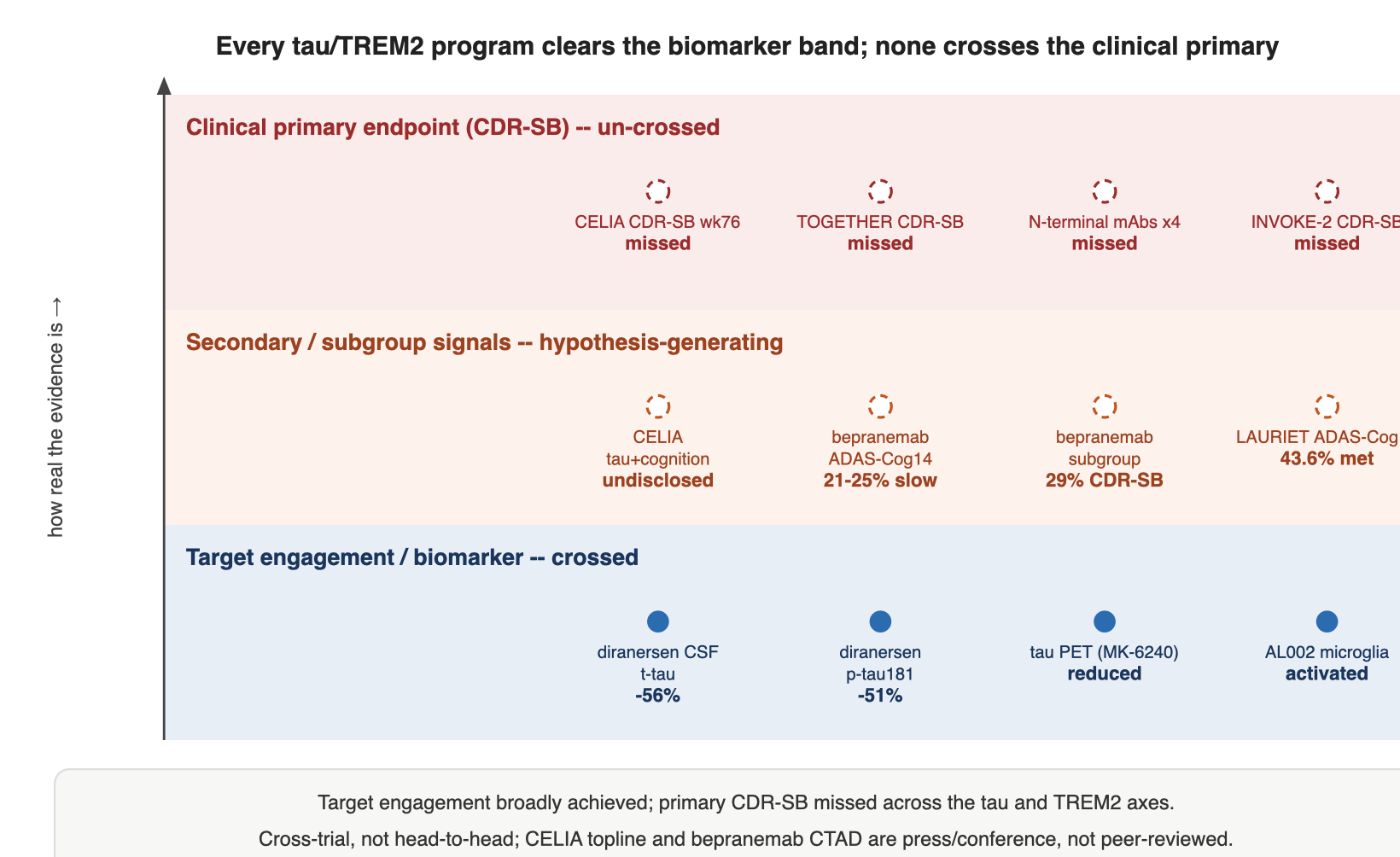
The firm’s recurring lens — “the headline is the starting point; the real bottleneck is elsewhere” — applies here too. Antibodies targeting tau largely missed their primary endpoints, and the N-terminal class was wiped out entirely. The mid-region antibody bepranemab missed its primary and produced only secondary/subgroup signals. The only program to show a reduction in tau pathology and a cognition signal together was the ASO that lowers intracellular MAPT mRNA — yet even its CELIA Phase 2 missed the primary (dose-response) endpoint, with effect sizes disclosed only in a topline press release. Crucially, the antibody failures look mechanistic: tau is an intracellular pathology, so extracellular-binding antibodies are structurally disadvantaged, while an ASO blocks tau protein production upstream, inside the cell.
| Item | Status | Basis (trial-attributed) |
|---|---|---|
| Tau’s phenotype proximity (cognition correlation) | Demonstrated (observational) | Tau PET spatial extent / Braak staging correlate with cognition and future decline more tightly than amyloid PET |
| Tau ASO target engagement (diranersen) | Demonstrated | Phase 1b: CSF t-tau down 56% (95% CI 50–62%), p-tau181 down 51% (38–63%), tau PET reduction (Nature Medicine 2023) |
| Tau ASO clinical benefit (CELIA primary) | Missed | Dose-response CDR-SB at week 76 not met (topline 2026-05-14) |
| Tau ASO cognition signal (CELIA secondary) | Hypothesis-generating / undisclosed | Sponsor claims “tau reduction plus cognitive benefit together”; effect sizes are press-release only |
| Mid-region antibody (bepranemab) primary | Missed | TOGETHER CDR-SB (full population) missed; secondary tau 33–58% / ADAS-Cog14 21–25% slowing only |
| N-terminal antibodies (four) | Wiped out (primary missed / futility) | semorinemab TAURIEL, gosuranemab TANGO, tilavonemab, zagotenemab |
| TREM2 agonist (AL002) | Missed | INVOKE-2 CDR-SB primary and secondary missed; microglial activation (target engagement) achieved |
| Tau vs amyloid translational advantage | Unconfirmed | No advantage established in intervention trials; primaries missed broadly on the tau axis too |
Deep dive
1. Background — why tau, from the observational epidemiology
The prior expectation for tau rests on observational data, not intervention data.
- Tau PET spatial extent > simple SUVR: in [18F]MK-6240 tau PET, the spatial extent of tau pathology correlates with cognitive performance more strongly than the standardized uptake value ratio. How widely tau has spread aligns with cognition better than how intense it is.
- Prognostic value of in-vivo Braak staging: tau PET-based Braak stage predicts future cognitive/functional decline and MCI/dementia conversion risk independently of Centiloid (amyloid burden) and diagnostic group, and reportedly explains more of the variance in future cognitive decline than amyloid PET.
- Implication: tau is a more downstream, phenotype-proximal target than amyloid. That is the a-priori basis for expecting better translation — which this piece then tests against trial results.
An important caveat: an observational correlation does not guarantee a causal advantage as a target. “Tau correlates with cognition more tightly” and “lowering tau improves cognition” are separate propositions (surrogate versus intervention effect) — the crux of section 3.
2. The landscape — tau and next-generation target trials (trial-attributed)
- diranersen / BIIB080 (Ionis/Biogen) — MAPT ASO, intrathecal. CELIA Phase 2 (N=416, MCI/mild AD, amyloid-positive), primary = dose-response CDR-SB change at 76 weeks: primary MISSED; the sponsor described it as “the first tau-targeting trial to show tau-pathology reduction plus cognitive benefit together” and plans a registrational path — but the effect sizes are press-release only (undisclosed) (Biogen/Ionis topline 2026-05-14). In the earlier Phase 1b MAD study (mild AD), CSF total-tau fell 56% (95% CI 50–62%) and p-tau181 fell 51% (38–63%) in the high-dose group, with regional tau PET (MK-6240) reduction in a small cohort and acceptable safety (Nature Medicine 2023, Mummery et al.). FDA Fast Track granted.
- bepranemab (UCB; returned by Roche/Genentech) — mid-region tau monoclonal antibody. TOGETHER (AH0003) Phase 2a (N=466, 80 weeks), primary CDR-SB (full population): primary MISSED; secondary signals were tau accumulation slowed 33–58% and ADAS-Cog14 slowed 21–25%, with a subgroup (low-tau / APOE4 non-carriers, ~50%) showing high-dose tau slowing 63–67% and CDR-SB 29% (CTAD 2024).
- semorinemab (AC Immune/Genentech) — N-terminal tau monoclonal antibody. TAURIEL (early AD, N=457, 73 weeks) primary CDR-SB MISSED, with ADAS-Cog13 and ADCS-ADL also missed (2020). LAURIET (mild-to-moderate AD, N=272, 49 weeks) co-primary ADAS-Cog11 and ADCS-ADL: ADAS-Cog11 met (43.6% slowing, significant) but ADCS-ADL / global function missed; Genentech/Roche ended the collaboration on 2024-01-22 (Neurology 2023).
- gosuranemab (Biogen) — N-terminal tau monoclonal antibody. TANGO (MCI/mild AD) primary CDR-SB at 78 weeks MISSED, development discontinued; CSF N-terminal tau lowering (target engagement) was achieved (an earlier PSP trial, PASSPORT, had also failed) (2021).
- tilavonemab / ABBV-8E12 (AbbVie) — N-terminal tau monoclonal antibody, Phase 2 AD: stopped early for futility; CSF free-tau lowering (target engagement) achieved (PSP also failed).
- AL002 (Alector/AbbVie) — TREM2 agonist monoclonal antibody. INVOKE-2 (early AD, ~96 weeks, 11 countries) primary CDR-SB MISSED, with no secondary benefit either; microglial activation (target engagement) was achieved. AbbVie ended the collaboration in 2025-01 and Alector cut 17% of staff (2024-11-25).
The shared pattern (the key observation): the primary clinical endpoint (usually CDR-SB) is missed almost everywhere on the tau and TREM2 axes, while target engagement (CSF tau lowering, tau PET reduction, microglial activation) is mostly achieved. This is the anti-amyloid structure from Part 0 — “the target was moved but the clinic did not follow” — recurring, and in a more severe form on the tau axis (anti-amyloid at least met its primary statistically; the tau antibodies missed the primary itself).
3. Mechanistic hypotheses — why antibodies lose and the ASO is a mechanistic bet
(a) “Tau is a better target than amyloid” — still unconfirmed (neutral). The observational epidemiology (section 1) supports tau being phenotype-proximal, but that advantage has not been confirmed in intervention trials. Tau antibodies missed primaries broadly, and the only concurrent signal (diranersen) also missed its primary (dose-response). A closer target did not automatically translate into better outcomes. Hypothesis A is thus neither supported nor refuted; diranersen’s biomarker-plus-cognition concordance is the only candidate evidence for A.
(b) The reach limit of extracellular antibodies — the ASO’s intracellular access is a mechanistic bet (with basis). Tau pathology accumulates and spreads substantially as intracellular neurofibrillary tangles, whereas monoclonal antibodies bind mostly extracellular tau — the rationale being to intercept the extracellular seeds of spread. But the N-terminal antibodies were wiped out (gosuranemab, tilavonemab, semorinemab TAURIEL, zagotenemab); one reading is that N-terminal fragments may not be the core species of spread and toxicity (Alzforum: N-terminal antibodies fade, mid-domain ones push to the fore). The mid-region antibody bepranemab, aimed at an aggregation-relevant epitope, produced tau slowing (33–58%) and a secondary cognition signal (ADAS-Cog14 21–25%) but still missed its primary (CDR-SB). By contrast, the ASO diranersen binds MAPT pre-mRNA (intron 9) and recruits RNase H1 to degrade the mRNA, blocking tau protein production upstream inside the cell — bypassing the reach limit by “not making it in the first place.” In Phase 1b it showed deeper target engagement than any antibody (CSF t-tau down 56%, p-tau181 down 51%, regional tau PET reduction). So the narrative “antibodies lose, the ASO is a mechanistic bet” has a basis in delivery route (extracellular versus intracellular) — but deep engagement has not yet been shown to translate into large clinical benefit (CELIA primary missed).
(c) The “miss the primary, advance on secondary/subgroup” pattern — risk of re-running the aducanumab lesson (skeptic). Bepranemab, semorinemab (LAURIET) and diranersen all continued development on secondary endpoints or subgroup signals after missing the primary (or co-primary / dose-response). This mirrors the lesson left by aducanumab’s conflicting results and market withdrawal (Part 0): subgroup/secondary signals after a pre-specified primary fails are multiplicity-uncorrected and hypothesis-generating, not confirmatory. Bepranemab’s low-tau / APOE4 non-carrier subgroup (29% CDR-SB slowing) is a strong signal, but it sits on top of a post-hoc character and a missed full-population primary. So “tau broke the translation bottleneck” is an overstatement at this point.
Summary: tau’s translational advantage is unconfirmed (a); the ASO’s intracellular access is a mechanistically reasonable bet (b); but the current clinical evidence sits inside an aducanumab-type pattern of missed primaries plus secondary/subgroup signals (c). Neither “tau beats amyloid” nor “tau also failed” can be asserted yet — the deciding evidence rests on diranersen’s full data and any registrational Phase 3.
4. Neighbouring domains — TREM2 and neuroinflammation (the post-amyloid pipeline)
- TREM2 agonist (AL002, Alector/AbbVie): TREM2 is a microglial surface receptor, and the agonist antibody is meant to activate microglia to help clear pathology. In INVOKE-2, target engagement and microglial activation were achieved, but both the CDR-SB primary and secondary endpoints were missed (2024-11-25); AbbVie ended the collaboration in 2025-01 and Alector cut 17% of staff. “Microglia were switched on, but the clinic did not follow” — target engagement not equalling clinical benefit recurs on the immune axis, beyond amyloid and tau.
- Broader synapse / neuroinflammation pipeline: tauopathy pipeline reviews (Alz Res Ther 2025) catalog tau ASOs, antibodies, small molecules (aggregation inhibitors, O-GlcNAcase, etc.) and vaccines broadly, but most are early/preclinical or at a missed-primary stage. This axis shows post-amyloid target diversification, yet — with no “translational success” case so far — it re-confirms and extends the Part 0 bottleneck. (Individual program status here is thin — marked unverified.)
5. Commercialization and competitive context
- Maturity (TRL frame): tau target engagement (CSF tau lowering, tau PET reduction) is demonstrated, but hard-outcome maturity is early because primaries are broadly missed. The gating layer is translation from surrogate to clinical benefit, not target engagement.
- Ionis (IONS) / Biogen (BIIB): diranersen/BIIB080 is the leading intracellular tau bet (deepest engagement in Phase 1b), but CELIA missed its primary and the effect sizes are press-release only; the deciding evidence is CELIA full data and any registrational Phase 3.
- UCB: bepranemab (mid-region antibody, returned from Roche/Genentech) missed its TOGETHER primary, with secondary/subgroup signals only.
- AC Immune (ACIU) / Genentech (Roche): semorinemab missed TAURIEL and met only one LAURIET co-primary; the collaboration ended 2024-01-22.
- Alector (ALEC) / AbbVie (ABBV): AL002 (TREM2) missed INVOKE-2; AbbVie ended the collaboration 2025-01 and Alector cut 17% of staff.
- Company statements are limited to neutral, trial-attributed description; competitive or efficacy-ranking statements are not buy/sell signals. Deal and pipeline details beyond the trial-attributed figures are [unverified].
6. The skeptic’s bottom line
- Headline is not the primary: CELIA’s primary (dose-response CDR-SB) was missed; the “tau reduction plus cognitive benefit” claim is topline press-release only, with effect sizes undisclosed (full data and peer review pending). Reading the headline as a “primary success” is the specific error this piece corrects.
- Secondary/subgroup, not primary: the cognition signals from bepranemab, semorinemab and diranersen sit below a failed primary (multiplicity-uncorrected, hence hypothesis-generating — an aducanumab-type pattern).
- Target engagement ≠ clinical benefit: CSF tau, tau PET and microglia move, but the primary is missed across the tau and TREM2 axes.
- Cross-trial, not head-to-head: diranersen versus bepranemab versus anti-amyloid comparisons differ in target, epitope, population, scale and duration — there is no head-to-head.
- Observational, not causal: tau’s cognition-correlation advantage (section 1) is observational epidemiology, not causal evidence of an intervention effect.
- Neutral-framing note: to prevent misreading listed-company (IONS, BIIB, UCB, Roche, ACIU, ALEC, ABBV) implications as security signals; “tau > amyloid” and “ASO superior / antibody inferior” assertions are blocked.
7. What to watch (falsifiable)
- P1: if CELIA full data / a follow-on registrational Phase 3 shows a diranersen CDR-SB (or alternative primary) effect whose CI lower bound crosses clinical meaningfulness (MCID) and aligns with tau PET reduction by dose/time, hypothesis A (tau translational advantage) plus hypothesis (b) (intracellular ASO access) are strengthened. If the effect vanishes or flattens, the picture shifts to hypothesis B (pattern repeats), with diranersen resolving to an anti-amyloid-grade “small effect” or less.
- P2: if a mid-region antibody re-attempt (e.g. a bepranemab Phase 3) enrolls the “low-tau / APOE4 non-carrier” population as a pre-specified primary and hits CDR-SB, the subgroup signal is validated (the threshold being population selection). If the primary is still missed in that population, the extracellular-antibody reach limit (hypothesis b) is reinforced and the tau-antibody modality is broadly disconfirmed.
- P3: if the correlation between target engagement (CSF tau, tau PET reduction) and clinical outcome (CDR-SB) stays low on the tau axis too, the surrogate-to-clinical bottleneck is structural, independent of modality or target (hypothesis c strengthened). Conversely, if diranersen shows a dose/exposure-response where larger tau PET reduction yields larger cognitive benefit, that is the first evidence of tau as an actionable surrogate — connecting directly to the pTau217 / tau PET diagnostic axis.
- Also watch: whether any tau program converts a target-engagement biomarker into a hit primary endpoint, and whether tau PET / pTau217-based patient selection becomes an axis of future guidelines (currently no approved tau-targeting DMT; Alzheimer’s Association Appropriate Use Recommendations, AAN and KDA remain anti-amyloid centered).
References
- Mummery, Catherine J., et al. 2023. “Tau-targeting antisense oligonucleotide MAPTRx in mild Alzheimer’s disease” (BIIB080 Phase 1b; CSF t-tau −56%, p-tau181 −51%). Nature Medicine. https://www.nature.com/articles/s41591-023-02326-3 (also PMC: https://pmc.ncbi.nlm.nih.gov/articles/PMC10616768/)
- BIIB080 Phase 1b exploratory clinical outcome follow-up. 2025. Nature Aging. https://www.nature.com/articles/s43587-025-01031-9
- Biogen. 2026. “Topline Results of Phase 2 CELIA Study of Diranersen (BIIB080)” (primary missed; registrational intent; effect sizes not disclosed). Investor release, 14 May 2026. investors.biogen.com/…/topline-results-phase-2-celia-study-diranersen-biib080-first
- Alzheimer’s Association. 2026. “Topline Results, CELIA Phase 2 Clinical Trial, Tau Therapy Diranersen” (confirms primary missed). https://www.alz.org/news/2026/topline-results-celia-phase-2-clinical-trial-tau-therapy-diranersen
- CELIA trial design (N=416, MCI/mild AD, amyloid-positive, intrathecal, dose-response CDR-SB week 76). PMC. https://pmc.ncbi.nlm.nih.gov/articles/PMC12740992/
- UCB. 2024. “UCB Presents Encouraging Data on Bepranemab in Early Alzheimer’s Disease at CTAD 2024” (mid-region tau mAb; TOGETHER Phase 2a). ucb.com/…/bepranemab-ctad-2024
- Alzforum. Therapeutics entry: bepranemab (mid-region epitope; TOGETHER details). https://www.alzforum.org/therapeutics/bepranemab
- Alzforum. Conference coverage: “N-Terminal Tau Antibodies Fade, Mid-Domain Ones Push to the Fore.” alzforum.org/…/n-terminal-tau-antibodies-fade-mid-domain-ones-push-fore
- AC Immune. “Top-Line Results of TAURIEL Phase 2 Trial” (semorinemab, early AD, primary CDR-SB missed). ir.acimmune.com/…/tauriel-phase-2-trial
- Teng, Edmond, et al. 2023. Semorinemab LAURIET (mild-to-moderate AD; ADAS-Cog11 met, ADCS-ADL missed). Neurology. https://www.neurology.org/doi/10.1212/WNL.0000000000207663
- Biogen. “Topline Results of Phase 2 Study of Gosuranemab” (TANGO, primary CDR-SB missed, discontinued). Investor release. investors.biogen.com/…/topline-results-phase-2-study-gosuranemab-anti
- NeurologyLive. “AL002 Falls Short in Phase 2 INVOKE-2 Trial for Early Alzheimer Disease” (TREM2 agonist; primary missed). https://www.neurologylive.com/view/al002-falls-short-phase-2-invoke-2-trial-early-alzheimer-disease
- Tauopathy therapeutic pipeline review. 2025. Alzheimer’s Research & Therapy / PMC. https://pmc.ncbi.nlm.nih.gov/articles/PMC9241406/
- Tau PET spatial extent / Braak staging versus cognition (observational). PMC. https://www.ncbi.nlm.nih.gov/pmc/articles/PMC11043108/
Disclosure
This post is for information only and is not investment advice, and not medical advice. Treatment decisions should always be made with your own clinician.
COI note: this post describes listed pharmaceutical companies (Ionis IONS, Biogen BIIB, UCB, Roche, AC Immune ACIU, Alector ALEC, AbbVie ABBV, and their sponsored trials) in a descriptive, neutral context. Every effect-size figure is attributed to the sponsoring trial or company (CELIA, TOGETHER, TAURIEL, LAURIET, TANGO, INVOKE-2); the CELIA topline (2026-05-14) and bepranemab CTAD 2024 figures are sponsor press releases or conference presentations rather than peer-reviewed data, and are labeled as such (full data and peer review pending). Quantitative claims are attributed to the vendor, author or press release. Comparisons across programs are cross-trial, not head-to-head. Competitive and efficacy statements are factual, neutral descriptions and are not buy/sell implications for any security. The author holds no position in, and has no financial interest in, the companies named.
 Uthando Nethemba
Leave a comment