Evidence-first notes on bioscience and deep tech, at the edge of the lab and the market. Information only — not investment advice, not medical advice. All efficacy, biomarker and safety figures are attributed to the sponsoring trial or its primary publication. Amyloid clearance versus clinical benefit are kept strictly separate; cross-trial numbers are never ranked head-to-head.
The 30-second version
- What. Two anti-amyloid monoclonal antibodies — lecanemab (CLARITY-AD, NEJM 2023) and donanemab (TRAILBLAZER-ALZ2, JAMA 2023) — unambiguously clear amyloid plaque on PET (lecanemab amyloid PET difference −59.12 Centiloid; donanemab 76-week clearance 76–80%) and statistically slow cognitive/functional decline. But the effect size is small: lecanemab CDR-SB adjusted difference −0.45 (95% CI −0.67 to −0.23, P=0.00005, a 27% slowing); donanemab iADRS 35.1% slowing and CDR-SB −0.67 in the low/medium-tau population.
- So what. Amyloid removal (the surrogate) is solved; the clinical translation is contested. ★ Critical: the commonly cited CDR-SB minimal-clinically-important-difference (MCID) — MCI +1 / mild AD +2 points; Andrews et al. −0.98 / −1.63 — is a within-patient threshold, whereas the trial numbers (−0.45 / −0.67) are between-group differences. The two live on different levels, so “above or below MCID” cannot be established either way (an over-claim in both directions). The over-claim that the effect “exceeds an established MCID and is clinically significant” is refuted.
- Now what. Three competing explanations do not close. (a) True-but-small disease modification: the open-label-extension (OLE) delayed-start separation held at 18–36 months, but after 18 months the placebo arm dissolves (all cross to active), so there is no contemporaneous control to tell “widening gap” from “parallel shift.” (c) ARIA-driven functional unblinding is not excluded: symptomatic ARIA and a steep APOE4 dose dependence (homozygote ARIA-E 40.6% vs 15.7% in noncarriers) create a leakage path, and a 2025 Bayesian reanalysis found moderate evidence of no effect in APOE4 homozygotes. Donanemab recorded 3 treatment-related (ARIA-related) deaths vs 1 on placebo. Aducanumab’s discordant EMERGE/ENGAGE trials and its 2024 withdrawal remain the cautionary anchor for the amyloid hypothesis.
The five-minute read
Amyloid cleared, curve barely bent — separating surrogate from clinical
The axis of this part is a single translation layer: in anti-amyloid antibodies, amyloid removal (the surrogate marker) is no longer ambiguous, yet the clinical effect is small. Lecanemab lowered amyloid PET by a between-group 59.12 Centiloid — effectively pushing plaque below the 30-CL threshold — while its CDR-SB benefit was an adjusted −0.45 over 18 months. Donanemab cleared 76–80% of plaque by week 76 while slowing iADRS by 35.1% in low/medium-tau patients. The magnitude of clearance is not a guarantee of the magnitude of clinical benefit; that is the whole point of keeping the two layers apart, and aducanumab is why.
The MCID trap — why “above or below” is not answerable
The critics’ argument is that a ~0.5-point CDR-SB between-group difference is hard for patients, families and clinicians to perceive. The counter-methodological point that must travel with it: the cited MCID values are within-patient change thresholds, while the trial numbers are between-group means — comparing them directly is itself inappropriate. The more accurate statement is that no consensus MCID exists for this comparison. At the same time, a patient-centred measure, ADCS-MCI-ADL (function) +2.0 and 47% of donanemab patients with no CDR worsening at one year, points in the same direction, which weakens (but does not close) the “failed translation” reading. [diagram placeholder]
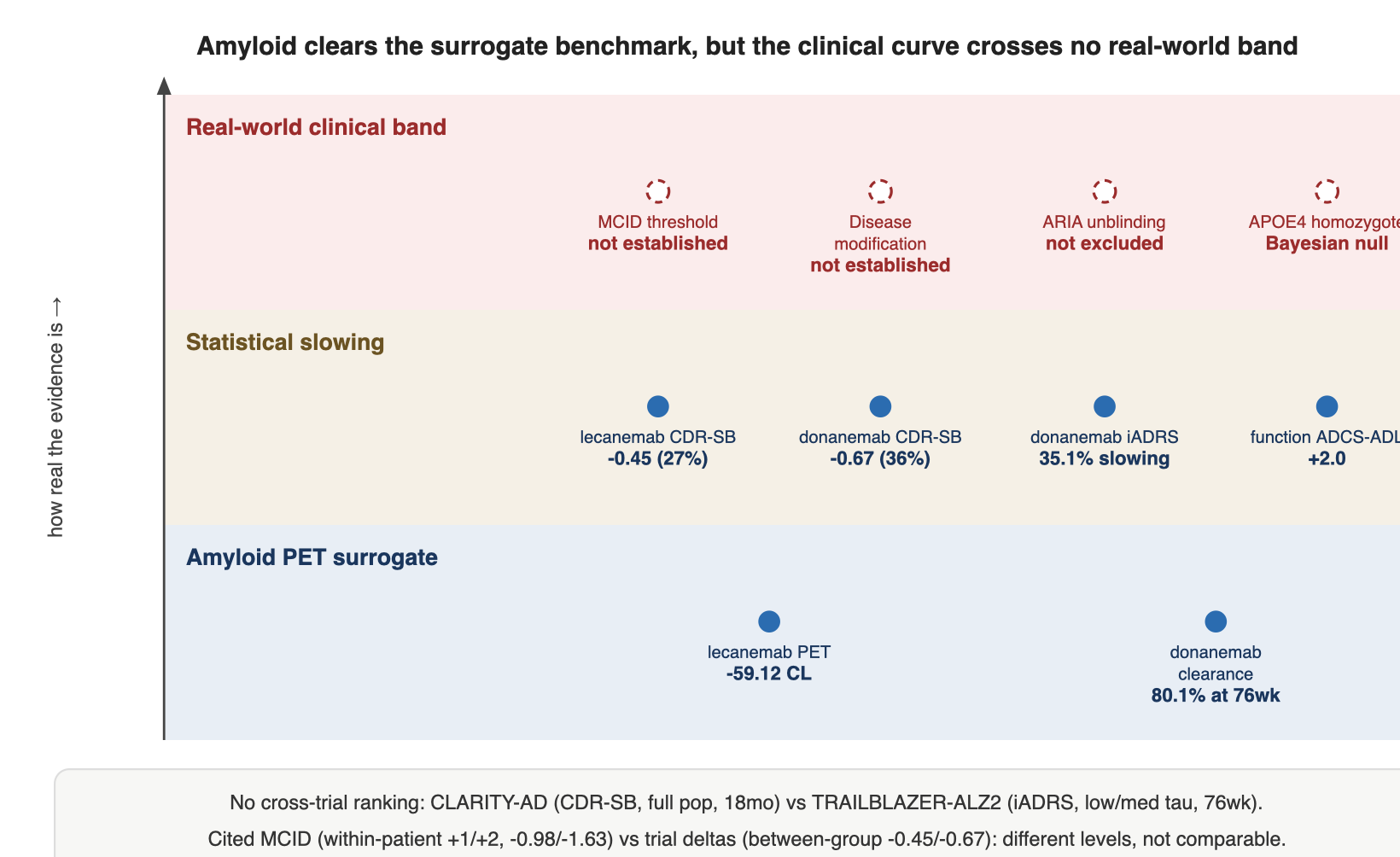
| Item | Status | Basis (trial-attributed) |
|---|---|---|
| lecanemab amyloid removal | Demonstrated | CLARITY-AD amyloid PET −59.12 CL (NEJM 2023) |
| lecanemab CDR-SB | Small, significant | −0.45 (95% CI −0.67 to −0.23), P=0.00005 = 27% |
| lecanemab function (ADCS-MCI-ADL) | Significant | +2.0 (1.2 to 2.8), P<.001 |
| donanemab amyloid removal | Demonstrated | 76-week clearance 80.1% (low/med) / 76.4% (combined) |
| donanemab iADRS (low/med tau) | Effect, significant | 35.1% slowing (19.90 to 50.23), P<.001 (JAMA 2023) |
| donanemab CDR-SB (low/med tau) | Effect, significant | −0.67 (−0.95 to −0.40), 36.0%, P<.001 |
| clinical significance vs MCID | Contested; threshold not established | Cited MCID (+1/+2, −0.98/−1.63) is within-patient; between-group comparison inappropriate |
| compounding (long-term widening gap) | Supported, not established | OLE delayed-start does not catch up (p<0.05); but placebo dissolves after 18 months |
| ARIA functional unblinding | Not excluded | Symptomatic ARIA; APOE4 40.6% vs 15.7%; post-ARIA imputation criticized; homozygote Bayesian null |
| lecanemab vs donanemab superiority | Not determinable | Cross-trial (differing scale, population, duration) |
| donanemab treatment-related deaths | Recorded fact | 3 (ARIA-related) vs 1 on placebo |
Deep dive
1. Background — narrowing three hypotheses with data
Part 0 set a single axis: amyloid removal by anti-amyloid antibodies is now unambiguous, so the small clinical effect must be one of three things — (a) real-but-small disease modification that compounds over time, (b) a non-translating surrogate whose effect sits below any MCID, or (c) ARIA-driven functional unblinding. This part pins the primary and secondary numbers of the two confirmatory trials to their source publications, then uses OLE, subgroup and MCID literature to narrow the three hypotheses in a falsifiable way. Pulling the conclusion forward: it neither fully establishes (a) nor fully excludes (b) or (c). A repeated cross-trial warning applies throughout — lecanemab (full population, CDR-SB primary, 18 months) and donanemab (low/medium tau, iADRS primary, 76 weeks) differ on scale, population and duration, so no vertical ranking is permitted; every number below is within-trial.
2. What this research newly established
lecanemab — CLARITY-AD (NEJM 2023, van Dyck et al.). In early AD (MCI due to AD or mild AD, amyloid-confirmed), N=1,795, 18 months, double-blind, 10 mg/kg IV every two weeks. Primary: CDR-SB change at 18 months. The adjusted mean difference was −0.45 (95% CI −0.67 to −0.23), P=0.00005, a 27% slowing (observed change 1.21 vs 1.66), separating significantly from placebo at every timepoint from 6 months. Secondary endpoints (all P<0.001): ADAS-Cog14 −1.44 (95% CI −2.27 to −0.61); ADCOMS −0.050 (−0.074 to −0.027); ADCS-MCI-ADL +2.0 (1.2 to 2.8), the measure closest to patient-centred function. Target engagement: amyloid PET −55.48 CL (lecanemab) vs +3.64 CL (placebo), difference −59.12 Centiloid. Safety: ARIA-E 12.6% (placebo 1.7%), infusion-related reactions 26.4%, mostly first three months and mild-to-moderate, with an APOE4 dose dependence.
donanemab — TRAILBLAZER-ALZ2 (JAMA 2023, Sims et al.). In early symptomatic AD, N=1,736, 76 weeks, double-blind, targeting deposited N3pG-Aβ plaque. Two design specifics: (1) tau stratification — the primary analysis population was low/medium tau (n≈1,182), with the high-tau-inclusive combined population secondary; (2) amyloid-clearance-based dosing cessation — switch to placebo once amyloid PET <11 CL (single) or <25 and ≥11 CL (two consecutive). Primary (iADRS): low/medium tau −6.02 vs −9.27, difference 3.25, 35.1% slowing (95% CI 19.90–50.23), P<.001; combined −10.19 vs −13.11, difference 2.92, 22.3% slowing (11.38–33.15), P<.001. Key secondary (CDR-SB): low/medium tau difference −0.67 (95% CI −0.95 to −0.40), 36.0% slowing, P<.001 (1.20 vs 1.88); combined −0.70, 28.9%. Clinical stability (no CDR worsening at one year): donanemab 47% vs placebo 29%. Amyloid clearance at 76 weeks: 80.1% (low/med) / 76.4% (combined) vs ~0%. Safety: ARIA-E 24.0% (205 patients; symptomatic 52 = 5.8%; serious 1.5%) vs placebo 2.1%; infusion reactions 8.7%; 58.3% of first ARIA-E occurred by the third infusion (~3 months); ARIA-E APOE4 dose dependence — noncarrier 15.7% / heterozygote 22.8% / homozygote 40.6%. Deaths: donanemab 16 (1.9%) vs placebo 10 (1.1%); treatment-related deaths donanemab 3 vs placebo 1 (the 3 attributed to ARIA).
3. Methodology — strengths and limits (the three hypotheses)
(a) Compounding — partly supported, not established. In the CLARITY-AD OLE (van Dyck et al., Alzheimer’s & Dementia 2025), early- versus delayed-start separation held at 18–36 months (p<0.05) and the delayed-start group did not catch up on CDR-SB — a delayed-start pattern that a purely symptomatic drug should not produce, pointing toward disease modification. ★ But the decisive test (a “widening” gap) was not observed: after 18 months the placebo arm all cross to active (OLE), so the contemporaneous control disappears and “widening (strengthening a) versus parallel shift (one-time effect)” cannot be separated against a concurrent placebo. The OLE is open-label and uncontrolled, relying on historical comparison. So (a) is supported but not established. (A donanemab long-term extension also exists with the same limitation; the quantitative trajectory is deferred to deeper reading.)
(b) Non-translating surrogate — the MCID debate, whose consensus value itself is unsettled. lecanemab CDR-SB −0.45, donanemab −0.67 (low/med tau). Widely cited CDR-SB MCID estimates: MCI +1 / mild AD +2 points (expert-consensus type); Andrews et al. −0.98 (MCI) / −1.63 (mild dementia) (anchor-based). Held against these, the between-group differences sit below MCID, and critics (Cochrane, Espay and others) argue a ~0.5-point CDR-SB difference is hard for patients, families and clinicians to perceive. ★ But the methodological trap must travel with it: the cited MCIDs are within-patient change thresholds, whereas −0.45/−0.67 are between-group means — comparing them directly is inappropriate, and the more accurate state is that no consensus MCID exists. That the patient-centred ADCS-MCI-ADL (+2.0) and 47% no-worsening move in the same direction weakens (b). So (b) cannot be fully excluded, but function measures are a counter-example.
(c) ARIA functional unblinding — not excluded. The path is real: symptomatic ARIA-E (present in lecanemab; donanemab 5.8%), MRI findings, and the large risk gap for APOE4 homozygotes (40.6% vs 15.7% noncarrier in donanemab) structurally allow allocation to leak through side effects and monitoring. Donanemab handled post-ARIA clinical data by imputing the same arm’s non-ARIA participant mean trajectory; third-party critics consider this correction insufficient. A 2025 Bayesian reanalysis of APOE4 homozygotes reported moderate evidence of no effect (odds of no difference ~3× the odds of difference) for both lecanemab and donanemab — precisely in the subgroup with the highest ARIA risk. ★ The decisive test is missing: a clean within-RCT net-effect analysis splitting CDR-SB/iADRS by ARIA-occurrence versus no-ARIA was not publicly confirmed. So (c) is not excluded.
4. Neighbouring domains — the heart-versus-brain amyloid contrast
The sharpest cross-domain contact is cardiac amyloidosis. The ATTR-CM programs (tafamidis, acoramidis) address the same protein-misfolding/amyloid pathology yet delivered a hard outcome (mortality HR ~0.70), whereas brain anti-amyloid clears the surrogate (PET) almost completely and still bends the clinical curve only below MCID — a direct “why does the heart translate but the brain stall” contrast. A second contact is the predictive-diagnostics actionability gap: as plasma pTau217 (Part 4) opens earlier, non-invasive diagnosis, a below-MCID disease-modifying effect turns it into a neurological case of “diagnose earlier, change little.” A third is AI/causal inference: statistically correcting for ARIA-driven functional unblinding (imputing post-ARIA data, sensitivity analysis) is a treatment-effect-identification-under-measurement-error problem, and whether donanemab’s “replace with non-ARIA mean” approach suffices is the open question.
5. Commercialization and investment view (TRL, companies) — neutral, trial-attributed
- lecanemab (Leqembi, Eisai / Biogen BIIB): FDA full approval July 2023, biweekly IV (with subcutaneous maintenance and home-start dosing conveniences progressing); label recommends APOE4 testing and ARIA MRI monitoring.
- donanemab (Kisunla, Eli Lilly LLY): FDA approval July 2024, once-monthly IV, with a dosing-cessation option on reaching amyloid clearance (a cumulative-cost/burden argument); tau-PET stratification is an access barrier for the label and real-world use.
- Shared commercial bottlenecks: ARIA MRI monitoring and APOE4 genotyping infrastructure; infusion-centre and PET/CSF diagnostic access; and payer/pricing (cost-effectiveness assessments such as ICER are tied directly to the effect-size debate). Because effect size hangs on the MCID debate, valuation is contested — deferred to Part 5 (commercial synthesis). Tickers, market caps and investment judgment belong to the investment layer; only facts here.
- Maturity: both agents cleared a single Phase 3 primary endpoint (unlike aducanumab), so they are past regulatory approval (high TRL as products), but the disease-modification claim (compounding) and the clinical-significance claim (MCID) remain scientifically unsettled.
6. The skeptic’s bottom line
- Separate surrogate from clinical: do not fold “amyloid removal” (PET clearance = established) and “cognitive/functional benefit” (CDR-SB/iADRS = small effect) into one sentence. Clearance of 76–80% is not a warranty of clinical benefit magnitude (the aducanumab warning).
- Do not extend MCID: using a within-patient MCID to declare a between-group difference “meaningful” or “meaningless” is an over-claim in both directions. State explicitly that no consensus MCID exists. The claim that the effect “exceeds an established MCID and is clinically significant” is refuted; so is the flat claim that it is “meaningless.”
- No cross-trial ranking: do not stack lecanemab 27% against donanemab 35% as a superiority order (differing scale, population, duration).
- State unblinding as not excluded: the adequacy of the ARIA correction is unresolved; the APOE4-homozygote Bayesian null signal travels with it.
- The aducanumab anchor: aducanumab’s discordant EMERGE (positive) / ENGAGE (negative) Phase 3 trials, its 2021 accelerated approval on amyloid surrogate amid advisory-committee objection, and Biogen’s January 2024 withdrawal remain the costliest example that “amyloid cleared ≠ clinical benefit.”
7. What to watch (falsifiable)
- P1: in long-term data with a contemporaneous control (registry matching, placebo-maintenance sub-designs), if the placebo gap widens over time it strengthens (a) compounding; if it stays parallel it moves toward a one-time shift. — Verify: long-term OLE, RWD, registries (Parts 4–5).
- P2: if the CDR-SB/iADRS effect is preserved in the no-ARIA subgroup, (c) unblinding weakens; if effect is concentrated in the ARIA group, (c) strengthens. If effect loss in APOE4 homozygotes (highest risk) replicates, both (c) and (b) strengthen. — Verify: individual-participant-data reanalysis, regulatory review documents.
- P3: if a patient-centred hard outcome (delayed nursing-home admission, caregiver burden, quality of life) shows a significant benefit, (b) failed-translation weakens; if not, the statistical ADCS-MCI-ADL gain falls short of patient-perceptible levels, strengthening (b). — Verify: long-term functional/PRO data (Parts 4–5).
References
- van Dyck, Christopher H., et al. 2023. “Lecanemab in Early Alzheimer’s Disease” (CLARITY-AD). New England Journal of Medicine. NEJMoa2212948. https://www.nejm.org/doi/full/10.1056/NEJMoa2212948
- Sims, John R., et al. 2023. “Donanemab in Early Symptomatic Alzheimer Disease” (TRAILBLAZER-ALZ2). JAMA. https://pmc.ncbi.nlm.nih.gov/articles/PMC10352931/ · https://pubmed.ncbi.nlm.nih.gov/37459141/
- Eisai. 2022. “Lecanemab Confirmatory Phase 3 CLARITY AD Study Met Primary Endpoint.” News release. https://www.eisai.com/news/2022/news202285.html
- van Dyck, Christopher H., et al. 2025. Lecanemab CLARITY-AD open-label extension (delayed-start analysis). Alzheimer’s & Dementia. https://alz-journals.onlinelibrary.wiley.com/doi/10.1002/alz.70905
- Lecanemab OLE 48-month analysis. PMC. https://www.ncbi.nlm.nih.gov/pmc/articles/PMC12725329/
- Donanemab long-term extension. PubMed. https://pubmed.ncbi.nlm.nih.gov/41330788/
- APOE4-homozygote Bayesian reanalysis (2025). PMC. https://pmc.ncbi.nlm.nih.gov/articles/PMC11894547/
- Andrews, J. Scott, et al. CDR-SB minimal-clinically-important-difference (anchor-based). PMC. https://pmc.ncbi.nlm.nih.gov/articles/PMC11095473/ · https://alz-journals.onlinelibrary.wiley.com/doi/full/10.1002/trc2.12411
- MCID / clinical-significance discussion (CDR-SB). PMC. https://www.ncbi.nlm.nih.gov/pmc/articles/PMC11982174/
Disclosure
This post is for information only and is not investment advice, and not medical advice. Treatment decisions should always be made with your own clinician.
COI note: this post describes listed pharmaceutical companies (Eisai, Biogen BIIB, Eli Lilly LLY) and their sponsored trials in a descriptive, neutral context. CLARITY-AD figures are attributed to the Eisai/Biogen-sponsored trial and NEJM 2023 (van Dyck et al.); TRAILBLAZER-ALZ2 figures to the Lilly-sponsored trial and JAMA 2023 (Sims et al.). The two trials differ in scale (CDR-SB vs iADRS), population (full vs low/medium tau) and duration (18 months vs 76 weeks) and are not head-to-head — no superiority ranking is made. The MCID and functional-unblinding debates are attributed to third-party literature (Cochrane, Bayesian reanalyses), separate from any sponsor claim. Every quantitative claim is attributed to the sponsoring trial, its primary publication or the third-party analysis. Competitive and efficacy statements are factual, neutral descriptions and are not buy/sell implications for any security. The author holds no position in, and has no financial interest in, the companies named.
 Uthando Nethemba
Leave a comment