Evidence-first notes on bioscience and deep tech, at the edge of the lab and the market. Information only — not investment advice, not medical advice. Every effect size, reduction figure and surrogate result is attributed to the sponsoring trial or company; some sponsor-funded trials are noted inline. Surrogate endpoints (amyloid PET, plasma neurofilament) are kept separate from clinical endpoints (CDR-SB, ALSFRS-R). Cross-trial comparisons are not head-to-head.
The 30-second version
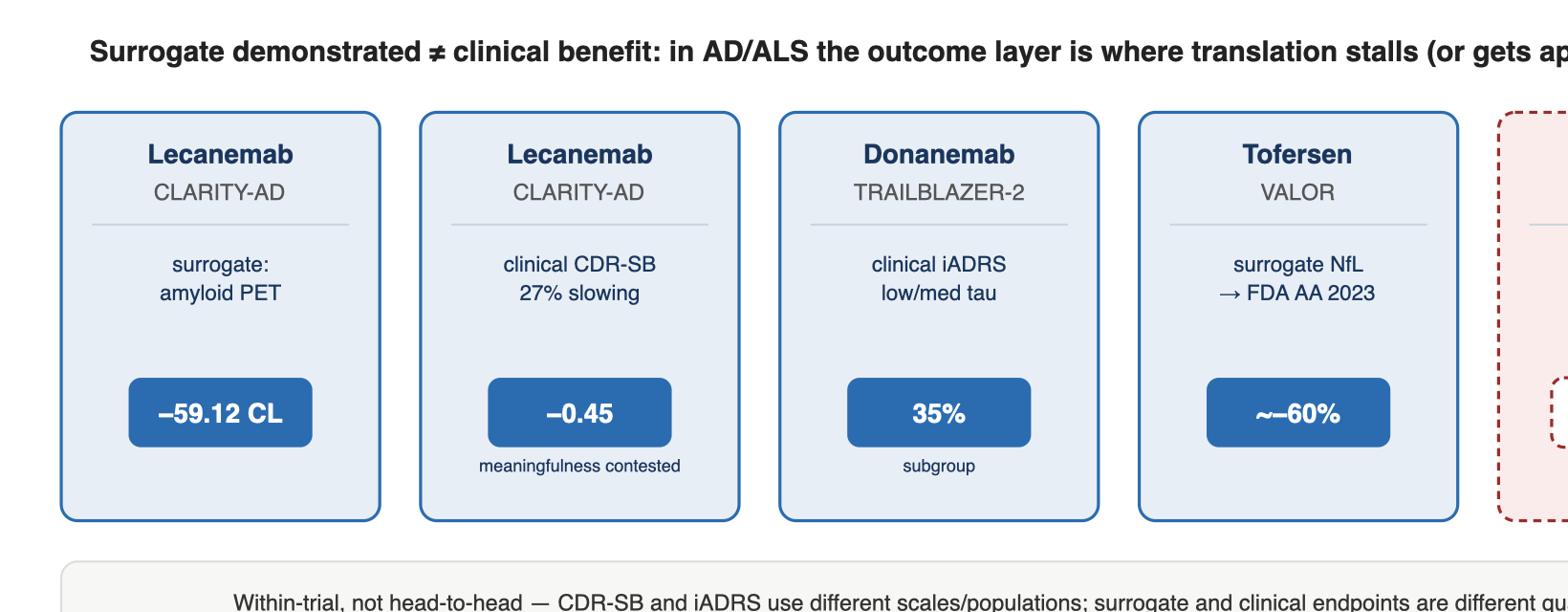
- What. In central-nervous-system (CNS) neurodegeneration, disease-modifying therapy (DMT) has clearly hit its surrogate target. Anti-amyloid monoclonal antibodies (mAbs) unambiguously clear amyloid plaque on PET: in CLARITY-AD, lecanemab (Leqembi, Eisai/Biogen) reduced amyloid PET by −59.12 centiloids versus placebo (−55.48 vs +3.64 CL). But the paired clinical effect on cognition and function is small: the adjusted CDR-SB difference was −0.45 (95% CI −0.67 to −0.23; P=0.00005), a 27% slowing over 18 months (company/trial data, NEJM 2023). Donanemab (Kisunla, Eli Lilly) in TRAILBLAZER-ALZ2 slowed iADRS by 35% in the low/medium-tau subgroup (22% overall).
- So what. The headline (amyloid removal) is close to solved; the real bottleneck is the surrogate-to-clinical translation layer. The small CDR-SB effect can be read three ways, and the field has not settled which: (a) a real-but-small disease modification that compounds over time; (b) a non-translating surrogate — 0.45 CDR-SB points may not be clinically meaningful; or (c) an ARIA-unblinding confound, where a side effect (amyloid-related imaging abnormalities) leaks treatment assignment and biases assessment. None of the three can yet be fully excluded.
- Now what. The neighbouring amyotrophic-lateral-sclerosis (ALS) case sharpens the point and must not be misread. Tofersen (Qalsody, Biogen/Ionis) MISSED its VALOR primary clinical endpoint — the 28-week ALSFRS-R difference was 1.2 (95% CI −3.2 to 5.5; P=0.97) — yet the FDA granted accelerated approval on 25 April 2023 on the plasma neurofilament (NfL) surrogate (NfL fell ~60% vs +20% on placebo). This is the OPPOSITE regulatory outcome to the same antisense-oligonucleotide (ASO) modality in cardiac amyloidosis. The watch items — long-term open-label extension (OLE) gaps and ARIA-free subgroup effects — are unresolved. Do not read amyloid clearance as established disease modification.
The five-minute read
One question, not a modality race: does the surrogate translate?
This landscape is the firm’s recurring lens at its sharpest — “the headline is the starting point; the real bottleneck is at the outcome layer.” Unlike the in-vivo-editing series, which is a race between modalities, CNS neurodegeneration DMT converges on a single question: does a demonstrated surrogate success translate into a hard-ish clinical outcome, and is the size of that translation meaningful to patients? The scope here places Alzheimer’s disease (AD) anti-amyloid at the core, with ALS (tofersen/SOD1 ASO) and Parkinson’s disease as adjacent territory. AD and ALS belong together because both build an approval logic on a surrogate (amyloid PET / plasma NfL) while the clinical hard endpoint stays unmet or contested.
From a cardio-kidney-metabolic (CKM) vantage the symmetry with the firm’s ATTR cardiac-amyloidosis work is striking: the same “protein-misfolding, amyloid-deposition” pathology yields hard outcomes (mortality, cardiovascular events) in the heart but, in the brain, has so far demonstrated mainly a surrogate. Why does translation stall specifically in the brain? That is the question this Part 0 frames — and deliberately does not resolve.
The surrogate is unambiguous; the clinical effect is small and contested
Amyloid removal is no longer in doubt (−59.12 CL in CLARITY-AD). The unsettled part is what the small clinical effect (adjusted CDR-SB −0.45) actually is. A frequent error is to treat “plaque cleared” as “disease modified” — the trials do not license that step. Equally, the ALS case must not be inverted: tofersen VALOR did not succeed on its clinical primary — it missed (P=0.97) — and was approved on a surrogate. Cross-trial figures below are within-trial results; lecanemab (CDR-SB) and donanemab (iADRS) used different scales, populations and durations and are not head-to-head.
| Program (trial) | Surrogate (target engagement) | Clinical primary | Verdict |
|---|---|---|---|
| lecanemab (CLARITY-AD, N=1,795, 18mo) | Amyloid PET −59.12 CL vs placebo — demonstrated | CDR-SB adjusted diff −0.45 (95% CI −0.67 to −0.23; P=0.00005) = 27% slowing; change 1.21 vs 1.66 | Small, statistically significant; meaningfulness contested |
| donanemab (TRAILBLAZER-ALZ2, N=1,736, 76wk) | Substantial amyloid-plaque removal — demonstrated | iADRS 35% slowing (low/medium tau, n=1,182); 22% overall; CDR-SB 1.20 vs 1.88 (low/med tau) | Effect in a pre-specified subpopulation; not head-to-head vs lecanemab |
| aducanumab (ENGAGE/EMERGE) | Amyloid removed | ★ Conflicting (EMERGE positive, ENGAGE negative) → market withdrawal 2024 | The cautionary “removal ≠ benefit” case |
| tofersen (VALOR, N=108, 28wk, SOD1 ALS) | Plasma NfL ~−60% vs +20% — demonstrated → basis of FDA accelerated approval 2023-04-25 | ★ ALSFRS-R primary MISSED: −6.98 vs −8.14 (diff 1.2, 95% CI −3.2 to 5.5; P=0.97) | Clinical primary unmet; approved on surrogate |
| prasinezumab etc. (α-synuclein, Parkinson’s) | Surrogate itself uncertain | Large trials predominantly miss the primary | Deepest translation bottleneck (Part 2) |
Deep dive
1. Background — disease, target, translation bottleneck across three axes
- AD (core): amyloid-beta (Aβ) plaque plus tau neurofibrillary-tangle pathology. Anti-amyloid mAbs target Aβ aggregates. The amyloid cascade hypothesis — that Aβ accumulation is the upstream cause — has been debated for 30 years, and the phenomenon of “plaque erased, cognitive curve only slightly bent” is its touchstone.
- ALS (adjacent): amyotrophic lateral sclerosis. In the SOD1 variant form (~2% of all ALS), tofersen (an ASO) lowers toxic SOD1 protein. The surrogate is plasma neurofilament light (NfL), a marker of axonal injury.
- Parkinson’s / other (adjacent): α-synuclein-targeting mAbs (prasinezumab, cinpanemab) have largely missed their primary endpoints in large trials — a deeper translation bottleneck than AD anti-amyloid (covered in Part 2).
The common bottleneck is surrogate-to-clinical translation. On all three axes, “the target was engaged” (surrogate) holds, but “the patient deteriorated clinically less, meaningfully” (the hard-ish outcome) is where magnitude and interpretation are disputed.
2. What this landscape establishes — trials, primary endpoints and key results (trial-attributed)
Principle: effect sizes and surrogate figures are reported as in the source; surrogate results are kept separate from clinical primaries; and cross-program comparisons are not head-to-head.
- lecanemab (Leqembi, Eisai/Biogen), CLARITY-AD — anti-amyloid mAb, intravenous. N=1,795, 18 months. Primary CDR-SB change: adjusted difference −0.45 (95% CI −0.67 to −0.23; P=0.00005), a 27% slowing; 18-month change 1.21 vs 1.66; statistically significant at every timepoint from 6 months (p<0.01). Amyloid PET −55.48 vs +3.64 CL (difference −59.12). NEJM 2023 (van Dyck et al.). Class safety issue: ARIA (see §4).
- donanemab (Kisunla, Eli Lilly), TRAILBLAZER-ALZ2 — anti-amyloid mAb, intravenous. N=1,736, 76 weeks. Primary iADRS change in the low/medium-tau population (n=1,182): 35% slowing; overall 22%. CDR-SB 1.20 vs 1.88 (low/medium tau); 1.72 vs 2.42 (overall). Substantial amyloid-plaque clearance. JAMA 2023 (Sims et al.).
- aducanumab (Aduhelm, Biogen), ENGAGE/EMERGE — first-generation anti-amyloid mAb. ★ Conflicting results (EMERGE positive, ENGAGE negative); after prolonged controversy, withdrawn from the market in 2024. Cited as the emblematic “amyloid removal ≠ clinical benefit” case.
- tofersen (Qalsody, Biogen/Ionis), VALOR — SOD1 ASO, intrathecal delivery. N=108 (72/36), 28 weeks. ★ Clinical primary MISSED: ALSFRS-R change −6.98 vs −8.14 (difference 1.2; 95% CI −3.2 to 5.5; P=0.97). Plasma NfL ~−60% vs +20%. NEJM 2022 (Miller et al.). FDA accelerated approval 25 April 2023 rested on the NfL surrogate, not the clinical endpoint. Same ASO modality lineage as the firm’s cardiac ASO (eplontersen) but the mirror-image narrative — cardiac ASO: missed → not approved; CNS ASO: missed → surrogate accelerated approval.
- α-synuclein mAbs (prasinezumab etc., Roche and others) — Parkinson’s progression scales. Large trials predominantly in the primary-missed column; the surrogate itself is uncertain, an even more upstream block than AD anti-amyloid (Part 2).
2b. The core scientific question — what is the small CDR-SB effect? (falsifiable)
Amyloid removal is no longer ambiguous. So the small clinical effect (adjusted CDR-SB −0.45) is one of three things; the section states what observation would falsify each.
- (a) Real-but-small disease modification that compounds over time. Evidence: in CLARITY-AD the curves separated at every timepoint from 6 months (p<0.01), and donanemab agrees in direction. If true, the placebo gap should widen over time in open-label extension (OLE). Falsifier: if the OLE gap stays parallel (does not widen), it is a one-off shift, not compounding disease modification. (Tested in Part 1.)
- (b) A non-translating surrogate — 0.45 CDR-SB points is not clinically meaningful. Evidence: small versus commonly discussed minimal-clinically-important-difference (MCID) estimates; aducanumab’s conflicting result and withdrawal are cited. Falsifier: significant benefit on patient-/caregiver-centred hard outcomes (function, quality of life, delay to institutionalization) would weaken (b). (Parts 1 and 5.) ★ Note: a later series correction found that the trial between-group figure and the usually cited within-patient MCID are different quantities, so an “exceeds/misses MCID” claim is itself not well-formed.
- (c) An ARIA-unblinding confound. Evidence: symptomatic ARIA-E (edema type) is visible on MRI and via symptoms, so assignment can leak (functional unblinding); ARIA risk varies strongly by APOE4 status (§4). Falsifier: if the CDR-SB effect persists in an ARIA-free subgroup, or is reproduced under blinded-read/assessment-separated design, (c) weakens. (Tested in Part 1.)
★ Provisional position: none of the three can be fully excluded. The decider between (a) and (b) is whether the long-term OLE gap widens; the decider for (c) is whether the effect holds in the ARIA-free subgroup. Part 0 juxtaposes all three falsifiably rather than picking one.
3. Safety and population variables — ARIA and APOE4
- ARIA-E (edema) / ARIA-H (microhemorrhage): the anti-amyloid class effect. In CLARITY-AD, overall ARIA-E ~12.6% (placebo ~1.7%), mostly in the first three months, mild-to-moderate.
- APOE4 dose-dependent risk: CLARITY-AD ARIA-E — homozygous 32.6% / heterozygous 10.9% / non-carrier 5.4%; ARIA-H — 39% / 14% / 11.9%. Donanemab is reported with a higher ARIA-E incidence class (exact figures confirmed in Part 1).
- Implication: APOE4 homozygotes may see a larger effect but also the highest risk, so genotype-based patient selection and monitoring is the real deployment bottleneck. This also feeds hypothesis (c) directly: because ARIA risk differs by assignment, ruling out assessment bias requires subgroup analysis.
4. Neighbouring domains — cardiac amyloid and predictive diagnostics
- Amyloid heart ↔ brain: the firm’s ATTR cardiac-amyloidosis series is the mirror. The same protein-misfolding, amyloid-deposition pathology delivers hard outcomes (mortality, cardiovascular) in the heart, but only a surrogate in the brain. Why does translation stall specifically in the brain is the cross-domain hook.
- Predictive-diagnostics actionability gap: plasma pTau217 (the Lumipulse pTau217/Aβ42 ratio received a first FDA clearance on 16 May 2025; AUC ~0.93–0.966) and circulating-RNA assays open early, non-invasive diagnosis. But if the DMT effect size is small, this becomes a neurological instance of the “we can diagnose it, but there is little to change” actionability gap.
- Silencer / ASO axis: tofersen (SOD1 ASO, intrathecal) shares the modality lineage of the firm’s cardiac ASO (eplontersen) and in-vivo-editing work — the same CNS-delivery challenge and the NfL-surrogate accelerated-approval logic.
5. Commercialization and competitive context (TRL, listed companies)
- Maturity (TRL frame): the surrogate is demonstrated (amyloid removal, NfL reduction — high TRL on the biomarker), but the clinically-meaningful-outcome layer is early and contested; the gating layer is translation, not target engagement.
- Eisai / Biogen (BIIB): lecanemab (Leqembi) is the most advanced approved anti-amyloid mAb; deployment turns on APOE4-genotype-based selection, ARIA monitoring and access.
- Eli Lilly (LLY): donanemab (Kisunla) competes on a low/medium-tau, pre-specified-subpopulation design and a limited-duration dosing concept.
- Biogen / Ionis (IONS): tofersen (Qalsody) is the CNS-ASO accelerated-approval case built on the NfL surrogate after a missed clinical primary; a confirmatory-outcome requirement remains.
- Roche (α-synuclein, Parkinson’s): the adjacent axis with the largest translation bottleneck.
- Company statements are limited to neutral, trial-attributed description; competitive or efficacy-ranking statements are not buy/sell signals.
6. The skeptic’s bottom line
- Surrogate ≠ clinical benefit: amyloid removal and NfL reduction are demonstrated, but the clinical effect is small and its meaningfulness is contested.
- Compounding is unproven: whether the OLE gap widens (disease modification) or stays parallel (one-off shift) is not yet verified.
- ARIA-unblinding is not excluded: symptomatic ARIA and APOE4 risk differences make functional unblinding plausible; an ARIA-free-subgroup net-effect analysis is required and not yet found.
- Do not invert the ALS case: ★ tofersen VALOR MISSED its clinical primary (ALSFRS-R P=0.97) and was granted accelerated approval on the NfL surrogate — the opposite regulatory outcome to the same ASO modality (eplontersen) in cardiac amyloidosis. It must never be stated that VALOR succeeded.
- Cross-trial, not head-to-head: lecanemab (CDR-SB) versus donanemab (iADRS) differ in scale, population and duration; no superiority claim is licensed.
- Neutral-framing note: to prevent misreading listed-pharma (Eisai, BIIB, LLY, Roche, IONS) pipeline and the amyloid-hypothesis debate as security or scientific-verdict signals.
7. What to watch (falsifiable)
- P1: if the long-term OLE placebo gap for lecanemab/donanemab widens over time, hypothesis (a) compounding disease modification strengthens; if it stays parallel, it moves toward a “one-off shift” (a↔b). (Tested in Part 1.)
- P2: if the CDR-SB effect persists in the ARIA-free subgroup, hypothesis (c) unblinding-confound weakens; if the effect concentrates in the ARIA-positive group, (c) strengthens. (Tested in Part 1.)
- P3: as plasma pTau217 / circulating-RNA early diagnosis spreads, a small DMT effect size would resolve into a neurological case of the predictive-diagnostics actionability gap — the gap between “diagnosing earlier” and “what can be changed” becoming the commercial and clinical bottleneck. (Tested in Part 4.)
- Also watch: whether any anti-amyloid program ever converts a surrogate into a patient-centred hard outcome, and whether a defensible MCID reference is agreed at all.
References
- van Dyck CH, et al. 2023. “Lecanemab in Early Alzheimer’s Disease” (CLARITY-AD; CDR-SB adjusted difference −0.45; amyloid PET −59.12 CL). New England Journal of Medicine. NEJMoa2212948. https://www.nejm.org/doi/full/10.1056/NEJMoa2212948
- Sims JR, et al. 2023. “Donanemab in Early Symptomatic Alzheimer Disease” (TRAILBLAZER-ALZ2; iADRS 35% low/medium tau). JAMA / PubMed Central. https://pmc.ncbi.nlm.nih.gov/articles/PMC10352931/
- Miller TM, et al. 2022. “Trial of Antisense Oligonucleotide Tofersen for SOD1 ALS” (VALOR; ALSFRS-R primary missed, P=0.97; plasma NfL ~−60%). New England Journal of Medicine. NEJMoa2204705. https://www.nejm.org/doi/full/10.1056/NEJMoa2204705
- Biogen. 2023. “FDA Grants Accelerated Approval of QALSODY (tofersen) for SOD1 ALS” (accelerated approval 2023-04-25 on the NfL surrogate). Investor release. https://investors.biogen.com/news-releases/news-release-details/fda-grants-accelerated-approval-qalsodytm-tofersen-sod1-als
- PubMed record (anti-amyloid / neurodegeneration primary source). https://pubmed.ncbi.nlm.nih.gov/40582836/
- Neurology (ARIA / anti-amyloid safety-and-population source). Neurology. https://www.neurology.org/doi/10.1212/WNL.0000000000205923
- Eisai. 2022. “Lecanemab CLARITY-AD topline / trial announcement.” Corporate news. https://www.eisai.com/news/2022/news202271.html
Disclosure
This post is for information only and is not investment advice, and not medical advice. Treatment decisions should always be made with your own clinician.
COI note: this post describes listed pharmaceutical companies (Eisai, Biogen BIIB, Eli Lilly LLY, Roche, Ionis IONS, and their sponsored trials) in a descriptive, neutral context. Every effect size and surrogate figure is attributed to the sponsoring trial (CLARITY-AD, TRAILBLAZER-ALZ2, VALOR); the anti-amyloid mAb trials are sponsor-funded (Eisai/Biogen; Lilly), noted as such. Surrogate endpoints (amyloid PET, plasma NfL) are kept separate from clinical endpoints (CDR-SB, ALSFRS-R). ★ Tofersen VALOR MISSED its clinical primary (P=0.97) and was approved on the NfL surrogate — this must not be framed as a clinical-endpoint success. Cross-trial figures (lecanemab vs donanemab) are not head-to-head. Quantitative claims are attributed to the trial, author or sponsor. Competitive and efficacy statements are factual, neutral descriptions and are not buy/sell implications for any security. The author holds no position in, and has no financial interest in, the companies named.


Leave a Reply