Evidence-first notes on bioscience and deep tech, at the edge of the lab and the market. Information only — not investment advice, not medical advice.
The 30-second version
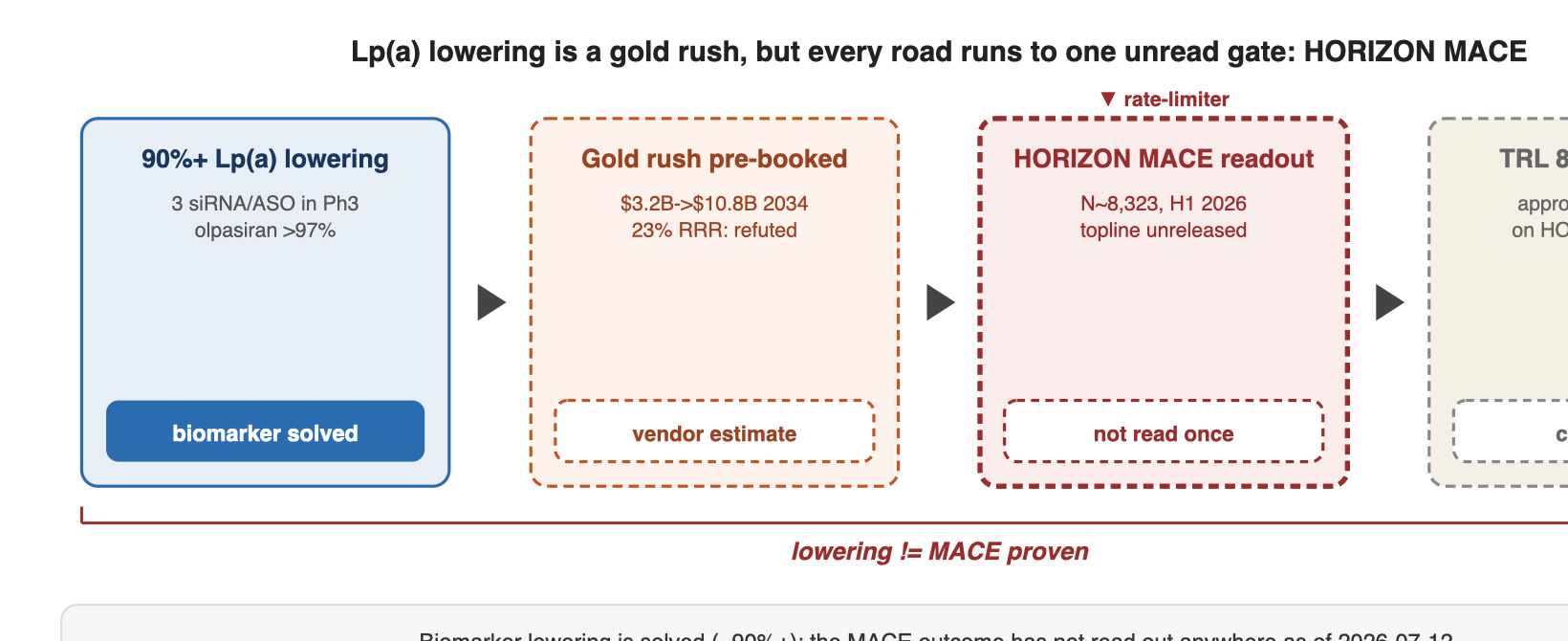
- What. Lipoprotein(a) lowering is already a mature commercial field: three injectable siRNA/ASO agents are in large cardiovascular-outcome Phase 3 trials at roughly 90%+ Lp(a) reduction, an oral small molecule (muvalaplin) entered Phase 3 in 2025, and two more oral follow-ons are behind it. One market vendor has called it “biotech’s next gold rush.” But the whole map runs through a single gate — the pelacarsen HORIZON MACE readout — and as of this writing that topline is not yet public (H1 2026 guidance, delayed from 2025 on slow blinded-event accrual).
- So what. This is the firm’s recurring lens in commercial dress: the headline (90%+ lowering, “gold rush”) is already priced into capital markets and vendor reports, while the bottleneck (event reduction, MACE) has not been read a single time. It surfaced concretely in this pass: one market vendor asserted a specific “HORIZON positive readout in Nov 2025, MACE 23% relative risk reduction,” which every reputable primary/secondary source (“still awaited”) contradicts — so we mark that claim refuted and quarantine it as a vendor hallucination. It is a live demonstration of a commercial narrative pre-booking an unreleased result.
- Now what. On the CKM residual-risk map, Lp(a) fills the genetically fixed axis that statins, ezetimibe and PCSK9 inhibitors essentially cannot move — a real, unmet coordinate. But its therapeutic value is the least proven of the firm’s CKM trilogy. Market-size figures are single-vendor and quarantined; the destination remains one readout. Watch HORIZON topline — it re-adjudicates the entire class.
The five-minute read
The commercial track is already laid — the science gate is not yet open
The Lp(a) field is commercially mature. A three-way siRNA/ASO race is in large cardiovascular-outcome Phase 3 at around 90% lowering; an oral small molecule, muvalaplin, entered Phase 3 (MOVE-Lp(a)) in September 2025; and two further oral follow-ons (licensed to Merck and to AstraZeneca) sit behind it. Vendor reports call it “biotech’s next gold rush” (FierceBiotech) and sketch a multi-billion-dollar market. Yet the entire landscape hinges on one gate — the pelacarsen HORIZON major-adverse-cardiovascular-event (MACE) readout. As of 2026-07-12 that result is not public (guided to H1 2026, slipped from 2025 on blinded-event accrual). Until the first-mover’s outcome reads out, market size, competitive order and any TRL 8–9 transition are all conditional.
Headline versus bottleneck — and the vendor noise in between
The through-line the firm has carried across its CKM work applies here in commercial language: “the 90%+ lowering headline is already reflected in capital markets, but the event-reduction bottleneck has not been read once.” A cautionary precedent is the CETP-inhibitor / niacin history, where an attractive lipid surrogate failed to translate into outcomes — or did harm. A 90% reduction does not automatically mean MACE reduction; on the Mendelian-randomization efficiency gap, the reaching of a large absolute reduction (>50–100 mg/dL) is what matters (Part 0 §2), and the first-mover carries that hypothesis risk alone.
| Agent | Sponsor (listed) | Modality | Phase 3 trial | Differentiation axis | Status (2026-07-12) |
|---|---|---|---|---|---|
| pelacarsen | Novartis (NVS) / Ionis (IONS) origin | ASO, monthly SC | HORIZON, N≈8,323 | First-mover — first-ever outcome readout | H1 2026 guidance, topline unreleased |
| olpasiran | Amgen (AMGN) | siRNA, q12–24w SC | OCEAN(a)-OUTCOMES, ~6,000 | Strongest lowering (>97%), dosing interval | Ongoing; readout 2026–27 (unverified) |
| lepodisiran | Eli Lilly (LLY) | siRNA, long-acting SC | ACCLAIM, ~12,500 | Includes primary prevention, largest | Data ~2029 |
| zerlasiran | Silence (SLN) | siRNA, q16–24w SC | Phase 3-ready (not started) | Dosing convenience | Awaiting a partner, not initiated |
| muvalaplin | Eli Lilly (LLY) | Oral small molecule | MOVE-Lp(a), N=10,450 | Only oral — adherence, access | Started 2025-09, complete ~2031 |
| HRS-5346 | Merck (MRK) / Jiangsu Hengrui | Oral small molecule | Early | Oral follow-on | Early development |
| YS2302018 | AstraZeneca (AZN) / CSPC | Oral small molecule | Preclinical | Combination with oral PCSK9 (enlicitide) explored | Preclinical |
Deep dive
1. Background — the track is laid, but the gate is singular
Commercially, the Lp(a) chapter is already mature. The siRNA/ASO three-way race entered large outcome Phase 3 at around 90% lowering; the oral muvalaplin reached Phase 3 (MOVE-Lp(a)) in 2025; and two further oral candidates (licensed to Merck and to AstraZeneca) follow. Vendor reports call it “biotech’s next gold rush” and draw a multi-billion-dollar market. Yet the entire landscape hangs on a single gate — pelacarsen HORIZON’s MACE readout, not public as of 2026-07-12 (guided H1 2026, slipped from 2025 on blinded-event accrual). This is Part 5 of the lp-a series; it inherits the Part 0 spine (VERIFIED) and references Parts 1–4 by plan only (their independent verification is not re-adjudicated here — honest labeling).
2. What this synthesis establishes — the commercial landscape and its four differentiation axes
Core: the relevant sponsors are, in practice, all listed companies. The section above describes only pipeline and differentiation, neutrally. Four competitive axes stand out:
- First-mover premium (pelacarsen). HORIZON produces the first-ever outcome. If positive, it pre-empts the first-in-class label and guideline entry — but the first-mover bears the hypothesis risk alone (§4, §6).
- Magnitude and dosing interval (olpasiran). >97% lowering plus q12–24w favors adherence and durability; its outcome is validated behind pelacarsen.
- Market-expansion potential (lepodisiran). Uniquely includes primary prevention — if successful, the addressable population extends well beyond secondary prevention. But it reads out latest (~2029).
- Oral / access (muvalaplin, and the Merck / AZN follow-ons). Adherence and primary-care penetration are the advantage over injectables. But its lowering is assay-dependent at 47–86%, below injectable siRNA (90%+), and MOVE-Lp(a) reads out latest (~2031).
Market size (vendor estimate — quarantined). One vendor (dataintelo) estimates the Lp(a)-lowering market at $3.2B in 2025 → $10.8B in 2034 (CAGR 14.4%), North America ~44% share. Because this is single-vendor with an opaque method, firm discipline marks it as a vendor estimate only and does not rely on it (§9 unverified). Company framing of the addressable population (“8 million+ worldwide with high Lp(a) + CVD”) is likewise quarantined as a company estimate.
3. CKM cross-domain — Lp(a)’s coordinate on the residual-risk map
This is the angle closest to the Principal’s field (CKM). On the residual-risk map the firm’s CKM series has drawn, Lp(a) fills a distinct blank. Each axis is a different pathophysiological lever, and Lp(a) is the one that is genetically fixed.
| Residual-risk axis | Representative intervention | Mechanistic lever | Modifiability | Firm series |
|---|---|---|---|---|
| LDL axis | Statins, ezetimibe, PCSK9i | LDL-C lowering | Pharmacologically modifiable | (baseline) |
| Metabolic axis | GLP-1 RA | Weight, metabolic, (weight-independent CV) | Modifiable | glp1 |
| Anti-fibrotic / neurohormonal axis | finerenone (ns-MRA) | Inflammation, fibrosis | Modifiable | finerenone |
| Hemodynamic / renal axis | SGLT2i | Preload, renal protection | Modifiable | (CKM core) |
| Genetic axis (Lp(a)) | pelacarsen, olpasiran, etc. | apo(a) production blockade | Near-fixed (LPA / KIV-2) | lp-a (this work) |
Core insight. Even when LDL is driven to the extreme with PCSK9 inhibition, a substantial share of the residual risk is attributable to Lp(a) — and Lp(a) is barely lowered by statins, ezetimibe or PCSK9i (PCSK9i may even raise it slightly) [Part 0 §2, §9]. Lp(a) therefore defines a residual the other CKM interventions structurally cannot address.
Firm-series linkage.
- glp1 series: GLP-1’s CV benefit is confirmed to be ~2/3 weight-independent (mediation) — even the metabolic axis did not reduce to a single surrogate (weight). Same discipline for Lp(a): lowering (surrogate) ≠ events (hard).
- finerenone series: established the residual risk of a separate (anti-fibrotic) axis. Lp(a) adds the genetic axis, pushing the residual-risk map toward completion.
- ckm-smd (definitional power): “what counts as residual risk” is a matter of definitional and measurement power. Lp(a) reproduces that issue in the lipid domain through assay non-standardization (mg/dL vs nmol/L, intact vs apo(a)) — the subject of Part 3.
Cross-domain hooks. (1) The chronic-cardiovascular expansion of siRNA/ASO GalNAc liver-targeted delivery — manufacturing/delivery (materials) and dosing frequency become the competitive axes. (2) The reliability of market-size and “positive readout” vendor reports — the risk that AI-generated market intelligence plausibly fabricates an unreleased clinical result (§4, §9) connects directly to an information-hygiene (AI) problem.
4. The through-line — headline versus bottleneck, and a fabricated readout
The firm’s recurring bottleneck fallacy caution found a live commercial demonstration in this verification pass.
Case: a readout that does not exist. One market-vendor report asserted that “HORIZON gave a positive readout in November 2025, with a 23% relative risk reduction in MACE.” But reputable primary/secondary sources — CNBC (2026-04), BioSpace (H1 2026 watchlist), medpath (timeline extension) — all describe HORIZON as still awaited. The vendor’s specific figure (23%) is supported by no reliable source and contradicts the timeline → refuted (untrustworthy vendor claim), quarantined as a hallucination.
This is the commercial edition of the through-line: the headline (90% lowering, “gold rush”) is already pre-booked — and in this case hallucinated — as “event success” in capital markets and vendor reports, while the bottleneck (MACE) has not been read once. The CETP-inhibitor / niacin history — where a good-looking lipid surrogate failed to translate to outcomes, or did harm — is the cautionary line. A 90% reduction does not automatically imply MACE reduction (on the MR efficiency gap, reaching a large absolute reduction of >50–100 mg/dL is what counts, Part 0 §2), and the first-mover carries that risk alone.
5. Commercialization and investment context (TRL, companies)
- Maturity of the commercial pipeline: high — three siRNA/ASO plus one oral in outcome Phase 3, two more oral follow-ons entering. Regulatory submission is guided to H2 2026–2027, conditional on HORIZON success.
- Biomarker lowering: solved (90%+, Part 0 §3).
- Hard events: unresolved — HORIZON topline unreleased (H1 2026 guidance, imminent/overdue).
- TRL: the class holds at TRL 7 (consistent with Part 0) — large outcome Phase 3 running and the biomarker endpoint demonstrated, but “therapeutic goal = event reduction” is unproven, so the TRL 8–9 transition is conditional on HORIZON. The oral muvalaplin entered TRL 6→7 with its Phase 3 start (2025-09).
- Sponsors: all listed (NVS, IONS, AMGN, LLY, SLN, MRK, AZN, CSPC, Hengrui). The ordering above is a factual sort of lowering/design/timeline, not a ranking of securities; product-competition statements are neutral and are not buy/sell signals. Price targets and market-cap discussion are out of scope (charter).
6. The skeptic’s gate
- Surrogate risk (top). 90% lowering is a surrogate. CETP precedent. The first-mover bears the class hypothesis alone.
- Pre-booking / hallucination risk (new). A vendor report fabricated a specific figure for an unreleased outcome (§4 refuted case). A commercial narrative running ahead of the science can bleed into a security frame → basis for escalation.
- Market-size reliability. Single-vendor, opaque method → quarantined. No price-target or market-cap statements (charter).
- Oral lowering shortfall. Muvalaplin 47–86% (assay-dependent); the oral follow-ons are preclinical-to-early — the outcome translation versus injectable siRNA (90%+) needs separate proof.
- COI. All trials are manufacturer-sponsored (Novartis/Ionis, Amgen, Lilly, Silence, Merck/Hengrui, AZN/CSPC). Lowering and design figures are stated as sponsor-attributed only.
Verdict: proceed-with-caveats (conditional). The commercial landscape, the CKM coordinate and the lowering are established as fact, but the therapeutic value (MACE) is unproven to a degree approaching hold. At the knowledge-asset stage this remains neutral, sponsor-attributed and vendor-quarantined. On HORIZON topline release, the whole class and series are re-adjudicated. Any security implications for listed companies are escalated.
Required caveat (skeptic gate). The ordering and “gold rush” framing organize lowering, design and timeline facts — not a ranking of securities. The claim that “lowering equals event reduction” is unproven for every agent in the class; the single most-cited vendor figure of a “HORIZON positive 23% RRR readout” is refuted and quarantined as a hallucination.
7. Three falsifiable predictions
- HORIZON primary MACE significant (HR<1, upper CI<1) → confirms the class and market-size narrative and raises the probability for the followers (olpasiran, lepodisiran). Conversely, non-significant (CI includes 1) → a CETP-style disappointment, prompting valuation/development re-review down to the oral and follow-on group.
- The outcome benefit tracks absolute lowering (reaching >50–100 mg/dL) and baseline Lp(a) in a dose-response manner → groups with high percent lowering but small absolute lowering (low baseline) see little benefit. Falsification would shake the MR efficiency-gap logic.
- The oral group’s (muvalaplin, Merck, AZN) commercial position is decided not by lowering magnitude but by “outcome success × adherence premium” — despite lower lowering, primary-care penetration could expand the market. Falsification: the oral outcome is significantly inferior to injectables, or Phase 3 stops early.
8. Series retrospective (Part 0–5) and position in the firm’s CKM trilogy
lp-a series arc. Part 0 (landscape, VERIFIED) fixed the chapter’s central tension: causality (MR), genetic fixity (KIV-2 copy-number variation) and 90%+ lowering are demonstrated, while the lowering→MACE translation is entirely unproven. Parts 1–4 (in parallel) cover causal evidence, siRNA/ASO magnitude-durability-dosing, oral/measurement (assay standardization = definitional power), and the outcome trials (HORIZON, OCEAN(a), ACCLAIM) head-on. Part 5 (this work) closes with the commercial landscape, the CKM coordinate and the skeptic synthesis — the commercial track is already laid and the gate is HORIZON alone, with the vendor report’s pre-booking/hallucination caught by the same lens.
Position in the firm’s CKM trilogy. The firm has dissected CKM residual risk axis by axis — glp1 (metabolic axis, CV benefit ~2/3 weight-independent) → finerenone (anti-fibrotic axis) → lp-a (genetic axis). The shared discipline is one line: “biomarker lowering is the starting point; the real bottleneck is the hard outcome.” glp1 has already cleared that bottleneck (FLOW all-cause death −20%, etc.), finerenone has partly cleared it, and Lp(a) has not yet cleared it (the earliest stage). The lp-a series fills the last, genetic blank of the CKM residual-risk map, while its therapeutic value remains the least proven of the trilogy. It connects to the ckm-smd (definitional-power) series in that assay standardization governs “what is counted as risk.”
One-line retrospective. Lp(a) defines the genetic axis of the CKM residual-risk map and is already at a gold-rush commercial stage, but through the firm’s lens: “the 90% lowering is drawn on the map, yet the destination — events — hangs entirely on a single HORIZON readout.”
References
- Novartis extends timeline for pelacarsen Phase 3 cardiovascular trial (HORIZON) to 2026. medpath / trial.medpath.com (2026). Topline unreleased as of writing; H1 2026 guidance. https://trial.medpath.com/news/5789d0b880688613/novartis-extends-timeline-for-pelacarsen-phase-3-cardiovascular-trial-to-2026
- “5 clinical readouts to watch in H1 2026.” BioSpace (2026). HORIZON listed as still awaited. https://www.biospace.com/drug-development/5-clinical-readouts-to-watch-in-h1-2026
- “Excitement and interest as Lp(a) therapies inch closer.” Healio Cardiology (2026-05-28). https://www.healio.com/news/cardiology/20260528/excitement-and-interest-as-lpa-therapies-inch-closer
- MOVE-Lp(a), muvalaplin Phase 3 (N=10,450, started 2025-09-02, completion ~2031). ClinicalTrials.gov NCT07157774. https://clinicaltrials.gov/study/NCT07157774
- “Silence quiets Phase III pace for lipoprotein drug (zerlasiran), seeks partner.” BioSpace (2026). Phase 3-ready but not initiated, awaiting a partner. https://www.biospace.com/drug-development/silence-quiets-phase-iii-pace-for-lipoprotein-drug-seeks-partner
- “‘It’s going to be huge’: diabolical molecule poised to become biotech’s next gold rush.” FierceBiotech. “Next gold rush” framing. https://www.fiercebiotech.com/biotech/its-going-be-huge-diabolical-molecule-poised-become-biotechs-next-gold-rush
- “NLA 2025 — novel therapeutic approaches for targeted reduction of Lp(a) in ASCVD.” Pharmacy Times (2025). Muvalaplin Ph2 47–86%; oral follow-ons (Merck/Hengrui, AZN/CSPC). https://www.pharmacytimes.com/view/nla-2025-novel-therapeutic-approaches-show-promise-for-targeted-reduction-of-lp-a-in-patients-with-ascvd
- Lipoprotein(a)-lowering therapies market report (vendor estimate — quarantined; $3.2B 2025 → $10.8B 2034, CAGR 14.4%; single-source, opaque method). dataintelo. https://dataintelo.com/report/lipoproteina-lowering-therapies-market
Disclosure
This post is for information only and is not investment advice, and not medical advice. Treatment decisions should always be made with your own clinician.
COI note: this post describes listed pharmaceutical companies (Novartis NVS, Amgen AMGN, Eli Lilly LLY, Ionis IONS, Silence SLN, AstraZeneca AZN, Merck MRK, CSPC, Jiangsu Hengrui) and the manufacturer-sponsored clinical trials associated with them in a descriptive, neutral context. All lowering and design figures are attributed to the specific trial or sponsor. The biomarker (Lp(a) lowering) is kept distinct from the hard outcome (MACE); percent lowering is kept distinct from absolute lowering. The market-size figure is a single-vendor (dataintelo) estimate with an opaque methodology and is presented as a vendor estimate only, not relied upon. The vendor claim of a “HORIZON positive readout with 23% MACE relative risk reduction” is refuted by all reputable primary/secondary sources and is quarantined as a hallucination, not presented as a result. Competitive, pipeline-ordering and market statements are factual, neutral descriptions and are not buy/sell implications for any security. The author holds no position in, and has no financial interest in, the companies named.


Leave a Reply