Evidence-first notes on bioscience and deep tech, at the edge of the lab and the market. Information only — not investment advice, not medical advice.
The 30-second version
- What. Muvalaplin (Eli Lilly, LY3473329) is the first oral, once-daily small molecule that lowers lipoprotein(a) — it blocks assembly of the Lp(a) particle rather than shutting off apo(a) production like the injectable siRNA/ASO drugs. In the Phase 2 KRAKEN trial (Lilly-sponsored) its placebo-adjusted reduction reads as high as 85.8% on an “intact” Lp(a) assay but only about 68.9% on a traditional apo(a) assay — same patients, same blood, a ~17-point spread.
- So what. Roughly half of muvalaplin’s apparent “efficacy gap” versus the injectables is not pharmacology — it is measurement. The apo(a) assay counts drug-bound apo(a) as if it were still Lp(a), over-measuring residual particles and under-stating the reduction. This sits on top of three overlapping layers of assay noise — mg/dL (mass) versus nmol/L (particle count), “intact” versus apo(a)-specific detection, and size-dependent isoform bias — that structurally contaminate every cross-trial Lp(a) comparison in this series, not just muvalaplin’s.
- Now what. Read the reduction number as inseparable from the ruler that produced it. There is no head-to-head trial of oral versus injectable, so “muvalaplin is weaker” and “correct the assay and it ties” are both over-reads. Muvalaplin’s Phase 3 outcome trial, MOVE-Lp(a) (NCT07157774), only started on 2 September 2025 with primary completion planned for 2031 — the latest readout in the class. Assay standardization (IFCC LC-MS/MS reference method, single-epitope antibodies) is the quiet prerequisite that could reshuffle the entire cross-trial ranking.
The five-minute read
An access thesis with a magnitude asterisk
The earlier parts of this series framed Lp(a) lowering as a simple ladder: siRNA/ASO drugs cut Lp(a) by roughly 90–100%, while oral muvalaplin sits lower at 70–86%. Taken at face value that looks like a clean efficacy ranking. It is not. Muvalaplin’s reported reduction moves from 85.8% to about 69% depending only on which assay you use — because the drug’s mechanism happens to strike the blind spot of the older assays head-on.
The access case is real and distinct. Muvalaplin is the first oral, once-daily Lp(a) lowering agent; the alternatives are all subcutaneous injections dosed monthly to twice-yearly (pelacarsen, olpasiran, lepodisiran). An oral small molecule removes needle avoidance, cold chain and administration infrastructure, which in principle enables earlier and broader primary-prevention use for a lifelong, genetically fixed risk factor. The trade-off is that muvalaplin gives some of that access advantage back on magnitude — and the size of what it gives back is exactly what the assay dispute clouds.
Why the same blood gives two different numbers
Lp(a) is assembled in two steps: apo(a) and apoB-100 first associate non-covalently inside the hepatocyte, then a disulfide bond locks the mature particle together at the cell surface. Muvalaplin blocks step one — the non-covalent association — so the particle is never built. The apo(a) protein is still made; it simply cannot assemble, and the unassembled, drug-bound apo(a) lingers in the blood. A traditional apo(a)-specific assay counts that leftover apo(a) as if it were still Lp(a), so it over-measures residual particles and under-states the reduction. An “intact” assay only detects particles where apo(a) and apoB are actually joined, so it reads the true assembly-blocking effect (85.8%). Tellingly, on the apo(a) assay the 240 mg dose read lower than 60 mg (68.9% versus 70.0%) — consistent with more drug-bound apo(a) accumulating at higher doses and widening the over-measurement bias (the precise quantitative cause is [unverified]).
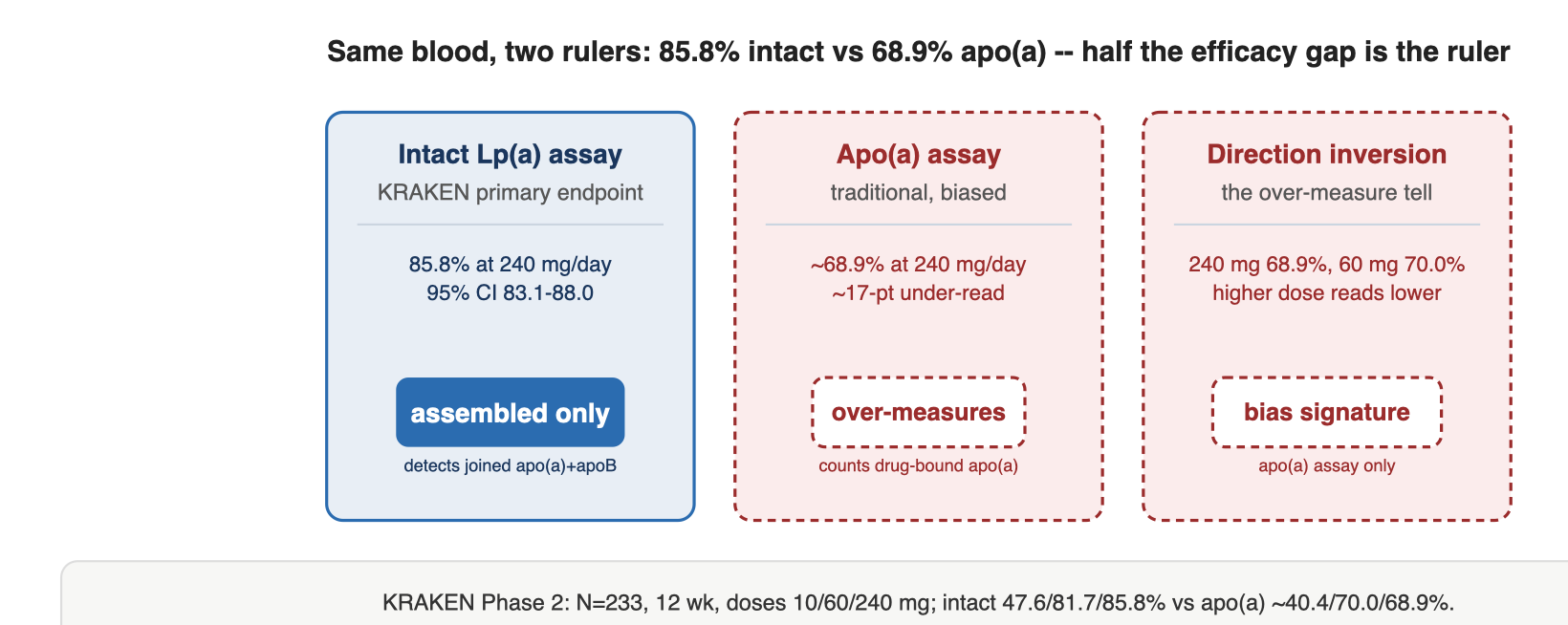
| KRAKEN dose (12 weeks) | Intact Lp(a) assay (primary) | Traditional apo(a) assay |
|---|---|---|
| 10 mg/day | 47.6% (95% CI 35.1–57.7) | ~40.4% |
| 60 mg/day | 81.7% (95% CI 78.1–84.6) | ~70.0% |
| 240 mg/day | 85.8% (95% CI 83.1–88.0) | ~68.9% |
The measurement problem is bigger than one drug
Muvalaplin is the most dramatic exhibit, but the assay noise it exposes contaminates the whole field. Lp(a) measurement carries at least three overlapping layers of structural noise: units (mg/dL measures mass, nmol/L measures particle count, and because apo(a) size varies 275–800 kDa there is no single valid conversion factor — the familiar “×2.5” shortcut introduces systematic error); isoform bias (apo(a) has 40+ isoforms from variable KIV-2 repeats, up to 80% of patients carry two different isoforms, and mass assays over-read particles larger than the calibrator and under-read smaller ones); and what counts as “Lp(a)” (intact versus apo(a)-specific detection). A statement like “olpasiran 97% beats muvalaplin 86%” is therefore two numbers produced by two different rulers. The same noise reaches patient selection thresholds (≥70 mg/dL versus ≥175 nmol/L) and baseline comparisons across trials. Every reduction table in Parts 0–2 should be read under this caveat.
Deep dive
1. Background — the mechanism that broke the ruler
Muvalaplin (Lilly, LY3473329) is an oral small molecule that competitively inhibits the interaction between the KIV domain of apo(a) and apoB-100. Lp(a) assembly proceeds in two stages — (1) non-covalent association of apo(a) and apoB-100 inside the hepatocyte, then (2) formation of a disulfide bond at the cell surface that completes the mature particle. Muvalaplin blocks stage one, so the particle is never assembled. This is mechanistically distinct from the siRNA/ASO agents, which switch off apo(a) production at the mRNA level: with muvalaplin the apo(a) protein is still synthesized but cannot assemble. That single difference — apo(a) still present, just unassembled and drug-bound — is the root of the assay problem, because the older assays were built to detect apo(a), not to distinguish assembled from unassembled particles.
2. What KRAKEN establishes — and how precisely
Principle: reductions, confidence intervals and doses are reported exactly as in the source; the assay used is named alongside each number; cross-trial comparisons are not head-to-head.
- KRAKEN (Phase 2, JAMA, 18 November 2024): N=233, 12 weeks, 43 sites across 5 countries, doses 10 / 60 / 240 mg/day. Baseline was a high-Lp(a) population, median roughly 216.8 nmol/L (intact) / 246.5 nmol/L (apo(a)).
- Primary endpoint (intact assay), placebo-adjusted: 47.6% / 81.7% / 85.8% (240 mg 95% CI 83.1–88.0). On the traditional apo(a) assay the same doses read ~40.4% / 70.0% / 68.9%, with the 240 mg value falling below 60 mg — the signature of the over-measurement bias.
- Secondary signals: dose-dependent apoB reduction of 8.9% / 13.1% / 16.1%; hs-CRP unchanged.
- Safety: no liver-enzyme abnormalities and no change in plasminogen activity — a meaningful negative finding given that apo(a) shares homology domains with plasminogen and the mechanism operates in that neighbourhood.
- Phase 1 (14 days) had earlier shown up to ~65% reduction with good tolerability.
Verdict on the number itself: muvalaplin’s oral reduction is verified as a Phase 2 RCT result (up to 85.8% on the intact assay). What is not verified is the last decimal of the apo(a)-assay figures, which differ slightly between sources; only the direction and magnitude are firm.
3. Strengths and limits of the method — three layers of assay noise
This is the structural core of Part 3. Lp(a) is, unusually, a biomarker whose units are not interchangeable.
- Units — mass versus particle count. mg/dL weighs particles of variable size; nmol/L counts molar particle number. Because apo(a) size differs particle to particle, no single conversion factor exists and mg/dL↔nmol/L conversion is not recommended; every conversion factor is isoform-dependent.
- Isoform-dependent bias. apo(a) carries 3 to 40+ KIV-2 repeats, producing 40+ isoforms, and up to 80% of patients carry two different isoforms simultaneously. Mass assays over-measure particles larger than the calibrator and under-measure smaller ones — the fundamental reason different labs and kits disagree.
- Intact versus apo(a)-specific. As above, apo(a)-counting assays can include free and drug-bound apo(a), which specifically inflates residual Lp(a) for an assembly inhibitor like muvalaplin. A novel isoform-insensitive immunoassay has been developed to address exactly this; its quantitative re-measurement of muvalaplin is not yet detailed in the public record [unverified].
The consequence is that reduction percentages, selection thresholds and baseline comparisons all rest on a ruler that is not standardized. Until standardization arrives, any cross-trial ranking is provisional.
4. Neighbouring domains — standardization as a proteomics and antibody-design problem
- Reference materials: nmol/L assays traceable to the WHO/IFCC reference (SRM-2B) reduce size-dependent bias; certification runs through the Northwest Lipid Metabolism and Diabetes Research Laboratories (Seattle).
- Mass spectrometry as reference method: the IFCC Working Group APO-MS is developing an LC-MS/MS reference procedure that quantifies apo(a) peptides directly, without antibodies — a proteomics/analytical-chemistry approach that could redefine the diagnostic infrastructure. Secondary reference materials would carry target values that reflect apo(a) size polymorphism.
- Single-epitope antibody design: an isoform-insensitive antibody that recognizes each particle exactly once — avoiding KIV-2 repeat and plasminogen cross-reactivity (the Marcovina single-antigenic-site / KIV type 9 approach) — is essentially an antibody-engineering and structure-prediction problem, adjacent to AI-driven protein design.
- Guideline coupling: ESC/EAS 2019 (measure once in a lifetime) and the EAS 2022 consensus carry measurement recommendations, but because unit and assay standardization is itself unfinished, threshold interpretation (≥125 nmol/L ≈ 50 mg/dL) retains residual uncertainty. National lipid guidelines, including KSoLA in Korea, depend on this standardization progress for coherent Lp(a) reporting.
5. Commercialization and TRL
- Access thesis (bull case): muvalaplin is the first oral, once-daily Lp(a) lowering agent, differentiated from injectable siRNA/ASO on adherence, scalability and the potential for earlier intervention in a broader primary-prevention population. A short half-life also makes discontinuation reversible if a safety signal emerges — though that cuts both ways, since effect is lost quickly if adherence lapses.
- Magnitude and sequence (bear case): even the intact-assay 85.8% sits below the injectables’ reported 90–100%, and in a domain where absolute lowering translates into outcomes (Part 0’s Mendelian-randomization logic implies a large absolute reduction is needed per unit of relative risk reduction), a few points can matter. More decisively, the evidence arrives last.
- Phase 3 status (newly confirmed): muvalaplin’s outcome trial MOVE-Lp(a) (NCT07157774) started on 2 September 2025, targeting roughly 10,450 participants with primary completion planned for 31 March 2031 — updating this series’ earlier “Phase 3 not yet started” placeholder to “started,” but also confirming that the readout trails the siRNA/ASO front-runners (e.g. HORIZON, first half of 2026) by years.
- TRL: muvalaplin alone sits at roughly TRL 6–7 — oral lowering demonstrated in a Phase 2 RCT on a biomarker endpoint, with the large-scale outcome trial only just underway. Because outcome completion is planned for 2031, the latest in the class, the distance to TRL 8–9 (approval / real-world use) is longer than for the siRNA/ASO leaders; a conservative reading holds it below 7.
- All company and competitive statements here are neutral, trial-attributed descriptions and are not buy/sell implications for any security.
6. The skeptic’s bottom line
- The “weaker drug” frame is a trap in both directions. “Muvalaplin 86% < siRNA 97%" compares (a) different assays, (b) not head-to-head, where (c) the apo(a) assay systematically disadvantages muvalaplin. Declaring it weaker and assuming “correct the assay and it ties” are both over-reads — there is no direct comparison.
- Assay noise contaminates the whole field. Reduction percentages, thresholds, patient selection and baseline comparisons all depend on an unstandardized ruler. Before standardization, every cross-trial ranking is provisional.
- Access is not outcome. An oral adherence advantage may or may not translate into MACE reduction, and small-molecule reversibility means effect is lost quickly if patients stop.
- COI. KRAKEN and MOVE-Lp(a) are both Lilly-sponsored. The reduction figures and the assay choice — including the decision to set the intact assay as the primary endpoint — are described as sponsor-trial attributions only.
- Inherited surrogate risk. Part 0’s top-level caveat carries through: lowering is a surrogate. Muvalaplin’s own hard-outcome evidence does not exist until MOVE-Lp(a) reads out.
Verdict: proceed with caveats (conditional). Oral lowering, the assay noise and the Phase 3 start are close to verified. But (1) superiority or inferiority versus injectables is on hold for lack of a head-to-head, and (2) therapeutic benefit (MACE) is unverified until 2031. The framing stays neutral, trial-attributed, and explicit about the assay caveat; no “muvalaplin is weaker / stronger” claim without direct data.
7. What to watch
- Whether assay standardization (LC-MS/MS reference procedure or single-epitope antibodies) reshuffles the cross-trial reduction ranking — and specifically whether much of muvalaplin’s apo(a)-assay “inferiority” is reclassified as a measurement artifact. Falsifier: if unifying on an intact assay preserves the gap versus siRNA, it is a real drug difference.
- Whether muvalaplin’s MOVE-Lp(a) effect size scales with baseline Lp(a) and absolute lowering, and roughly aligns with the siRNA outcome trials on an effect-per-mg(a)-lowered basis (as the Lp(a) hypothesis predicts, if the pathway is single). Falsifier: large outcome differences at equal lowering would suggest modality-specific mechanisms.
- Whether guidelines (ESC/EAS, NLA, KSoLA) codify nmol/L-only reporting and assay standardization in future revisions.
- Real-world adherence to a daily oral agent versus twice-yearly injections, and whether that translates into durable exposure.
References
- Nicholls, S. J., et al. 2024. “Muvalaplin, an Oral Small Molecule Inhibitor of Lipoprotein(a) Formation (KRAKEN).” JAMA, 18 November 2024. Intact-assay placebo-adjusted reduction up to 85.8%. https://jamanetwork.com/journals/jama/fullarticle/2826850
- TCTMD. 2024. “Two Lp(a)-Lowering Therapies Clear the Bar: KRAKEN and ALPACAR-360.” (apo(a) assay figures, baseline, safety). https://www.tctmd.com/news/two-lpa-lowering-therapies-clear-bar-kraken-and-alpacar-360
- Marcovina, S. M., et al. 2025. Lp(a) measurement standardization — units, isoform bias, WHO/IFCC SRM-2B, IFCC WG APO-MS LC-MS/MS reference procedure. PMC (PMC11949557). https://pmc.ncbi.nlm.nih.gov/articles/PMC11949557/
- Review. 2024. Lp(a) assembly (non-covalent association plus surface disulfide bond) and muvalaplin mechanism. Annals of Translational Medicine (PMC12106114). https://pmc.ncbi.nlm.nih.gov/articles/PMC12106114/
- Novel isoform-insensitive immunoassay for intact Lp(a). PMC (PMC11761857). https://pmc.ncbi.nlm.nih.gov/articles/PMC11761857/
- ClinicalTrials.gov. 2025. MOVE-Lp(a), muvalaplin Phase 3 outcome trial. NCT07157774 — started 2 September 2025, N ~10,450, primary completion 31 March 2031. https://clinicaltrials.gov/study/NCT07157774
- Related methodology reference on apo(a)/Lp(a) quantification. ScienceDirect, 2026. https://www.sciencedirect.com/science/article/pii/S0021915026001620
Disclosure
This post is for information only and is not investment advice, and not medical advice. Treatment decisions should always be made with your own clinician.
COI note: this post describes listed pharmaceutical companies (Eli Lilly LLY, Amgen AMGN, Novartis, Silence Therapeutics, Ionis) and clinical trials in a descriptive context. The muvalaplin trials KRAKEN and MOVE-Lp(a) are Eli Lilly-sponsored; their reduction figures and assay choices (including the decision to set the intact Lp(a) assay as the primary endpoint) are attributed to the sponsor trials only. Reduction percentages are assay-dependent and are reported with the assay named; cross-trial figures are not head-to-head comparisons. Competitive and efficacy statements are factual, neutral descriptions and are not buy/sell implications for any security. The author holds no position in, and has no financial interest in, the companies named.


Leave a Reply