Evidence-first notes on bioscience and deep tech, at the edge of the lab and the market. Information only — not investment advice, not medical advice. All accuracy figures (AUC, concordance, NPV) are attributed to the specific study or assay, and diagnostic accuracy (how well a blood test identifies brain pathology) is kept separate throughout from clinical utility (whether acting on that result changes patient outcomes). Company statements are factual and neutral.
The 30-second version
- What. Blood-based Alzheimer’s diagnosis has arrived on the accuracy axis. Plasma phosphorylated tau at threonine 217 (pTau217) now identifies brain amyloid/tau pathology with accuracy that matches amyloid PET and cerebrospinal fluid (CSF): in Ashton et al. (JAMA Neurology 2024, N=786) it reached amyloid AUC 0.92–0.96 and tau AUC 0.93–0.97. It was written into the 2024 Alzheimer’s Association (AA) revised, biological criteria as a Core 1 biomarker, and the regulatory layer is settled — the FDA cleared Fujirebio’s Lumipulse plasma ratio (2025-05-16, concordance 91.7% positive / 97.3% negative) and Roche’s Elecsys pTau181 (2025-10-13, first primary-care rule-out, NPV 97.9%).
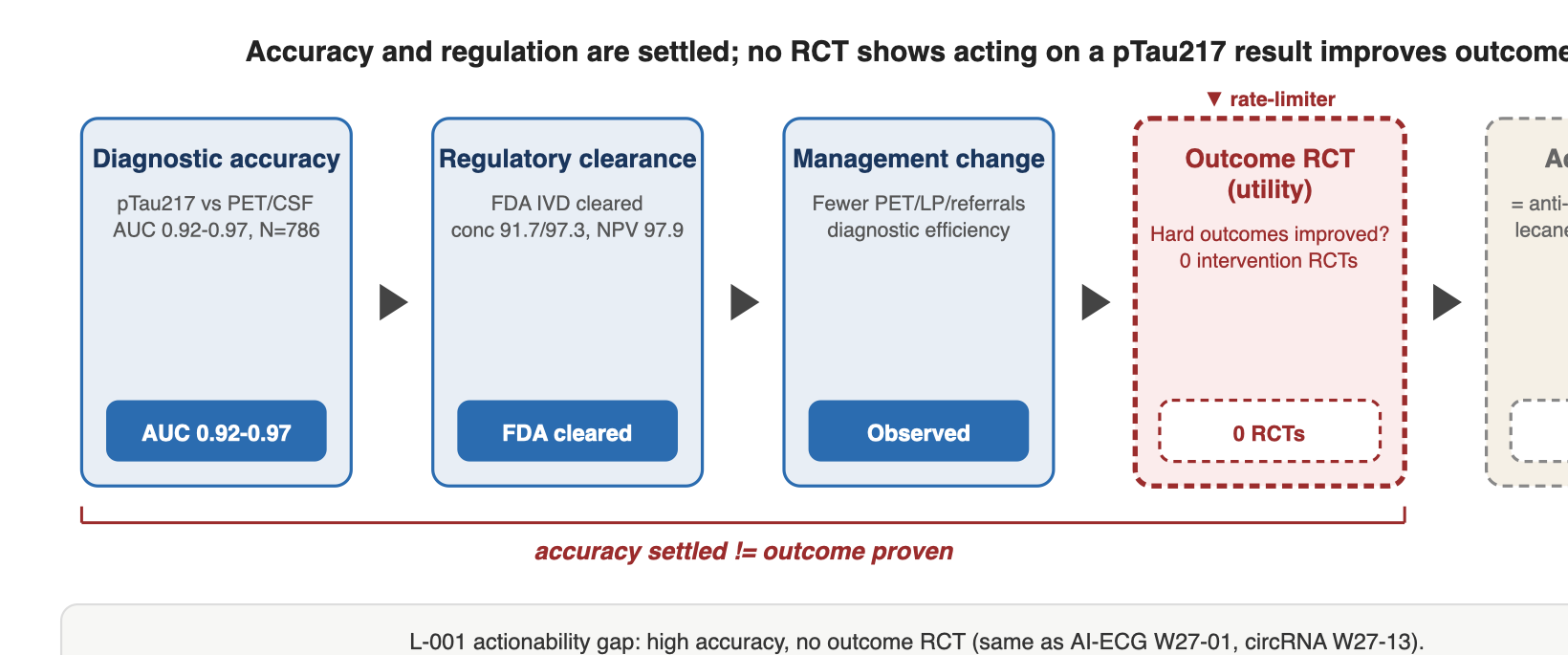
- So what. Accuracy and regulation are essentially decided — but that is not the same as clinical utility. Diagnostic accuracy (AUC, concordance) and clinical utility (does knowing change the outcome) are separate axes. As of 2026-07, the intervention chain that would prove utility — “biomarker-guided early detection → change in management → improved patient outcome” tested in a randomized trial — is not confirmed. Because the only disease-targeting intervention on offer (anti-amyloid disease-modifying therapy, DMT) has a small and contested effect (see Part 1), the actionability of a pTau217-positive result is a function of that DMT effect size. This is the same pattern the firm has flagged for AI-ECG (W27-01) and circulating-RNA AD diagnostics (W27-13): high classification accuracy, no outcome RCT.
- Now what. Do not read this as either “diagnostic revolution = better outcomes” or “diagnostics are useless.” Both overshoot. The honest position is proceed-with-caveats: accuracy and the regulatory layer are settled; clinical utility is unproven and hinges on DMT effect size. Two corrections belong on the record: neurofilament light (NfL) was reclassified as a non-specific “N” (not AD-specific) in the 2024 AA criteria, asymmetric to its surrogate role in ALS (Part 3); and the common claim that “C2N’s PrecivityAD2 was the first FDA-cleared AD blood test” is an error — the first clearance was Lumipulse; C2N is under FDA review and currently offered as a laboratory-developed test (LDT).
The five-minute read
Diagnosis as the enabler — and what it exposes
Parts 0–3 established the core tension of the series: anti-amyloid therapy clears amyloid (a confirmed surrogate), but its effect on the CDR-SB clinical scale is small and its meaning is contested (Part 1). Part 4 turns to the entry point of that picture — the diagnostic layer — and the firm’s recurring lens folds once more.
Anti-amyloid DMT labels require confirmation of amyloid positivity. To use lecanemab or donanemab, a clinician must first prove pathology by amyloid PET, CSF, or a blood biomarker. That requirement created demand for the plasma pTau217 revolution: PET is expensive and access-limited and CSF needs a lumbar puncture, but a single blood draw can now sort amyloid status with 91–97% concordance. Diagnosis enabled therapy. The same fact exposes the flip side. Accuracy is mature — but “does knowing a pTau217-positive result change the patient’s outcome” is a different question. If the only pathology-targeting intervention has a small effect (Part 1’s unresolved debate), the actionability of that positive result is correspondingly small. That is convergence-ledger item L-001 (predictive-diagnostic actionability gap) in its completed AD form.
The central thread — accuracy is not utility
The falsifiable claim of this part: plasma pTau217 and amyloid PET have established diagnostic accuracy (AUC 0.92–0.97, concordance 91–97%). But as of 2026-07, no intervention RCT shows that advancing diagnosis with a biomarker improves patient-centered hard outcomes (cognition, function, nursing-home entry, quality of life). The gap between accuracy and utility is L-001, and the DMT effect size (Part 1) sets its width. Falsification condition: if any trial demonstrates that a “biomarker-guided early-intervention arm vs standard-diagnosis arm” improves patient-centered hard outcomes, the gap closes and L-001 evolves to resolved.
| Layer | Status (2026-07) | Verdict |
|---|---|---|
| Diagnostic accuracy (pTau217) | Ashton JAMA Neurology 2024: amyloid AUC 0.92–0.96, tau AUC 0.93–0.97, N=786; comparable to CSF | Demonstrated (high) |
| Real-world accuracy (primary/secondary care) | Palmqvist Nature Medicine 2025, automated platform, higher than clinicians’ initial judgment (precise figures pending source read) | Demonstrated |
| Regulatory clearance | Lumipulse FDA 2025-05-16 (concordance 91.7%/97.3%); Roche pTau181 FDA 2025-10-13 (rule-out, NPV 97.9%) | Settled |
| 2024 AA biological definition / Core 1 | pTau217 = Core 1; tau PET = Core 2; NfL = non-specific “N” | Established |
| Diagnosis → management change | Fewer unnecessary PET/LP, misdiagnoses, referrals (Palmqvist; rule-out logic) | Observed |
| Management change → outcome improvement (utility) | No biomarker-guided outcome-improvement intervention RCT confirmed as of 2026-07 | Unproven |
| Actionability of a pTau217-positive result | A function of anti-amyloid DMT effect size (Part 1: small CDR-SB effect, MCID debate) | Open question |
Deep dive
1. Background — plasma pTau217, the breakthrough blood marker (accuracy layer)
Phosphorylated tau at threonine 217 rises in plasma in tight linkage with brain amyloid and tau pathology. Its fold-change between amyloid-positive and amyloid-negative states, and its discriminative power, exceed those of prior blood markers (pTau181, Aβ42/40, GFAP), so a single blood marker approaches PET/CSF accuracy.
The key primary evidence — Ashton et al., JAMA Neurology 2024 (ALZpath Simoa pTau217): N=786 (mean age 66.3, 64.1% women) across three cohorts (TRIAD, WRAP, SPIN). Amyloid-pathology identification AUC 0.92–0.96, tau-pathology identification AUC 0.93–0.97; significantly higher than other plasma-marker combinations and comparable to CSF biomarkers. Longitudinally, the annual pTau217 rise was observed only in amyloid-positive individuals. Source: Ashton NJ et al., JAMA Neurology 2024;81(3):255–263, DOI 10.1001/jamaneurol.2023.5319 (preprint PubMed 37502842).
Discipline of this part: that AUC of 0.92–0.97 measures the ability to identify brain amyloid/tau status from blood. It does not answer whether acting on that status makes the patient deteriorate less — a separate axis, isomorphic to the circRNA (W27-13) lesson that a headline AUC scores a pathology-defined label, not a clinical outcome.
Real-world validation — Palmqvist et al., Nature Medicine 2025 (fully automated platform) tested pTau217 in primary- and secondary-care patients and reported high diagnostic accuracy exceeding clinicians’ initial judgment (precise figures require source read; DOI 10.1038/s41591-025-03622-w, PubMed 40205199). But this too is an accuracy study — “more accurate than clinicians,” not “accuracy improved patient outcomes.” The link from management change to outcome improvement remains untested (§4).
2. What this establishes — the 2024 AA criteria and the biological definition (institutional layer)
The maturation of blood markers rewrote the diagnostic criteria themselves. Jack et al. (chair C. Jack, Mayo), Alzheimer’s & Dementia 2024-06-27, “Revised criteria for diagnosis and staging of Alzheimer’s disease: Alzheimer’s Association Workgroup” (DOI 10.1002/alz.13859):
- Biological definition: AD is defined by neuropathology (amyloid plaques plus tau tangles) rather than as a clinical syndrome. Detecting AD neuropathologic change by biomarker permits an AD diagnosis even in the asymptomatic stage — a paradigm shift to “biomarker detection = disease diagnosis.”
- Core 1 (early change; a single abnormal marker enters the AD continuum): amyloid PET, CSF/plasma Aβ42 ratio, plasma pTau181/217/231. Plasma pTau217 is included here — blood testing is formally written into the diagnostic axis.
- Core 2 (prognosis/staging): tau PET (the only Core 2 currently with sufficient evidence); medial-temporal tau-PET = Stage B, neocortical moderate/high = Stage C/D.
- Non-specific “N” / non-AD copathology: NfL is (re)classified as a non-specific “N” (large-axon injury) category, not AD-specific. This is the Part 3 cross-link: NfL was the surrogate for tofersen’s (SOD1 ALS) accelerated approval (Part 3), yet in AD it lacks diagnostic specificity and is excluded from the Core set — the same plasma marker occupies a different status by disease.
Implication: moving the criteria from “clinical” to “biological” formally created a population diagnosed before symptoms (asymptomatic amyloid-positive). This opens an early-intervention window but simultaneously widens the actionability void — a population diagnosed with no well-suited (or only small-effect) approved intervention (§4). The biological definition is itself contested: commentaries (e.g., in Neurology) have raised the clinical and ethical problems of calling asymptomatic biomarker positivity a “disease,” and the AA states this is a research/definition frame, not a practice guideline. Overdiagnosis concerns are treated in §4.
2b. Imaging/CSF references — what “concordance” is measured against
The “accuracy” of a plasma marker is agreement with a reference standard. Those standards, and their 2024 AA status: amyloid PET (Core 1 “A,” quantified in Centiloids), tau PET (Core 2 “T2,” SUVR/staging), CSF Aβ42/40 (Core 1 “A,” requires lumbar puncture), CSF/plasma pTau (Core 1 “T1,” pTau217 most discriminative), and NfL (non-specific “N,” no AD specificity). Exact Centiloid and CSF cutoffs vary by assay and center and are pending source read (unverified). The point: pTau217 concordance (e.g., Lumipulse 91.7% positive / 97.3% negative) states how well the blood test agrees with the more expensive standard — a cost/access innovation in the diagnostic pathway, not evidence of outcome improvement.
3. Method — regulatory clearance settles the accuracy layer; utility does not follow
Blood diagnostics have reached regulatory approval; the accuracy layer is effectively closed.
- Lumipulse G pTau217/β-Amyloid 1-42 Plasma Ratio (Fujirebio) — the first US blood-based AD IVD clearance, 2025-05-16 (510(k) K242706). For adults 55+ with cognitive-decline symptoms; concordance vs amyloid PET/CSF 91.7% positive / 97.3% negative. The FDA wording is “aid to identify amyloid pathology” — an aid, not a standalone diagnosis. Sources: FDA press release 2025-05-16; accessdata K242706; Warren SL et al. review PubMed 40582836.
- Roche Elecsys pTau181 plasma — FDA clearance 2025-10-13, the first for primary care, intended to rule out amyloid pathology, NPV 97.9%; co-developed with Eli Lilly. Source: Roche 2025-10-13. Hierarchy: pTau181 (rule-out, primary care) sits below pTau217 (rule-in, specialist) on accuracy.
- C2N Diagnostics PrecivityAD2 — a mass-spectrometry %pTau217 + Aβ42/40 algorithm. Not FDA-cleared as of 2026-07 (submitted for review around 2025-10, under review); currently offered as an LDT (self-pay ~$1,450). Clinical validation: Meyer et al., related JAMA Neurology, PubMed 38491912. Sources: c2n.com; alzdiscovery.org.
Correction (refuted item): the widely repeated claim that “C2N’s PrecivityAD2 was the first FDA-cleared AD blood test” is an error. The first US clearance was Lumipulse (Fujirebio), 2025-05-16; C2N submitted for review around 2025-10 and remains under review (not cleared), currently offered as an LDT. The confusion arises because C2N was commercially prominent earlier.
Entity summary (accuracy layer = mature, competitive phase): Roche, Lilly, and Fujirebio/H.U. Group hold FDA clearances; C2N and ALZpath are under review / LDT / research-use; Quanterix provides the Simoa measurement infrastructure. Accuracy and regulation are settling — competition is shifting to channel (primary-care rule-out vs specialist rule-in) and reimbursement.
4. The central thread — the actionability gap (accuracy ≠ utility), L-001 in AD form
Settled accuracy and regulation do not prove clinical utility, defined as “does knowing this test result improve the patient’s outcome” — the question an intervention trial answers.
What is observed (accuracy → management change): pTau217 is more accurate than clinician judgment (Palmqvist 2025) and reduces unnecessary PET, lumbar punctures, misdiagnoses, and specialist referrals; Roche pTau181 as a primary-care rule-out excludes non-AD patients early. This is real diagnostic-pathway efficiency.
What is unproven (management change → outcome improvement): as of 2026-07, no intervention RCT confirms that a biomarker-guided early-diagnosis/intervention arm improves patient-centered hard outcomes (cognition, function, nursing-home entry, quality of life) versus a standard-diagnosis arm. pTau217 is accumulating evidence as a clinical-trial endpoint (a drug-effect surrogate; Neurology 2025, PMC12699484) — but “a drug lowers pTau217” is not “knowing pTau217 changes the outcome.”
Why this is L-001 — DMT effect size sets the gap width. (1) Anti-amyloid DMT requires amyloid confirmation, creating pTau217 demand (enabler). (2) But that DMT’s CDR-SB effect is small and contested (Part 1: lecanemab −0.45, 27%; criticized as small vs MCID, with ARIA risk). (3) So the actionability of a pTau217-positive result equals the expected benefit of the intervention available to that positive patient; if the intervention has a small effect and carries ARIA risk, the behavioral implication of “you are positive” shrinks. (4) The asymptomatic amyloid-positive population created by the 2024 biological definition has the most limited approved intervention (anti-amyloid is labeled for early-symptomatic disease) — the widest actionability void. This is precisely L-001: accuracy competition is over, but the “early detection → management change → outcome improvement” intervention RCT is commonly absent. It is isomorphic to AI-ECG (W27-01) and circRNA (W27-13): high classification accuracy, no outcome RCT. AD adds the extra condition that the sole intervention’s effect size is itself small, making the gap most vivid.
Fair counter-view — not overstating the gap. (a) Accurate early rule-out can itself improve outcomes by cutting misdiagnosis-driven inappropriate treatment, unnecessary testing, and anxiety (indirect outcomes) — the value of Roche pTau181’s primary-care rule-out. (b) DMT effect may be re-evaluated: if the gap compounds in long-term open-label extensions (Part 1), the benefit of early diagnosis grows, so actionability is a function of the effect-size debate, not a fixed value. (c) Future intervention pipelines (tau-targeting, Part 2; next-generation drugs) could raise the actionability of a positive result retrospectively — the diagnostic infrastructure would already be ready (option value). The verdict is therefore “actionability is an open question tied to DMT effect size,” not “diagnostics are useless.” Neutral and falsifiable.
5. Commercialization and competitive context
- Maturity (TRL frame): assay accuracy and FDA clearance are secured by multiple parties (roughly TRL 8–9 on accuracy), so competition is moving to channel (primary-care rule-out vs specialist rule-in), reimbursement, and pre-analytical standardization. Clinical-utility maturity, by contrast, is early — no outcome trial exists.
- Listed: Roche (ROG.SW; Elecsys pTau181/217, primary-care rule-out); Eli Lilly (LLY; pTau181 co-development, donanemab demand side); Fujirebio / H.U. Group (4544.T; Lumipulse, first IVD clearance); Quanterix (QTRX; Simoa measurement infrastructure, ALZpath-related); Eisai (4523.T) / Biogen (BIIB; lecanemab demand side).
- Private: C2N Diagnostics (PrecivityAD2, under FDA review / LDT); ALZpath (pTau217 assay); Circular Genomics (CircPATH; the W27-13 circRNA program, whose corresponding author Cruchaga has a disclosed paid-advisory + 2023 partnership COI, re-cited here as a factual disclosure).
- Reimbursement / utility bottleneck: even with accuracy, absent “test → outcome improvement” utility evidence, a reimbursement debate remains (isomorphic to the L-003 liquid-biopsy reimbursement analogy). Demonstrating the utility of asymptomatic screening is the gate to reimbursement.
- Company statements are limited to neutral, trial-attributed description; competitive and assay-ranking statements are factual and neutral, not buy/sell implications for any security.
6. The skeptic’s bottom line
- Accuracy ≠ utility: AUC/concordance measure how well the blood test matches PET/CSF pathology; they do not show that acting on the result improves outcomes. As of 2026-07 the outcome-improvement intervention RCT count is zero.
- Concordance is a pathology-label match: the circRNA (W27-13) task-label lesson applies — agreement with a biomarker-defined status is not patient benefit.
- FDA clearances are an “aid,” not a standalone diagnosis — worded as an aid to identify amyloid pathology in a defined population, not a screening authorization.
- Overdiagnosis debate stands: the biological definition creates an asymptomatic biomarker-positive “disease” population and is itself contested on clinical and ethical grounds.
- NfL asymmetry: NfL remains a non-specific “N” in AD (2024 AA), asymmetric to its ALS surrogate role (Part 3) — a “NfL-based AD screening” claim would be expected to fail on specificity.
- Neutral framing maintained: the “diagnostic revolution” thesis connects directly to the anti-amyloid DMT significance debate (Part 1) — it must not be read as either “diagnostics are useless” or “diagnostic revolution = better outcomes,” and listed/private-company statements are not security signals.
7. What to watch (falsifiable)
- P1 (gap resolution): if any trial demonstrates that a “biomarker(pTau217/amyloid PET)-guided early-intervention arm vs standard-diagnosis arm” improves patient-centered hard outcomes, the §4 central claim is falsified and L-001 evolves to resolved. Conversely, zero such intervention RCTs registered within 12–24 months strengthens the “accuracy only, utility unproven” hypothesis.
- P2 (DMT dependency): if the anti-amyloid gap compounds in Part 1 long-term open-label extensions, the actionability of early pTau217 diagnosis rises retrospectively and the gap narrows; if the arms stay parallel, the gap persists or widens.
- P3 (NfL asymmetry): as long as NfL remains a non-specific “N” in AD (2024 AA), plasma NfL alone will not gain AD diagnostic specificity — a “NfL-based AD screening” claim should fail on specificity against Parkinson’s, DLB, FTD, and non-neurologic causes.
References
- Ashton NJ, et al. 2024. “Diagnostic Accuracy of a Plasma Phosphorylated Tau 217 Immunoassay for Alzheimer Disease Pathology.” JAMA Neurology 81(3):255–263. DOI 10.1001/jamaneurol.2023.5319. https://jamanetwork.com/journals/jamaneurology/fullarticle/2813751 (preprint: PubMed 37502842)
- Jack CR, et al. 2024. “Revised criteria for diagnosis and staging of Alzheimer’s disease: Alzheimer’s Association Workgroup.” Alzheimer’s & Dementia. DOI 10.1002/alz.13859. https://alz-journals.onlinelibrary.wiley.com/doi/10.1002/alz.13859
- Alzheimer’s Association. 2024. “Revised Criteria for Diagnosis and Staging of Alzheimer’s” (news). https://www.alz.org/news/2024/revised-alzheimers-diagnostic-staging-criteria
- US FDA. 2025. “FDA Clears First Blood Test Used in Diagnosing Alzheimer’s Disease” (Lumipulse, 2025-05-16). https://www.fda.gov/news-events/press-announcements/fda-clears-first-blood-test-used-diagnosing-alzheimers-disease
- US FDA. 510(k) K242706 — Lumipulse G pTau217/β-Amyloid 1-42 Plasma Ratio (concordance 91.7%/97.3%). https://www.accessdata.fda.gov/cdrh_docs/pdf24/K242706.pdf
- Warren SL, et al. 2025. Review of plasma pTau AD diagnostics. PubMed 40582836. https://pubmed.ncbi.nlm.nih.gov/40582836/
- Roche. 2025. “FDA-cleared Elecsys pTau181 Alzheimer’s blood test” (primary-care rule-out, NPV 97.9%, 2025-10-13). https://diagnostics.roche.com/us/en/news-listing/2025/fda-cleared-ptau181-alzheimers-blood-test.html
- Palmqvist S, et al. 2025. Plasma pTau217 in primary and secondary care (automated platform). Nature Medicine. DOI 10.1038/s41591-025-03622-w. https://www.nature.com/articles/s41591-025-03622-w (PubMed 40205199)
- C2N Diagnostics. “C2N Diagnostics releases the PrecivityAD2 blood test for clinical care” (LDT; under FDA review as of 2026-07). https://c2n.com/news-releases/cnnbspdiagnostics-releases-the-precivityad2-blood-test-for-clinical-care
- Meyer MR, et al. 2024. Clinical validation of a mass-spectrometry %pTau217 + Aβ42/40 blood test (PrecivityAD2). PubMed 38491912. https://pubmed.ncbi.nlm.nih.gov/38491912/
Disclosure
This post is for information only and is not investment advice, and not medical advice. Diagnostic and treatment decisions should always be made with your own clinician.
COI note: this post describes listed and private diagnostic and pharmaceutical companies (Roche ROG.SW, Eli Lilly LLY, Fujirebio / H.U. Group 4544.T, Quanterix QTRX, Eisai 4523.T, Biogen BIIB, and the private firms C2N Diagnostics, ALZpath, and Circular Genomics) in a descriptive, neutral context. Every accuracy figure (AUC, concordance, NPV) is attributed to the specific study or assay: Ashton 2024 relates to the ALZpath assay; Palmqvist 2025 validated Lilly/Roche assays; Roche pTau181 was co-developed with Lilly — sponsorship and conflicts of interest exist and are stated factually, not mitigated. The circRNA (W27-13) program’s corresponding author has a disclosed paid-advisory and 2023 partnership conflict, re-cited here as a factual disclosure. Quantitative claims are attributed to the vendor, author, or preprint. Assay-superiority and company-success/failure statements are factual, neutral descriptions and are not buy/sell implications for any security. The author holds no position in, and has no financial interest in, the companies named (ownership: no interest).


Leave a Reply