Evidence-first notes on bioscience and deep tech, at the edge of the lab and the market. Information only — not investment advice, not medical advice. All revenue, list-price, prescribing and regulatory figures are attributed to company earnings releases, CMS documents, EMA/PMDA/NMPA filings, or ICER/Value-in-Health reports. Lecanemab-versus-donanemab efficacy and safety comparisons are cross-trial (indirect) and are not head-to-head RCTs. Yen/renminbi-to-dollar conversions are approximate.
The 30-second version
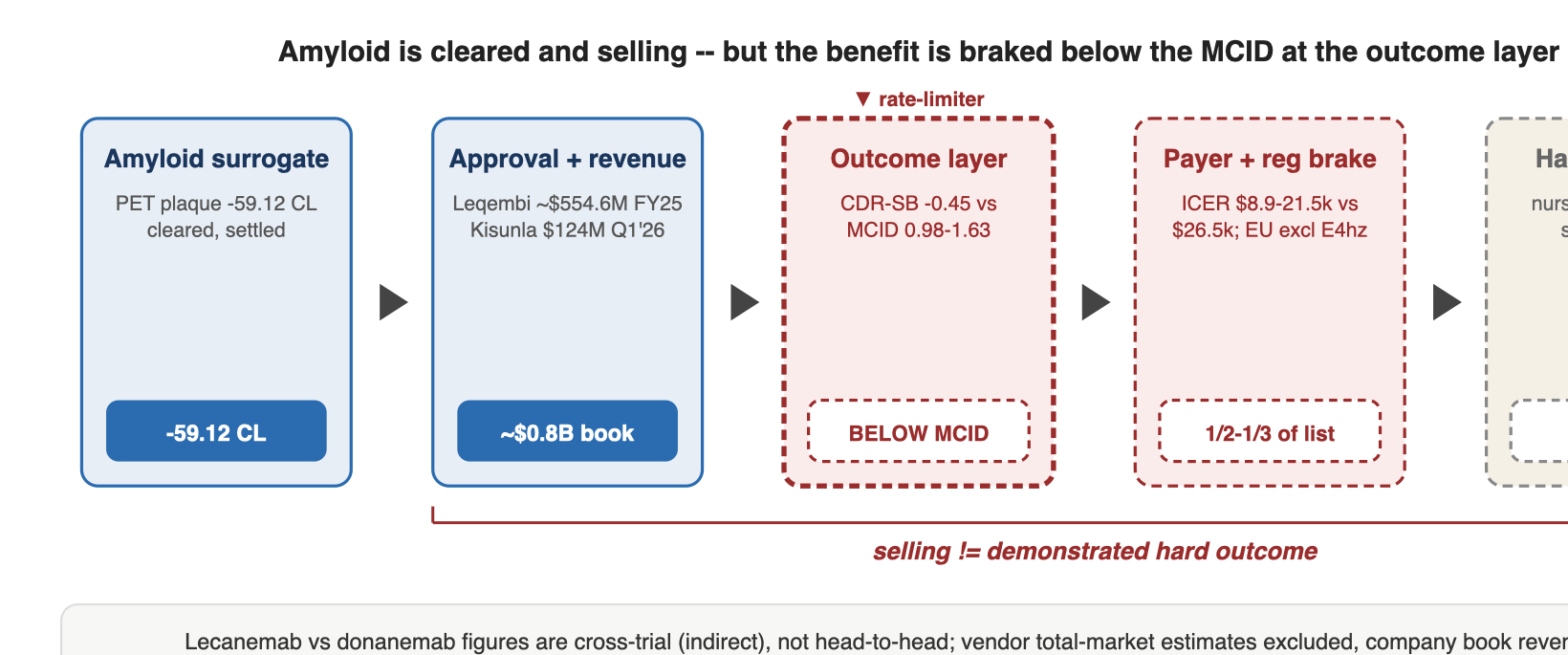
- What. Anti-amyloid monoclonal antibodies did the thing they were designed to do — they cleared the surrogate. Lecanemab drove amyloid PET plaque down (CLARITY-AD, −59.12 centiloids) and that was enough to earn approval, launch and revenue: Leqembi (Eisai/Biogen) FY2025 revenue ~$554.6M (Eisai, up from ~$279M in FY2024) and Kisunla (Eli Lilly) $124M in Q1 2026 (Lilly, US $84M). The surrogate is cleared and the drugs are selling.
- So what. But the very smallness of the clinical benefit brakes it at the outcome layer. The absolute clinical effect (CDR-SB −0.45 over 18 months) falls below the contested minimal clinically important difference (MCID 0.98–1.63), and regulators, payers and societies act on exactly that: the EU granted a restricted approval that excludes ApoE4 homozygotes (EC marketing authorization 2025-04-15), ICER’s fair price ($8,900–21,500/yr) sits at one-half to one-third of the ~$26,500 list price, and CMS requires registry (CED) participation as a condition of coverage. This is not a demonstrated hard outcome; every launch metric rests on a cleared surrogate plus a below-MCID clinical signal.
- Now what. This translates Part 0’s three-way science question directly into commercial decisions. The 48-month open-label extension (OLE) shows the CDR-SB gap widening over time (0.52 → 1.01 → 1.75), which supports the direction of a compounding, disease-modifying effect — but the comparator is an ADNI external control, not a randomized placebo, so it is confounded and unresolved. Below-MCID persists; the ARIA-unblinding question awaits the Part 1 subgroup analysis. Verdict: proceed-with-caveats. Cross-trial is not head-to-head.
The five-minute read
The paradox: amyloid is selling, but the outcome layer is where it gets braked
The neurodegeneration story is sharper than the cardiac-amyloid one. Anti-amyloid antibodies clearly hit their target — amyloid PET plaque removal is settled — and they turned that surrogate into approvals, launches and revenue. Yet the size of the clinical benefit is what invites the brakes. Part 0’s central question — is the small CDR-SB effect (a) a compounding disease-modifying signal, (b) a surrogate that does not translate, or (c) an ARIA-unblinding artifact — is now being answered in commercial and regulatory decisions rather than only in journals. The EU restricting lecanemab to ApoE4 non-carriers and heterozygotes (homozygotes excluded), ICER computing a fair price at one-half to one-third of list, and CMS conditioning coverage on a registry are three expressions of the same outcome-layer skepticism: the surrogate is accepted, but the magnitude and certainty of the clinical benefit are not yet.
Two bottlenecks under one headline
The firm’s recurring lens — “the headline is the entry point; the real bottleneck is elsewhere” — narrows here to two constraints. First, the surrogate-to-clinical translation threshold: does amyloid removal convert into a cognitive/functional gain that exceeds the MCID? Second, the effect-size-versus-ARIA tradeoff: is a small benefit worth the risk of ARIA and rare fatal hemorrhage, especially in APOE4 carriers? These two bottlenecks — not the modality itself — are the real contest behind the revenue curve, the EU restriction, the ICER gap and the infrastructure burden.
| Headline (starting point) | Real bottleneck (underneath) |
|---|---|
| “First disease-modifying Alzheimer’s therapy” | Surrogate → clinical translation threshold — amyloid −59.12 CL removal is settled, but CDR-SB −0.45 is below the MCID (0.98–1.63). The EU, ICER and CMS brake here. |
| “27% / 35% slowing of progression” | Large relative %, small absolute difference — 18-month CDR-SB absolute difference 0.45 points; patient-centered hard outcomes (delay to nursing-home placement, etc.) unproven. |
| “Subcutaneous self-injection makes it easy” | Effect size unchanged — the SC option (IQLIK) eases the access bottleneck but leaves the outcome-layer bottleneck intact; diagnostic, MRI and APOE4 infrastructure remains. |
| “Safe amyloid removal” | Effect-ARIA tradeoff — ARIA-E ~12.6%, macrohemorrhage 0.7% vs 0.2%, 3 investigator-attributed deaths in the OLE (anticoagulation, APOE4); small benefit against real risk. |
| “List price = value” | ICER fair-price gap — lecanemab health-benefit price benchmark $8,900–21,500/yr vs list $26,500; ~$794,895 per QALY (below threshold). |
| “Niche → large market explosion” | Vendor total-market figures self/mutually contradictory (refuted) — company book revenue (~$0.8B combined) only; diagnostics and infrastructure gate real growth. |
Deep dive
1. Background — the commercial landscape, product by product (all attributed to earnings/regulators)
Anti-amyloid disease-modifying therapy (DMT) is not a pill: it demands a three-part infrastructure of diagnosis, administration and monitoring, which is the structural reason for a slow launch ramp and for access inequality.
| Product (brand / company) | Administration | US list price (attributed) | Revenue trajectory (attributed) |
|---|---|---|---|
| lecanemab (Leqembi, Eisai / Biogen) | IV q2w → SC maintenance (IQLIK) | ~$26,500/yr | Eisai FY2024 ¥44.3B (~$279M) → FY2025 ¥88B (~$554.6M); above the ¥76.5B FY2025 guidance |
| donanemab (Kisunla, Eli Lilly) | IV q4w (may stop once plaque cleared) | ~$32,000/yr ($695.65/vial, monthly); ~$12,522 for a 6-month course | Q1’25 ~$21–22M → Q4’25 $109M (+54% QoQ) → Q1’26 $124M (US $84M); 2028 guided ~$2.2B |
Refuted (skeptic catch) — vendor market-size estimates. Market-analysis vendors’ “Alzheimer’s drug market” totals are self- and mutually contradictory. The same vendor reports “Alzheimer’s Drug Market $7.53B by 2035” in one report and “Alzheimer Therapeutics Market $33.62B by 2034” in another (~4.5× larger with an earlier end-year), and 2025-era totals scatter across $4.18B / $5.22B / $7.57B — the year-on-year direction itself disagrees. A claimed “anti-amyloid mAb = 44% of the 2025 market” implies ~$1.8–2.3B, yet actual book revenue (Leqembi FY2025 ~$554.6M plus Kisunla’s roughly few-hundred-million 2025) is ~$0.8B — a 2–3× overshoot, because the vendor totals blend symptomatic generics (donepezil, memantine) with DMTs. These figures are excluded; only company book revenue is used (isomorphic to the refuted $65.4M case in the cardiac-amyloid series).
2. Infrastructure and access bottleneck — the three-part barrier and the regulatory map
Anti-amyloid DMT requires diagnosis → administration → monitoring infrastructure.
- (1) Confirmation (PET/CSF → plasma pTau217): coverage is conditioned on confirmed amyloid pathology (amyloid PET or CSF). Plasma pTau217/Aβ42 (Lumipulse, first FDA clearance 2025-05-16) is easing the PET access/cost bottleneck — a market expander, but if the DMT effect is small this becomes the neurology instance of the L-001 actionability gap (diagnosis opens up, but little can be changed).
- (2) Administration (IV → SC): initial IV (q2w lecanemab / q4w donanemab) creates infusion-center capacity limits. Lecanemab SC self-injection (LEQEMBI IQLIK) maintenance dosing was FDA-approved 2025-08-29, with SC initiation approval expected in 2026 and a Japan SC NDA filed 2025-11 — the key variable for a second-act ramp.
- (3) Monitoring (repeat MRI + APOE4 genotype): periodic MRI for ARIA surveillance and APOE4 testing for risk stratification are mandatory (FDA label). APOE4 homozygotes may show larger effect but carry the highest ARIA risk — genotype-based selection is itself a real-world bottleneck and connects directly to the unblinding hypothesis.
Regulatory map (attributed).
- US (CMS CED): broad Medicare coverage after traditional approval, conditioned on clinician/team participation in an evidence-collecting registry (CED). At the $26,500 list price, 20% coinsurance is ~$5,300/yr out of pocket without supplemental cover — coverage is premised on evidence collection, an institutionalization of outcome-layer skepticism.
- EU (restricted approval): CHMP negative opinion 2024-07 → positive opinion on re-examination → EC marketing authorization 2025-04-15, but limited to ApoE4 non-carriers/heterozygotes with homozygotes excluded — the CHMP judged the CDR-SB difference not large enough relative to serious adverse events such as ARIA. Donanemab (Kisunla) received EC marketing authorization 2025-09; Austria and Germany were first EU launch markets.
- Japan: lecanemab approved 2023-09; ~6,000 patients treated at one year post-launch (expert survey); public insurance cover.
- China: NMPA approved 2024-01, launched 2024-06; IV maintenance dosing approved 2025-09; listed on a commercial-health-insurance innovative-drug directory 2025-12 (an access-expansion signal).
Guideline linkage. The Alzheimer’s Association Appropriate Use Recommendations (AUR) advise withholding lecanemab in patients on anticoagulants (pending further data) and specify APOE4 testing, MRI monitoring and patient-selection protocols. Where cardiac amyloid connected to ESC/ACC heart guidelines, CNS connects to the AUR/AAN/FDA-label axis — the heart guidance is hard-outcome-based, the brain guidance is AUR/safety-management-centered (the asymmetry, again).
3. Skeptic synthesis — where Part 0’s three-way question stands now (falsifiable)
Part 0 juxtaposed the small CDR-SB effect as (a) compounding disease modification, (b) a surrogate that does not translate, or (c) an ARIA-unblinding artifact, and pinned the decision on long-term OLE and the ARIA-free subgroup. Updating honestly and falsifiably with the verified web evidence:
(a) Compounding — currently the strongest-supported, but external-control confounding remains. In the CLARITY-AD 48-month OLE, the lecanemab CDR-SB gap widened over time — 0.52 (18mo) → 1.01 (36mo) → 1.75 (48mo) vs an ADNI matched control — and the authors read this as consistent with a sustained disease-modifying effect. Part 0’s prediction (“a widening gap strengthens compounding”) is met in the observed direction. The decisive caveat: the comparator is an ADNI external matched control, not a randomized placebo (the original placebo arm crossed over to lecanemab in the OLE). External controls are exposed to selection, measurement and secular effects, so the widening gap supports but does not establish compounding. Residual falsifier: the widening must reproduce in a cohort where randomization is preserved.
(b) Surrogate that does not translate — not weakened; below-MCID is the core. The CDR-SB MCID is estimated at 0.98 (MCI) / 1.63 (mild AD dementia) (Lancet 2022 and others). The CLARITY-AD 18-month between-group absolute difference of −0.45 is below both MCIDs. Statistical significance (P=0.00005) and individual-level clinical meaningfulness are separate; (b) is a still-live hypothesis, and the EU/ICER/CMS brakes institutionalize it. If (a)’s 48-month widening (1.75) is real, the cumulative absolute difference could exceed the MCID — so (a) and (b) split along the time axis (short-term 18mo favors (b), long-term cumulative favors (a)). Falsifier: a significant benefit on patient-centered hard outcomes (nursing-home placement delay, caregiver burden) would weaken (b) — currently unproven.
(c) ARIA-unblinding artifact — not excluded, awaiting the Part 1 subgroup. Symptomatic ARIA and MRI findings can unblind assignment (functional unblinding). Whether effect is maintained in the ARIA-free subgroup is the decider, and it is deferred to Part 1’s subgroup analysis — so (c) is neither excluded nor confirmed here. A weak counter-signal exists: the OLE reports ARIA rates falling to placebo-like levels after six months, making it hard to explain the long-term widening by ARIA confounding alone.
DMT vs symptomatic (the series axis). Symptomatic agents (donepezil, memantine) temporarily shift the curve without changing its slope. A true DMT should bend the slope so the gap widens — the 48-month OLE widening (0.52 → 1.75) fits the DMT signature in direction, but external-control confounding (a) and below-MCID (b) prevent declaring disease modification established. This matters commercially: if it is a DMT, early and sustained dosing is justified by compounding value; if a mere shift, a finite intervention suffices.
Effect-size-versus-ARIA tradeoff (number-needed view). Against an absolute CDR-SB gain of 0.45 points (18mo, below MCID): ARIA-E ~12.6%, symptomatic ARIA, macrohemorrhage 0.7% vs placebo 0.2% (rising further with anticoagulation), and 3 investigator-attributed deaths in the CLARITY-AD OLE (one APOE4 non-carrier on anticoagulation with macrohemorrhage; one APOE4 homozygote with CAA/vasculitis multi-hemorrhage after tPA). Serious ARIA is ~3% in homozygotes vs ~1% in heterozygotes/non-carriers. This narrow tradeoff justifies the EU’s homozygote-excluding restriction and the AUR’s anticoagulation-withhold advice — a net-benefit judgment is impossible without patient selection (APOE4, anticoagulation, CAA).
4. Neighbouring domains — the cross-domain payoff
- Amyloid heart ↔ brain asymmetry (confirmed commercially). Cardiac ATTR (TTR heart amyloid) proved hard outcomes (all-cause/CV) and delivered tafamidis (~$6.38B) and vutrisiran as blockbusters. The same “misfolded amyloid removal” modality is braked at the outcome layer in the brain (EU restriction, ICER shortfall, below-MCID). Why does translation stall only in the brain? Candidate answers: (i) in the heart, deposit clearance restores mechanical function directly, whereas neuronal loss is irreversible so plaque removal is not equivalent to functional recovery; (ii) a cardiac endpoint (death) is harder than a cognitive one (CDR-SB). Part 0’s question is re-confirmed by revenue curves and regulatory decisions.
- ASO regulatory asymmetry. Tofersen (SOD1 ASO) missed its primary endpoint but won accelerated approval on the NfL surrogate; by contrast eplontersen (TTR ASO) missed its cardiomyopathy primary and was not approved for CM. Same modality, same “primary miss + surrogate” structure — yet the surrogate approval passed only in the CNS (a lethal, high-unmet-need setting). Regulatory tolerance is domain-dependent, a symmetry point across the two series.
- Predictive-diagnostics actionability (L-001). The easier pTau217 and SC self-injection make diagnosis and dosing, the more an actionability gap materializes if the DMT effect falls below MCID — the mirror image of cardiac amyloid, where diagnostics (PYP scintigraphy) opened a market. The neurology risk is the opposite ending: “diagnosis opens up, but there is little to change.”
5. Commercialization and competitive context (TRL, related companies)
- Maturity (TRL frame): the surrogate (amyloid removal) is demonstrated, but the outcome layer is early — the gating layers are surrogate-to-clinical translation and effect-size meaningfulness, not target engagement.
- Eisai / Biogen (lecanemab): first-mover, slow ramp (FY2025 ~$554.6M), SC (IQLIK) the second-act variable; Eisai is the P&L lead, Biogen co-promotes under profit-sharing.
- Eli Lilly (donanemab): fast ramp (Q1’26 $124M), differentiated on a finite, stoppable course; the “cost advantage” claim is provisional pending re-accumulation/re-dosing data.
- Roche, and the diagnostics layer: plasma pTau217/Lumipulse and other blood tests lower the diagnostic barrier — a market expander whose value is capped if the DMT effect stays below MCID.
- Company statements are limited to neutral, trial/earnings-attributed description; competitive, superiority or amyloid-hypothesis win/lose statements are not buy/sell signals. Lecanemab-versus-donanemab is cross-trial, not head-to-head.
6. The skeptic’s bottom line
- Do not declare disease modification established: the 48-month OLE widening is against an ADNI external control, not randomized — direction supported, not confirmed.
- Relative % ≠ absolute benefit: CDR-SB −0.45 is below the MCID (0.98–1.63); “27% / 35% slowing” must not be read as absolute clinical benefit.
- Cross-trial, not head-to-head: lecanemab vs donanemab superiority (efficacy or ARIA) cannot be adjudicated; even indirect treatment comparisons depend on adjustment assumptions.
- Provisional cost claim: donanemab’s “stoppable = cost advantage” is unresolved on re-accumulation and re-dosing.
- Vendor totals refuted: self/mutually contradictory market-size figures (44% → ~$2B implied) sit 2–3× above actual book revenue (~$0.8B) → excluded; company book revenue only.
- ICER fair price is method-dependent: transition probabilities and utilities drive it — the “fair price” absolute must not be read as a fixed truth.
- Neutral-framing note: to prevent misreading listed-company (Eisai, Biogen BIIB, Eli Lilly LLY, Roche) statements as security or policy signals.
7. What to watch (falsifiable) + series retrospective
- P1: if the CDR-SB gap widening reproduces in a randomization-preserved long-term dataset (or a placebo-maintained cohort), (a) compounding is confirmed beyond external-control confounding; if it plateaus, it shifts toward a one-time shift (b). Currently the ADNI external control supports direction only.
- P2: if CDR-SB effect is maintained in the ARIA-free subgroup, (c) unblinding is weakened; if effect concentrates in the ARIA-positive subgroup, (c) is strengthened (Part 1 subgroup).
- P3: if, after SC self-injection and pTau217 relieve the diagnosis/administration bottleneck, the real adoption bottleneck remains effect size (MCID), the ARIA tradeoff and price-versus-value, the L-001 actionability gap surfaces as a value-recovery problem versus infrastructure investment.
Series retrospective (Part 0–5). Across landscape (Part 0) → anti-amyloid mAb (Part 1) → tau and next-generation (Part 2) → CNS ASO/tofersen (Part 3) → biomarkers and diagnostics (Part 4) → commercial/skeptic/synthesis (Part 5), the series converged on one question: does surrogate success translate into a hard-ish outcome, and is its magnitude meaningful? Three through-lines: (1) the real bottleneck is at the outcome layer — anti-amyloid hit the target (amyloid −59.12 CL), yet CDR-SB is below MCID, the EU restricted, ICER priced at one-half to one-third, and CMS conditioned coverage; the firm-wide thesis in its clearest form. (2) For neurodegeneration the bottleneck is specifically surrogate → clinical-benefit translation plus effect-size meaningfulness — the surrogate itself is solved, so the remaining fight is translation (48-month OLE supports the direction, with external-control confounding) and meaning (MCID, patient-centered outcomes, the ARIA tradeoff); “disease modification established” is still falsifiably open. (3) Modality-superiority claims do not hold here — lecanemab/donanemab lack a head-to-head, and tofersen was approved on a surrogate after a primary miss. Cross-domain payoff: the amyloid heart↔brain symmetry (heart proved hard outcomes, brain stuck at the surrogate) and ASO regulatory asymmetry (tofersen approved on surrogate vs eplontersen not) feed the knowledge-index and convergence-ledger as durable signals.
References
- Eisai. 2025. Leqembi (lecanemab) news release. https://www.eisai.com/news/2025/news202534.html
- BioArctic. 2025. “Eisai Projects Leqembi Revenue to Total JPY 76.5 Billion for Fiscal Year 2025 (April 2025–March 2026).” bioarctic.com/…/eisai-projects-leqembi-revenue-fy2025
- Precision Medicine Online. “Eli Lilly Posts Strong Kisunla Growth, $124M in Q1” (Kisunla Q1’26 $124M). precisionmedicineonline.com/…/kisunla-growth-124m-q1
- CMS. “Statement: Broader Medicare Coverage of Leqembi Available Following FDA Traditional Approval” (CED registry condition). cms.gov/…/broader-medicare-coverage-leqembi
- ICER. “ICER Publishes Evidence Report on Lecanemab for Alzheimer’s Disease” (health-benefit price benchmark $8,900–21,500/yr). icer.org/…/evidence-report-lecanemab
- Value in Health. Cost-effectiveness of lecanemab/donanemab (QALY analysis; lecanemab ~$794,895/QALY). valueinhealthjournal.com/article/S1098-3015(24)00449-2/fulltext
- EMA. Leqembi (lecanemab) EPAR (EC marketing authorization 2025-04-15; ApoE4-homozygote exclusion). ema.europa.eu/en/medicines/human/EPAR/leqembi
- Eisai. 2025. “FDA Approves LEQEMBI (lecanemab-irmb) Subcutaneous Injection for Maintenance Dosing” (IQLIK, 2025-08-29). media-us.eisai.com/…/IQLIK-subcutaneous-maintenance
- PMC. CLARITY-AD OLE 48-month data (CDR-SB gap 0.52 → 1.01 → 1.75 vs ADNI external control). https://pmc.ncbi.nlm.nih.gov/articles/PMC12725329/
- Alzforum. “Two New Deaths on Leqembi Highlight Need to Better Manage ARIA” (OLE fatal ARIA events). alzforum.org/…/two-new-deaths-leqembi-manage-aria
- The Lancet. 2022. CDR-SB minimal clinically important difference (MCID 0.98 MCI / 1.63 mild AD). thelancet.com/…/PIIS0140-6736(22)02480-1/fulltext
- Eisai. 2025. Leqembi additional news release (regulatory/commercial update). https://www.eisai.com/news/2025/news202586.html
Disclosure
This post is for information only and is not investment advice, and not medical advice. Treatment decisions should always be made with your own clinician.
COI note: this post describes listed pharmaceutical companies (Eisai, Biogen BIIB, Eli Lilly LLY, Roche) and their sponsored trials in a descriptive, neutral context. Every revenue, list-price, prescribing and regulatory figure is attributed to the respective company earnings release (Eisai/Biogen/Lilly press releases, SEC filings), CMS documents, EMA/PMDA/NMPA regulatory filings, or ICER/Value-in-Health reports. Lecanemab-versus-donanemab efficacy and ARIA comparisons are cross-trial (indirect) and are not head-to-head RCTs; even indirect treatment comparisons depend on adjustment assumptions. Vendor total-market estimates are self/mutually contradictory and are excluded; only company book revenue is used. Quantitative claims are attributed to the vendor, author or press release/report. Competitive and amyloid-hypothesis win/lose statements are factual, neutral descriptions and are not buy/sell implications for any security. The author holds no position in, and has no financial interest in, the companies named.


Leave a Reply