Evidence-first notes on bioscience and deep tech, at the edge of the lab and the market. Information only — not investment advice. All sensitivity and material figures are attributed to the specific instrument, paper or announcement; peer-reviewed data (Physical Review Applied, Nano Letters, Nature Reviews Materials) are separated from company specifications (QuSpin QZFM) and trade press. Cross-instrument sensitivity numbers differ in frequency band, measurement volume and physical geometry and are not head-to-head.
The 30-second version
- What. Three magnetometer families compete to sense weak magnetic fields: the classical incumbent SQUID (cryogenic), atomic-vapor OPM (optically pumped, SERF regime), and solid-state NV (nitrogen-vacancy diamond). The common headline — “a room-temperature quantum diamond sensor measures brain activity (MEG)” — reads as “quantum replaces classical.” The raw-sensitivity ordering says otherwise: SQUID (~3–5 fT/√Hz) > OPM (~7–15 fT/√Hz) >> NV (best demos ~0.67–0.9 pT/√Hz; a real CW instrument ~9.4 pT/√Hz) — NV is roughly 2–3 orders of magnitude less sensitive.
- So what. NV’s genuine edge is on a different axis — nanoscale spatial resolution (current-density imaging at 22–50 nm), room-temperature operation and high-field range — which is a materials/condensed-matter niche, not weak-field bio-magnetometry. Even the clearest bio win, OPM-MEG, does not beat SQUID on raw sensitivity either; its advantage is the system axis (cryogen-free, on-scalp proximity, wearable). Two misreadings define the hype here: spatial resolution (where) ≠ sensitivity (how weak), and research deployment ≠ approved clinical replacement.
- Now what. Cerca’s wearable OPM-MEG is an unlicensed research system (no FDA 510(k) / CE mark) that still requires a magnetically shielded room. NV’s best sensitivity figure (670 fT/√Hz) is a trade/preprint claim whose “record” status is unverified, and Tokyo Tech’s “ambient MEG” remains aspirational (its 9.4 pT/√Hz instrument is ~3 orders from the fT-class figures MEG demands). On current data this maps to Part 0’s hypothesis (a) — classical-beating holds only on a narrow, application-specific axis.
The five-minute read
Three modalities, and why the axes matter more than the headline
This part applies Part 0’s falsifiable question to magnetometers: do quantum/atomic magnetometers (NV, OPM) actually beat the classical incumbent (SQUID) in the field — and if so, on which axis? The instinct is to line up the sensitivity numbers and declare a winner. But the honest ordering splits the narrative. On raw sensitivity (magnetic-field noise density, fT/√Hz) the classical SQUID has the lowest noise (most sensitive), atomic-vapor OPM comes next, and NV diamond trails by roughly two orders of magnitude. NV’s strength is not sensitivity but a different axis entirely: nanoscale spatial resolution (current-density imaging at 22–50 nm), room-temperature operation, a wide field range and vector readout.
The subtler point is that even OPM-MEG — the most-cited “quantum win” in bio — does not owe its edge to raw sensitivity. OPM’s noise floor is higher (less sensitive) than SQUID’s; its advantage comes from the system axis: no cryogenics, on-scalp proximity that boosts signal amplitude, and a wearable form factor. Mixing the axes is the error. Nanoscale resolution answers “where can you measure”; sensitivity answers “how weak a field can you detect.” NV wins the first; SQUID and OPM win the second.
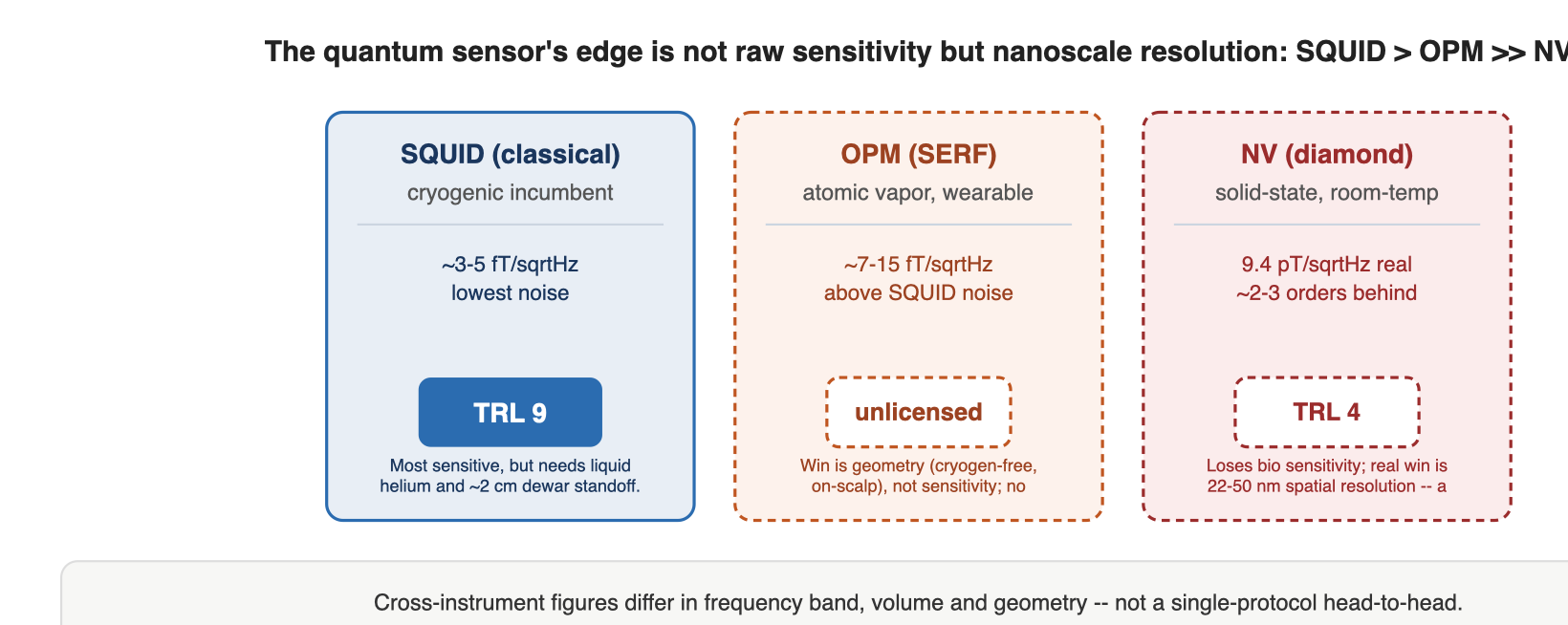 OPM >> NV” width=”1640″ height=”654″ style=”width:100%;height:auto;max-width:820px;” />
| Modality | Raw sensitivity (as reported, attributed) | Spatial resolution / operating condition | Status |
|---|---|---|---|
| SQUID (classical incumbent) | ~3–5 fT/√Hz (clinical whole-head MEG); state-of-the-art low-Tc ~3; dewar noise 1–2 — lowest noise | cm standoff (dewar gap ~2 cm); cryogenic (liquid helium) | Clinically mature (TRL 9) |
| OPM (SERF) (atomic vapor) | ~7–15 fT/√Hz (QuSpin QZFM Gen-2, 1–100 Hz); Gen-3 <23 (3–100 Hz) — higher noise than SQUID | mm on-scalp; room-temperature (heated vapor cell); zero-field only (dynamic range ±5 nT) | Research-system deployment (unlicensed) |
| NV (diamond) (solid state) | Best ensemble ~0.9 pT/√Hz shot-noise-limited; laser-enhanced 670 fT/√Hz; real CW-ODMR instrument 9.4 pT/√Hz — ~2–3 orders less sensitive | 22–50 nm (current-density imaging); sensor–sample few nm; room-temp, DC–GHz, high field | Lab (nanoscale imaging, TRL 4) |
Deep dive
1. Three magnetometer families — sensitivity, physics and status (instrument/paper-attributed)
Each family is defined by a distinct physics, which fixes both what it is good at and where it is stuck.
- SQUID (classical): the strongest raw sensitivity (~3–5 fT/√Hz) and the MEG/MCG clinical incumbent (TRL 9). Its bottleneck is not sensitivity but cryogenics (liquid helium), a fixed helmet and a large dewar standoff. This is the wall quantum/atomic magnetometers must break.
- OPM (atomic, SERF): the most credible quantum-enabled bio win. But its raw sensitivity is lower than SQUID’s (7–15 vs 3–5 fT/√Hz). The advantage lives on the system axis — cryogen-free, on-scalp proximity (which raises signal amplitude), wearable. The constraint: zero-field only (dynamic range ±5 nT), so a shielded room is still required.
- NV (solid state): raw sensitivity is roughly two orders behind SQUID/OPM (real CW instrument ~9 pT/√Hz; best demos ~0.67–0.9 pT/√Hz). The edge is nanoscale spatial resolution (22–50 nm), room temperature, high field, DC–GHz and vector readout — a materials / condensed-matter niche, not bio.
The discipline that governs the whole part: the three sensitivity numbers (SQUID fT vs OPM fT vs NV pT) are not a same-protocol head-to-head, because frequency band, measurement volume and geometry differ. But for the same physical quantity in a similar low-frequency band the rough ordering — SQUID > OPM >> NV — does hold. What inverts that ordering for NV is spatial resolution, and spatial resolution is a different axis from sensitivity.
2. The raw-sensitivity ordering — an honest comparison (the axis NV loses)
Bottom line first: on raw sensitivity (magnetic-field noise density) NV trails both SQUID and OPM. Approximate ordering in the low-frequency, bio-relevant band:
- SQUID ~3–5 fT/√Hz (clinical whole-head; state-of-the-art low-Tc ~3, dewar noise 1–2) — MDPI Sensors 25/4625, PMC review.
- OPM (SERF) ~7–15 fT/√Hz (QuSpin QZFM Gen-2 measured, 1–100 Hz; Gen-3 <23) — company spec / arXiv 2408.02941. Slightly higher (less sensitive) noise than SQUID.
- NV best ~0.67–0.9 pT/√Hz (laser-enhanced 670 fT/√Hz at 280 µT dynamic range; ensemble shot-noise-limit 0.9 pT/√Hz, 1011 NV) — but the actual operating CW-ODMR instrument is 9.4 ± 0.1 pT/√Hz (Tokyo Tech, Phys. Rev. Applied 21.064010, 2024-06).
So NV’s best demo (670–900 fT/√Hz) is already roughly two orders less sensitive than SQUID (3–5 fT/√Hz), and its real operating instrument (9.4 pT/√Hz) is about three orders behind. Detecting MEG signals (tens of fT to pT) needs fT-class sensitivity, which puts raw magnetoencephalography detection with today’s NV instruments at the margins.
This confirms the proposition Part 0 flagged: NV’s edge is not raw sensitivity. Reading NV as “the most sensitive magnetometer” is hype; the axis NV wins is spatial resolution (§3). And one layer more honest: OPM cannot beat SQUID on raw sensitivity either. When OPM-MEG is described as “replacing SQUID,” if the basis is raw sensitivity it is wrong (OPM 7–15 fT > SQUID 3–5 fT). OPM’s real advantage is the system axis (§4) — on-scalp proximity boosts signal amplitude so that a sensitivity deficit is offset by geometry.
3. The axis NV wins — nanoscale spatial resolution (the classical-beating niche)
The axis where NV clearly beats SQUID/OPM is not sensitivity but spatial resolution and operating condition, and it comes from the physics: an NV is an atom-scale single/ensemble spin inside the diamond lattice, so it can sit within a few nanometres of the target.
- Nanoscale current-density imaging: scanning NV magnetometry has imaged current density in metallic nanowires and carbon nanotubes at 50 nm (best 22 nm) spatial resolution, DC currents of a few µA, current-density noise floor ~2×10⁴ A/cm2 (Nano Letters / arXiv 1609.09644, peer-reviewed). SQUID/OPM, with cm–mm standoff, cannot in principle reach this scale.
- Condensed-matter probe: NV measures local magnetization/current in superconductors, 2D materials and magnets directly, across DC–GHz, cryogenic to room temperature, at few-nm sensor–sample distance (Nature Reviews Materials 2018) — a local probe for correlated-electron and topological systems.
- Room-temperature, high-field operation: SQUID is trapped at cryogenic temperature, OPM at zero field (±5 nT). NV operates at room temperature up to DC ~280 µT and beyond — often the only option in high-field environments (current, power, materials inspection).
So NV’s classical-beating holds not in bio raw sensitivity but in nm-scale materials imaging — the magnetometry instance of Part 0’s hypothesis (a), the “narrow win.” NV beats the classical only on the one axis it uniquely accesses (nanoscale). The moment that boundary is blurred into “NV = the best magnetometer,” it becomes hype. Spatial resolution is the advantage of where you measure, not how weak a field you measure. Bio-magnetometry (MEG/MCG) senses weak far-field outside the scalp, so sensitivity is rate-limiting — SQUID/OPM win. Materials inspection senses a local field over a device, so spatial resolution is rate-limiting — NV wins. Combine the axes and you misread.
4. OPM-MEG — the clearest bio win, but “geometry not sensitivity” + unlicensed
In bio-magnetometry the clearest quantum/atomic win is OPM (atomic-vapor SERF), not NV. But the nature of that win must be stated precisely.
- OPM-MEG’s edge = the system axis (not sensitivity): no cryogenics (room-temperature heated vapor cell), on-scalp proximity (SQUID’s ~2 cm dewar gap vs OPM’s mm scale → higher signal amplitude and spatial information, especially for children and movement), and wearability (3D-printed helmet plus backpack, measurement during natural movement). The advantage over SQUID is cryogen-free, proximate, mobile — not raw sensitivity.
- Research deployment is a fact: QuSpin/Cerca wearable OPM-MEG systems are deployed at research institutions including SickKids (Toronto), Princeton, University of Zurich and Boys Town (Cerca / Wellcome). QuSpin announced completion of an epilepsy-diagnosis clinical trial in January 2023 and unveiled a wearable scanner in 2025; there are multiple epilepsy pre-surgical evaluation studies (PMC 10896867). A 384-channel OPM-MEG is also under development (arXiv 2509.03107).
- But research deployment ≠ approved medical device: Cerca OPM-MEG is a research-use system with no medical/regulatory approval in any jurisdiction (no FDA 510(k), no CE mark) (CB Insights / Cerca), and it still requires a magnetically shielded room (a zero-field constraint). Describing “wearable quantum MEG has replaced the hospital SQUID” misreads a research deployment as an approved clinical replacement.
- NV’s bio attempt is aspirational: Tokyo Tech claims “a step toward MEG under ambient conditions” with a room-temperature, mm-resolution NV magnetometer (Phys. Rev. Applied 2024), but its operating sensitivity of 9.4 pT/√Hz is ~3 orders from the fT-class MEG demands, and ambient (unshielded) MEG is not demonstrated. NV bio-magnetometry has a long way to go relative to OPM/SQUID.
Summary: in bio, the quantum/atomic magnetometer win is carried by OPM (the geometry axis), while NV is behind in bio. And even OPM’s win is geometry, not sensitivity, and is not yet an approved medical device. The two misreadings — spatial-resolution/geometry ⇒ sensitivity, and research deployment ⇒ clinical replacement — are the core hype points of this modality.
5. The falsifiable question — does the quantum magnetometer beat SQUID?
Applying Part 0’s three hypotheses, narrowed to magnetometers.
- (a) Narrow win — classical-beating only on a specific axis/application — best fit to current data. NV beats the classical only in nanoscale materials imaging (22–50 nm; SQUID/OPM cannot reach it in principle), while losing bio raw sensitivity by ~2–3 orders. OPM-MEG complements/partly replaces SQUID on the geometry axis (cryogen-free, proximate, wearable) but is actually behind on raw sensitivity. The “win” is fragmented by application and axis. Falsified if NV actually surpasses SQUID/OPM on bio raw sensitivity in the same protocol (ambient MEG demonstrated), or OPM exceeds SQUID on raw sensitivity — neither observed.
- (b) Broad win — quantum magnetometers replace SQUID across many applications — weakly supported now. The evidence is research-institution deployment and wearable demos. Falsified/weakened as long as OPM-MEG remains FDA/CE-unlicensed, shielded-room-dependent and behind SQUID on raw sensitivity; NV bio sensitivity is further away still. “A room-temperature quantum magnetometer replaces hospital MEG” is refuted at the results layer.
- (c) Dual-use / bio-pull — bio (MEG/MCG) pulls magnetometer deployment — partly holds. Clinical research demand for OPM-MEG (QuSpin/Cerca) and magnetocardiography (MCG) pulls the OPM modality toward maturity. Weakened if OPM-MEG fails to secure approval, escape the shielded room, or demonstrate a clinical edge over SQUID. Research pull is real; approved clinical replacement is undetermined.
Current tentative position: (a) the narrow win fits magnetometry best. NV is classical-beating only in the nanoscale niche; OPM complements SQUID only on the geometry axis (not sensitivity, and unlicensed). Part 2 does not assert any single hypothesis, but it refutes the narrative that “NV/quantum magnetometers beat SQUID on sensitivity” and separates the axes: NV’s real win is nanoscale (not bio), OPM’s real win is geometry (not sensitivity).
6. Neighbouring domains and the cross-domain connection
- Neuro / MEG × Brain2Qwerty: the firm’s first non-bio cross-domain publication, Brain2Qwerty (non-invasive brain-to-text, best MEG character-error-rate ~18–19%), held only on traditional SQUID-MEG (Megin 306-channel, room-sized shielded room, non-portable). Its top caveat was “this performance holds only on non-portable MEG.” OPM-MEG is the hardware path that relaxes that “non-portable” bottleneck via cryogen-free, on-scalp, wearable operation — so whether quantum/atomic magnetometers can unlock the hardware bottleneck of non-invasive BCI is what links the two firm axes. But OPM still needs a shielded room and is FDA/CE-unlicensed, inheriting Brain2Qwerty’s “headline vs fine print” gap; and OPM’s edge being geometry rather than raw sensitivity is isomorphic to Brain2Qwerty’s “the decoder is half the performance” discipline (a hardware label is not the source of performance).
- Materials / condensed matter: the one axis NV genuinely wins is not bio but materials (§3) — current density at 22–50 nm, local probing of superconductors and 2D materials (Nature Reviews Materials). The magnetometry classical-beating of quantum sensing holds in nm-scale materials imaging (materials), not MEG (bio) — an axis re-placement of Part 0’s “narrow win” hypothesis.
7. Commercialization and competitive context (neutral, instrument-attributed)
- Maturity (TRL frame): modality-dependent — OPM-MEG research-system deployment (FDA/CE-unlicensed), SQUID-MEG clinically mature (TRL 9, the classical incumbent), NV nanoscale imaging in the lab (TRL 4). This is not a single number.
- QuSpin / Cerca Magnetics (private): wearable OPM-MEG deployed at research institutions (SickKids, Princeton, Zurich, Boys Town); QuSpin announced an epilepsy-diagnosis trial completion (2023-01) and a wearable scanner (2025). Cerca OPM-MEG remains a research-use system with no FDA 510(k) / CE mark and still requires a shielded room.
- Megin (private): the SQUID-MEG incumbent (whole-head, room-sized shielded room), the classical baseline all quantum/atomic systems are measured against.
- All company statements are limited to neutral, instrument/paper-attributed description; cross-instrument sensitivity numbers are not head-to-head and are not efficacy rankings or buy/sell signals.
8. The skeptic’s bottom line
- Spatial resolution ≠ sensitivity: NV’s 22 nm is a “where” advantage, not a “how weak” advantage. On raw sensitivity NV is ~2–3 orders behind SQUID/OPM. Reject “NV = the best magnetometer.”
- Geometry ≠ sensitivity: OPM-MEG’s edge over SQUID is cryogen-free, proximate, wearable (the system axis) — not raw sensitivity (OPM 7–15 > SQUID 3–5 fT/√Hz).
- Research deployment ≠ approved clinical replacement: Cerca OPM-MEG is FDA/CE-unlicensed research equipment that still needs a shielded room; do not read it as “replaced the hospital MEG.”
- Cross-instrument sensitivity is a cross-claim, not head-to-head: frequency band, measurement volume and geometry differ.
- Unverified items: NV’s 670 fT/√Hz “record” status (trade/preprint) and Tokyo Tech’s ambient-MEG demonstration (aspirational) are not confirmed. NV magnetocardiography clinical status, whether OPM-MEG actually “replaces” SQUID-MEG in the clinic, and the 384-channel OPM-MEG real performance remain unverified.
9. What to watch (falsifiable)
- P1 — NV bio sensitivity reversal: if an NV magnetometer surpasses SQUID/OPM on bio raw sensitivity in the same protocol, or demonstrates ambient (unshielded) MEG, the (a) narrow-win boundary expands; if NV stays confined to the nanoscale materials-imaging niche, (a) is confirmed. (Check: Tokyo Tech follow-up, NV MEG replication.)
- P2 — OPM approval / shielding escape: if OPM-MEG secures FDA/CE approval and reduces shielded-room dependence while demonstrating a clinical edge over SQUID, (c) dual-use pull and (b) replacement strengthen; if it stays unlicensed and shielding-dependent, it remains a research tool. (Check: Cerca/QuSpin regulatory progress, clinical head-to-head.)
- P3 — axis-confusion market signal: if vendors/press repeatedly frame NV’s spatial-resolution edge as a sensitivity edge, or OPM’s research deployment as an approved clinical replacement, the “quantum-enabled ≠ classical-beating” hype pattern is confirmed for magnetometry; if axis separation settles in, this prediction weakens. (Check: subsequent vendor announcements and reviews.)
References
- SQUID / OPM magnetometry review. Sensors (MDPI) 25(15):4625. https://www.mdpi.com/1424-8220/25/15/4625
- SQUID MEG sensitivity review. PMC. https://pmc.ncbi.nlm.nih.gov/articles/PMC6112825/
- OPM (QuSpin QZFM) sensitivity and specifications. arXiv:2408.02941. https://arxiv.org/pdf/2408.02941
- NV ensemble shot-noise-limited sensitivity (~0.9 pT/√Hz). arXiv:1411.6553. https://arxiv.org/pdf/1411.6553
- NV laser-enhanced 670 fT/√Hz, 280 µT dynamic range (trade/preprint). Quantum Zeitgeist. https://quantumzeitgeist.com/280-670-diamond-center-magnetometry-achieves-dynamic-range-sensitivity/
- Tokyo Tech NV CW-ODMR magnetometer (9.4 pT/√Hz; “toward ambient MEG”), Phys. Rev. Applied 21.064010 coverage. Phys.org. https://phys.org/news/2024-06-highly-sensitive-diamond-quantum-magnetometer.html
- NV nanoscale current-density imaging (22–50 nm). arXiv:1609.09644 (Nano Letters). https://arxiv.org/abs/1609.09644
- NV condensed-matter probing (DC–GHz, cryogenic–room-temp). Nature Reviews Materials 2018. https://www.nature.com/articles/natrevmats201788
- Cerca Magnetics — OPM-MEG research systems. https://www.cercamagnetics.com/story
- Wellcome — OPM-MEG “revolution” in brain-imaging technology (context). https://wellcome.org/insights/articles/opm-meg-revolution-brain-imaging-technology
- Cerca Magnetics — company profile (research-use, unlicensed). CB Insights. https://www.cbinsights.com/company/cerca-magnetics
- OPM-MEG epilepsy pre-surgical evaluation. PMC. https://www.ncbi.nlm.nih.gov/pmc/articles/PMC10896867/
- 384-channel OPM-MEG development. arXiv:2509.03107. https://arxiv.org/pdf/2509.03107
Disclosure
This post is for information only and is not investment advice.
COI note: this post describes private companies (QuSpin, Cerca Magnetics, Megin) in a descriptive, neutral context. Every sensitivity and material figure is attributed to the specific instrument, paper or announcement; peer-reviewed sources (Physical Review Applied, Nano Letters, Nature Reviews Materials, MDPI Sensors) are separated from company specifications (QuSpin QZFM) and trade press, and labeled as such. Cross-instrument sensitivity numbers differ in frequency band, measurement condition and physical geometry and are not head-to-head. OPM-MEG “clinical deployment” is a research-system deployment, not FDA/CE approval (stated factually and neutrally). Quantitative claims are attributed to the vendor, author or preprint. Competitive statements are factual, neutral descriptions and are not buy/sell implications for any security. This is not investment or medical advice.


Leave a Reply