Evidence-first notes on quantum sensing and deep tech, at the edge of the lab and the market. Information only — not investment advice. All sensitivity, deployment and error figures are attributed to the instrument, field trial or announcement that reported them; peer-reviewed data (Nature), company statements (Exail, Q-CTRL), agency projections (NASA/JPL, MoD) and preprints (arXiv) are kept separate. Drift-free absolute gravimeters (demonstrated and field-deployed) are not conflated with inertial-navigation “quantum advantage” (field trial, preprint, company claim).
The 30-second version
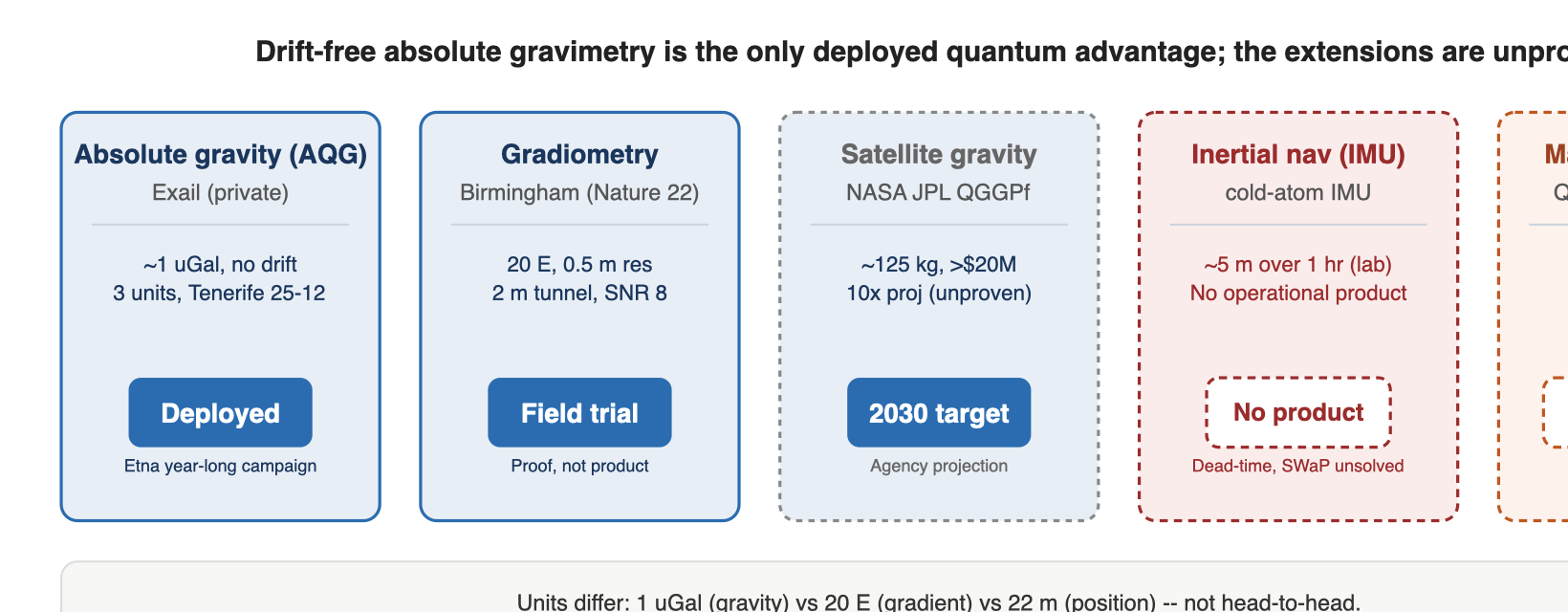
- What. The genuine, deployed quantum advantage of atom interferometry is drift-free ABSOLUTE gravimetry, not raw instantaneous sensitivity. A classical gravimeter (spring or superconducting) is a relative instrument whose baseline drifts over time; a cold-atom absolute quantum gravimeter (AQG) drops free-falling cold Rb atoms as its own test mass and reads the absolute value of g directly — no moving parts, no drift, no recalibration (company statement). Exail (formerly Muquans/iXblue) delivered three AQGs to Tenerife (INVOLCAN) for volcano monitoring (2025-12), after a year-long Mount Etna campaign; the University of Birmingham reported the first outdoor gravity gradiometer in Nature (2022), detecting a ~2 m buried tunnel at SNR 8.
- So what. This is one of the rare “quantum-enabled AND classical-beating” cases the firm’s landscape (Part 0) could actually confirm — but the win is narrow. It holds in a well-defined niche: multi-year, drift-free absolute measurement (volcanology, mass-change surveying), where the classical superconducting gravimeter (SG) drifts. The SG still leads on short-term sensitivity, so AQG and SG are complementary, not a replacement. Reading “AQG beats every gravimeter on sensitivity” is hype.
- Now what. The three extensions of that advantage are all unproven and must not be read as deployed capability. Gradiometry (subsurface mapping) is a field trial and proof-of-principle, not a product (SNR 8, measurement-time and SWaP unsolved). Satellite gravity — NASA JPL’s QGGPf pathfinder with Infleqtion — is development-stage (~125 kg, >$20M, 2030 launch target); its “up to 10x classical” figure is an agency projection, not a result. Inertial navigation has no operational product (dead-time, dynamics and SWaP unsolved). Note a common modality confusion: the frequently cited “quantum navigation advantage” (Q-CTRL, arXiv 2504.08167) is MAGNETIC anomaly navigation (a magnetometer, map-matching), not atom-interferometry inertial navigation — a company claim in preprint form.
The five-minute read
Why the advantage is absoluteness, not sensitivity
The firm’s recurring lens — “the headline is the starting point; the real bottleneck is elsewhere” — applies cleanly to atom interferometry, but with a twist that is easy to miss. The quantum advantage here is not that the instrument sees a smaller signal instant-to-instant. It is absoluteness and long-term stability. Classical gravimeters — mechanical spring instruments and superconducting gravimeters (SG) — measure change against a baseline, so in principle they drift, and multi-year observation requires periodic re-tie to an absolute reference. A cold-atom AQG measures the absolute value of g from free-falling atoms, so it has no moving part, no drift and no recalibration cycle. That is precisely why it wins where it wins: magma migration and other multi-year mass changes appear as µGal-level gravity shifts over months to years, and the decisive requirement there is drift-free continuity rather than instantaneous sensitivity.
The boundary matters as much as the win. The AQG does not beat classical instruments on everything: the SG remains top-class on short-term (seconds-to-hours) sensitivity and low noise. Real observation campaigns often run AQG (absolute, long-term) and SG (relative, short-term) side by side, complementary rather than substitutive. This is the most robust piece of Part 0’s “narrow win” hypothesis — a deployable instrument beating the classical state of the art in the field — but only along the absoluteness axis.
Deployed win vs three unproven extensions
Push the drift-free advantage outward and the “results layer” gap reopens, in three directions of increasing controversy: (1) satellite gravity, (2) gravity gradiometry for subsurface search, and (3) inertial navigation for GPS-denied positioning, navigation and timing (PNT). The table separates what is demonstrated and deployed from what is a field trial, a development target or a company claim. The figures below are within-device values in different physical quantities (gravity, gravity gradient, position error) and are not head-to-head comparisons.
| Application (instrument) | Key figure (source-attributed) | Status |
|---|---|---|
| Ground absolute gravity Exail AQG (ex-Muquans/iXblue, private) |
Rb atom-interferometry absolute gravity, ~1 µGal (=10⁻⁸ m/s²) level sensitivity/stability/repeatability; no moving parts, no drift, no maintenance (company) | Field-deployed — three AQGs to INVOLCAN, Tenerife (2025-12); year-long Etna campaign |
| Gravity gradiometry Birmingham (university, MoD contract) |
Statistical uncertainty 20 E (1 E=10⁻⁹ s⁻²), 0.5 m spatial resolution over an 8.5 m line, ~2 m buried tunnel detected at SNR 8 (Nature 2022) | Field trial / proof — first outdoor gradiometer; not a commercial product |
| Satellite gravity NASA JPL QGGPf (with Infleqtion) |
Rb atom interferometry, ~0.25 m³, ~125 kg; >$20M; “up to 10x classical” sensitivity (agency projection, unproven) | Development — 2030 launch target (pathfinder) |
| Inertial navigation cold-atom IMU (AOSense, Vector Atomic → IonQ, research) |
Cold-atom accelerometers/gyros; ~5 m over 1 hour potential accuracy (review-level, lab potential) | Lab / early field — no operational product |
| Magnetic navigation (reference — NOT inertial) Q-CTRL (private) |
arXiv 2504.08167: 19,000 ft; best 22 m or 0.006% of distance; ≥11x (up to 46x) vs INS airborne; 7x vs INS on the ground | Field trial (preprint) — “quantum-assured” magnetic map-matching (company claim) |
Deep dive
1. Background — the atom-interferometry gravity and inertial axis
This part narrows Part 0’s landscape to the atom-interferometry axis. Part 0 framed the results-layer bottleneck of quantum sensing as a triple gap — “a lab sensitivity record is not a deployable instrument, and a deployable instrument is not classical-beating” — and concluded that the only places that clearly cross all three gaps are timing (optical clocks at the 10⁻¹⁹ level) and drift-free absolute gravity. This part concentrates on the second, and orders the material from where the advantage is confirmed to where it is contested: Exail AQG (ground absolute gravity, deployed) → Birmingham gradiometry (outdoor proof) → NASA JPL QGGPf (satellite, in development) → inertial and magnetic navigation for PNT (field trial and preprint, earliest of all).
2. What this landscape establishes — drift-free absolute gravity as the genuine advantage (and its boundary)
Principle: sensitivity, deployment and error figures are reported as in the source; peer-reviewed (Nature), company (Exail, Q-CTRL), agency-projection (NASA/JPL, MoD) and preprint (arXiv) claims are kept separate; and cross-instrument figures in different physical quantities are not head-to-head.
- Classical gravimeters are relative, so they drift. Spring-type and superconducting gravimeters (SG) measure change against a baseline, which drifts over time; multi-year observation needs periodic re-tie to an absolute reference. The atom-interferometry AQG reads absolute g from free-falling atoms, with no drift, no recalibration and no moving part (Exail: no moving parts, no drift, no maintenance).
- Volcanology and multi-year mass change are the kill-app. Subsurface mass movement such as magma migration appears as µGal-level gravity change over months to years. The decisive requirement is drift-free continuity rather than instantaneous sensitivity — exactly where the AQG beats the classical SG. This is why INVOLCAN adopted three AQGs to monitor the post-2016 unrest at Tenerife’s Teide (Europe’s highest peak at 3,715 m).
- The boundary (no overstatement). The AQG does not beat classical instruments on every axis. The SG remains top-class on short-term (seconds-to-hours) sensitivity and low noise; the AQG’s edge is absoluteness, long-term stability and maintenance-free operation. Campaigns often use both complementarily — AQG (absolute, long-term) plus SG (relative, short-term). Reading “the AQG replaces all gravimeters” is hype.
The firm’s conclusion for this axis: this is the most robust demonstration of Part 0’s “narrow win” hypothesis — in the well-defined niche of drift-free absolute gravity, a deployable instrument beats the classical state of the art (the SG’s drift) in the field. But the win is confined to the absoluteness axis; generalizing it to sensitivity or to all applications is overstatement, and pushing it into the extensions of section 3 and 4 reopens the results-layer gap.
3. Extensions (i) and (ii) — gradiometry and satellite gravity: outdoor proof vs agency projection
Gradiometry — Birmingham 2022 Nature (real outdoor proof, but proof-level). A University of Birmingham-led team (UK National Quantum Technology Hub, MoD contract, UKRI Gravity Pioneer) reported the first gravity gradiometer working outside the lab in Nature (2022): statistical uncertainty 20 E (1 E=10⁻⁹ s⁻²), 0.5 m spatial resolution over an 8.5 m survey line, and detection of a ~2 m buried tunnel at SNR 8. The gradiometer configuration — differencing two atom clouds to cancel common-mode vibration — is the key to outdoor operation. Results-layer caveat: this is a field trial, not a commercial instrument. SNR 8 and 0.5 m resolution are proof-of-principle; measurement time (minutes per point), SWaP and automation remain the commercialization bottleneck. “Quantum sensors map the underground in real time” is a vision, not a deployed capability.
Satellite gravity — NASA JPL QGGPf (development, projection). NASA JPL, with Infleqtion, is developing the first standalone quantum gravity gradiometer pathfinder (QGGPf) for low Earth orbit, using two clouds of cold Rb atoms as test masses (atom interferometry): ~0.25 m³, ~125 kg (smaller and lighter than existing space gravimeters), a contract of >$20M, and a 2030 launch target. The purpose is hardware validation (a pathfinder) for mass-change observation — groundwater, ice melt, crustal movement — as a successor to classical satellite gravity (GRACE / GRACE-FO). Caveat: the “up to 10x classical” sensitivity is an agency projection (unproven), and the launch is a 2030 target. A pathfinder is a technology demonstration, not a science-grade result; “satellite quantum gravity beats classical by 10x” is a claim, not an outcome.
Common results-layer point: the ground absolute-gravity advantage is confirmed, but gradiometry is proof-level and satellite is development-stage. “Quantum gravity now beats classical underground and in space” is not established.
4. Extension (iii) — inertial navigation (GPS-denied PNT): the most contested “quantum advantage” (modality-confusion warning)
Extending the advantage to inertial navigation (GPS/GNSS-denied dead-reckoning) is the most contested step, and where the firm’s lens bites hardest. Two different things must be kept apart.
- Atom-interferometry inertial navigation (cold-atom IMU) — cold-atom accelerometers and gyroscopes for dead-reckoning. A “~5 m over 1 hour” potential accuracy is cited, but that is a lab potential (review-level). The results-layer bottlenecks are (a) dead-time (an inertial information gap between atom preparation, drop and measurement), (b) dynamics (dynamic range, vibration, attitude change — real aircraft/vehicle motion differs from static lab conditions), and (c) SWaP (shrinking cooling, vacuum and lasers into a deployable size). No operational product exists, and “a quantum IMU beats classical strapdown INS” is unproven.
- Magnetic anomaly navigation — map-matching a geomagnetic anomaly map against magnetometer measurements. This is not atom-interferometry inertial navigation; it is a separate, magnetometer-based modality. Q-CTRL’s “quantum-assured navigation” (arXiv 2504.08167, Muradoglu et al., 2025-04) belongs here.
Q-CTRL 2504.08167 — facts and attribution (company claim, preprint). The paper reports tests at 19,000 ft altitude in a fixed-wing drone and a commercial-aircraft avionics bay, a best position error of 22 m or 0.006% of distance travelled, ≥11x (up to 46x) vs INS airborne, and 7x bounded error vs INS on a ground vehicle over a public anomaly map. Three attribution caveats:
- Modality confusion: this is magnetic navigation (magnetometer plus map-matching), not atom-interferometry inertial navigation. Citing it as a “quantum inertial-navigation advantage” is an error.
- Company claim / preprint: it is an arXiv preprint (peer-reviewed journal status unconfirmed), and “quantum advantage / quantum-assured” is a Q-CTRL framing. The tests themselves (altitude, distance, uptime) are impressive, but whether the “advantage” holds against a well-tuned classical baseline (strapdown INS plus velocity-aid plus software denoising/map-matching) is contested — the separation of the software contribution from the sensor contribution must be established by third-party replication.
- Figure mismatch: the company-blog figures cited in Part 0 (6,700+ km, 99.97% uptime, ~0.01% of distance / ~50 m) differ from the arXiv abstract figures (best 22 m, 0.006%, ≥11x vs INS). These read as best-case vs representative, blog vs paper — and neither should be cited as a single confirmed specification.
The firm’s conclusion: the “quantum advantage” of inertial and magnetic navigation is, on this axis, still at the field-trial, preprint and company-claim stage, with operational product, third-party replication and software-vs-sensor attribution unresolved. This is the sensing-side inverse of convergence signal L-005 (dequantization): “quantum-enabled (using a quantum magnetometer or atoms) is not the same as classical-beating (a real edge over well-tuned classical navigation).” It must be kept clearly separate from drift-free absolute gravimetry (section 2, confirmed); blurring the two into “quantum navigation replaces GPS” is hype and defense/PNT-sensitive.
5. Commercialization and competitive context
- Maturity (TRL frame): ground absolute gravimetry is deployed (roughly TRL 8–9 for the AQG in volcanology/survey), while the extensions are earlier — gradiometry a field-trial proof, satellite a pathfinder in development (2030 target), inertial navigation no operational product. The gating layers are SWaP, dynamics and third-party replication, not raw sensitivity.
- Exail (private, ex-Muquans/iXblue): the AQG is the one instrument on this axis with a confirmed results layer (field deployment plus a classical-beating drift-free edge); INVOLCAN Tenerife (three units, 2025-12) and the Mount Etna campaign are the field record.
- NASA JPL / Infleqtion (private): the QGGPf satellite pathfinder (~125 kg, >$20M, 2030 target) is development-stage; its “10x classical” is an agency projection.
- University of Birmingham (MoD / UKRI Gravity Pioneer): the outdoor gradiometer is a peer-reviewed proof, not a commercial instrument.
- Q-CTRL, SandboxAQ (private): the magnetic-navigation results are preprint/company-claim; the demand driver is defense PNT (GPS-denied). AQNav-type programs sit here.
- IonQ (IONQ, listed): acquired Vector Atomic (2025-10), bringing cold-atom inertial/timing capability in-house. Company statements here are neutral, source-attributed description only, and are not buy/sell implications for any security. Deal terms are [unverified] in detail.
6. The skeptic’s bottom line
- Advantage axis: the atom-interferometry advantage is drift-free absoluteness, not sensitivity. Reading it as “beats classical on sensitivity” is an error — the SG still leads short-term (complementary use).
- Proof ≠ product: the Birmingham outdoor gradiometer (2 m tunnel at SNR 8) is a field-trial proof, not a deployed commercial instrument (measurement time, SWaP unsolved).
- Projection ≠ demonstration: NASA QGGPf’s “10x classical” is an agency projection; launch is a 2030 target.
- Modality confusion: Q-CTRL 2504.08167 is magnetic (magnetometer) navigation, not atom-interferometry inertial navigation. It must not be cited as a “quantum inertial-navigation advantage.” An operational inertial-navigation quantum product does not exist (refuted), and “Q-CTRL’s quantum advantage is atom-interferometry inertial” is refuted (it is magnetic anomaly navigation).
- Company claim ≠ classical-beating: Q-CTRL’s “quantum advantage” is a preprint/company claim; the edge over a well-tuned classical baseline (INS + velocity-aid + map-matching software), and the software-vs-sensor split, are unconfirmed pending third-party replication.
- Not head-to-head: 1 µGal (gravity), 20 E (gradient) and 22 m (navigation position) are different physical quantities — no cross-claim.
- Neutral-framing note: to prevent misreading defense/PNT (GPS-denied) demand and listed/private-company (IONQ, Q-CTRL, Infleqtion, Exail) performance claims as security or defense signals.
7. What to watch (falsifiable)
- P1 (absolute-gravity niche win persists): through 2026–2028 the AQG’s drift-free edge stays a confirmed niche (expanding INVOLCAN/Etna-type deployments) but does not fully replace the SG — the two coexist complementarily (AQG absolute/long-term + SG short-term). (Falsified if the AQG replaces the SG on short-term sensitivity too, or conversely if absolute-gravity deployment fails to spread.)
- P2 (inertial operational gap persists): through 2028 no operational cold-atom IMU product appears (dead-time, dynamics, SWaP), and the cited “quantum navigation advantage” stays confined to magnetic navigation (Q-CTRL-type map-matching) — the inertial-vs-magnetic confusion persists. (Falsified if an atom-interferometry IMU demonstrates a third-party-replicated edge over classical strapdown INS in dynamic flight/vehicle deployment.)
- P3 (satellite quantum gravity deferred): NASA JPL QGGPf, a 2030-target pathfinder (technology demonstration), leaves its “10x classical” science-grade edge unconfirmed into the 2030s — GRACE-FO-type classical satellite gravity remains the mass-change workhorse meanwhile. (Falsified if QGGPf demonstrates a quantified in-orbit edge over classical.)
References
- Exail. 2025. “Three Exail Absolute Quantum Gravimeters delivered to Tenerife for advanced volcano monitoring” (INVOLCAN, 2025-12). https://www.exail.com/news/three-exail-absolute-quantum-gravimeters-delivered-to-tenerife-for-advanced-volcano-monitoring
- optics.org. 2016 (news reference 16/12/21). Exail/Muquans absolute quantum gravimeter coverage. https://optics.org/news/16/12/21
- Exail. “A year-long field campaign on Mount Etna to prove the Absolute Quantum Gravimeter value for volcanology” (customer story). https://www.exail.com/resources/customer-stories/a-year-long-field-campaign-on-mount-etna-to-prove-the-absolute-quantum-gravimeter-value-for-volcanology
- Stray, B., et al. 2022. “Quantum sensing for gravity cartography” (first outdoor gravity gradiometer; 20 E, 0.5 m resolution, ~2 m tunnel at SNR 8). Nature. https://www.nature.com/articles/s41586-021-04315-3
- University of Birmingham. 2022. “Sensor breakthrough paves way for groundbreaking map of world under Earth’s surface.” https://www.birmingham.ac.uk/news/2022/sensor-breakthrough-paves-way-for-groundbreaking-map-of-world-under-earth-surface
- NASA JPL. “NASA Aims to Fly First Quantum Sensor for Gravity Measurements” (QGGPf; ~125 kg; 2030 launch target; up to 10x projection). https://www.jpl.nasa.gov/news/nasa-aims-to-fly-first-quantum-sensor-for-gravity-measurements/
- Quantum Computing Report. “Infleqtion and NASA JPL to Launch World’s First Space-Based Quantum Gravity Sensor” (>$20M; Infleqtion collaboration). https://quantumcomputingreport.com/infleqtion-and-nasa-jpl-to-launch-worlds-first-space-based-quantum-gravity-sensor/
- Muradoglu, M., et al. 2025. “Quantum-assured magnetic navigation” (arXiv 2504.08167; 19,000 ft; best 22 m or 0.006%; ≥11x vs INS). Preprint — magnetic anomaly navigation, not atom-interferometry inertial; peer-review status [unverified]. https://arxiv.org/abs/2504.08167
- Bongs, K., et al. 2021. Review of fieldable atom interferometry (cold-atom inertial sensing, review-level potentials). Advances in Physics: X. https://www.tandfonline.com/doi/full/10.1080/23746149.2021.1946426
Disclosure
This post is for information only and is not investment advice.
COI note: this post describes listed (IonQ, IONQ — which acquired Vector Atomic) and private (Exail/Muquans, Infleqtion, Q-CTRL, SandboxAQ, AOSense) organizations in a descriptive, neutral context. Every sensitivity, deployment and error figure is attributed to the reporting instrument, field trial or announcement, and peer-reviewed data (Nature), company statements (Exail, Q-CTRL), agency projections (NASA/JPL, MoD) and preprints (arXiv) are labeled separately. Defense/PNT (GPS-denied) demand is described factually and neutrally. The genuine deployed quantum advantage — drift-free absolute gravimetry (Exail AQG at INVOLCAN Tenerife / Mount Etna) — is kept distinct from the unproven extensions (gradiometry field trial, the QGGPf development-stage satellite pathfinder, and inertial navigation with no operational product) and from Q-CTRL’s magnetic-navigation “quantum advantage,” which is a preprint/company claim. Quantitative claims are attributed to the vendor, agency or preprint. These are factual, neutral descriptions and are not buy/sell implications for any security.


Leave a Reply