Evidence-first notes on bioscience and deep tech, at the edge of the lab and the market. Information only — not investment advice. All funding, contract and valuation figures are attributed to each company’s press release, SEC filing (8-K / Form 425) or the trade press; company performance and “advantage” claims are kept separate from peer-reviewed results and agency projections. Market-size estimates are second-hand market-research numbers and are flagged as unverified where they diverge or fail internal arithmetic.
The 30-second version
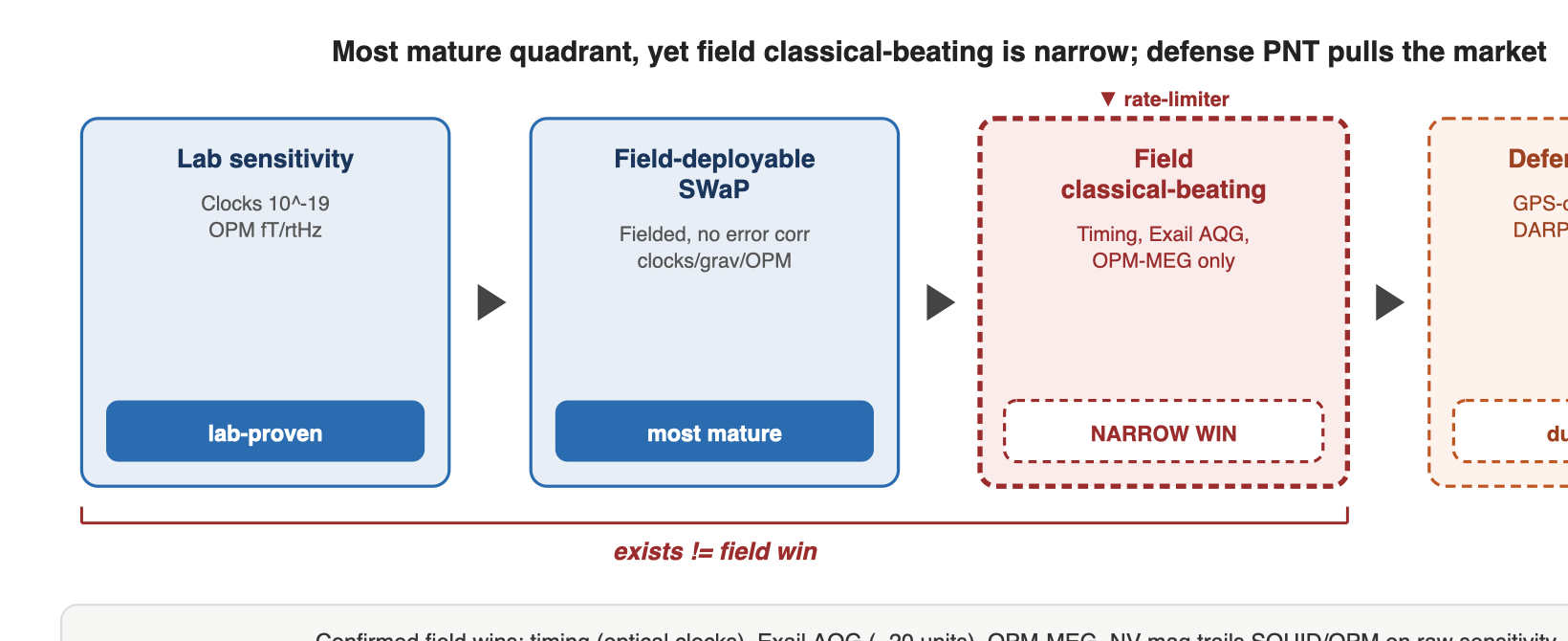
- What. Among the four quadrants of quantum technology, sensing is the most mature: unlike quantum computing it already fields working instruments without error correction (atomic clocks, cold-atom gravimeters, optically-pumped magnetometers). But the commercial reality splits into two layers — a “most mature quadrant” narrative, and an outcome layer where genuinely beating the best classical sensor in the field is narrow: it is confirmed only for timing (optical clocks), drift-free absolute gravimetry (Exail AQG) and OPM-MEG spatial resolution. Much of the marketed “quantum sensing advantage” is quantum-enabled but not yet a field win over classical.
- So what. What actually pulls capital and contracts is not consumer-grade sensitivity but defense position-navigation-timing (PNT) demand in GPS-denied environments, a dual-use pull. On the funding/contract layer: Q-CTRL reports 2025 revenue/contracts of $50M+ and a DARPA RoQS award of A$38M (US$24.4M) (company); SandboxAQ reports ~$950M raised and AQNav flight testing (450+ flight hours, 4 aircraft) (company); Vector Atomic — holder of $200M+ in US government contracts — was acquired by IonQ on 2025-10-07 in an all-stock deal whose price was not disclosed; Infleqtion went public via SPAC on NYSE (INFQ) at a $1.8B valuation.
- Now what. Two skeptic catches must travel with the story. (a) Quantum-sensing “market size” estimates diverge roughly 2x across research firms and some are arithmetically inconsistent — flag them, do not adopt a single number. (b) The earlier “IonQ–Vector Atomic $200M+” figure is Vector Atomic’s held government contracts, not the acquisition price (which is undisclosed). Resolving the series’ central question: the data favor a narrow win plus dual-use pull — quantum sensing is a near-term quantum win, but narrower than marketed. Verdict: proceed-with-caveats.
The five-minute read
Two layers — a “most mature quadrant” narrative and a narrow outcome layer
The paradox of quantum sensing’s commercial landscape is that two claims are both true and easily conflated. First, sensing is the most mature quantum quadrant: unlike quantum computing, which is three-to-four orders of magnitude away from useful computation even after crossing below-threshold error correction, sensing already has fielded instruments — optical-lattice clocks, cold-atom absolute gravimeters, optically-pumped magnetometers — that need no error correction. Second, on the outcome layer, genuinely beating the best classical sensor in the field is confined to a few niches: timing (optical-clock uncertainty at the 10⁻¹⁹ level), drift-free absolute gravimetry (Exail’s AQG), and the spatial resolution of OPM-MEG. Outside those niches much of the “quantum sensing advantage” is quantum-enabled — it uses quantum principles — but is not yet a demonstrated field win over the best classical instrument. NV-center magnetometers, for instance, trail SQUID/OPM on raw sensitivity (their edge is nanoscale spatial resolution), and field classical-beating for quantum imaging/RF is largely unproven.
The firm’s recurring lens — “the headline is the starting point; the real bottleneck is the outcome layer” — applies here as it did to GLP-1 (mechanism headline vs hard outcome) and energy storage (lab Wh/L vs grid $/kWh). In sensing the three-fold gap is lab sensitivity (10⁻¹⁹, fT/√Hz) → field-deployable SWaP → genuine classical-beating. The last step is where the marketing and the evidence part company.
What actually pulls the market is defense PNT, not consumer sensitivity
The commercial moat is not consumer-grade sensitivity; it is national-security PNT — precise timing and navigation in GPS-denied environments (submarines, polar regions, electronic warfare, jamming and spoofing). Real contracts and programs demonstrate this demand: DARPA RoQS (Q-CTRL, A$38M) and ACES (next-generation chip-scale atomic clocks); the Defense Innovation Unit’s Transition of Quantum Sensing (SandboxAQ, 2025-11); Vector Atomic’s $200M+ government contracts (now inside IonQ); and NASA’s QGGPf gravimeter work (AOSense, Infleqtion, Vector Atomic). Defense primes such as Lockheed Martin enter as subcontractors and integrators. The same magnetometer and clock modalities extend into biomedicine — OPM-MEG (QuSpin/Cerca) and magnetocardiography (SandboxAQ CardiAQ) — a dual-use structure in which defense and bio share the same quantum hardware, and that shared demand is what matures the modality.
| Layer | Status (2026-07, attributed) | Verdict |
|---|---|---|
| Timing — field classical-beating | JILA ⁸⁷Sr optical clock 8.1×10⁻¹⁹; NIST ²⁷Al⁺ 5.5×10⁻¹⁹ (PRL/NIST) — beats Cs primary standards | Peer-reviewed win |
| Drift-free absolute gravimetry | Exail AQG (Rb atom interferometry, ~10⁻⁸ m/s²), ~20 units deployed worldwide (volcanology, geodesy, hydrology) | Deployed win (niche) |
| OPM-MEG spatial resolution | QuSpin + Cerca whole-head systems (clinical) | Peer-reviewed win (niche) |
| NV magnetometer raw sensitivity | Trails SQUID/OPM on raw sensitivity (edge is nanoscale spatial resolution) | Not a raw-sensitivity win |
| Q-CTRL “111× vs INS” / “quantum advantage” | Company claim (preprint-based); third-party same-protocol replication not established | Company claim (unreplicated) |
| Defense PNT demand (dual-use pull) | DARPA RoQS/ACES, DIU, Vector Atomic $200M+ contracts, NASA QGGPf — contracts and programs | Demonstrated |
| Market size | 2024–25 base $401.8M–$839M; 2030 target $726.7M–$1,422M (~2x spread); some CAGR-vs-absolute figures inconsistent | Flag (do not adopt) |
Deep dive
1. Background — the “most mature quadrant” narrative and where it splits
Quantum sensing is routinely called the most mature quadrant of quantum technology, and on the instrument-existence test that is fair: optical-lattice clocks, cold-atom gravimeters and optically-pumped magnetometers are fielded today without any quantum error correction, whereas quantum computing remains three-to-four orders of magnitude from useful computation even after crossing below-threshold error correction (this series’ computing-power Part 4). But maturity at the instrument layer does not settle the outcome layer. The relevant question is not “does a quantum sensor exist?” but “does it beat the best classical sensor in the field, in the same measurement, under the same protocol?” On that test the confirmed wins are narrow — timing, drift-free absolute gravimetry and OPM spatial resolution — and the rest is quantum-enabled but not yet field-proven against classical. Separating quantum-enabled from classical-beating is the skeptic axis of the whole series.
2. What this landscape establishes — company positions (all PR/SEC/trade-press attributed)
Principle: funding, contract and valuation figures are reported as in the source; company performance/”advantage” claims are separated from peer review and from agency projections; and cross-company comparisons are not head-to-head.
| Modality / role | Company (listed/private) | 2025–26 commercial position (attributed) | Status |
|---|---|---|---|
| Magnetic navigation (GPS-denied) | Q-CTRL (private) | Ironstone Opal: up to 111× position accuracy vs advanced INS in GPS-denial (company claim); 2025 revenue/contracts $50M+; DARPA RoQS A$38M (US$24.4M), Lockheed Martin subcontractor; “first commercial quantum advantage” claim (preprint-based) | Field trials / contracts |
| Magnetic-anomaly nav / cardiac | SandboxAQ (private) | AQNav: 450+ flight hours across 4 aircraft (USAF, Airbus Acubed, Boeing); ~$950M raised cumulatively (Series E $450M+), valuation ~$5.6–5.75B (company); DIU Transition of Quantum Sensing (2025-11), NATO DIANA 2025; CardiAQ (magnetocardiography) | Field trials / programs |
| Neutral-atom computing + sensing | Infleqtion (INFQ, listed) | SPAC merger with Churchill Capital Corp X, $1.8B valuation, ~$550M raised ($125M PIPE); NYSE listing 2026-02-17 (ticker INFQ, debut $14.25); optical clocks, RF receivers, inertial sensors; defense/aerospace target | Listed (2026-02), pre-scale |
| Atomic clocks / inertial (precise timing) | Vector Atomic → IonQ (IONQ, listed) | IonQ completed an all-stock acquisition on 2025-10-07, deal price undisclosed; Vector Atomic holds $200M+ US government contracts, 29 patents, 75+ staff; picosecond timing “up to 1,000× more precise than GPS” (company claim) | Acquisition complete (into listed co.) |
| Atom-interferometry absolute gravimeter | Exail (formerly iXblue, private) | Acquired Muquans (2021) for cold-atom sensor integration; AQG (Rb atom-interferometry absolute gravity, drift-free, ~10⁻⁸ m/s²); ~20 units deployed worldwide (volcanology, geodesy, hydrology) | Field-deployed (commercial) |
| Atom-interferometry gravimeter (US) | AOSense (private) | Portable quantum gravimeters, a US cold-atom interferometry leader (founded 2004); NASA QGGPf collaboration | Commercial / development |
Deal-price correction (skeptic catch). The IonQ–Vector Atomic acquisition is all-stock with an undisclosed price (BusinessWire / IonQ PR / SEC 8-K). The “$200M+” figure that an earlier landscape (Part 0) placed next to this deal is Vector Atomic’s cumulative held US government contracts, not the acquisition consideration. Conflating the two is misleading; the acquisition price is treated as undisclosed/unverified.
3. Primary market = defense PNT, plus the market-size divergence (skeptic catch), and the resolution of the central question
The commercial logic is driven by defense/national-security PNT (GPS-denied timing and navigation), not consumer sensitivity. GPS is vulnerable to jamming and spoofing; in GPS-denied settings, magnetic-anomaly navigation, atom-interferometry inertial sensing and precise timing are the alternatives, and real contracts prove the demand (DARPA RoQS/ACES, DIU Transition of Quantum Sensing, Vector Atomic’s $200M+ contracts, NASA QGGPf). Defense demand — not chemistry or consumer markets — is what matures the modality.
Market size cannot be reduced to a single number (skeptic catch, flag). Second-hand market-research estimates diverge sharply:
- $401.8M (2025) → $726.7M (2030) at CAGR 12.6% (BCC via GlobeNewswire, 2026-07-14)
- $839.0M (2023) → $1,422.2M (2030) at CAGR 7.8% (Grand View lineage)
- $0.52B (2024) → $1.25B (2030) at CAGR 16.7% (separate estimate)
- $0.7B–1.0B (2030) at 10–15% (McKinsey)
The 2024–25 base spans $401.8M–$839M (~2x) and the 2030 target spans $726.7M–$1,422M (~2x). Some estimates are arithmetically inconsistent: compounding $0.52B at 16.7% over six years gives ~$1.35B, not the stated ~$1.25B. Scope definitions (sensors only vs systems and services) and methods differ, so no single market size can be treated as established — flag as unverified. The divergence itself is evidence that this domain is still early and its definitions unstable; the moat is not “the largest TAM estimate” but “which validated primary demand (defense PNT) absorbs which instrument into actual deployment.”
Resolving Part 0’s three hypotheses. Part 0 posed a falsifiable trichotomy: (a) narrow win — only specific modalities beat classical in the field; (b) broad win — quantum sensing soon replaces classical across many applications; (c) dual-use pull — defense PNT and bio each drive deployment. The commercial and deployment evidence puts the center of gravity on (a) narrow win + (c) dual-use pull. Confirmed field classical-beating is limited to timing (optical clocks), drift-free absolute gravimetry (Exail AQG, ~20 units deployed) and OPM-MEG spatial resolution; NV magnetometers trail on raw sensitivity and quantum imaging/RF is largely unproven; Q-CTRL’s “111×”/”quantum advantage” is a company claim awaiting third-party replication. Hypothesis (b) is true at the “mature quadrant” level but overstated as “broad field classical-beating.” The one-line synthesis: quantum sensing is the near-term quantum win — true, but narrower than marketed.
4. Neighbouring domains — computing contrast, the dequantization mirror, and dual-use to bio
- Contrast with quantum computing (Part 4): quantum computing is the immature quadrant — three-to-four orders of magnitude from useful computation even past below-threshold error correction — whereas sensing is the most mature quadrant, with fielded instruments and no error-correction requirement. Yet even the mature quadrant splits at the outcome layer: computing’s bottleneck is the resource gap (qubits, noise); sensing’s bottleneck is the narrow boundary of genuine classical-beating. Same firm lens (headline ≠ outcome layer), different position.
- The dequantization mirror (convergence L-005, reverse-symmetry): L-005 warns that in quantum chemistry a “first quantum-computer calculation” is not a quantum advantage if a classical method can dequantize it. Sensing’s isomorphic risk is the opposite symmetry — classical sensors often still win in the field: NV magnetometers vs SQUID/OPM on raw sensitivity, or Q-CTRL’s “111×” against an optimal classical navigation stack. A quantum label is not, by itself, a field win over classical.
- Dual-use to bio: the same magnetometer and clock modalities extend to OPM-MEG (QuSpin/Cerca, clinical) and magnetocardiography (SandboxAQ CardiAQ). Defense (DARPA, DIU, Lockheed) and biomedicine share the same quantum hardware — the structure that drives modality maturity.
5. Commercialization and competitive context
- Maturity (TRL frame): instrument existence is high (fielded clocks, gravimeters, magnetometers), but “genuine field classical-beating at scale” is early and narrow; the gating layer is the outcome boundary, not the physics.
- Q-CTRL (private): the narrative frontrunner in magnetic navigation; Ironstone Opal, DARPA RoQS, Lockheed subcontracting. The “111×”/”first commercial quantum advantage” is a company claim (preprint-based), contested pending third-party replication.
- SandboxAQ (private): AQNav 450+ flight hours across 4 aircraft is a fact about test scale; the ~$950M raised and ~$5.6–5.75B valuation are round-announcement figures, not audited enterprise value; CardiAQ’s clinical validation status is unconfirmed.
- Infleqtion (INFQ, listed): the $1.8B SPAC figure is a valuation, not revenue or profit; a hybrid computing-plus-sensing play whose sensing revenue mix is a company claim (post-listing segment results awaited). Post-listing share price is not described.
- Vector Atomic → IonQ (IONQ, listed): acquisition complete 2025-10-07, all-stock, deal price undisclosed; the $200M+ figure is held government contracts, not the price. A computing-listed company extending into sensing (dual-use).
- Exail / Muquans (private): one of the few camps with confirmed classical-beating in commercial deployment — the AQG’s drift-free absolute measurement, ~20 units worldwide.
- AOSense (private): a long-standing US cold-atom gravimeter vendor (founded 2004), NASA QGGPf — atom-interferometry gravity commercialized narrowly for research infrastructure and defense.
- Company statements here are limited to neutral, source-attributed description; competitive or success/failure statements are not buy/sell signals. Valuations and the IonQ–Vector Atomic deal price are unverified where marked.
6. The skeptic’s bottom line
- Quantum-enabled ≠ classical-beating: Q-CTRL’s “111×”/”commercial quantum advantage” and NASA’s “10×” are company/agency claims; confirmed field classical-beating is confined to timing, absolute gravimetry and OPM spatial resolution.
- Valuation ≠ revenue or profit: Infleqtion’s $1.8B and SandboxAQ’s ~$5.6–5.75B are round/SPAC valuations, not results.
- Deal price undisclosed: the IonQ–Vector Atomic consideration is not public; the $200M+ figure is held government contracts (do not conflate).
- Market size diverges and fails arithmetic: base and target each span ~2x and some CAGR-vs-absolute figures are internally inconsistent — no single number can be adopted (flag).
- Company claim ≠ peer review ≠ agency projection: lumping Q-CTRL (preprint), NASA (projection) and Infleqtion (claim) together produces hype; and clocks, magnetic sensitivity and absolute gravity are different quantities in different units — not head-to-head.
- Neutral-framing note: to prevent misreading listed (IONQ, INFQ) and private (Q-CTRL, SandboxAQ, Exail, AOSense) success/failure or defense-PNT demand as security or sector signals.
7. What to watch (falsifiable) and the series retrospective
- P1 — third-party replication (decides (a) vs (b)): if Ironstone Opal’s “111× vs INS” and AQNav are independently replicated as a real advantage over an optimal classical stack (inertial + map-matching + software) under the same protocol, and DARPA RoQS/DIU programs convert to actual deployment, (b) broad win and (c) dual-use strengthen. If the “advantage” turns out to be software/classical-sensor contribution, or programs stall at trials, (a) narrow win strengthens (the sensing analogue of dequantization).
- P2 — bio dual-use (decides (c)): if OPM-MEG (QuSpin/Cerca) actually replaces SQUID-MEG clinically and CardiAQ achieves clinical validity, (c) is confirmed on the bio side. Failure to replace weakens (c).
- P3 — market-size and segment results (hype test): if TAM estimates converge (definitions/methods align, base/target spread narrows) around 2027–28 and INFQ/IONQ sensing-segment revenue supports the valuations, the picture moves toward (b); if the spread persists and results lag valuation, current valuations look like a premium leaning on the “mature quadrant” narrative.
- Series retrospective (Part 0–5): the through-line is “the real bottleneck is the outcome layer” — lab sensitivity (10⁻¹⁹, fT/√Hz) → field-deployable SWaP → genuine classical-beating. Confirmed field classical-beating is limited to timing, drift-free absolute gravimetry (Exail AQG, ~20 units) and OPM spatial resolution; defense PNT dual-use demand is confirmed by contracts and programs. Against computing-power Part 4 (quantum computing far from useful), sensing is the most mature quantum quadrant — yet even the mature quadrant splits again at the outcome layer. The L-005 reverse-symmetry (classical sensors often still win in the field) is confirmed in the sensing register. Overall verdict: proceed-with-caveats; the center of gravity is (a) narrow win + (c) dual-use pull, and “quantum sensing = near-term quantum win” is true but narrower than marketed.
References
- Q-CTRL. “Q-CTRL Overcomes GPS Denial with Quantum Sensing, Achieves Quantum Advantage” (Ironstone Opal; 111× vs INS; “first commercial quantum advantage” — company claim). q-ctrl.com/blog/q-ctrl-overcomes-gps-denial-with-quantum-sensing-achieves-quantum-advantage
- The Quantum Insider. 2025. “DARPA Selects Q-CTRL to Develop Next-Generation Quantum Sensors for Navigation on Advanced Defense Platforms” (RoQS award). thequantuminsider.com/2025/08/27/darpa-selects-q-ctrl…
- Infleqtion. “Infleqtion to Go Public in SPAC Deal Valuing Quantum Firm at $1.8 Billion.” infleqtion.com/news/infleqtion-to-go-public-in-spac-deal…
- Quantum Computing Report. “Infleqtion Goes Public on NYSE via SPAC Merger, Raising $550 Million” (ticker INFQ). quantumcomputingreport.com/infleqtion-goes-public-on-nyse…
- SandboxAQ. “SandboxAQ Closes $450M Series E Round with Expanded Investor Base.” sandboxaq.com/press/sandboxaq-closes-450m-series-e-round…
- IonQ. “IonQ Completes Acquisition of Vector Atomic, the Global Leader in Advanced Quantum Sensing” (all-stock, price undisclosed). ionq.com/news/ionq-completes-acquisition-of-vector-atomic…
- BusinessWire. 2025. “IonQ Completes Acquisition of Vector Atomic, the Global Leader in Advanced Quantum Sensing” (2025-10-07). businesswire.com/…/IonQ-Completes-Acquisition-of-Vector-Atomic
- Exail. “Muquans, now part of Exail” (AQG absolute gravimeter; Muquans 2021 acquisition). exail.com/muquans-now-part-of-exail
- GlobeNewswire. 2026. “Global Quantum Sensor Market to Reach $726.7 Million by 2030…” (BCC estimate; second-hand market research, flagged). globenewswire.com/…/global-quantum-sensor-market-to-reach-726-7-million-by-2030
- McKinsey. “Quantum Sensing Poised to Realize Immense Potential in Many Sectors” (agency-style projection; $0.7B–1.0B by 2030 range). mckinsey.com/…/quantum-sensing-poised-to-realize-immense-potential
Disclosure
This post is for information only and is not investment advice.
COI note: this post describes listed companies (IonQ IONQ — which acquired Vector Atomic; Infleqtion INFQ — listed via SPAC) and private companies (Q-CTRL, SandboxAQ, Vector Atomic prior to acquisition, Exail/Muquans, AOSense, and their programs) in a descriptive, neutral context. Every funding, contract and valuation figure is attributed to the company’s PR, SEC filing (8-K / Form 425) or the trade press; company performance and “quantum advantage” claims are separated from peer-reviewed results and from agency projections. Defense/PNT (GPS-denied) demand is described factually and neutrally. Market-size estimates are second-hand market-research numbers that diverge ~2x and, in places, fail internal arithmetic; they are flagged as unverified and no single figure is adopted. The IonQ–Vector Atomic acquisition price is undisclosed (unverified); the “$200M+” figure is Vector Atomic’s held government contracts, not the acquisition price. Competitive and success/failure statements are factual, neutral descriptions and are not buy/sell implications for any security. The author holds no position in, and has no financial interest in, the companies named.
 Uthando Nethemba
Leave a comment