Evidence-first notes on bioscience and deep tech, at the edge of the lab and the market. Information only — not investment advice. All titer, yield and cost figures are attributed to the strain, condition or announcement they come from, and peer-reviewed results are kept separate from company claims and trade-press reporting (noted inline). Company outcomes for listed and failed firms are stated as neutral facts, attributed to the primary source.
The 30-second version
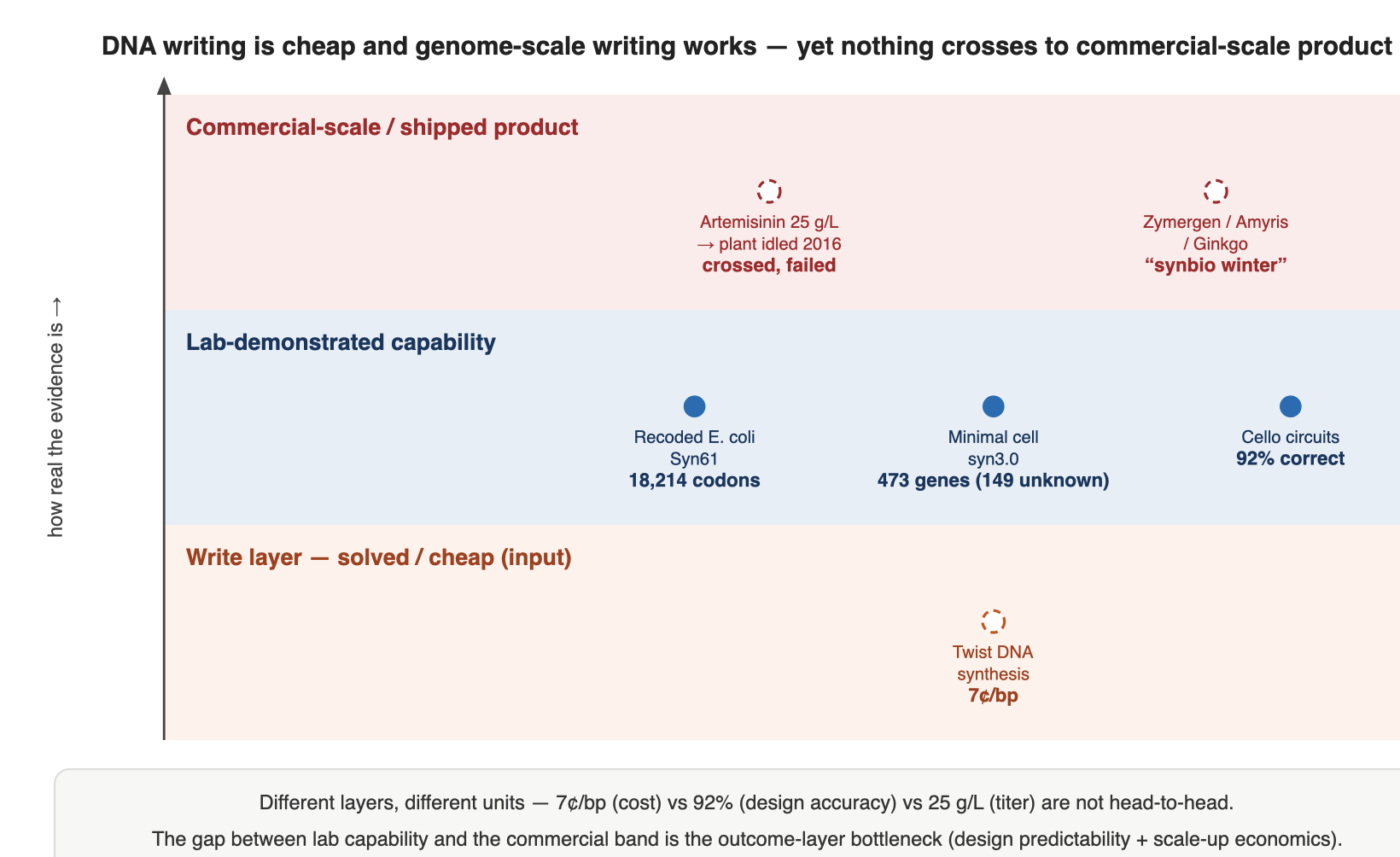
- What. Synthetic biology (engineering biology) is the build/write layer of the design-build-test-learn (DBTL) cycle: where AI protein design specifies a part, synbio writes it into DNA, assembles it into circuits, and tests it in a cellular or cell-free chassis. On the headline metrics it has delivered — DNA synthesis has fallen to ~7¢/base for gene fragments (Twist Bioscience, company), genome-scale writing works (the recoded E. coli Syn61 4-Mb genome, Nature 2019; the yeast Sc2.0 project has synthesized all 16 chromosomes; JCVI-syn3.0 is a 473-gene minimal cell, Science 2016), and circuit design has been automated (Cello compiles Verilog to DNA, Science 2016).
- So what. The headline (writing DNA cheaply) is largely solved; the real bottleneck is elsewhere — design predictability (context-dependence, metabolic burden, evolutionary instability) and scale-up economics/reproducibility. The fact that synthesis is already ~7¢/bp and yet commercial synbio products have not exploded suggests cost was never the rate-limiting step. Note the ceiling on understanding: JCVI-syn3.0’s 473-gene minimal cell still contains 149 genes of unknown function — genome writing is a capability, not a product and not full understanding.
- Now what. That gap surfaced commercially in the 2023–24 “synbio winter”: Zymergen collapsed after its 2021 IPO and was acquired by Ginkgo (2022), Amyris filed Chapter 11 (August 2023), and Ginkgo cut 40%+ of staff and did a 1-for-40 reverse stock split (2024). The central, still-open question is whether this was a scientific failure, a business-model failure, or both. On current data the “both” reading fits best — writing and automation genuinely advanced, but a real design-predictability and scale-up gap sits underneath the SPAC-era overreach.
The five-minute read
The DBTL cycle — and where this series sits
Synthetic biology’s methodological core is the design-build-test-learn (DBTL) cycle. The firm’s completed sister series each covered a different layer of that loop: ai-protein-design is the “D” (designing the part), in-vivo-gene-editing is write-in-place (locally rewriting an existing genome), and bio-foundation-models is the “L” (learning from data to predict the next design). Synbio owns the build/write layer plus cycle integration — where AI protein design specifies a sequence (for example an RFdiffusion binder with a ProteinMPNN sequence), synbio writes it into DNA, expresses it, assembles it into a circuit, and tests it in a chassis.
Two poles of “writing DNA” bracket the field. In-vivo gene editing rewrites an existing genome locally (edit); synbio writes genomes at scale de novo — Syn61 recoded 18,214 codons across the 4-Mb E. coli genome, and Sc2.0 redesigned all 16 yeast chromosomes. The sister-series discipline carries straight over: in-silico ≠ wet-lab, benchmark ≠ real-world, announced ≠ shipped, lab strain ≠ commercial-scale manufacturable.
The headline is nearly solved; the bottleneck is design predictability and scale-up economics
The firm’s recurring lens — “the headline is the starting point; the real bottleneck is elsewhere” — applies cleanly here. DNA reading (sequencing) is effectively solved, and DNA writing (synthesis) has traced its own cost curve down to ~7¢/bp. What is not solved is whether engineering biology has actually become predictable, modular and scalable engineering — because biology routinely violates the engineering premise that “assembling parts yields the designed system.” Context-dependence, metabolic burden, evolutionary instability and emergent interactions all break that premise. Circuit automation offers the strongest positive evidence: Cello achieved 92% agreement between predicted and observed output states — but for a specific E. coli chassis and part library, and whether that transfers to another chassis or scale is unverified.
The commercial expression of the gap is the 2023–24 synbio winter. After the 2021 SPAC-era peak (Ginkgo’s listing, Zymergen’s IPO), Zymergen collapsed and was acquired by Ginkgo (2022), Amyris filed Chapter 11 (August 2023), and Ginkgo cut 40%+ of staff and executed a 1-for-40 reverse split (2024). The archetype of the underlying science-versus-market gap is semi-synthetic artemisinin: the yeast pathway was engineered to a 25 g/L titer (a genuine scientific success), but it did not win commercially — at scale it failed to beat plant extraction on cost, and Sanofi’s semi-synthetic plant was idled (2016, trade-press). Pathway engineering succeeded; the market did not follow. That is the shape of the bottleneck.
| Item | Status (2026-07) | Verdict |
|---|---|---|
| DNA synthesis cost (column) | Twist: gene fragment 7¢/bp, clonal gene 9¢/bp, 9,600 genes per silicon chip (company) | Demonstrated |
| Enzymatic DNA synthesis (benchtop) | DNA Script Syntax-100, TdT chemistry, 96×60-mer/13h, aqueous, GFP assembly verified (Sci Adv 2023) | Early commercial |
| Genome-scale writing (recoded E. coli) | Syn61: 4-Mb synthetic genome, 18,214 codons recoded to 61-codon set, one tRNA deleted (Nature 2019) | Lab-demonstrated |
| Synthetic yeast genome (Sc2.0) | All 16 nuclear chromosomes + tRNA neochromosome synthesized; single-cell integration ongoing | Capability, not product |
| Minimal genome | JCVI-syn3.0: 531,560 bp, 473 genes — of which 149 unknown function (Science 2016) | Capability ≠ understanding |
| Circuit design automation | Cello: 60 circuits/880 kbp, 45 fully correct, 92% output-state agreement (Science 2016) — one chassis/condition | Strongest positive; transfer unproven |
| Metabolic pathway (titer) | Artemisinic acid 25 g/L (engineered yeast) — but semi-synthetic artemisinin was cost-uncompetitive at scale; Sanofi plant idled (2016) | Pathway win ≠ market win |
| Synbio winter (company outcomes) | Zymergen collapse / Ginkgo acquisition (2022); Amyris Chapter 11 (2023-08); Ginkgo 40%+ layoffs, 1:40 reverse split (2024) | Fact (business + science gap) |
Deep dive
1. Background — the write/assemble/test layers and where the sister series meet
The field spans an input layer, a core, and an outcome layer, all sharing one bottleneck: “part/pathway-design headline vs commercial-scale reproducibility and cost.”
- DNA writing — column synthesis (the input layer): Twist Bioscience’s silicon-chip gene synthesis is the standard — gene fragments at 7¢/bp, clonal genes at 9¢/bp, 9,600 genes per chip across 1.3M nano-wells (company). The cost curve is real, but this is an input, not the rate-limiting step.
- DNA writing — enzymatic synthesis: DNA Script’s Syntax-100 uses terminal deoxynucleotidyl transferase (TdT) reversible-termination chemistry to write 96×60-mer oligos in 13 hours under aqueous conditions, with GFP-gene assembly verified (Science Advances 2023). This is benchtop, on-demand, early-commercial.
- Genome-scale writing — recoding: Syn61 (Jason Chin, MRC LMB) is a 4-Mb synthetic E. coli genome in which 18,214 instances of three codons were synonymously recoded to a 61-codon set with one tRNA deleted, growing ~1.6× slower than MDS42 (Nature 2019). A later extension, Syn57 (57-codon code, >100,000 substitutions, Constructive Bio 2025), pushes this further (added by Part 1).
- Genome-scale writing — yeast: Sc2.0 (an international consortium, launched 2006) has synthesized all 16 nuclear chromosomes plus a tRNA neochromosome, using LoxPSym, PCRTags and recoding (Cell Press / Science). Critically, the 16 chromosomes are complete individually; full single-cell integration and debugging are still ongoing — a capability demonstration, not a product.
- Minimal cell: JCVI-syn3.0 (Venter/Hutchison) is a 531,560-bp, 473-gene self-replicating minimal cell — and 149 of those genes are of unknown function (Science 2016). That we cannot fully account for even a minimal genome is direct evidence of the design-predictability ceiling.
- Circuit design automation: Cello (Nielsen/Voigt, MIT) compiles Verilog to DNA; across 60 E. coli circuits (880 kbp), 45 were fully correct and prediction matched observation in 92% of output states (Science 2016; Cello 2.0, Nat Protocols 2021). This is the strongest positive evidence for “designable biology” — but for one chassis and library.
- Cell-free systems: freeze-dried, cell-free (“just add water”) transcription/translation machinery enables on-demand vaccines and biosensors and a distributed-manufacturing biosecurity angle (Jewett and others) — an alternative chassis that sidesteps cellular burden, at the lab-to-early-application stage.
2. What this landscape establishes — layers, results and status (attributed)
Principle: titers, yields, costs and accuracies are reported as in the source and attributed to the specific strain/condition; peer-reviewed lab results are separated from company claims and trade-press; lab demonstrations are never equated with commercial scale.
- DNA writing (input layer): the cost curve is demonstrated. Column synthesis (Twist, 7¢/bp) is the standard; enzymatic synthesis (DNA Script) is entering as benchtop on-demand. But this is the input layer, not the rate limiter — the core argument of section 3.
- Genome-scale writing (core): the peer-reviewed demonstrations are strong (Syn61 in Nature, Sc2.0 in Cell/Science, JCVI-syn3.0 in Science). Yet these demonstrate “we can write,” not “there is a product.” JCVI-syn3.0’s 149 unknown-function genes make the point directly: we do not fully understand even a minimal genome.
- Circuit automation (core): Cello’s 92% output-state agreement is the strongest positive evidence for designability — but it is bounded to a specific E. coli chassis, condition and library, and transfer to another chassis or to scale is untested (Part 2).
- Metabolic engineering (core-to-outcome): semi-synthetic artemisinin is the archetypal precedent — and it cuts both ways. Pathway engineering (25 g/L titer) succeeded scientifically, but the product failed on commercial-scale cost competitiveness (section 3, refuted) — the prototype of “pathway success ≠ market win.”
- Cell-free (alternative chassis): an alternative that sidesteps cellular burden and regulation, with an on-demand-manufacturing and biosecurity (dual-use of distributed synthesis) angle. Early application stage (Part 5).
Attribution caution: the figures above are within-study values. Twist 7¢/bp (cost), Cello 92% (design accuracy) and artemisinin 25 g/L (titer) belong to different layers and units and are not head-to-head. Sc2.0’s “16 chromosomes complete” means complete individually; full single-cell integration and debugging are ongoing.
3. The central science-and-commerce question — is designable biology arriving, and was the winter science or business? (falsifiable)
DNA reading is solved and writing cost has fallen, yet the synbio winter arrived. The collapse can be narrowed to three hypotheses, each with an explicit falsification condition.
- (a) Business-model failure. The science advanced; the collapse was SPAC-era overvaluation and premature scale-up economics. Writing cost (7¢/bp), circuit automation (Cello 92%) and genome-scale writing all progressed through the winter; Zymergen, Amyris and Ginkgo foundered on platform/SPAC valuation, absent revenue models and fermentation scale-up cash burn — not because “engineering biology does not work.” Falsified if cost and automation keep advancing while designed systems keep missing predictions in the cellular context or commercial titers fail to materialize (→ b/c). Tested in Parts 3 and 5 via financials and titers.
- (b) Scientific failure / artisanal ceiling. Biological complexity and context-dependence beat predictable, modular design. JCVI-syn3.0’s 149 unknown-function genes, Cello’s 92% being chassis/condition-bound, and pathways collapsing at scale from burden and evolutionary instability all say engineering biology is still dozens of artisanal DBTL loops, short of engineering-grade predictability. Falsified if AI-guided design plus biofoundry automation (Part 4) hits commercial titers first-pass (iterations collapse). Tested in Parts 2 and 4 via design predictability.
- (c) Both — writing and automation are a real curve, but the bottleneck is the outcome layer (design predictability + scale-up economics), and the winter is SPAC overreach layered on top. Writing and circuit automation are demonstrated (a’s evidence), but the design-to-commercial-scale gap (fermentation economics vs petrochemicals, strain stability, reproducibility) remains an outcome-layer bottleneck (b’s evidence). Falsified at the margins: if writing cost falls further and shipped/profitable products rise proportionally, cost was the bottleneck and (c)’s “outcome-layer” claim weakens; if cost falls and products do not, (c) strengthens. Tested in Parts 1, 3 and 5 via the cost-to-product correlation.
Current provisional position: none can be excluded, and (c) fits the current data best — the advance in writing cost and circuit automation (a) is real, but JCVI-syn3.0’s 149 unknown-function genes, artemisinin’s commercial failure (refuted), and the scale of the winter jointly support a real outcome-layer bottleneck (b). The winter’s character is mainly business-model (SPAC overreach) but amplified by a real predictability/scale gap. Part 0 does not settle on one; it juxtaposes the three falsifiably. (Part 5’s integration confirms the “both” reading: proximate cause = business model / platform over-promise / B2C, amplified on a real design-predictability bottleneck.)
4. The bottleneck axis — scale-up and design predictability (the outcome layer)
- Lab strain ≠ commercial-scale manufacturable ≠ profitable product. A flask titer (25 g/L, say) is a small-volume, idealized result. Commercial fermentation must simultaneously deliver oxygen transfer, metabolic burden, evolutionary strain stability, downstream processing and cost at tens-to-hundreds of tonnes. Artemisinin foundered at exactly this gap: the pathway succeeded, but at scale it could not beat plant extraction on cost.
- Context-dependence is the enemy of modular design. Cello’s 92% is a value for a specific chassis, condition and part library. Move the same circuit to another cell, medium or scale and burden, crosstalk and resource competition break the prediction — the strongest violation point of the “assemble parts, get the design” premise (Part 2).
- Announced ≠ shipped ≠ profitable. The SPAC-era “platform” narrative (hundreds of programs) diverged from actual products and revenue: Zymergen (announced pipeline vs no revenue), Amyris (many brands vs cash burn), Ginkgo (hundreds of programs vs 40%+ layoffs) — the bio version of announced≠operational, structurally like Northvolt in the energy-storage series (Part 5).
- DNA writing cost is an input, not the bottleneck. Even if 7¢/bp becomes 0.7¢/bp, if designs do not behave predictably in the cell and reproduce at scale, products do not multiply. This is the synbio version of “the bottleneck is neither read nor write cost but the outcome layer” (tested in Parts 1 and 4 via the cost-to-output correlation).
- Upstream biosecurity regulation. Falling writing cost, benchtop enzymatic synthesis (DNA Script) and cell-free on-demand raise dual-use risk, pushing sequence screening and synthesizer access control toward being a regulatory rate limiter (Part 5).
5. Commercialization and competitive context
- Maturity (TRL frame): DNA writing and genome-scale writing are demonstrated (roughly TRL 6–7 for column synthesis as a tool), but predictable, scalable engineering biology as a product engine is early — because design predictability and scale-up economics are unproven. The gating layers are predictability and scale-up, not the ability to write DNA.
- Twist Bioscience (TWST): the DNA-writing standard (7¢/bp gene fragments; company). A tools/services model; FY2025 breakeven is a target, not an achievement (pre-breakeven), per Part 5.
- Ginkgo Bioworks (DNA): after its SPAC listing, Ginkgo acquired Zymergen (2022) and, in 2024, cut 40%+ of staff (Part 0 figure; corrected upward to cumulative >50% on the latest 10-Q, Part 5) and executed a 1-for-40 reverse split, with a sub-$1 NYSE notice (GenomeWeb/SEC). Stated as neutral fact.
- Amyris: filed Chapter 11 (2023-08-09, D. Delaware; Foris Ventures $190M financing, SEC 8-K). A cautionary case; post-bankruptcy asset disposition and product economics are deferred to Parts 3/5 (unverified beyond the filing).
- Zymergen: collapsed after its 2021 IPO and was acquired by Ginkgo (2022-10-19; ~96.9M shares, ~$236.4M at $2.44, SEC). A separate SEC action ($30M) concerned misleading Hyaline market-size/revenue statements (securities law), which is distinct from a verdict of “ML-foundry scientific failure” (Part 4).
- Private / non-profit: DNA Script, Constructive Bio, Molecular Assemblies (enzymatic synthesis competitors), and the JCVI and Sc2.0 consortia. Enzymatic-synthesis competitive positioning (Molecular Assemblies, Ansa, Camena) is deferred to Part 1 (unverified).
- Company statements here are limited to neutral, source-attributed description of listed and failed firms; negative facts (Amyris bankruptcy, Zymergen collapse, Ginkgo restructuring) are stated as fact and are not buy/sell signals.
6. The skeptic’s bottom line
- Lab ≠ commercial: every titer/cost/accuracy figure is attributed to a specific strain, condition or library and is lab-level; do not equate it with commercial scale.
- Cello’s 92% is bounded: it holds for one E. coli chassis and library; transfer to another chassis or scale is unverified.
- Pathway success ≠ market win: artemisinin is the precedent — engineered to 25 g/L, but not cost-competitive at scale.
- The winter is fact, but the cause must be split: the company failures are real, and separating scientific from business causes is required rather than assumed.
- Source mix: parts of this landscape rest on trade-press and company claims (for example the artemisinin cost narrative traces partly to SynBioWatch, an advocacy critic — “commercial cost-uncompetitiveness” is confirmed only that far; neutral primary production/cost data are to be re-checked in Part 3).
- Neutral framing maintained: to prevent misreading listed (Ginkgo DNA, Twist TWST) and failed (Amyris, Zymergen) company outcomes as security implications.
7. What to watch (falsifiable)
- P1 (tests hypothesis c): if DNA writing cost falls further significantly and shipped/profitable synbio products do not rise proportionally, cost was not the bottleneck (→ outcome-layer bottleneck, c strengthened). If products explode in proportion to cost declines, cost was the bottleneck (c weakened). Tested in Parts 1, 3, 5.
- P2 (tests hypothesis b): if AI-guided design plus biofoundry automation (Part 4) collapses DBTL iteration counts and hits commercial titers first-pass, design predictability improved (b refuted; “engineering-ization” advanced). If dozens of artisanal iterations are still needed, the context-dependence ceiling persists (b strengthened). Tested in Parts 2, 4.
- P3 (tests hypothesis a): if survivors (Ginkgo’s pivot, Twist’s tools/services) turn a profit on a tools/services model rather than product royalties, the winter was a business-model failure and the science survived (a strengthened). If even the tools revenue cannot stand, both science and market are implicated (b/c). Tested in Part 5 — symmetric with the energy-storage Northvolt case and the bio-FM “zero marketed drugs” finding.
- Also watch: whether genome-scale writing (Sc2.0 single-cell integration, Syn57) converts from capability into any product; and whether the 149 unknown-function genes in the minimal cell ever get assigned function.
References
- Twist Bioscience. “Gene Synthesis” (gene fragment 7¢/bp, clonal gene 9¢/bp, 9,600 genes per chip). Company product page. https://www.twistbioscience.com/products/genes/gene-synthesis
- DNA Script et al. 2023. Enzymatic DNA synthesis (Syntax-100, TdT chemistry, 96×60-mer/13h; GFP assembly). Science Advances, adi0263. https://www.dnascript.com/wp-content/uploads/2023/08/sciadv.adi0263-1.pdf
- Fredens, Chin et al. 2019. Total synthesis of E. coli with a recoded genome (Syn61, 4 Mb, 18,214 codons, 61-codon set). Nature, s41586-019-1192-5. https://www.nature.com/articles/s41586-019-1192-5
- Hutchison, Venter et al. 2016. Design and synthesis of a minimal bacterial genome (JCVI-syn3.0, 531,560 bp, 473 genes, 149 unknown function). Science, aad6253. https://www.science.org/doi/10.1126/science.aad6253
- Nielsen, Voigt et al. 2016. Genetic circuit design automation (Cello; 60 circuits/880 kbp, 92% output-state agreement). Science, aac7341. https://www.science.org/doi/10.1126/science.aac7341
- UC Berkeley News. 2013. “Launch of antimalarial drug a triumph for UC Berkeley synthetic biology” (artemisinic acid 25 g/L; Keasling→Amyris→Sanofi). https://news.berkeley.edu/2013/04/11/launch-of-antimalarial-drug-a-triumph-for-uc-berkeley-synthetic-biology/
- SynBioWatch. 2016. “Not cheap and not plentiful” (semi-synthetic artemisinin cost-uncompetitive; Sanofi plant idled) — advocacy source, attributed; to be re-checked with neutral primary data in Part 3. https://www.synbiowatch.org/2016/02/not-cheap-and-not-plentiful/
- Amyris. 2023. Chapter 11 filing press release (2023-08-09; Foris Ventures $190M financing). SEC 8-K. https://www.sec.gov/Archives/edgar/data/1365916/000136591623000094/a20230810xex991pressrelease.htm
- GenomeWeb. 2024. “Ginkgo Bioworks Completes 1-for-40 Reverse Stock Split.” https://www.genomeweb.com/business-news/ginkgo-bioworks-completes-1-40-reverse-stock-split
- Cell Press. “The Synthetic Yeast Genome (Sc2.0)” consortium collection (16 chromosomes + tRNA neochromosome; single-cell integration ongoing). https://www.cell.com/consortium/synthetic-yeast-genome
Disclosure
This post is for information only and is not investment advice.
COI note: this post describes listed companies (Ginkgo Bioworks, DNA; Twist Bioscience, TWST) and failed or acquired companies (Amyris [Chapter 11, 2023-08]; Zymergen [2021 IPO then collapse, acquired by Ginkgo 2022]) in a descriptive, neutral context, alongside private firms (DNA Script, Constructive Bio, Molecular Assemblies) and non-profits (JCVI, the Sc2.0 consortium). Negative facts about listed and failed companies — the Amyris bankruptcy, the Zymergen collapse, and Ginkgo’s layoffs and reverse split — are stated as neutral facts and attributed to the primary source (SEC filings, GenomeWeb), not softened and not framed as buy/sell implications for any security. Every titer, yield and cost figure is attributed to the specific strain, condition or announcement it comes from, and peer-reviewed results are separated from company claims and trade-press reporting; the artemisinin cost-uncompetitiveness narrative traces partly to an advocacy source (SynBioWatch) and is labeled as such. Quantitative claims are attributed to the vendor, author or preprint. The author holds no position in, and has no financial interest in, the companies named.


Leave a Reply