Evidence-first notes on bioscience and deep tech, at the edge of the lab and the market. Information only — not investment advice. All cost, error-rate, length and yield figures are attributed to the platform, kit or publication that reported them; company list prices and vendor performance specs are separated from peer-reviewed and technical-literature values (noted inline). Quantitative vendor claims are largely company measurements or press releases rather than independent, standardized head-to-head comparisons.
The 30-second version
- What. DNA writing spans three layers. Column phosphoramidite chemistry is already the cheap, mature workhorse — Twist Bioscience lists gene fragments from about 7 cents per base pair and NGS-verified clonal genes from about 9 cents, synthesizing up to 9,600 genes on a single silicon chip (company product page). Its one hard wall is a practical length limit of roughly 150–200 nt per oligo, imposed by the chemistry itself. Enzymatic / de-novo synthesis (DNA Script’s benchtop SYNTAX; Ansa’s world-record 1,005-base single oligo, 2023) is longer and greener, and genome-scale writing (Syn61’s 4-Mb recoded genome; Syn57; the Sc2.0 yeast chromosomes) shows DNA can now be written at scale.
- So what. Cheaper, faster writing did not translate into a proportional explosion of shipped synbio products — which is itself the clue that the cost of writing DNA was never the rate-limiting step. The 150–200 nt wall is routinely bypassed by hierarchical assembly (Gibson), so “can we physically write it?” is largely solved. What is not solved sits downstream: design predictability (a designed sequence is not automatically functional in context), the labour of assembling and debugging large constructs, and what the DNA actually does inside a living cell.
- Now what. Read the headlines as capability, not product. Enzymatic synthesis has not displaced column chemistry at scale — it is entering as a benchtop, on-demand and long-fragment niche, and most of its performance numbers are vendor specs, not peer-reviewed independent comparisons. Genome-scale writing is a capability demonstration, not a finished product or an understanding: the Sc2.0 chromosomes were each synthesized but full single-cell integration is unfinished, and 149 of JCVI-syn3.0’s 473 genes remain of unknown function. The cost of writing is an input to the real bottleneck, not the bottleneck.
The five-minute read
Three layers of DNA writing — and why cost is the wrong place to look
DNA writing is where the firm’s recurring lens — “the headline is the starting point; the real bottleneck is elsewhere” — holds most counter-intuitively. The folk claim is that “the cost of DNA synthesis is the bottleneck for synthetic biology.” The data say the opposite. Column phosphoramidite synthesis is already cheap (gene fragments from about 7 cents per base pair, confirmed on Twist’s product page), and enzymatic synthesis has already built a 1,005-base de-novo sequence in a single run (Ansa, 2023 press release). Yet commercialized synbio products did not multiply in proportion to falling synthesis cost — a fact that itself suggests writing cost was not the rate-limiting step.
This piece walks the three layers in order — (1) column phosphoramidite (Twist’s silicon arrays: already the mature, low-cost scale standard); (2) enzymatic / de-novo synthesis (DNA Script, Ansa, Molecular Assemblies: longer and greener, but a demo-versus-product maturity gap); and (3) assembly and genome-scale writing (Gibson assembly, then Syn61, Syn57, Sc2.0 and JCVI-syn3.0: capability demonstrations, not products) — and then asks, falsifiably, why writing cost is not the bottleneck.
The headline is cheap and fast; the bottleneck is design, assembly and context
Column chemistry is a mature, deflating-cost standard, and its physical limits (a per-base error around 1:300 to 1:1,000 and a practical no-error length ceiling near 150–200 nt) are bypassed by writing short and assembling up — Gibson assembly stitches fragments into constructs up to about 900 kb, and 4-Mb and 16-chromosome genomes have already been written. So the physical act of writing is, at scale, largely a solved input. What remains unsolved is downstream: whether a designed sequence is functional in its cellular context, the labour of debugging large assemblies, and the burden and evolutionary instability of the construct once it is in a cell. The clearest single piece of evidence that writing is not the same as understanding: even the minimal JCVI-syn3.0 genome could be written, yet 149 of its 473 genes remain of unknown function.
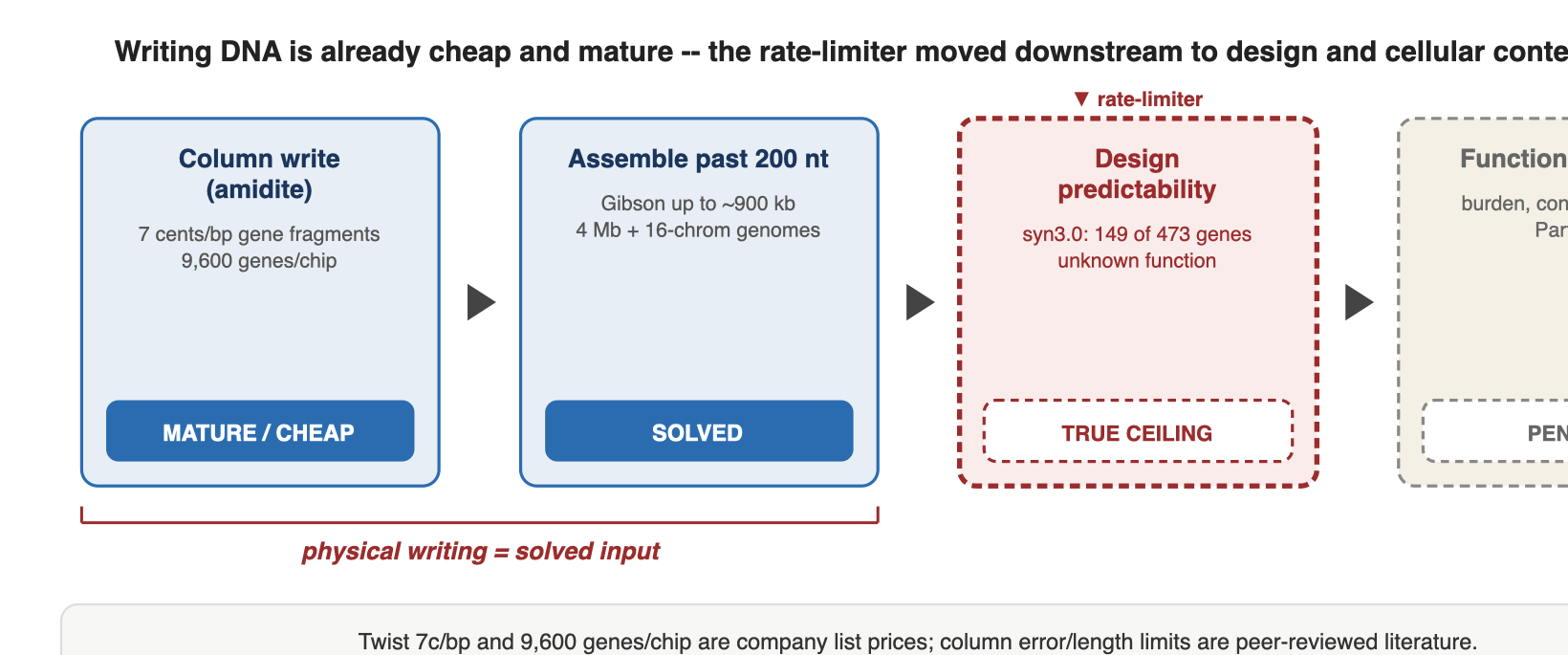
| Layer | Status (2026-07) | Verdict |
|---|---|---|
| Column phosphoramidite (cost / scale) | Twist gene fragments from ~7¢/bp, clonal genes ~9¢/bp, up to 9,600 genes/chip; Express turnaround cut to 2 business days (2025-07, company) | Cheap, mature standard |
| Column phosphoramidite (length) | Coupling 98.5–99.5%/step; per-base error ~1:300–1:1,000; practical no-error length ~150–200 nt (technical literature, a wall since the late 1980s) | Hard length wall (bypassed by assembly) |
| Enzymatic / de-novo synthesis | DNA Script SYNTAX benchtop (96 oligos, ≤120 nt, TdT, aqueous); Ansa 1,005-base record (~28% sequence-perfect) — mostly vendor spec / press release | Longer, greener — has NOT displaced column at scale |
| Assembly (short → large) | Gibson: 20–40 bp overlap, fragments ≥250 bp, up to ~900 kb; JCVI Mycoplasma 583 kb from 25 cassettes (~24 kb each) | Works; large-construct debugging is the real cost |
| Genome-scale writing | Syn61 (4 Mb, 18,214 codon swaps); Syn57 (57-codon, >100,000 swaps); Sc2.0 (16 chromosomes synthesized, single-cell integration unfinished); JCVI-syn3.0 (473 genes, 149 unknown) | Capability, not product or understanding |
Deep dive
1. Background — column phosphoramidite is the cheap, mature scale standard
The workhorse of DNA writing is solid-phase phosphoramidite chemistry, and on Twist Bioscience’s silicon arrays it is already cheap and mature (company-attributed, as of 2025-07). Gene fragments list from about 7 cents per base pair and NGS-verified clonal genes from about 9 cents; a single silicon chip synthesizes up to 9,600 genes in one run, the miniaturization to roughly 1.3 million nano-wells being the core of the cost decline. In July 2025 Twist cut Express gene-fragment turnaround to two business days while holding the 7-cent price (investor release).
The physics of the chemistry, however, sets hard limits (peer-reviewed and technical literature). Coupling efficiency runs 98.5–99.5% per step, and because full-length yield scales as (efficiency) raised to (n−1), it decays exponentially with length: even at 99.5%, full-length yield after 200 cycles is only about 36.7% (about 4.9% at 98.5%). Per-base error typically runs 1:300 to 1:1,000 for column synthesis, and the practical no-error length ceiling sits near 150–200 nt — a wall that has barely moved since the late 1980s, with IDT’s high-efficiency cycles pushing to roughly 200 nt. The takeaway is not “column will get much cheaper” but “column is already a cheap, mature standard, and the 200-nt wall is a fundamental limit of the chemistry” — which is why genome-scale writing writes short oligos and assembles them (§3) rather than trying to make single long oligos.
2. Enzymatic / de-novo synthesis — longer and greener, but demo is not product
Enzymatic synthesis extends a 3′ end one base at a time using terminal deoxynucleotidyl transferase (TdT) in aqueous conditions, without the hazardous organic solvents (acetonitrile and the like) of phosphoramidite chemistry. In principle it is longer and greener and well-suited to on-demand benchtop use. In practice it has not displaced column chemistry at scale — this is a demo-versus-product maturity gap, and the performance numbers come from a different class of source than the column figures above.
| Player | Form / maturity | Headline performance (attributed) | Source type |
|---|---|---|---|
| DNA Script | Benchtop SYNTAX (commercially shipping) | SYNTAX 96 Hi-Fidelity kit = 96 oligos in parallel, up to 120 nt; spec 15–500 nt, error 0.35%, cycle efficiency 99.4% at ≤280 nt | Company spec / product page |
| Ansa Biotechnologies | Service (long / clonal) | World’s longest single de-novo oligo at 1,005 bases (2023-03); claimed ~99.9% stepwise yield, ~28% sequence-perfect; later clonal DNA up to 50 kb (2025) | Company press release |
| Molecular Assemblies | Enzymatic synthesis platform | “Long, green de-novo” positioning (qualitative) — quantitative specs unverified | Company (qualitative) |
Two judgments follow. First, the “longest 1,005-base” is a single best record, not a routine yield — the ~28% sequence-perfect fraction at 1,005 nt shows the length–accuracy tradeoff persists in enzymatic synthesis too. Second, displacement at scale has not happened. Column silicon arrays (Twist’s 9,600 genes per chip) remain the high-volume, low-cost scale standard, while enzymatic synthesis is entering benchtop, on-demand and specialty roles (long fragments, difficult sequences). “Enzymatic will soon replace column” is, for now, a trajectory rather than a product — and this is the one claim the source verification explicitly refutes: enzymatic DNA synthesis has not already displaced column phosphoramidite at scale.
3. Assembly and genome-scale writing — capability, not product
To get past the ~200-nt wall (§1) to gene-, pathway- and genome-scale DNA, short oligos are assembled hierarchically. Gibson assembly (Gibson 2009, JCVI) places a 20–40 bp overlap on fragment ends and joins them seamlessly in one pot with an exonuclease, polymerase and ligase; fragments are stable at ≥250 bp, and assemblies up to about 900 kb have been demonstrated. JCVI’s first synthetic bacterial genome (Mycoplasma genitalium, 583 kb) was built by hierarchically assembling 25 cassettes of about 24 kb each. So the real workflow is oligo (≤200 nt, column) → gene fragment → hierarchical assembly (Gibson) → pathway → chromosome → genome, and “make one long oligo” (enzymatic’s strength) competes with and complements “make short and assemble” (column plus Gibson).
| Demonstration | Scale / key figure (attributed) | What it proves | What it does not yet prove |
|---|---|---|---|
| Syn61 (Chin / MRC LMB, Nature 2019) | E. coli 4-Mb synthetic genome, 18,214 codons recoded (three codons removed → 61-codon) | A 4-Mb recoded genome can be written and kept alive | Not a commercial product; slower doubling vs the parent strain |
| Syn57 (Constructive Bio / Chin, 2025) | 57-codon genetic code, >100,000 codon substitutions, 7 codons freed | The most compressed genetic code to date can be written | Lab/company demonstration; not a commercial product |
| Sc2.0 (international consortium, Nat Biotech 2025) | All 16 nuclear chromosomes plus a tRNA neochromosome synthesized | A eukaryotic genome can be redesigned and synthesized chromosome by chromosome | Full single-cell integration of all 16 chromosomes is unfinished (a future goal) |
| JCVI-syn3.0 (Venter / Hutchison, Science 2016) | 531,560 bp, 473 genes (minimal self-replicating) | A minimal genome can be designed and written | 149 of the 473 genes are of unknown function — even a minimal genome is not understood |
Genome-scale writing proves a genuine capability: DNA from 4 Mb (bacterium) to 16 chromosomes (yeast) can be written de novo and the cell kept alive, with Syn57’s >100,000 substitutions at the frontier. What it does not prove is decisive. Sc2.0’s full single-cell integration and debugging is still in progress (chromosomes complete, integration a future goal); JCVI-syn3.0’s 149 genes of unknown function are direct evidence of a design-predictability ceiling — a genome can be written without knowing why its genes are needed; and none of this is a commercial product. Writing is not understanding, and it is not design.
4. Why the cost of writing DNA is not the bottleneck
The provisional thesis — that the bottleneck is neither reading nor writing cost but the downstream result layer — is tested by this part’s data, and it holds.
- Cost is already low, and where it fell, products did not proportionally explode. At 7 cents per base pair for gene fragments (§1), commercialized synbio products did not multiply in proportion to falling synthesis cost. If cost were the rate-limiting step, product output should have tracked cost down; it did not — observational (and falsifiable) evidence that writing cost was not the bottleneck.
- Length and error limits are bypassed by assembly. The 200-nt wall is crossed by hierarchical assembly, and 4-Mb and 16-chromosome genomes have already been written (§3). “Can it be physically written?” is largely solved — what remains is “does what was written work?”
- Writing is not understanding or design. JCVI-syn3.0’s 149 unknown-function genes and Sc2.0’s unfinished single-cell integration show a genome can be written without knowing why or how it works. The bottleneck is not stamping letters (write) but grammar and meaning (design predictability).
- The bottleneck moves to three places: design predictability (a designed sequence is not automatically functional in context); the labour and time of assembling and debugging large constructs (Gibson works, but error accumulation and troubleshooting in large builds is the real cost); and what the DNA does inside a cell (burden, context-dependence, evolutionary instability — Parts 2–3). Writing cost is an input to these three, not the rate limiter.
- Practical implication for column versus enzymatic: even if enzymatic gets cheaper and longer, products will not increase unless those three bottlenecks are solved. The value of enzymatic synthesis is not “removing a cost bottleneck” but a different axis — long fragments, difficult sequences, benchtop on-demand, greener chemistry — which should be kept separate from the cost narrative.
5. Commercialization and competitive context (neutral, source-attributed)
- Maturity (TRL frame): column synthesis is a mature, shipping standard (high TRL); enzymatic synthesis is benchtop/emerging (mid TRL); genome-scale writing is a research/company capability demonstration (early TRL), not a product. The gating layers are design predictability, large-construct assembly and cellular context — not writing cost.
- Twist Bioscience (listed, TWST): silicon-array column synthesis is the high-volume, low-cost scale standard (gene fragments from ~7¢/bp, up to 9,600 genes/chip; 2-business-day Express as of 2025-07, company). Figures are company list prices, volume- and service-dependent.
- DNA Script (private): benchtop enzymatic SYNTAX is a shipping product (96 oligos, ≤120 nt, TdT, aqueous); its 500 nt / 0.35% error / 99.4% cycle-efficiency numbers are company specs, not independently verified.
- Ansa Biotechnologies (private): holds the world-record single de-novo oligo (1,005 bases, 2023) and reports clonal DNA up to 50 kb (2025); the ~99.9% stepwise / ~28% perfect figures are press-release claims, not peer-reviewed.
- Molecular Assemblies (private): enzymatic-synthesis platform with qualitative “long, green” positioning; quantitative specs are unverified.
- Constructive Bio (private, Jason Chin), JCVI, Sc2.0 consortium, MRC LMB (non-profit/academic): genome-scale writing (Syn57, JCVI-syn3.0, Sc2.0, Syn61) is capability demonstration, not a commercial product; attributions are peer-reviewed where noted and company-plus-secondary reporting for Syn57.
- Company descriptions are limited to neutral, source-attributed statements; maturity and performance comparisons are not buy/sell signals for any security.
6. The skeptic’s bottom line
- Cost is not the bottleneck (unsupported the other way): falling synthesis cost did not produce a proportional rise in shipped synbio products; the “writing cost is the bottleneck” narrative is unsupported.
- Vendor-spec skew: enzymatic error rates, maximum lengths and per-base costs are largely company specs and press releases, not independent standardized head-to-head comparisons against column error accounting. Treat accordingly.
- Demo is not product: enzymatic synthesis has not displaced column at scale — it is benchtop/emerging, a trajectory, not a scale standard (explicitly refuted in the source).
- Capability is not understanding: genome-scale writing proves DNA can be written at scale, but Sc2.0’s single-cell integration is unfinished and 149 of JCVI-syn3.0’s 473 genes are of unknown function — writing is not the same as design or understanding.
- Neutral framing maintained: maturity and performance claims about the listed (Twist, TWST) and private vendors are factual, source-attributed descriptions, not security implications; “enzymatic replaces column” and “writing cost is the bottleneck” are both contested in both directions.
7. What to watch (falsifiable)
- P1 (cost ↔ product): if writing cost falls further still (for example enzymatic $/bp dropping below column) and yet shipped, profitable synbio products do not rise in proportion, writing cost was confirmed not to be the bottleneck. If products explode as cost falls, writing was the bottleneck after all.
- P2 (demo → product): if enzymatic synthesis actually takes high-volume, low-cost gene-synthesis share from column (with independent, standardized error/$/bp/throughput at least matching column), “enzymatic replaces column” is demonstrated. If it stays confined to benchtop on-demand and long-fragment niches, demo-not-product persists.
- P3 (writing → integration and understanding): if Sc2.0 completes full single-cell integration and debugging of all 16 chromosomes, and the unknown-function-gene fraction in minimal genomes falls meaningfully, “writing leads to understanding and design” is demonstrated. If integration stays unfinished and ~149-unknown-gene-level ignorance persists, the “writing ≠ understanding” ceiling holds.
References
- Twist Bioscience. “Gene Synthesis / Gene Fragments” product page (gene fragments from ~7¢/bp; clonal genes ~9¢/bp; up to 9,600 genes/chip). https://www.twistbioscience.com/products/genes/gene-synthesis
- Twist Bioscience. 2025. “Twist Bioscience Expands Express Delivery Turnaround Time” (Express to 2 business days, price held). Investor release. investors.twistbioscience.com/…/express-delivery-turnaround-time-all
- DNA Script. “SYNTAX Kits” (benchtop enzymatic synthesis; SYNTAX 96 Hi-Fidelity, up to 120 nt; TdT, aqueous). https://www.dnascript.com/syntax-kits/
- Enzymatic DNA synthesis review (TdT, aqueous de-novo synthesis). PMC. https://pmc.ncbi.nlm.nih.gov/articles/PMC7424958/
- Ansa Biotechnologies. 2023. “Ansa Biotechnologies Announces Successful de-novo Synthesis of World’s Longest Oligonucleotide at 1005 Bases.” BusinessWire, 9 March 2023. businesswire.com/…/Worlds-Longest-Oligonucleotide-at-1005-Bases
- Ansa Biotechnologies. “Ansa targets nucleic-acid synthesis market with ultra-long clonal DNA service” (clonal DNA up to 50 kb; 600-mer starting oligo). ansabio.com/…/ultra-long-clonal-dna-service
- Glen Research. “Coupling efficiency and full-length yield in phosphoramidite synthesis.” Technical report GR21-211. https://www.glenresearch.com/reports/gr21-211
- Clinical Chemistry. 2021. Oligonucleotide synthesis error rates and length limits. 67(10):1384. academic.oup.com/clinchem/article/67/10/1384/6359542
- Fredens et al. 2019. “Total synthesis of Escherichia coli with a recoded genome” (Syn61, 4 Mb, 18,214 codons). Nature. https://www.nature.com/articles/s41586-019-1192-5
- Constructive Bio. 2025. Syn57 (57-codon genetic code, >100,000 codon substitutions). Publication page. https://constructive.bio/publications/syn57
- Sc2.0 consortium. 2025. Synthetic yeast chromosomes and tRNA neochromosome (16 chromosomes synthesized; single-cell integration unfinished). Nature Biotechnology. https://www.nature.com/articles/s41587-025-02913-4
- Hutchison et al. 2016. “Design and synthesis of a minimal bacterial genome” (JCVI-syn3.0, 531,560 bp, 473 genes, 149 of unknown function). Science. https://www.science.org/doi/10.1126/science.aad6253
- Gibson assembly guide (20–40 bp overlap, fragments ≥250 bp, up to ~900 kb). biocat.com/…/Gibson_Guide_V2
Disclosure
This post is for information only and is not investment advice.
COI note: this post describes a listed company (Twist Bioscience, TWST) and private companies (DNA Script, Ansa Biotechnologies, Molecular Assemblies, Constructive Bio) and non-profit/academic efforts (JCVI, the Sc2.0 consortium, MRC LMB) in a descriptive, neutral context. Every cost, error-rate, length and yield figure is attributed to the platform, kit or publication that reported it: Twist’s 7¢/bp and 9,600-genes/chip are company list prices (volume- and service-dependent); DNA Script’s and Ansa’s enzymatic performance numbers (error rate, cycle efficiency, the 1,005-base record, ~99.9% stepwise, ~28% perfect) are company specs or press releases, not independent standardized head-to-head comparisons and not peer-reviewed; the coupling-efficiency, per-base-error and length-limit figures for column chemistry are from peer-reviewed and technical literature. Genome-scale results (Syn61, Syn57, Sc2.0, JCVI-syn3.0) are lab or company capability demonstrations, not commercial products. Quantitative claims are attributed to the vendor, author or preprint/press release. Maturity and performance statements are factual, neutral descriptions and are not buy/sell implications for any security. The author holds no position in, and has no financial interest in, the companies named.
 Uthando Nethemba
Leave a comment