Evidence-first notes on bioscience and deep tech, at the edge of the lab and the market. Information only — not investment advice, not medical advice. All circuit-accuracy, gene-count, metabolic-burden and generation-count figures are attributed to the specific paper, strain, library and condition in which they were measured; peer-reviewed results are separated from review or secondary sources. Cello’s 92% is a value obtained within one chassis (E. coli), one growth condition and one characterized parts library, and must not be equated with commercial deployment or other chassis.
The 30-second version
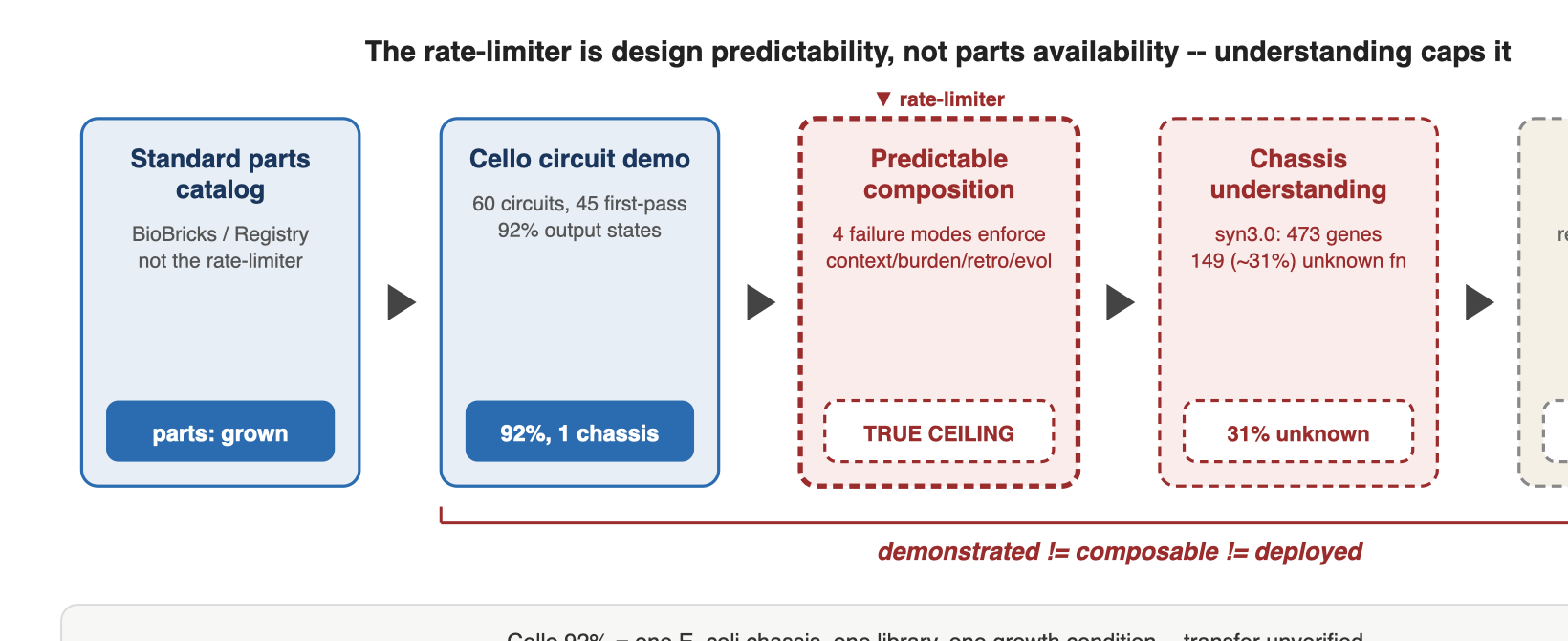
- What. Genetic-circuit and chassis engineering are the layers where the engineering premise — “assemble the parts and the system behaves as designed” — is stress-tested against biology. On the headline, both have arrived in the lab: Cello (Nielsen & Voigt, Science 2016) auto-compiles Verilog code into DNA circuits — 60 circuits designed in E. coli, 45 correct on the first pass, 92% of output states matching prediction — and JCVI-syn3.0 (Science 2016) is a designed, synthesized, self-replicating minimal genome of 473 genes. These are demonstrations, not turnkey predictable engineering.
- So what. The firm thesis is that the bottleneck is design predictability (understanding), not parts availability. Cello reached 92% only by taking gate “insulation” as an explicit premise — and the very need for that premise testifies that parts do not compose cleanly in context. Four recurring failure modes from the primary literature enforce this: context-dependence (Cardinale & Arkin 2012), metabolic burden (Ceroni 2015/2018), retroactivity (Del Vecchio 2008 — modularity is a property that must be enforced), and evolutionary instability (Sleight 2010 — the T9002 circuit lost function in <20 generations).
- Now what. On the chassis side, the most honest ceiling in the field: JCVI-syn3.0’s 473 essential/quasi-essential genes include 149 (~31%) of unknown function — “we can build it but don’t understand it.” Design predictability is capped by mechanistic understanding. The current data fit best the reading that circuit automation and genome writing are real curves, but the bottleneck lives at the result layer (predictable composition) — neither “biology is now predictable engineering” nor “biology cannot be engineered” is supportable.
The five-minute read
Two layers of the DBTL cycle — and why this part tracks circuits and chassis
Synthetic biology’s design-build-test-learn (DBTL) loop is best examined at its BUILD/TEST layers. Genetic circuits use transcription factors, repressors and riboswitches as Boolean logic gates so that a cell performs computation; chassis engineering tries to design the host genome itself, at the limit a minimal or synthetic genome. Both are the proving ground for a single engineering premise — that standardized parts can be assembled into a system that behaves as designed. The surface narrative is that biology has become a predictable, semiconductor-EDA-like discipline. This part tests that claim against the primary literature.
The landmark on the circuit side is Cello. A user writes a logic circuit in Verilog (a hardware-description language); Cello then draws the circuit diagram, assigns and wires gates from a characterized DNA-parts library, simulates performance, and emits a DNA sequence. In E. coli it designed 60 circuits, 45 of which worked correctly on the first attempt, with 92% of output states matching prediction and the DNA assembling as the software predicted without additional tuning. This is the strongest positive evidence for design automation in the field.
The headline is a bounded demonstration; the bottleneck is design predictability
The firm’s recurring lens — “the headline is the starting point; the real bottleneck is at the result layer” — applies cleanly. Cello’s success is genuine but bounded. The key is its own design principle: reliable circuit design requires that gates be insulated from genetic context so they behave the same when reused. That premise is the boundary line. Cello reached 92% not because parts are intrinsically context-independent, but because context-dependence was managed — gates were characterized and insulated. A demonstrated circuit is not a predictably-composable methodology.
Underneath sit four structural failure modes by which biology violates the “assemble and it behaves” premise. Context-dependence (Cardinale & Arkin, Biotechnol J 2012): part behavior is swayed by compositional, host and environmental context — a non-modularity that violates the predictability principle other engineering fields rest on. Metabolic burden (Ceroni, Nat Methods 2015/2018): heterologous expression imposes a resource load; a GFP-based capacity monitor quantified it, and lower-burden designs grew predictably better at equal output. Retroactivity (Del Vecchio, Ninfa & Sontag, Mol Syst Biol 2008): connecting a downstream module changes the upstream module’s input/output dynamics — modularity is not automatic but must be enforced with insulation devices. Evolutionary instability (Sleight, J Biol Eng 2010): the assembled circuit T9002 lost function in fewer than 20 generations, chiefly by deletion between two homologous terminators.
| Layer / claim | Status (attributed) | Verdict |
|---|---|---|
| Cello circuit design automation (Verilog to DNA) | Science 2016: 60 circuits / E. coli, 45 correct first-pass, 92% of output states matching prediction, no extra tuning | Demonstrated (lab) |
| Transfer of Cello’s 92% to other chassis / scale | Value within one E. coli condition and library; re-characterization required per chassis | Unverified |
| “Gate insulation is the premise of reliable circuits” | Cello paper states it explicitly — managing context-dependence is the condition for predictability | Demonstrated (principle) |
| Four recurring failure modes | Context-dependence (Cardinale & Arkin 2012), burden (Ceroni 2015/2018), retroactivity (Del Vecchio 2008), evolutionary instability (Sleight 2010) | Demonstrated (per-paper) |
| Minimal genome synthesized (self-replicating) | JCVI-syn3.0: 531 kbp, 473 genes, 3 design-synthesis-test cycles | Demonstrated (lab) |
| Complete understanding of the minimal genome | 149 of 473 genes still of unknown function (2016); syn3A follow-up partial | Not achieved |
| “Enough standard parts to assemble like LEGO” | Retroactivity, context, burden, evolutionary instability — modularity is not automatically guaranteed | Refuted |
Deep dive
1. Background — the circuit landscape from logic gates to Cello automation
Genetic circuits treat transcription factors, repressors and riboswitches as Boolean logic gates so a cell performs computation. Two decades of standardization (BioBricks / the parts Registry) grew the catalog of characterized parts, on the premise that a large enough parts library makes circuits composable like electronics. The landmark of automation is Cello (Nielsen, Voigt et al., MIT; Science 2016, aac7341; PubMed 27034378): from a Verilog description it generates the circuit diagram, assigns and wires gates from a characterized DNA-parts library, simulates performance, and emits a DNA sequence. In E. coli it designed 60 circuits, 45 of which worked correctly on the first pass, with 92% of output states matching prediction and no additional tuning. Cello 2.0 (Jones et al., Nat Protocols 2021) protocolized the workflow and extension to other organisms. This is the strongest positive evidence that software, not hand-tuning, can design biological circuits.
The design principle that made this possible is itself the boundary. Paraphrasing the Cello paper (≤150 chars): reliable circuit design must insulate each gate from its genetic context so it behaves the same when reused in a different circuit. The existence of that requirement is the key: Cello reached 92% because context-dependence was managed, not because parts are intrinsically modular.
2. What this landscape newly establishes — a bounded landmark, not composable biology
A demonstrated circuit is not a predictably-composable methodology. Cello’s success is genuine and lives within clear bounds. Chassis and condition bound: the 92% is a value within one E. coli strain, growth condition and parts library; moving the same circuit to another species, medium, temperature or scale shifts gate transfer functions. That transfer reproducibility is unverified. 45/60 is not 60/60, and 92% is per output state: 15 of 60 circuits did not work correctly on the first pass, and 92% is a fraction of output states matching prediction, not the fraction of whole circuits working flawlessly — a strong result that should be read without idealization. Characterization cost: the 92% followed precise gate characterization and insulation-spacer design; every extension to new parts or a new chassis requires that characterization to be redone, which is the practical limit of the automation. Depth and scale ceiling: as gates stack, burden, crosstalk and resource competition accumulate, so arbitrarily large circuits do not scale predictably. In short, Cello demonstrates that engineering-managed context-dependence yields substantial automation — a bounded landmark — but generalizing it to “biology is now predictable modular engineering” is the same category of overreach as equating a lab result with a market win.
3. Strengths and limits of method — four recurring failure modes (peer-reviewed)
The four structural failure modes are the substance of the “bottleneck = design predictability” thesis.
- (a) Context-dependence (Cardinale & Arkin, Biotechnol J 2012). Part behavior is governed by unintended interactions across three context layers: compositional (physical/functional interference between parts on the same molecule), host (implicit dependence on host resources and parasitic interaction with endogenous components), and environmental. The authors frame this non-modularity as a violation of the predictability and independent-behavior principles that underpin other engineering fields — a taxonomy of synbio failure.
- (b) Metabolic burden (Ceroni et al., Nat Methods 2015 / 2018). Heterologous gene expression imposes a resource load. A GFP-based E. coli capacity monitor quantified the burden each construct imposes and showed that, at equal output, lower-burden designs grow predictably better (nmeth.3339). The 2018 follow-up added burden-driven feedback control — a circuit that senses overload and auto-regulates expression (nmeth.4635). Burden couples design parameters to strain physiology, breaking part independence.
- (c) Retroactivity (Del Vecchio, Ninfa & Sontag, Mol Syst Biol 2008). Connecting a module immediately changes the upstream module’s input/output dynamics — analogous to non-zero output impedance in electrical circuits. The authors note that many biochemical and especially genetic networks, like many physical systems, do not exhibit modularity, and propose insulation devices to buffer it. Modularity is a property that must be enforced by design, not one that biology guarantees (directly linked to Cello’s insulation premise).
- (d) Evolutionary instability (Sleight et al., J Biol Eng 2010). Even a correct design decays evolutionarily without selective pressure. The representative circuit T9002 lost function in fewer than 20 generations, the recurrent cause being deletion between two homologous terminators; loss-of-function mutations spanned point mutations, small indels, large deletions and IS-element insertions, arising often at scar sequences between parts, with promoter mutations most strongly selected. Design principle: high expression is paid for in low evolutionary stability, and removing homology plus a 4-fold expression reduction extended the evolutionary half-life more than 17-fold. (A later report finds lost circuit function can be regained by evolution — PNAS 2019, 116:25162.)
These four converge on one point: a part’s metric must be re-measured in system context. An individual gate’s transfer function shifts under context, burden and retroactivity when placed in a circuit, and is lost to evolution over time. No amount of parts cataloging composes predictably unless these four forces are managed — the substance of “the bottleneck is design predictability, not parts availability.”
4. The chassis — “we can build it but don’t understand it” (JCVI-syn3.0)
The extreme attempt to design the chassis from the ground up is the minimal genome. JCVI-syn3.0 (Hutchison, Venter et al., Science 2016, aad6253) is a 531 kbp, 473-gene self-replicating minimal genome, reached from syn1.0 (901 genes) over three design-synthesis-test cycles. The follow-up (syn3A, Cell 2021) has begun assigning function — for instance identifying cell-division genes — but the headline honesty of the field is inside syn3.0: of the 473 essential/quasi-essential genes, 149 (~31%) are of unknown function — remove one and the cell dies or is sickened, yet what it does is unknown. Humanity can build a minimal genome but does not understand it.
This is why it is the core bottleneck. Design predictability is capped by mechanistic understanding: without knowing what 149 parts do, one cannot predict how they behave in a new context, and cannot in principle control the four failure modes of §3. syn3.0 is the chassis-side direct evidence for “understanding, not parts availability, is the bottleneck.” (Some functions have since been assigned via syn3A, but complete understanding is incomplete — see §5.)
5. Commercialization and TRL context
- Maturity (TRL frame): circuit design automation and minimal-genome synthesis are lab-demonstrated (roughly a mid-TRL demonstration), but the gating layer — predictable composition across arbitrary chassis and scale — is early, because per-chassis re-characterization is still required and 31% of the minimal gene set is not understood. The bottleneck is design predictability, not parts catalog size.
- Parts-vs-understanding thesis: the standard-parts catalog (BioBricks / Registry) has grown, but circuit success does not scale in proportion; retroactivity, context, burden and evolutionary instability show why. This is the same metric-reality gap seen in AI protein design (“in-silico success rate ≠ wet-lab function”) and in cell foundation models (“below a linear baseline”) — the 149 unknown-function genes are a region where the very labels to learn from are absent.
- Company layer (out of scope here): foundry business models (e.g., DNA-foundry approaches) are deferred to later parts of this series; this part rests almost entirely on university and non-profit peer-reviewed literature. Any read of “Cello made biology into predictable EDA-like engineering” as a valuation narrative for the foundry camp would be overreach, and the opposite read — “biology cannot be engineered” — would be understatement. Neutral, source-attributed description only; not a buy/sell implication for any security.
6. The skeptic’s bottom line
- Demonstrated circuit ≠ composable methodology: Cello’s 92% is a value within one E. coli condition and library; its transfer to other chassis and scale is unverified. 45/60 first-pass and 92%-of-output-states must be read without idealization.
- The insulation premise is the tell: Cello succeeded by taking gate insulation as an explicit premise — evidence that parts are not intrinsically modular, not that they are.
- Failure modes are real but per-paper: the four failure modes are peer-reviewed, but their quantities are attributed to specific circuits and strains, not universal constants.
- The chassis ceiling: syn3.0’s 149 unknown-function genes are a 2016 snapshot; some functions have since been assigned, but complete understanding is incomplete — the honest state is that understanding caps design predictability.
- Do not adjudicate the narrative either way: “biology is now predictable engineering” (overreach) and “biology cannot be engineered” (understatement) are both unsupportable on current data; this part juxtaposes them falsifiably.
7. What to watch (falsifiable)
- P1 — transfer reproducibility: if Cello-type designs, moved to another chassis, medium or scale, reproduce first-pass prediction-match near the E. coli level (~90%), design predictability has improved. If they collapse without per-chassis library re-characterization, the result-layer bottleneck persists. (Watch: Cello 2.0 organism transfers.)
- P2 — parts-vs-predictability correlation: if arbitrary-circuit first-pass prediction-match rises in proportion to the growing standard-parts catalog, the bottleneck was parts availability. If prediction-match stalls as parts grow, the bottleneck is confirmed as composition predictability, not part count.
- P3 — understanding-vs-design correlation: if assigning function to syn3.0’s 149 unknown genes improves minimal-chassis design and prediction accuracy, “understanding is the bottleneck” is demonstrated. If data-driven models (cell foundation models) improve prediction without knowing function, the understanding-bottleneck thesis weakens — symmetric with AI protein design (“in-silico ≠ wet-lab”) and cell FMs (“below a linear baseline”).
References
- Nielsen, Alec A. K., et al. 2016. “Genetic circuit design automation” (Cello; 60 circuits, 45 first-pass, 92% output states, gate insulation). Science 352 (6281): aac7341. https://www.science.org/doi/10.1126/science.aac7341 — PubMed record: https://pubmed.ncbi.nlm.nih.gov/27034378/
- Jones, Timothy S., et al. 2021. “Genetic circuit design automation with Cello 2.0” (workflow extension, transfer to other organisms). Nature Protocols. https://www.nature.com/articles/s41596-021-00675-2
- Hutchison, Clyde A., III, et al. 2016. “Design and synthesis of a minimal bacterial genome” (JCVI-syn3.0; 531 kbp, 473 genes, 149 of unknown function). Science 351 (6280): aad6253. https://www.science.org/doi/10.1126/science.aad6253
- Follow-up on the minimal cell (syn3A; cell-division genes and further function assignment). 2021. Cell. https://www.cell.com/cell/fulltext/S0092-8674(21)00293-2
- Ceroni, Francesca, et al. 2015. “Quantifying cellular capacity identifies gene expression designs with reduced burden” (GFP-based capacity monitor). Nature Methods 12: nmeth.3339. https://www.nature.com/articles/nmeth.3339
- Ceroni, Francesca, et al. 2018. “Burden-driven feedback control of gene expression.” Nature Methods 15: nmeth.4635. https://www.nature.com/articles/nmeth.4635
- Del Vecchio, Domitilla, Alexander J. Ninfa, and Eduardo D. Sontag. 2008. “Modular cell biology: retroactivity and insulation” (modularity must be enforced). Molecular Systems Biology 4: 161. https://www.embopress.org/doi/full/10.1038/msb4100204
- Cardinale, Stefano, and Adam P. Arkin. 2012. “Contextualizing context for synthetic biology — three context layers of failure.” Biotechnology Journal 7 (7). https://analyticalsciencejournals.onlinelibrary.wiley.com/doi/full/10.1002/biot.201200085
- Sleight, Sean C., et al. 2010. “Designing and engineering evolutionary robust genetic circuits” (T9002 loses function in <20 generations; half-life extended >17-fold). Journal of Biological Engineering 4: 12. https://jbioleng.biomedcentral.com/articles/10.1186/1754-1611-4-12
- Follow-up: evolutionary re-acquisition of lost circuit function. 2019. PNAS 116 (50): 25162. https://www.pnas.org/content/116/50/25162
Disclosure
This post is for information only and is not investment advice, and not medical advice.
COI note: this part rests almost entirely on peer-reviewed literature from universities and non-profit research institutes (Cello, JCVI-syn3.0, burden, retroactivity, context-dependence and evolutionary-instability sources). Every circuit-accuracy, gene-count, metabolic-burden and generation-count figure is attributed to the specific paper, strain, library and condition in which it was measured, and peer-reviewed results are separated from review or secondary sources. Cello’s 92% is a value within one E. coli condition and characterized parts library and must not be equated with commercial deployment or another chassis. Quantitative claims are attributed to the author or peer-reviewed source. Any foundry business-model or valuation discussion is deferred to later parts and is out of scope here; statements are factual, neutral descriptions and are not buy/sell implications for any security. The author holds no position in, and has no financial interest in, any company named.
 Uthando Nethemba
Leave a comment