Evidence-first notes on bioscience and deep tech, at the edge of the lab and the market. Information only — not investment advice. Every fold-improvement, titer and throughput figure is attributed to the specific campaign, strain, condition and source; peer-reviewed results, company self-report and marketing are labeled separately (noted inline). Descriptions of listed and defunct companies are factual, neutral and source-attributed.
The 30-second version
- What. A biofoundry industrializes the design-build-test-learn (DBTL) cycle of synthetic biology with robotics, high-throughput instruments and software, while AI/active-learning strengthens the “Learn” step. On the surface the promise is that biology becomes a predictable, modular, semiconductor-like engineering discipline. Throughput is real: recent peer-reviewed campaigns report isoprenol titer up 5-fold in 6 DBTL cycles (Nat Commun 2025), p-coumaric acid up 68% in 2 DBTL cycles (ACS Synth Biol), and surfactin/flaviolin gains of 160%/350% — all attributed to the specific study and strain.
- So what. These gains are search efficiency inside a measured combinatorial space (interpolation), not first-pass prediction of designs outside it (extrapolation). The isoprenol case is the clearest: it built and tested only 347 of >800,000 candidates (0.04%) and still needed 6 physical DBTL rounds. ML degrades on extrapolation — the ART/tryptophan literature reports predictions worsening as recommendations move outside the previously measured range. Throughput up is not the same as predictability up; a within-campaign search is not a first-pass prediction.
- Now what. The design-predictability gap is mostly not-yet-closed, and the reproducibility layer confesses it: iGEM interlab studies find 1.54x–5.75x variation across labs on the simplest fluorescence measurement, and standardization frameworks (GBA 2019, K-biofoundry 2025) are still being written — meaning cross-lab/cross-run reproducibility is not yet established. Zymergen (IPO ~$530M in 2021 → acquired by Ginkgo at ~10% of IPO value in 2022 → 2023 bankruptcy → 2024 SEC $30M settlement) is often read as “ML-foundry science failed,” but the SEC action was a securities-law matter about misrepresenting Hyaline’s market size and revenue (~5–10% of the claim), not an adjudication that the foundry science was impossible. Automation industrialized trial-and-error; it did not yet replace it with prediction.
The five-minute read
Two things a foundry can raise — and only one of them is “prediction”
The firm’s recurring lens — “the headline is the starting point; the real bottleneck is elsewhere” — bites hardest here. A biofoundry unambiguously raises build/test throughput: liquid-handling robots, high-throughput assays and CAD/LIMS software let it run many DBTL rounds in parallel. Public foundries (DOE Agile BioFoundry, Illinois iBioFAB, London Biofoundry at Imperial, Edinburgh Genome Foundry, KRIBB’s K-biofoundry) automate build/test as peer-reviewed infrastructure. Ginkgo Bioworks, on its own platform pages and in trade press, claims a >295,000 sq ft footprint, “hundreds of thousands of experiments per day,” and “tens of thousands of DBTL iterations in parallel,” shortening strain development from months to weeks — but this is company self-report/marketing with no independent audit, and absolute throughput numbers depend on the vendor’s own definition of what counts as one “experiment,” so head-to-head comparison does not hold.
The decisive distinction is that raising throughput is a different axis from raising design predictability. Running tens of thousands of DBTL rounds in parallel means trying more, faster — not getting the answer in fewer tries (first-pass). Cheaper iteration can ease the bottleneck, but that is not the same as making iteration unnecessary by replacing it with prediction. Ginkgo’s “hundreds of thousands per day” is therefore best treated as an announced-not-independently-operational, throughput-not-predictability signal, and shelved as self-report until audited.
Fold-improvements are real — but they are search, not prediction
The AI/active-learning gains in the “Learn” step are real and peer-reviewed. Their shared structure, however, is compressing a huge combinatorial space with a small number of batches — an interpolation inside what was measured, not a calculation that hits a novel design outside it on the first pass. The same literature admits the limit: mechanistic+ML tools (ART, and the tryptophan hybrid) report that recommendations degrade as they move outside the previously measured range. Useful for interpolation within the measured distribution; fragile for extrapolation into new territory. That is the gap between “made biology predictable” and “searches well around what we already measured.”
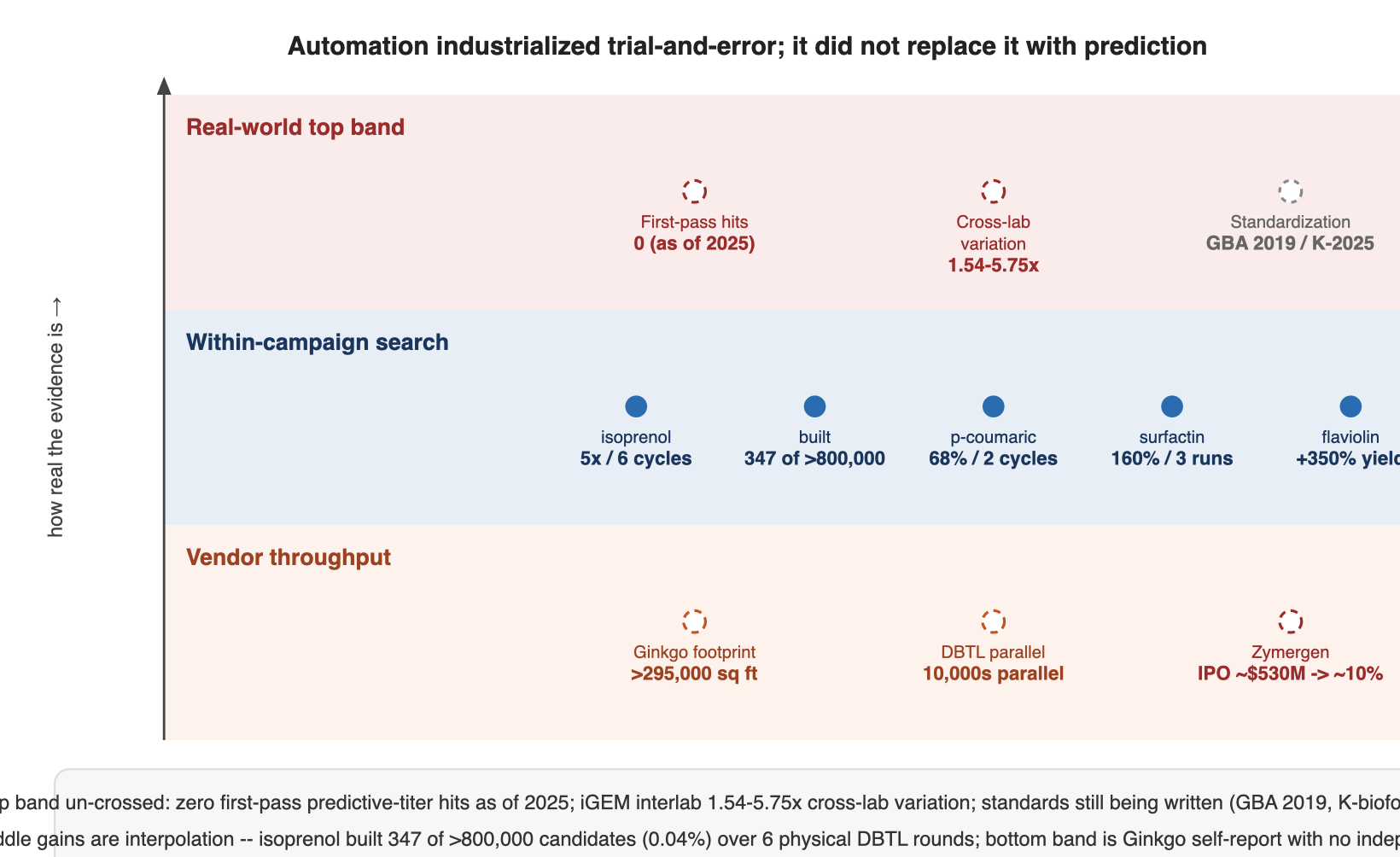
| Campaign / product | Organism, source (attributed) | Reported figure | Character |
|---|---|---|---|
| isoprenol | Pseudomonas putida, Nat Commun 2025 | 5-fold titer over 6 DBTL cycles; design space narrowed from >800,000 CRISPRi arrays to 347 | Interpolation / within-campaign search (0.04% built) |
| p-coumaric acid | yeast, ACS Synth Biol | 68% improvement in 2 DBTL cycles; final 0.52 g/L | Interpolation / iterative |
| surfactin | Bacillus, CSBJ 2024 | 160% yield increase vs M9 baseline after 3 DBTL runs | Interpolation / iterative |
| flaviolin | P. putida, Commun Biol 2025 | titer up 60%/70%; process yield up 350% (ML-guided media optimization) | Interpolation / iterative |
| ART (tool) | Radivojević et al., Nat Commun 2020 | Automated Recommendation Tool (EDD-linked); iterative titer gains — degrades on extrapolation | Search, not first-pass prediction |
Deep dive
1. Background — what a biofoundry actually industrializes
The biofoundry promise is simple: industrialize the DBTL cycle with robots, high-throughput instruments and software, and biology becomes a predictable, modular, scalable engineering discipline. Ginkgo Bioworks built a commercial foundry, Zymergen built an ML-foundry narrative, and DOE Agile BioFoundry, Illinois iBioFAB and London Biofoundry built public infrastructure on that premise. This part narrows the series’ central falsifiable question to one testable proposition: does automation-plus-AI close the “design-predictability gap,” or does it merely industrialize trial-and-error — trying more, faster — while the gap itself remains?
Two DBTL layers are the sister series to this one. AI protein design occupies the “D” (part design): tools like RFdiffusion/ProteinMPNN design a part in silico, and the foundry writes, expresses and tests it (build/test). Bio-foundation-models occupy the “L” (predict/learn): a cell model learns from build/test data to propose the next design. This part is the “B/T” hub where both are consumed — and the shared proposition across all three is score / throughput / optimization is not prediction.
2. What the landscape establishes — throughput is real, but is “prediction”? (company claims separated)
Principle: company self-report/marketing throughput (Ginkgo’s “hundreds of thousands/day”) is separated from independent verification; within-campaign fold-improvement is separated from first-pass predictive hits; and cross-tool throughput rankings are not asserted, because each foundry defines an “experiment” differently.
- Ginkgo Bioworks foundry (company self-report/marketing — no independent audit): per its platform pages and trade press, >295,000 sq ft, “hundreds of thousands of experiments per day,” “tens of thousands of DBTL iterations in parallel,” shortening strain development from months to weeks. Absolute throughput depends on the vendor’s own unit definition, so head-to-head is not possible. [self-report/marketing — no independent audit]
- Public foundries (peer-reviewed infrastructure): DOE Agile BioFoundry, Illinois iBioFAB, London Biofoundry (Imperial), Edinburgh Genome Foundry, K-biofoundry (KRIBB) automate build/test with robotic liquid handling, high-throughput assays and CAD/LIMS software. [confirmed — GBA paper, institutional pages]
The core distinction: throughput rising and design predictability rising are different axes. “We run tens of thousands of DBTL in parallel” means more trial-and-error, faster — not fewer tries to the right answer. The discriminating criterion is not throughput but a collapse in iteration count and a first-pass commercial-titer hit. Cheaper iteration can ease the bottleneck; replacing iteration with prediction is a separate thing.
3. AI/active-learning path optimization — real gains, but search, not prediction
The peer-reviewed evidence that AI/ML strengthens the “Learn” step is real (the table above). The shared structure is compressing a large combinatorial space with a few batches. The isoprenol case is clearest: it experimented on 347 of >800,000 candidates (0.04%) and won 5-fold — a demonstration of search efficiency (active learning picks what to build next well), not of first-pass predictive design that hits a novel design by calculation alone. Six DBTL rounds still had to run physically.
The literature admits the boundary. The repeatedly reported limit of ART/EDD-class and mechanistic+ML hybrids (tryptophan, Nat Commun 2020) is degradation on extrapolation — the further recommendations move outside the previously measured range, the noticeably worse the prediction. ML is useful for interpolation within the measured distribution and fragile for extrapolation into new regions. This is the difference between “made biology predictable” and “searches well around what we already measured.” It is the same signal reported in the bio-foundation-models series, where cell models fail to beat a linear baseline and collapse out-of-distribution (OOD) — the two “Learn” layers echo each other: useful for interpolation, fragile for extrapolation.
4. The reproducibility / transferability bottleneck — “it worked in our foundry” is not transferable
If automation-plus-AI had closed predictability, the same design would at least reproduce across labs and runs. This layer is unresolved enough that the standard is still being written — which is itself the bottleneck signal.
- iGEM Interlab study (direct reproducibility evidence): Beal et al., PLOS ONE 2016. 88 institutions measured fluorescence of three constitutive constructs in E. coli. Precision depended strongly on fluorescence intensity: 1.54-fold SD in the ratio between strong promoters and up to 5.75-fold SD between the strongest and weakest. Host strain did not affect expression ratio, but instrument choice did. A 2018 follow-up (1,400 people, 250 teams) improved reproducibility using silica-microsphere calibration — the fact that a standard calibrant is needed before lab-to-lab values become comparable means that, before standardization, the same construct is measured several-fold differently across labs. [confirmed/peer-review]
- Global Biofoundry Alliance (GBA): launched 9 May 2019 in Kobe, Nat Commun 2019; a consortium coordinating public foundries by sharing resources and protocols (33 member institutions). [confirmed]
- K-biofoundry international standardization framework (2025): KRIBB-led, Nat Commun 2025; a common language standardizing foundry operations into four tiers (Project/Service, Capability, Workflow, Unit Operations), with ~10 institutions across Korea, the US, the UK and Singapore. Its stated purpose is to resolve the problem that “differences in equipment, workflow and operating practice made resource and experience sharing hard,” and to improve equipment compatibility, data reproducibility and AI integration. [confirmed/institutional]
The firm’s read: the GBA and K-biofoundry standardization efforts are a positive signal and simultaneously a confession of the bottleneck — the fact that the standard is being written now (2019, 2025) means cross-lab/cross-run reproducibility is not yet established. iGEM interlab’s 1.54–5.75x variation shows that even the simplest fluorescence measurement wobbles several-fold between labs. That a strain or circuit optimized in one foundry reproduces in another foundry or at another scale — its transferability — must be demonstrated separately, and the current literature is still building the standardization infrastructure. This is direct evidence that context-dependence has not yet been eliminated by foundry automation.
5. Zymergen — the commercial collapse of an ML-foundry narrative (science-failure vs business/hype-failure, separated)
Zymergen was a pure specimen of the ML-foundry narrative (“engineer microbes with machine learning, automation and high-throughput screening”), and its collapse touches this part’s falsifiable question directly. But what failed is the crux.
The facts (SEC / trade press): a 2021-04 IPO raised roughly $530M; the only commercial product was Hyaline, an optical film for flexible electronics. In 2021-08 the stock fell 76% after disclosures of a weakening pipeline and revenue outlook. In 2022-07 Ginkgo Bioworks acquired the company at roughly 10% of its IPO valuation. In 2023 it filed for bankruptcy, and in 2024 it settled a $30M civil action with the SEC.
What the SEC action was actually about (to prevent overstatement): the SEC (2024-129) found Zymergen had misled IPO investors about market potential, revenue outlook and customer pipeline. Specifically, the claim that Hyaline’s display market alone was “over $1 billion in 2020” was found “materially misleading” and without reasonable basis — the sales team’s own realistic market was $42M–$100M (roughly 5–10% of the claim). [confirmed/SEC, quote ≤150 chars]
The firm’s separation rule: the SEC action was a securities-law matter about market size, revenue outlook and hype — not a technical adjudication that “ML-foundry science/automation itself cannot work.”
- It strongly supports a business-model/hype failure — SPAC-era market-size inflation, absent product-market fit, absent revenue model.
- It does not directly prove a science failure — the SEC sanctioned “inflated the market,” not “the foundry cannot make strains.” The technical success or failure of Zymergen’s internal platform is outside the SEC’s scope [unverified].
- The most accurate statement is therefore neither “ML-foundry = fraud” nor “ML-foundry = scientifically failed,” but “the collapse of a business model that layered an oversized market narrative on top of industrialized trial-and-error.”
6. Neighbouring domains — the “D” and “L” layers, and other outcome-layer analogues
- AI protein design (the “D” of DBTL): when in-silico part design outputs a sequence, the foundry writes it as DNA, expresses and tests it — so the AI-protein bottleneck (“in-silico design metric to wet-lab success rate is target-dependent, with no honest benchmark”) is exactly what the foundry’s build/test consumes. Fold-improvement is to search efficiency what self-consistency is to folding: a proxy for optimization, not for prediction.
- Bio-foundation-models (the “L” of DBTL): a cell/sequence model learning from build/test data to close the loop shows the same shape as ART’s extrapolation decay — useful for in-distribution interpolation, fragile OOD. Port the bio-FM honest-evaluation checklist onto foundry success-rate reporting.
- Materials / energy-storage outcome-layer analogue: a foundry’s “hundreds of thousands of experiments/day” claim (Ginkgo self-report) is like an energy-storage “GWh pilot line operating” announcement — announced is not operational, throughput is not predictability. Zymergen (IPO ~$530M → acquired ~10%) and Amyris (Chapter 11) resemble the Northvolt failure mode: the gap between “platform throughput” and “a shipped, profitable product.”
7. Commercialization and competitive context
- Maturity (TRL frame): build/test throughput is real (roughly TRL 6–7 on the automation axis), but the “predictive design” maturity is early because no first-pass predictive-design benchmark exists (TRL 4 equivalent). The gating layers are design predictability and cross-foundry reproducibility, not throughput.
- Ginkgo Bioworks (DNA): a listed foundry operator; its throughput figures are company self-report/marketing with no independent audit, and are shelved as such. Whether Ginkgo actually reduced iteration count in production is proprietary and undisclosed [unverified].
- Zymergen (defunct/acquired): IPO ~$530M (2021) → acquired by Ginkgo at ~10% of IPO value (2022) → 2023 bankruptcy → 2024 SEC $30M settlement. The SEC action addressed market/revenue misrepresentation (Hyaline), not the science. Described factually and neutrally only.
- Amyris (Chapter 11): named as an analogue of the platform-throughput vs shipped-product gap; factual, neutral description only.
- Public / non-profit infrastructure: DOE Agile BioFoundry, Illinois iBioFAB, London Biofoundry, Edinburgh Genome Foundry, K-biofoundry, and the GBA (non-profit consortium) are the peer-reviewed reproducibility infrastructure being standardized now.
- Company implications are limited to neutral, source-attributed description; competitive or capability-ranking statements are not buy/sell signals. Tickers, market cap and position sizing are out of scope.
8. The skeptic’s bottom line
- Throughput ≠ predictability: Ginkgo’s “hundreds of thousands/day” is self-report with no independent audit; more, faster trials is not fewer tries to the answer.
- Within-campaign search ≠ first-pass prediction: fold-improvements are interpolation inside a measured combinatorial space; ML degrades on extrapolation (ART/tryptophan).
- Still 2–6 DBTL rounds: every campaign required physical iteration; no first-pass predictive-design commercial-titer hit exists (count: zero as of 2025).
- Cross-lab reproducibility unresolved: iGEM interlab variation of 1.54–5.75x; standardization (GBA 2019, K-biofoundry 2025) is still being written — the bottleneck confessing itself.
- Zymergen: separate science from hype: the SEC $30M action was for securities-law violation (misrepresenting Hyaline’s market size/revenue, ~5–10% of the claim), not a verdict that ML-foundry science failed.
- Verdict: automation industrialized trial-and-error but did not replace it with prediction; the design-predictability gap is mostly not-yet-closed — though it is not fully refuted either, because throughput and search efficiency are real, and cheaper iteration eases the bottleneck.
9. What to watch (falsifiable)
- P1 — first-pass hit rate: on a benchmark that discloses the full funnel, if AI-guided design plus a biofoundry collapses DBTL iterations to 1–2 rounds and hits a commercial titer in a novel (OOD) combinatorial space first-pass, design predictability has improved. If 5–6 iterative rounds are still needed and extrapolation still collapses, the context-dependence ceiling persists.
- P2 — cross-foundry transferability: if, after GBA/K-biofoundry standardization, the same design reproduces across ≥2 independent foundries at within-lab levels under calibrant correction, transferability has improved. If iGEM-interlab-type fold variation persists on new assays, the “it worked in our foundry” ceiling persists.
- P3 — throughput vs shipped product: if foundry throughput (DBTL/day) and program count keep rising while shipped, profitable products do not rise proportionally, the bottleneck was predictability/scale (the outcome layer), not throughput. If products explode in proportion to throughput, throughput was the bottleneck.
References
- Hillson, Nathan, et al. 2019. “Building a global alliance of biofoundries.” Nature Communications 10, 2040 (Global Biofoundry Alliance launch, Kobe 2019-05-09). https://www.nature.com/articles/s41467-019-10079-2
- KRIBB / EurekAlert. 2025. K-biofoundry international standardization framework (four-tier common language; Project/Service, Capability, Workflow, Unit Operations). Nature Communications 2025 (news release). https://www.eurekalert.org/news-releases/1092136
- Beal, Jacob, et al. 2016. “Reproducibility of Fluorescent Expression from Engineered Biological Constructs in E. coli” (iGEM interlab; 88 institutions; 1.54x–5.75x variation). PLOS ONE 11(3): e0150182. https://journals.plos.org/plosone/article?id=10.1371/journal.pone.0150182
- Beal, Jacob, et al. 2018. iGEM interlab follow-up (1,400 participants, 250 teams; silica-microsphere calibration improves reproducibility). PLOS ONE 13(6): e0199432. https://journals.plos.org/plosone/article?id=10.1371/journal.pone.0199432
- 2025. Active-learning isoprenol campaign in Pseudomonas putida (6 DBTL cycles, 5-fold; >800,000 CRISPRi arrays narrowed to 347). Nature Communications. https://www.nature.com/articles/s41467-025-66304-8
- ML-guided p-coumaric acid campaign in yeast (2 DBTL cycles, 68%, 0.52 g/L). ACS Synthetic Biology. https://pubs.acs.org/doi/10.1021/acssynbio.4c00035
- 2025. ML-driven media optimization for flaviolin in P. putida (titer +60%/70%; process yield +350%). Communications Biology. https://www.nature.com/articles/s42003-025-08039-2
- Radivojević, Tijana, Zak Costello, Kenneth Workman, Hector Garcia Martin. 2020. “A machine learning Automated Recommendation Tool for synthetic biology” (ART, EDD-linked). Nature Communications 11, 4879. https://pmc.ncbi.nlm.nih.gov/articles/PMC7519645/
- 2020. Mechanistic+ML hybrid (tryptophan) reporting extrapolation degradation outside the measured range. Nature Communications. https://www.nature.com/articles/s41467-020-17910-1
- U.S. Securities and Exchange Commission. 2024. Press release 2024-129 — Zymergen settlement ($30M; Hyaline market-size/revenue misrepresentation). https://www.sec.gov/newsroom/press-releases/2024-129
- Ginkgo Bioworks. Platform page (foundry throughput self-report/marketing; no independent audit). https://www.ginkgo.bio/platform
Disclosure
This post is for information only and is not investment advice.
COI note: this post describes a listed company (Ginkgo Bioworks, DNA) and a defunct/acquired company (Zymergen — IPO ~$530M, acquired by Ginkgo at ~10% of IPO value, 2023 bankruptcy, 2024 SEC $30M settlement — and Amyris, Chapter 11) in a descriptive, neutral context. Negative facts (the Zymergen SEC settlement and collapse, the absence of an independent audit of Ginkgo’s throughput claims) are stated factually, neutrally and with source attribution, not framed as disparagement. Every fold-improvement, titer and throughput figure is attributed to the specific campaign, strain, condition and source; company self-report/marketing (Ginkgo throughput), peer-reviewed campaigns, and the SEC action are labeled separately. Quantitative claims are attributed to the vendor, author or preprint/abstract. The SEC action against Zymergen was for a securities-law violation (misrepresenting Hyaline’s market size/revenue), not an adjudication of ML-foundry science failure; science-failure and business/hype-failure are kept separate. Competitive and capability statements are factual, neutral descriptions and are not buy/sell implications for any security. The author holds no position in, and has no financial interest in, the companies named.


Leave a Reply