Evidence-first notes on bioscience and deep tech, at the edge of the lab and the market. Information only — not investment advice. All revenues, margins, valuations, layoff rates and bankruptcy facts are attributed to each company’s own reporting (SEC 8-K/10-Q, corporate press releases) or the trade press; company claims, institutional statistics and market estimates are kept separate. Announced pipelines are not shipped revenue; disclosures on failed/acquired companies are stated as neutral fact only.
The 30-second version
- What. The “synbio winter” (2021 SPAC peak → 2022–24 collapse) was not an indiscriminate crash but a selective survival sorted by business model. The tools / DNA-synthesis (picks-and-shovels) model survived: Twist Bioscience posted FY2025 record revenue of $376.6M (+20% YoY), gross margin 50.7% (up from 42.6%), across 11 consecutive quarters of sequential growth (company/SEC 8-K). The product / platform model foundered: Zymergen went from a ~$3B IPO to −68% in four months to a ~$300M acquisition and then 2023 Chapter 11; Amyris filed Chapter 11 after a failed B2C pivot; Ginkgo Bioworks saw FY2025 revenue fall −25%, cut >50% of staff cumulatively, and executed a 1-for-40 reverse split.
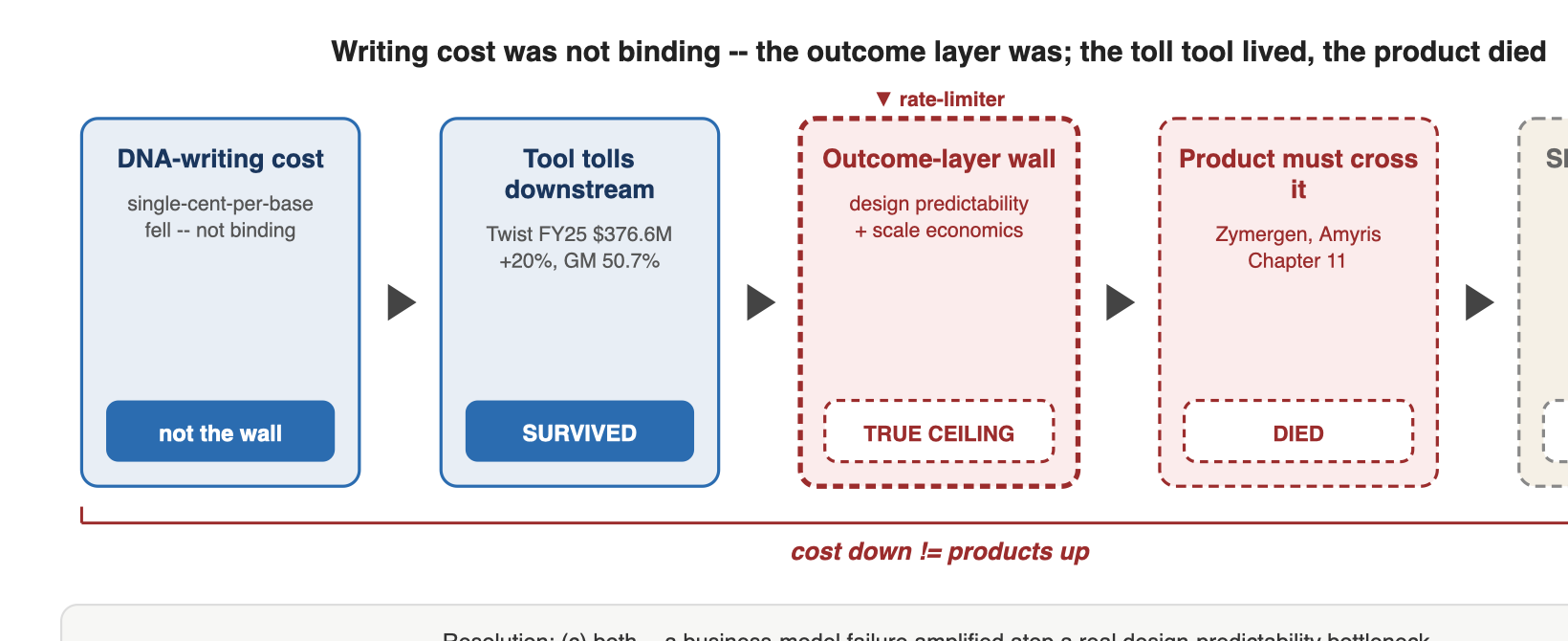
- So what. The winter is best explained as neither pure science failure nor pure business failure but both. The proximate cause was a business-model failure (SPAC overheating, platform over-promise, B2C forward-integration), but it was amplified on top of a real, unresolved design-predictability bottleneck. DNA-writing cost is not the binding constraint — the firm’s recurring lens holds: the real bottleneck is at the outcome layer (does a designed part behave predictably in the cell, and does it reproduce economically at scale). The tool that collects a toll downstream of that bottleneck lived; the product that has to cross it itself died.
- Now what. Twist’s FY2026 adjusted-EBITDA breakeven is a stated target, not an achieved result — it remains pre-breakeven. Ginkgo’s pivot toward data/foundry assets is real but its economics are unverified. And global synbio market-size estimates are internally inconsistent across vendors (2024 figures span $12.33B–$19.3B) and are flagged, not used as load-bearing. This installment also closes the synthetic-biology series: the through-line is that the bottleneck sits at the outcome layer, isomorphic to AI-protein design’s in-silico→wet-lab gap and energy storage’s lab→GWh gap.
The five-minute read
The paradox: the “platform” that drew the headlines died; the “tool” that never did survived
The commercial map of synthetic biology mirrors the pattern this series found in energy storage — “the chemistry that draws the lab-property headline is separate from the chemistry that has revenue.” Here the platform / product model that captured the capital-markets narrative (Ginkgo’s programmable cell, Zymergen’s ML-foundry, Amyris’s B2C brand) foundered, while the tools / DNA-synthesis model whose story was never flashy (Twist’s picks-and-shovels) survived and approached breakeven. That separation is the central fact of the synbio winter.
In numbers: Twist Bioscience reported FY2025 record revenue of $376.6M (+20% YoY, from $313.0M), gross margin 50.7% (from 42.6%), across 11 consecutive quarters of sequential growth, with an FY2026 adjusted-EBITDA breakeven target and a Q1 FY2026 record of $103.7M (SEC 8-K / company). By contrast, Zymergen — a 2021 IPO raising $575M at a ~$3B valuation (~$5B at peak) — collapsed within four months (−68% in August 2021, conceding zero product revenue), was acquired by Ginkgo for ~$300M in all-stock in 2022, and filed Chapter 11 in October 2023. Amyris filed Chapter 11 (August 2023) after a failed B2C pivot. Ginkgo posted FY2025 revenue of $170M (−25%, from $227M), cut >50% of staff cumulatively, and executed a 1-for-40 reverse split in 2024.
The firm’s read: the winter was a test of which business model could withstand the outcome-layer bottleneck
The winter was not about whether “synthetic biology works,” but about which business model could withstand the outcome-layer bottleneck. What survived was the tool that collects a toll downstream of the bottleneck — DNA synthesis sells whether the customer’s design succeeds or fails. What died was the product/platform that must cross the bottleneck itself before it books revenue: the design has to behave as predicted in the cellular context and reproduce economically in the fermentation tank. Because the bottleneck is real, the downstream tool is structurally safer than the upstream product. This resolves the series’ central question (below): the winter was a business-model failure amplified atop a real science bottleneck.
| Model type | Company (listed/bankrupt) | Commercial position (attributed) | Status |
|---|---|---|---|
| Tool / DNA synthesis (picks-and-shovels) | Twist Bioscience (TWST) | FY2025 record revenue $376.6M (+20%), GM 50.7% (FY24 42.6%); Q4FY25 $99.0M; 11 consecutive growth quarters; FY2026 adj-EBITDA breakeven target; Q1FY26 record $103.7M | Volume production, near-breakeven (pre-breakeven) |
| Platform (cell-programming) | Ginkgo Bioworks (DNA) | FY2025 revenue $170M (−25%, from $227M); Cell Engineering $133M (−24%, from $174M); Q1’26 revenue $19M (biosecurity divestiture effect); >50% cumulative layoffs (2024 Q2–); cash $373M, no debt; FY2026 cash-burn guidance $125–150M; 1-for-40 reverse split (2024) | Restructuring, revenue contraction |
| ML-foundry (precedent collapse) | Zymergen (bankrupt) | 2021-04 IPO $575M (~$3B valuation, peak ~$5B); 2021-08 −68% (zero product revenue conceded; Hound electronic-film technical issue); 2022 Ginkgo ~$300M all-stock acquisition; 2023-10-03 Chapter 11 (Delaware) | Collapse → acquisition → re-bankruptcy |
| B2C biomanufacturing (failed pivot) | Amyris (bankrupt) | 2023-08-09 Chapter 11 (Delaware); consumer brands (Biossance et al.) divested; refocus on core R&D/scale-up and sustainable ingredients; Foris Ventures DIP financing | Bankruptcy, asset disposal |
Deep dive
1. Background — a winter sorted by business model, not a uniform crash
The defining feature of the synbio winter is that it was selective survival sorted by business model, not an indiscriminate collapse. Three axes decompose it.
- Downstream toll (tool) vs upstream risk (product). Twist (DNA synthesis) collects a toll downstream of the outcome-layer bottleneck — a customer orders DNA whether their design ultimately succeeds or fails. Ginkgo/Zymergen (platform) and Amyris (product) book revenue only if they cross the bottleneck themselves (the design must work in the cell and reproduce economically in fermentation). As long as the bottleneck is real, the tool is structurally safer than the product — the synbio version of “picks-and-shovels outlive the gold-miner.”
- Announced pipeline is not revenue. The SPAC-era platform story was “hundreds of programs” (Ginkgo), yet actual revenue is Cell Engineering at ~$133M (FY2025) and contracting −24%. Zymergen was the extreme case: pipeline announcements versus zero product revenue. Announced pipeline is not shipped, recurring revenue — the biological analogue of “announced capacity is not shipped” (Northvolt) in energy storage.
- The B2C forward-integration trap. Amyris forward-integrated from ingredients (metabolic engineering) into consumer brands, burning marketing and distribution capital before its biomanufacturing cost advantage was established; the Chapter 11 refocus retreated to core R&D/scale-up and sustainable ingredients. The surviving posture was B2B upstream (ingredients, tools, licensing) — the direction of both Twist and Ginkgo’s restructuring.
2. What this landscape establishes — company positions (all attributed)
Principle: revenues, margins, valuations, layoff rates and bankruptcy facts are reported as in the source; company claims are separated from institutional statistics and vendor market estimates; announced pipelines are not treated as revenue.
- Twist (the tool survivor): the winter’s one clear survival-and-growth model. FY2025 $376.6M, GM 50.7%, 11 consecutive growth quarters — an empirical demonstration of the picks-and-shovels logic that “DNA sells whether the customer’s design succeeds or fails.” The caveat: breakeven is still a target (FY2026 adj-EBITDA), not an achieved result — near-breakeven but pre-breakeven. Silicon-chip gene synthesis (gene fragments at single-cent-per-base scale) is the cost-curve substructure of the model.
- Ginkgo (the platform contraction): the cell-programming platform narrative (“hundreds of programs”) did not convert into revenue. FY2025 revenue −25%, Cell Engineering −24%, >50% cumulative layoffs and a 1-for-40 reverse split are the ex-post correction of platform-economics over-promise. It retains survival capacity (cash $373M, no debt) and is restructuring around biosecurity divestiture and data/foundry assets, whose economics remain in the unverified column.
- Zymergen (the ML-foundry cautionary tale): the archetype of platform-narrative collapse. Four months after a ~$3B IPO the stock fell 68% (its lead product, Hound electronic film, hit market-scaling technical problems; zero product revenue), it was acquired by Ginkgo for roughly one-tenth of IPO value (~$300M), and re-entered bankruptcy in 2023. The gap between “an ML-plus-automation foundry produces products” and actual commercial product was most dramatically exposed here.
- Amyris (the failed B2C pivot): a metabolic-engineering ingredients company that forward-integrated into consumer brands and exhausted its cash. The Chapter 11 retreat back to core R&D/scale-up and sustainable ingredients repeats the lesson that “a successful engineering pathway is not the same as profit in a consumer market.”
Market-size flag (skeptic catch): global synbio market-size figures are severely internally inconsistent across vendors — 2024 estimates run $12.33B / $14.5B / $17.88B / $19.3B (up to ~1.6x spread), CAGR spans 19.3–26.1%, and forward views diverge from $31.52B (2029) to $126.9B (2034). Because market definition (tools-only vs finished-product-inclusive) and methodology differ by vendor, no single market-size figure can be fixed. It is flagged/unverified and is not cited in the argument — the same skeptic discipline applied elsewhere in the firm’s work to internally inconsistent vendor valuations and refuted market-size claims.
3. Synthesis — resolving the series’ central question (science vs business)
The landscape installment posed three falsifiable hypotheses. The commercial evidence shifts the center of gravity clearly.
- (a) Business-model failure — science advanced; the collapse was SPAC overheating and platform-economics over-promise. Support: DNA-writing cost, genome-scale writing and circuit automation kept advancing through the winter; Zymergen’s direct trigger was a lead-product market failure and an overheated valuation (−68% in four months), not “engineering biology doesn’t work”; Twist’s survival shows the tool model can withstand the winter. Strongly but partially supported — the business model (SPAC, B2C, platform) is genuinely the proximate cause.
- (b) Science failure / craft-dependence — context-dependence beat predictable, modular design. Support: it was precisely the product/platform models — the ones that must cross the outcome-layer bottleneck (design predictability, scale-up) — that died; Amyris’s B2C failure repeats “pathway success is not scale economics”; the minimal genome is still not fully understood. Partially supported — pure “the science doesn’t work” is an overstatement (writing and automation advanced), but the design-predictability bottleneck is real and it selectively killed the product models.
- (c) Both — the strongest fit to current data. The exact split of “tools lived (evidence for a) / products died (evidence for b)” is what hypothesis (c) predicts: a business-model failure amplified on top of a real science bottleneck. DNA-writing cost fell to single-cent-per-base, yet shipped, profitable synbio products did not multiply in proportion (observation of the landscape’s falsifiable prediction 1) — cost was not the binding constraint. And the survivor, Twist, approaches breakeven on tools/DNA-synthesis revenue rather than product royalties (observation of falsifiable prediction 3). Both predictions are observed at once.
Resolution: the weight of current data favors (c) — both. The winter is not a dichotomy but a compound: (i) the proximate cause is a business-model failure (SPAC overheating, platform over-promise, B2C forward-integration), and (ii) that failure occurred atop an unresolved design-predictability science bottleneck — without the bottleneck, the platform/product models might have booked revenue. Neither (a) alone nor (b) alone fits: if only (a), products should have followed the cost decline; if only (b), the tool model should not have survived either.
4. Neighbouring domains — synbio as the BUILD/WRITE layer of DBTL
Synthetic biology is the BUILD/WRITE layer of the Design-Build-Test-Learn (DBTL) cycle, and the winter connects directly to three sibling series.
- AI-protein design (the DESIGN layer, “D”): the winter’s root bottleneck (design predictability) is the same outcome-layer gap as the AI-protein finding that “in-silico success is not wet-lab-validated function; zero marketed de-novo protein drugs.” The reason the platforms’ “programmable biology” narrative did not convert to revenue is exactly that designed parts and pathways do not behave as predicted in the cellular context — a shared outcome layer.
- In-vivo gene editing (the WRITE-in-place layer): editing locally rewrites an existing genome; synbio writes a genome anew. In-vivo editing reached “marketed products with hard outcomes” via CRISPR therapeutics, whereas synbio biomanufacturing products foundered at commercial scale — a contrast in which write-in-place (therapy) crossed the commercialization threshold before de-novo write (manufacturing). The bottleneck is not the modality but reproducibility and economics at scale.
- Bio-foundation-models (the LEARN layer, “L”): if the winter is both a business failure and a science bottleneck (c), the exit is AI-guided design plus biofoundry actually raising design predictability and collapsing DBTL iterations. But the bio-FM series’ conclusion (cell foundation models underperforming a linear baseline; zero marketed drugs) warns that context-dependence may beat learning — and Ginkgo’s bet on data/foundry assets rides on this question.
- Energy-storage / materials (an isomorphic outcome layer): the Zymergen/Amyris founderings are the same announced-is-not-operational failure mode as Northvolt’s bankruptcy. Energy storage’s “lab-cell properties (844 Wh/L) vs GWh $/kWh,” AI-protein’s “in-silico vs wet-lab,” and synbio’s “lab titer / announced pipeline vs commercial-scale economics” are all domain variations on “the headline is the entry point; the bottleneck is the outcome layer.” Even the structure — the survivor being the incumbent tool (LFP ↔ Twist DNA synthesis) — is isomorphic.
5. Commercialization and competitive context
- Maturity (TRL frame): DNA-writing capability is demonstrated (writing cost fell to single-cent-per-base; genome-scale writing and circuit automation shown), but that is capability, not a commercial product. The gating layer is design predictability and scale-up economics, not writing cost.
- Twist Bioscience (TWST): the clearest survival-and-growth model (FY2025 $376.6M, GM 50.7%, 11 consecutive growth quarters). Its FY2026 adjusted-EBITDA breakeven is a stated target, not an achieved result — near-breakeven but pre-breakeven.
- Ginkgo Bioworks (DNA): the platform model in contraction (FY2025 revenue −25%, Cell Engineering −24%, >50% cumulative layoffs, 1-for-40 reverse split), but with survival capacity (cash $373M, no debt) and a restructuring around data/foundry assets whose economics are unverified.
- Zymergen (bankrupt): the ML-foundry cautionary precedent (~$3B IPO → −68% in four months → ~$300M acquisition → 2023 Chapter 11). Stated as neutral fact.
- Amyris (bankrupt): the failed B2C forward-integration (Chapter 11, August 2023; consumer brands divested; refocus on core ingredients). Stated as neutral fact.
- Company implications are limited to neutral, source-attributed description; financials, margins, valuations and layoff rates are attributed to each company’s SEC filings/press releases and the trade press. Competitive or success/failure statements are not buy/sell signals. The global synbio market-size figure is internally inconsistent across vendors and is flagged/unverified.
6. The skeptic’s bottom line
- Near-breakeven is not breakeven: Twist’s FY2026 adj-EBITDA breakeven is a target, not an achieved result — pre-breakeven.
- Announced pipeline is not revenue: Ginkgo’s “hundreds of programs” and Zymergen’s pipeline versus actual (in Zymergen’s case, zero) product revenue.
- A successful pathway is not a market win: Amyris and the artemisinin precedent — engineering success does not equal profit in a consumer market.
- Market size is internally inconsistent: 2024 vendor estimates span $12.33B–$19.3B; a single market-size figure cannot be fixed (flag), and it is not used as load-bearing.
- The (c) resolution is conditional on current data: it is open to the AI-plus-foundry (Part 4) result — if AI-guided design actually closes the design-predictability gap, hypothesis (b) weakens.
- Neutral-framing note: to prevent misreading listed/bankrupt-company (Ginkgo DNA, Twist TWST, Amyris, Zymergen) success/failure descriptions as security signals; Amyris/Zymergen are bankruptcies, so even the negative facts are handled as neutral, source-attributed statements only.
7. What to watch (falsifiable) + series retrospective
- P1 — the survivor’s breakeven (decides a/c): if Twist actually achieves FY2026 adj-EBITDA breakeven and stays profitable on DNA-synthesis/NGS tool revenue, the winter was a business-model failure with the tool science intact (strengthens a and c). If breakeven slips again, even the tool model is fragile (toward b). (Check: Twist FY2026 results.)
- P2 — first-pass design hit rate (discriminates b, ties to Part 4): if Ginkgo’s data/foundry restructuring plus AI-guided design collapses DBTL iterations and hits commercial titer on first-pass design, the design-predictability bottleneck has improved (weakens b) → the winter re-reads as pure business-model failure. If dozens of craft iterations are still needed, the context-dependence ceiling persists (strengthens b and c). (Check: Part 4 / foundry performance data.)
- P3 — cost-to-product correlation (discriminates c): if DNA-writing cost falls further (enzymatic synthesis commercialization) yet shipped, profitable biomanufacturing products still do not multiply in proportion, cost was confirmed not to be the bottleneck (outcome-layer bottleneck; strengthens c). If products instead explode as cost falls, cost was the bottleneck (weakens c). (Check: post-winter product shipment data.) Symmetric to energy-storage Northvolt and bio-FM’s “zero marketed drugs.”
Series retrospective (synthetic-biology): the series traced the BUILD/WRITE layer of DBTL from landscape, through DNA synthesis/writing, genetic circuits/chassis, metabolic engineering/biomanufacturing, biofoundry/DBTL automation-plus-AI, to this commercial synthesis. Three through-lines: (1) the real bottleneck is neither DNA-reading nor DNA-writing cost but the outcome layer — design predictability plus scale-up economics/reproducibility; writing cost fell to single-cent-per-base, yet shipped, profitable products did not follow. (2) What survived is the tool that collects a toll downstream of the bottleneck; what died is the product/platform that must cross it — the winter is (c), a business-model failure amplified atop a real design-predictability bottleneck. (3) The exit is actually raising design predictability — whether AI-plus-foundry closes the DBTL loop decides the next cycle, and the bio-FM warning (context-dependence may beat learning) keeps it undecided. In the firm’s through-line, synthetic biology is the biomanufacturing instance of “the real bottleneck is at the outcome layer,” isomorphic to AI-protein design’s in-silico→wet-lab gap and energy storage’s lab→GWh gap, down to the structural detail that the survivor is the incumbent tool.
References
- Ginkgo Bioworks. 2026. Earnings press release (FY2025 revenue $170M, Cell Engineering $133M, Q1’26 $19M, cash $373M, FY2026 cash-burn guidance). SEC EDGAR (Ex-99.1). sec.gov/…/ex991earningspr.htm
- Ginkgo Bioworks. 2025. Form 10-Q (dna-20250930; cumulative layoffs, segment revenue, reverse split). SEC EDGAR. sec.gov/…/dna-20250930.htm
- GenomeWeb. “Ginkgo Bioworks to Lay Off 35 Percent of Workforce” (layoff reporting). genomeweb.com/…/ginkgo-bioworks-lay-35-percent-workforce
- Twist Bioscience. 2025. Earnings press release (FY2025 revenue $376.6M, GM 50.7%, Q4FY25 $99.0M, breakeven target). SEC EDGAR (twst-20250930-ex99.1). sec.gov/…/twst-20250930xex991.htm
- Twist Bioscience. Investor materials (segment growth, Q1FY26 record $103.7M). investors.twistbioscience.com/static-files/af6dbd56-d91e-429e-b337-a8e2675fc255
- Feldman, Amy. 2021. “The Inside Story of How SoftBank-Backed Zymergen Imploded Four Months After Its $3 Billion IPO.” Forbes, 13 October 2021. forbes.com/…/zymergen-imploded-four-months-after-its-3-billion-ipo
- GEN (Genetic Engineering & Biotechnology News). “Synbio Synergy: Ginkgo to Acquire Troubled Zymergen for $300M.” genengnews.com/…/ginkgo-to-acquire-troubled-zymergen-for-300m
- FierceBiotech. “Seven Months After Announcing Pivot to Drug Discovery, Zymergen Acquired by Ginkgo.” fiercebiotech.com/…/zymergen-acquired-ginkgo
- Amyris. 2023. Chapter 11 press release (2023-08-10; Delaware; consumer-brand divestiture, Foris DIP financing). SEC EDGAR (Ex-99.1). sec.gov/…/a20230810xex991pressrelease.htm
- GlobeNewswire. 2024. “Synthetic Biology Market Worth $12.33 Billion in 2024…” (one vendor estimate; flagged as internally inconsistent across vendors, not load-bearing). globenewswire.com/…/Synthetic-Biology-Market-Worth-12-33-Billion-in-2024
Disclosure
This post is for information only and is not investment advice.
COI note: this post describes listed companies (Ginkgo Bioworks DNA, Twist Bioscience TWST) and bankrupt/acquired companies (Amyris [Chapter 11, 2023-08], Zymergen [collapsed after its 2021 IPO, acquired by Ginkgo in 2022, re-filed Chapter 11 in 2023]) in a descriptive, neutral, source-attributed context. Revenues, margins, valuations and layoff rates are attributed to each company’s own reporting (SEC 8-K/10-Q, corporate press releases) and the trade press; company claims are separated from institutional statistics and vendor market estimates. Many financials and valuations are often unverified in detail and are labeled as such; the global synbio market-size figure is internally inconsistent across vendors and is flagged/unverified. Announced pipelines are not treated as revenue, and announced capacity is not shipped. Negative facts about bankrupt/acquired companies (Amyris and Zymergen) are stated as neutral fact only. Quantitative claims are attributed to the vendor, author or press release/filing. Competitive or success/failure statements are factual, neutral descriptions and are not buy/sell implications for any security. The author holds no position in, and has no financial interest in, the companies named.


Leave a comment