Evidence-first notes on bioscience and deep tech, at the edge of the lab and the market. Information only — not investment advice. All sensitivity, stability and precision figures are attributed to the specific instrument, trial or company; peer-reviewed results, company claims and agency projections are labeled and kept separate (noted inline). Sensitivities quoted for different instruments measure different physical quantities in different units and are not head-to-head comparisons.
The 30-second version
- What. Quantum sensing uses the coherence of single or few quantum systems (atoms, ions, nitrogen-vacancy [NV] centers, atom ensembles) to measure time, magnetic field, gravity, rotation and RF. On the headline metric it is the most mature quadrant of quantum technology — unlike quantum computing, it already fields real instruments without error correction. Optical-lattice/ion clocks reach fractional uncertainty in the 10⁻¹⁹ range (JILA ⁸⁷Sr 8.1×10⁻¹⁹, peer-reviewed; NIST ²⁷Al⁺ 5.5×10⁻¹⁹), atom-interferometry absolute gravimeters are field-deployed (Exail AQG on volcano monitoring), and optically-pumped-magnetometer (OPM) MEG is in clinical research.
- So what. The headline (lab sensitivity/stability record) is largely met; the real bottleneck is elsewhere — the outcome layer: (1) whether that lab sensitivity translates into a field-deployable instrument (SWaP: size-weight-power-cost), and (2) whether the deployed device moves beyond “quantum-enabled” (it uses quantum physics) to “classical-beating advantage” (it actually beats the best classical sensor) in a real application. These are not the same thing. Lab sensitivity record ≠ deployable instrument ≠ beats classical — a triple gap.
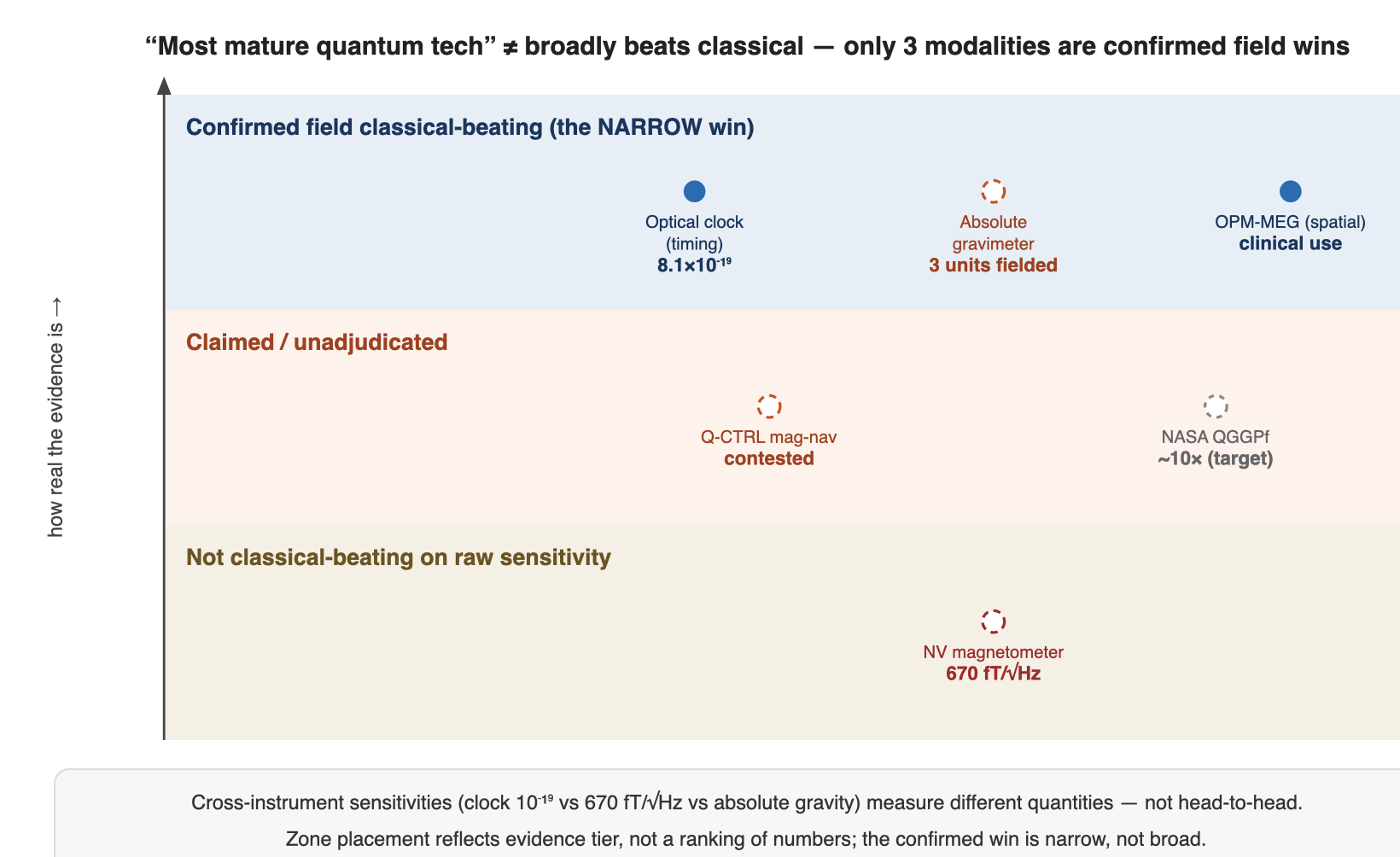
- Now what. The genuine, field, classical-beating win is narrow, not broad: it is clear for timing (optical clocks at 10⁻¹⁹), for drift-free absolute gravimetry (Exail AQG), and for OPM spatial resolution — and it is not yet established for NV magnetometry (whose raw sensitivity is 2–3 orders below SQUID/OPM; its edge is nanoscale spatial resolution, a different axis) or for quantum imaging/RF. The claim that “quantum sensing already broadly beats classical sensors in the field” is refuted as overstatement. Q-CTRL’s “commercial quantum advantage” in magnetic navigation is a company preprint claim, not independently adjudicated.
The five-minute read
The most mature quadrant of quantum tech — and why the outcome layer still splits it
Quantum sensing reproduces the firm’s recurring lens — “the headline is the starting point; the real bottleneck is the outcome layer” — but from the opposite position to the quantum-computing series. Quantum computing, even past below-threshold error correction (Willow, Λ=2.14), is still three-to-four orders of magnitude away from useful fault-tolerant computation. Quantum sensing, by contrast, already fields clinical and field-grade instruments using nothing more than the coherence of single or few quantum systems — no error correction required. It is the most mature corner of quantum technology.
Yet a mature quadrant still has an outcome-layer gap. The headlines here are usually lab sensitivity and stability records (fractional uncertainty 10⁻¹⁹, fT/√Hz, µGal). The real bottleneck is two-fold: does that sensitivity survive translation into a field-deployable instrument (SWaP), and does the deployed device deliver a classical-beating advantage — a real edge over the best classical sensor — rather than merely being “quantum-enabled”? Some modalities (optical-clock timing, drift-free absolute gravimetry) have clearly won; some (NV magnetometry’s raw sensitivity) have not yet beaten classical and hold their edge on a different axis; and some claims (quantum navigation’s “advantage”) remain contested.
Four modalities, one shared bottleneck
The landscape places atomic clocks/timing (optical-lattice/ion clocks, chip-scale atomic clocks [CSAC]) at the core, with NV/solid-state magnetometry, atom-interferometry gravity/inertial, and quantum imaging/RF as adjacent axes. They belong together because all four share the same outcome-layer bottleneck — lab-sensitivity headline vs field SWaP vs classical-beating — while each sits at a different point along that gap.
| Modality | Record figure (attributed) | Status (field vs lab) | Source type |
|---|---|---|---|
| Optical-lattice clock (JILA ⁸⁷Sr) | Systematic uncertainty 8.1×10⁻¹⁹ (2024-07) | Lab (room-sized) | Peer-review (PRL 133.023401) |
| Single-ion clock (NIST ²⁷Al⁺) | 5.5×10⁻¹⁹ (near lowest on record) | Lab | Peer-review (upgraded, see below) |
| Chip-scale atomic clock (CSAC, DARPA) | Size 100×↓, power 50×↓ vs lab clock; stability far lower (Cs vapor) | Field-deployed (commercial) | Agency (DARPA) |
| NV magnetometer (diamond) | 670 fT/√Hz, dynamic range 280 µT (“within 3× of best”) | Lab (some portable prototypes) | Preprint/trade |
| OPM magnetometer (atomic vapor) | QuSpin 40 dual-axis (80 channels) + Cerca whole-head OPM-MEG; epilepsy pre-surgical | Clinical research / early commercial | Peer-review (Sci Rep) |
| Atom-interferometry gravimeter (Exail AQG) | Rb absolute gravity, drift-free; 3 units delivered for Tenerife volcano monitoring | Field-deployed (commercial) | Company / optics.org |
| Satellite gravity gradiometer (NASA QGGPf) | Up to 10× classical sensitivity potential (claim) | In development (launch ~late 2020s) | Agency projection (unproven) |
| Quantum imaging / RF (squeezed light, Rydberg RF) | Specific SNR-advantage demos | Mostly lab | Industry general (secondary) |
| Navigation anchor — Q-CTRL magnetic navigation | 6,700+ km flight (2025-02), 99.97% uptime, error to ~0.01% of distance (~50 m) [blog figures] | Field trial (preprint) | Company / arXiv 2504.08167 |
Deep dive
1. Background — four modality axes and what actually rate-limits each
- Atomic clocks / timing (most mature — already beats classical): lab optical-lattice/ion clocks reach fractional uncertainty in the 10⁻¹⁹ range, dominating the cesium primary standard — here the quantum advantage is unambiguous. The rate limiter is not sensitivity but SWaP: the lab optical clock is room-sized, while the field-deployed CSAC has far lower stability (§4). “Best sensitivity” and “deployable” are not the same instrument.
- NV / solid-state magnetometry (mid maturity — classical-beating conditional): the diamond NV center’s strength is room-temperature operation, nanoscale spatial resolution and vector measurement — not raw sensitivity. On raw sensitivity, SQUID (cryogenic) and OPM (atomic vapor) beat NV. The rate limiter is the definition of the target application: NV wins for nanoscale imaging; OPM/SQUID win for bio-magnetometry raw sensitivity.
- Atom-interferometry gravity/inertial (mid-high maturity — already deployed in a niche): atom-interferometry absolute gravimeters offer drift-free absolute measurement — they lack the long-term drift of superconducting (classical) gravimeters. The Exail AQG is already field-deployed on volcano monitoring (§2). The rate limiter is extension to inertial navigation / gyroscopy, where SWaP, vibration and attitude problems are unsolved.
- Quantum imaging / RF (low maturity — mostly lab): entanglement/squeezed-light imaging (ghost imaging, quantum illumination), Rydberg-atom RF reception. Specific SNR-advantage demos exist, but field classical-beating is mostly unverified — this axis sits at the earliest point of the triple gap (treated in Part 5).
2. What this landscape establishes — principles, records and status (instrument/announcement-attributed)
Principle: each sensitivity figure is a within-device number for a specific instrument/trial; peer-review, company claim and agency projection are separated; cross-instrument sensitivities are cross-claims, not head-to-head.
- Atomic clocks (axis 1): the only axis that has already won at the outcome layer. Lab optical clocks at 10⁻¹⁹ dominate classical (quantum advantage unambiguous). But the bottleneck is SWaP — the deployed CSAC has lower stability, the textbook case of “best sensitivity ≠ deployable instrument.” JILA ⁸⁷Sr 8.1×10⁻¹⁹ (PRL 133.023401, 2024-07, peer-reviewed); NIST ²⁷Al⁺ 5.5×10⁻¹⁹; DARPA CSAC size 100×↓/power 50×↓; DARPA ACES targets a 1,000× improvement in temperature/aging/retrace.
- Magnetometry (axis 2): quantum-enabled but classical-beating only conditionally. NV’s edge is not raw sensitivity but room-temperature operation and nanoscale spatial resolution. For bio-magnetometry raw sensitivity, OPM (atomic vapor) is in actual clinical deployment (QuSpin 80 channels + Cerca whole-head, epilepsy pre-surgical evaluation, Sci Rep), attempting to displace SQUID-MEG. The separation of “quantum label” from “beats classical” is sharpest here.
- Atom interferometry (axis 3): already field-deployed in the clear niche of drift-free absolute measurement (Exail AQG, three units delivered for Tenerife volcano monitoring). The edge is not instantaneous sensitivity but long-term stability / absoluteness. Inertial-navigation extension and satellite gravity remain unverified (agency projection: NASA QGGPf, up to 10× classical, unproven, launch ~late 2020s).
- Imaging / RF (axis 4): earliest point of the triple gap — lab SNR demos exist, but field classical-beating is mostly unverified (deferred to Part 5).
- Navigation anchor — Q-CTRL: a magnetic-anomaly-navigation field trial (2025-02, Griffith, Cessna 208B; blog figures 6,700+ km, 99.97% uptime, error to ~0.01% of distance/~50 m; arXiv 2504.08167). Impressive, but the “commercial quantum advantage” label is a preprint-based company claim; whether it beats the best classical magnetic navigation plus software is contested.
Attribution caution: the sensitivities above are within-device figures. JILA 8.1×10⁻¹⁹ (clock uncertainty) vs NV 670 fT/√Hz (magnetic sensitivity) vs Exail absolute gravity measure different physical quantities in different units — they are not head-to-head and no ranking should be drawn. Company performance claims (Infleqtion 100×, Q-CTRL “quantum advantage”) stay company claims until third-party reproduction under the same protocol.
3. The central falsifiable question — does lab sensitivity beat classical in the field?
Timing and drift-free absolute gravimetry have already won at the outcome layer (field deployment plus beats-classical). So where does the rest of the strong lab-sensitivity headline resolve? Three hypotheses, each with an explicit falsification condition.
- (a) Narrow win — field classical-beating holds only for specific modalities/applications, and the rest remains merely quantum-enabled. Evidence: timing (optical clocks 10⁻¹⁹) and absolute gravity (Exail AQG on volcano monitoring) clearly won, but NV magnetometry is inferior to SQUID/OPM on raw sensitivity (its edge is nanoscale spatial resolution) and quantum imaging/RF field classical-beating is unverified. Falsified if NV magnetometry or quantum imaging actually beats the best classical sensor (SQUID/OPM, classical optics) in the field under the same protocol.
- (b) Broad win — quantum sensing soon displaces classical across many applications (“the near-term quantum winner”). Evidence: commercial vendor deployments (Infleqtion, SandboxAQ, Q-CTRL), defense PNT demand, and commercialization of CSAC/OPM/AQG. Falsified if the CSAC stability-vs-SWaP trade-off persists, if a Q-CTRL-type “advantage” turns out not to beat the best classical sensor plus software, or if vendor performance claims slip under third-party reproduction. (Watch for vendor-hype history.)
- (c) Dual-use pull — defense PNT (GPS-denied) and bio (MEG/MCG) each pull deployment in separate applications. Evidence: DARPA ACES, Q-CTRL AQNav, Vector Atomic (→IonQ) PNT demand alongside QuSpin/Cerca OPM-MEG clinical demand share the same magnetometer/clock modalities. Falsified if OPM-MEG fails to displace SQUID-MEG clinically (shielding/cost) or if GPS-denied navigation fails to beat classical inertial-plus-map-matching.
Current provisional position: none of the three can be excluded, but (a) best fits current data (timing/absolute gravity are confirmed field classical-beating; magnetometry/imaging are application-specific and conditional), with (c) dual-use pull also supported. The deciding evidence for (b) is the CSAC/OPM SWaP-sensitivity trade-off and third-party reproduction of vendor claims; for (c) it is OPM-MEG clinical displacement and GPS-denied navigation field results. Part 0 does not commit to any one; it holds all three falsifiable.
4. The field-deployment / SWaP bottleneck — where the firm’s lens bites
- Lab sensitivity ≠ field-deployable ≠ useful instrument. The lab optical clock’s 10⁻¹⁹ is the product of a room-sized, vibration-isolated, expert-operated setup. The field-deployed CSAC gains size 100×↓ and power 50×↓ (DARPA) at the cost of several orders of stability (Cs vapor cell). “Sensitivity record” and “deployable instrument” are not the same object — sensitivity record ≠ useful instrument. This is the outcome layer the firm’s lens bites (Parts 1 and 4).
- Quantum-enabled ≠ quantum-advantage over best classical. The NV magnetometer is a “quantum sensor” but does not beat SQUID/OPM on raw sensitivity — its edge is on the different axis of nanoscale spatial resolution. Reading this as “NV is the best magnetometer” is hype. Classical-beating can only be judged with the application (measured quantity, scale) fixed (the quantum version of the analysis-standards §2 demo-gap).
- Company claim ≠ peer-review ≠ agency projection. Q-CTRL’s “first commercial quantum advantage” is a company claim based on an arXiv preprint (2504.08167); the trial itself is impressive, but whether the “advantage” beats the best classical magnetic navigation plus software is contested. NASA QGGPf’s “10× classical” is an agency projection (unproven). Infleqtion’s “100× precision” is a company claim. Lumping the three together is hype — each is verified separately by Part.
- Dual-use demand structure. Defense PNT (GPS-denied timing, magnetic navigation, inertial) and bio (OPM-MEG, MCG) share the same magnetometer/clock modalities. Commercial logic emerges simultaneously from defense contracts (DARPA ACES, DoD APFIT, Vector Atomic→IonQ) and clinical use (QuSpin/Cerca) — application demand, not any single physics breakthrough, pulls modality maturity.
5. Commercialization and competitive context
- Maturity (TRL frame): the most mature quantum-tech quadrant overall — timing and absolute gravity are field-deployed (high TRL), while NV magnetometry field classical-beating and quantum imaging/RF are early (low TRL). The gating layers are SWaP and classical-beating, not raw sensitivity.
- Infleqtion: $1.8B SPAC merger (2026-02), Tiqker atomic clock, prior-year revenue ~$30M, ~$200M pipeline, DoD APFIT $11M (company/BusinessWire). Valuation and pipeline detail are company claims.
- SandboxAQ: AQNav (magnetic-anomaly navigation), CardiAQ (cardiac imaging / magnetocardiography), cumulative funding $1.4B+ (company). CardiAQ clinical-validation status is unverified.
- Vector Atomic → IonQ (IONQ): acquired by IonQ (announced 2025-10-07, all-stock). Correction: the “$200M+” figure is Vector Atomic’s held government contracts, not the acquisition price; the acquisition price is undisclosed.
- Q-CTRL: magnetic-anomaly navigation field trial (2504.08167); the “commercial quantum advantage” is a preprint company claim, not third-party adjudicated. Note the blog figures (6,700 km, 99.97%, ~50 m) differ from the arXiv figures (22 m, 0.006%, ≥11× vs INS) — reported as blog-vs-paper discrepancy.
- Exail (formerly iXblue): AQG absolute gravimeter, three units delivered for Tenerife volcano monitoring (company/optics.org) — the clearest commercial field classical-beating in a niche.
- NASA QGGPf: satellite gravity-gradiometer pathfinder (with AOSense, Infleqtion, Vector Atomic; launch ~late 2020s); the “10× classical” figure is an agency projection, unproven.
- Company statements are limited to neutral, instrument/announcement-attributed description; competitive or performance-ranking statements are not buy/sell signals. Deal terms (IonQ/Vector Atomic price, government-contract detail, Infleqtion SPAC valuation) are unverified in detail (attributed to company/trade-press sources).
6. The skeptic’s bottom line
- Quantum-enabled ≠ classical-beating: the “quantum sensor” label does not mean it beats the best classical sensor. NV magnetometry is 2–3 orders below SQUID/OPM on raw sensitivity (edge = nanoscale spatial resolution, a different axis).
- Sensitivity record ≠ deployable instrument: the CSAC trades several orders of stability for its SWaP gains. “Best sensitivity” and “field instrument” are not the same object.
- Company claim ≠ peer-review ≠ agency projection: Q-CTRL “quantum advantage” is a preprint company claim (contested); NASA 10× is an agency projection (unproven); Infleqtion 100× is a company claim. Do not lump them together.
- Cross-instrument sensitivities are not head-to-head: different instruments/protocols measuring different physical quantities cannot be ranked against each other.
- Refuted: “quantum sensing already broadly beats the best classical sensors in the field.” Genuine field classical-beating is limited to timing (optical clocks 10⁻¹⁹), drift-free absolute gravity (Exail AQG) and OPM spatial resolution — narrow, not broad. The common “quantum label = beats classical” hype pattern is the sensing mirror of the computing series’ dequantization risk.
- Neutral-framing note: to prevent misreading listed (IonQ IONQ) and private/SPAC (Infleqtion, SandboxAQ, Q-CTRL, Exail, Vector Atomic) technical success, performance claims and defense (PNT/GPS-denied) demand as security or defense-sector signals.
7. What to watch (falsifiable)
- P1 — CSAC/OPM SWaP-sensitivity: if a next-generation CSAC (DARPA ACES 1,000× target) or OPM demonstrates classical displacement at deployable SWaP, hypothesis (b) broad-win strengthens; if the trade-off persists, it shifts toward (a) narrow-win. (Parts 1, 2.)
- P2 — NV vs OPM/SQUID: if NV magnetometry beats OPM/SQUID on bio-magnetometry raw sensitivity under the same protocol, or conversely stays confined to the nanoscale-imaging niche, the application boundary of classical-beating is fixed (a↔b). If OPM-MEG actually displaces SQUID-MEG clinically, (c) dual-use strengthens. (Parts 2, 5.)
- P3 — GPS-denied navigation: if Q-CTRL/SandboxAQ AQNav/Vector Atomic-type magnetic/inertial navigation demonstrates a real field edge over the best classical (inertial-plus-map-matching) under third-party reproduction and defense PNT contracts convert to actual deployment, (c) strengthens; if the “advantage” turns out to be a software/classical-sensor contribution, (b) weakens. (Parts 3, 5.)
- Also watch: whether the SI second is redefined on optical clocks (a BIPM/CGPM agency roadmap — 2026 option, 2030 CGPM decision, unconfirmed; “optical clocks already redefined it” is refuted), and whether quantum imaging/RF ever produces a field classical-beating result.
References
- JILA / Aeppli et al. 2024. “Clock with 8×10⁻¹⁹ Systematic Uncertainty.” Physical Review Letters 133, 023401 (⁸⁷Sr optical lattice, peer-reviewed). https://link.aps.org/doi/10.1103/PhysRevLett.133.023401 (preprint arXiv:2403.10664)
- NIST. “High-Stability Single-Ion Clock with 5.5×10⁻¹⁹ Systematic Uncertainty” (²⁷Al⁺ quantum-logic clock). https://www.nist.gov/publications/high-stability-single-ion-clock-55-x-10-19-systematic-uncertainty
- DARPA. “Chip-Scale Atomic Clock” (CSAC, size 100×↓ / power 50×↓; ACES program). https://www.darpa.mil/about/innovation-timeline/chip-scale-atomic-clock
- Quantum Zeitgeist. “Diamond Center Magnetometry Achieves 280 µT Dynamic Range / 670 fT/√Hz Sensitivity” (NV magnetometer, preprint/trade). https://quantumzeitgeist.com/280-670-diamond-center-magnetometry-achieves-dynamic-range-sensitivity/
- Scientific Reports. 2024. Whole-head OPM-MEG (QuSpin dual-axis + Cerca), epilepsy pre-surgical evaluation. Sci Rep s41598-024-56878-6. https://www.nature.com/articles/s41598-024-56878-6
- Exail. “Quantum Gravimeters” (AQG, Rb atom-interferometry absolute gravimeter, drift-free). https://www.exail.com/product/quantum-gravimeters
- Optics.org. “Exail AQG delivered for Tenerife volcano monitoring” (three units). https://optics.org/news/16/12/21
- NASA. “NASA-Industry Team Creates and Demonstrates First Quantum Sensor for Satellite Gravimetry” (QGGPf pathfinder; 10× claim is an agency projection). https://www.nasa.gov/earth-and-climate/nasa-industry-team-creates-and-demonstrates-first-quantum-sensor-for-satellite-gravimetry/
- Q-CTRL. “Q-CTRL Overcomes GPS-Denial with Quantum Sensing, Achieves Quantum Advantage” (company claim; magnetic-anomaly navigation). https://q-ctrl.com/blog/q-ctrl-overcomes-gps-denial-with-quantum-sensing-achieves-quantum-advantage (preprint arXiv:2504.08167)
- Infleqtion. “Infleqtion Raises $100M to Scale Atom-Based Quantum Solutions for National Security and Next-Generation Intelligent Systems” (company). https://infleqtion.com/infleqtion-raises-100m-to-scale-atom-based-quantum-solutions-for-national-security-and-next-generation-intelligent-systems/
Disclosure
This post is for information only and is not investment advice.
COI note: this post describes one listed company (IonQ, IONQ — which acquired Vector Atomic) and several private/SPAC companies (Infleqtion, SandboxAQ, Q-CTRL, Exail, Vector Atomic, AOSense, QuSpin, Cerca Magnetics) in a descriptive, neutral context, alongside government agencies (NIST, JILA, DARPA, NASA). Every sensitivity, stability and precision figure is attributed to the specific instrument, trial or announcement, and peer-reviewed results, company claims and agency projections are labeled and kept separate. Defense / PNT (GPS-denied) demand is described factually and neutrally. Quantitative claims are attributed to the vendor, author or preprint (Infleqtion “100×”, Q-CTRL “quantum advantage”, NASA “10×”). Competitive and performance-ranking statements are factual, neutral descriptions and are not buy/sell implications for any security. The author holds no position in, and has no financial interest in, the companies named.


Leave a Reply