Evidence-first notes on bioscience and deep tech, at the edge of the lab and the market. Information only — not investment advice. All funding, valuation and roadmap figures are attributed to the industry association, the company, or the primary filing; many are company press releases, SPAC merger figures or association surveys rather than audited or peer-reviewed data (noted inline). Scientific milestones are attributed to the primary lab or agency.
The 30-second version
- What. The fusion headline is no longer only ignition (NIF’s plasma-level Q>1); it is now a private-capital boom. The Fusion Industry Association’s 2026 report (published July 2026) counts a record $4.48bn raised in the trailing 12 months (+69% year-on-year), $14.24bn cumulative, across 56 companies and 16,000+ staff, with 71% of companies expecting commercial electricity in the 2030s (FIA survey). One company crossed the last frontier of the earlier framing: General Fusion began trading as GFUZ (Nasdaq) on 2026-07-13 via a Spring Valley SPAC merger — the first listed pure-play fusion equity.
- So what. None of that capital has moved the outcome layer. No device has demonstrated engineering-level Q>1; tritium breeding ratio >1, neutron-durable first-wall materials, measured LCOE and delivered grid electricity are all still unproven or unmeasured. Announced ≠ demonstrated; a PPA or a roadmap ≠ an operating plant; scientific Q ≠ engineering Q ≠ wall-plug. And the boom is not homogeneous: capital is extremely concentrated — CFS’s $863M Series B2 alone is roughly one-third of all private fusion capital ever raised, and Helion reached a $15.5B post-money valuation.
- Now what. The current weight of evidence sits on “the milestones are real but commercial power is decades out,” with a shakeout co-present: General Fusion listed only after cutting 25%+ of staff and running short on cash — a distressed SPAC listing, not a healthy large-cap debut. The leaders (CFS, Helion, TAE, Pacific Fusion) remain private, so a large-cap pure-play is still absent and listed exposure runs mostly through HTS-magnet suppliers and fission-SMR adjacents. Verdict: proceed-with-caveats.
The five-minute read
A market where the capital is real but the capital cannot move the outcome layer
The fusion commercial landscape is the mirror image of the space-economy pattern (“launch cost collapsed, but only one company won”), one stage earlier. Space already produced a winner at the outcome layer (cash flow: SpaceX/Starlink); fusion has produced no player at its outcome layer (grid electricity) at all. The headline is now not just ignition (NIF’s plasma-level Q>1) but a private-capital boom — the FIA’s 2026 report tallies a record $4.48bn in the trailing 12 months (+69% YoY), $14.24bn cumulative, 56 companies and 16,000+ staff, with 71% of firms forecasting commercial electricity in the 2030s. Yet that money has moved none of the outcome-layer metrics: no device has demonstrated engineering-level Q>1, and tritium self-sufficiency, neutron-durable materials, measured LCOE and delivered electricity are all still unproven.
Three things 2025–2026 made visible: concentration, distress, and an unbroken outcome barrier
First, capital concentrates to an extreme. Commonwealth Fusion Systems (CFS) raised an $863M Series B2 in August 2025 — its largest round since the 2021 $1.8B Series B, and cumulatively ~$3B, roughly one-third of all private fusion capital worldwide (CFS/TechCrunch). Helion reached $15.5B post-money on a $465M Series G (June 2026). The “$4.48bn boom” did not spread wide; it tilted toward a few leaders. Second, where capital is absent, companies break. General Fusion cut 25%+ of staff and disclosed a $125M gap to its 2027 target in May 2025, took a $22M “pay to play” rescue in August 2025, then merged with Spring Valley Acquisition Corp III to list as GFUZ (Nasdaq) on 2026-07-13 — pro-forma equity ~$1B, cash ~$150M. It is the first listed pure-play, but it is a distressed post-layoff SPAC listing, structurally like the cautionary SPAC space names (StockTitan/TechCrunch). Third, no amount of capital, listing or PPA has crossed the outcome-layer metric (engineering-level Q>1).
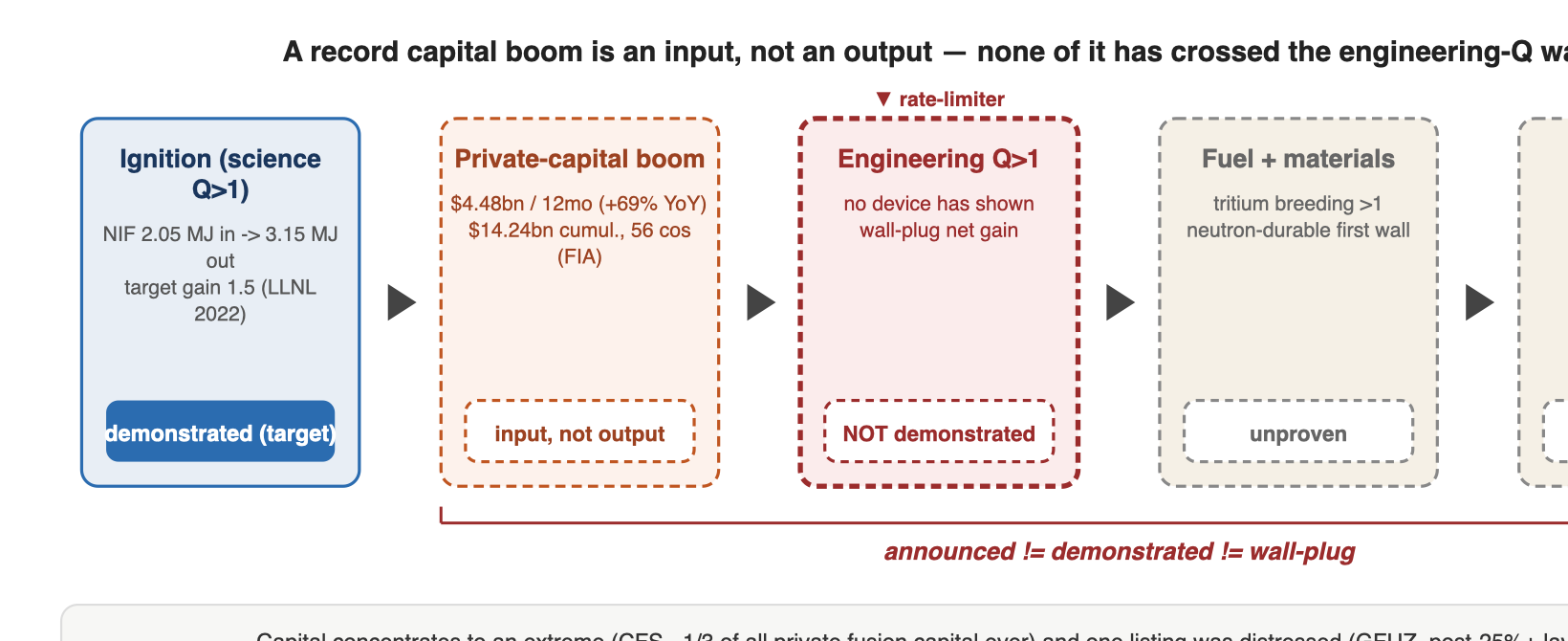
| Layer | Status (2026-07) | Verdict |
|---|---|---|
| Ignition (NIF plasma-level Q>1) | 2.05 MJ in → 3.15 MJ out, target gain 1.5 (LLNL, 2022) — demonstrated at the target | Real, but a target gain, not wall-plug |
| Private-capital boom (headline) | Record $4.48bn/12 months (+69% YoY), $14.24bn cumulative, 56 companies (FIA 2026) | Real, but an input, not an output |
| Engineering Q>1 (whole-plant gain) | Zero — no device has demonstrated it | Bottleneck |
| Tritium breeding (TBR>1) / neutron-durable materials | Unproven; no closed-loop self-sufficiency, no fusion-neutron materials test facility operating | Bottleneck |
| Measured LCOE / grid electricity | None — no operating plant, so no measured cost or delivered power | Bottleneck |
| Listed pure-play exposure | GFUZ (General Fusion) lists 2026-07-13, but distressed/small; leaders (CFS, Helion, TAE, Pacific) private; broad exposure via HTS suppliers + SMR adjacents | Large-cap pure-play still absent |
Deep dive
1. Background — the through-line, and why this landscape sits one stage before space
Across the firm’s series, one lens recurs: “the headline is the entry point; the real bottleneck is at the outcome layer.” In fusion the headline metrics — ignition (NIF plasma-level Q>1) and now a private-capital boom — are genuinely real, but they are inputs. The outcome layer is a stack that must be solved together: engineering-level Q>1 (whole-plant net gain), tritium breeding ratio >1 (self-sufficiency), neutron-durable first-wall materials, repeatable duty-cycle operation, and a competitive LCOE ending in delivered grid electricity. None of these is at the demonstration stage. Space produced a winner at its outcome layer; fusion has not yet placed a single player on the grid. This part surveys the commercial landscape, filters the “commercial in the 2030s” roadmaps against the outcome layer, resolves the series’ central questions, and closes the six-part arc.
2. What this landscape establishes — company positions (all attributed to disclosures/tallies)
Principle: funding, valuations and listings are reported as in the source; capital signals (inputs) are separated from outcome-layer demonstrations (there are none yet); and cross-company comparisons are not head-to-head.
- Commonwealth Fusion Systems (private) — capital anchor. $863M Series B2 (2025-08), its largest since the 2021 $1.8B round; ~$3B cumulative, roughly one-third of all private fusion capital; investors include Nvidia, Google and Breakthrough Energy (Bill Gates) plus a Japanese consortium (Mitsui, Mitsubishi, JERA, Fujikura, Kansai). SPARC completed; ARC (Virginia) in development. Capital-dominant and private; engineering Q>1 unproven (SPARC Q>1 is a ~2027 target, ARC 400 MWe a roadmap).
- Helion Energy (private) — direct-conversion FRC with a big-tech PPA. $465M Series G (2026-06), ~$1.5B cumulative, $15.5B post-money (~3x its Series F), led by Thrive Capital with SoftBank Vision Fund 2, Lightspeed and Bill Ford; a Microsoft PPA (2023-05) for 50 MW in 2028. Capital and PPA secured, but 2028/50 MW is a roadmap/PPA, not an operating plant, and even plasma-level Q>1 has no public demonstration. The ~3x valuation step is a price on future expectation, not a multiple on demonstration.
- Pacific Fusion (private) — milestone-linked pulsed-magnetic IFE. $900M Series A (out of stealth 2024-10), led by General Catalyst with Eric Lander; capital is paid out on milestone achievement — a disciplined funding-vs-milestone structure — but “net facility gain” is itself still a target and the concept is early proof-of-principle.
- General Fusion (GFUZ, listed 2026-07) — first listed pure-play, distressed. Cut 25%+ of staff and disclosed a $125M gap to its 2027 target (2025-05); took a $22M “pay to play” (2025-08); merged with Spring Valley to list on Nasdaq on 2026-07-13, pro-forma ~$1B, cash ~$150M, with a debut pop. This corrects the earlier “no listed pure-play” framing, but as a distressed SPAC listing it is a cautionary, not a healthy large-cap, listing — the debut move is retail dynamics, not an outcome-layer demonstration, and cash is thin against the 2027 target (audited financials and runway await post-listing filings).
- TAE Technologies (private) — aneutronic-oriented. Field-reversed configuration, beam-driven, with a long-term aim at p-¹¹B (aneutronic) fuel, which requires far higher temperatures; multiple experimental machines; Q>1 unproven.
- Others (private, proof-of-principle). Proxima Fusion $518M (2026-07), Marvel Fusion €113M Series B, Inertia Enterprises $450M Series A (2026-02), Zap Energy (sheared-flow Z-pinch), Xcimer (laser IFE). Capital is flowing, but most have not demonstrated plasma-level Q>1.
- Public programs. ITER (DT operation deferred to 2039, +€5bn); NIF/LLNL (ignition 2022); W7-X (triple-product record); the DOE Milestone-Based Fusion Development Program (2023-05): 8 companies (CFS, Focused Energy, Princeton Stellarators, Realta, Tokamak Energy, Type One, Xcimer, Zap), $46M, 100% private cost-match, milestone-linked, on the NASA COTS model. These are milestone demonstrations, not power delivery.
- Indirect listed exposure (HTS/magnets). AMSC, Fujikura, Bruker, SuperPower (Furukawa) supply REBCO/HTS tape; the top five hold ~95% of the market, but fusion is not yet material revenue for them — exposure is indirect only, and their valuations and fusion-revenue shares are unverified.
Attribution flag (skeptic catch): Nvidia is confirmed as a CFS Series B2 (2025-08) investor; Helion’s Series G (2026-06) confirmed lead is Thrive with SoftBank Vision Fund 2 — Nvidia is not confirmed in the Helion round in this verification. Attribute Nvidia to CFS and SoftBank to Helion separately; do not conflate “a chip company invested in fusion” into a single firm. Valuations (Helion $15.5B, CFS ~$3B, General Fusion pro-forma ~$1B) are round-issue or SPAC-merger prices, not audited continuing enterprise value; HTS-supplier valuations and fusion-revenue shares are unverified.
3. The “commercial electricity in the 2030s” roadmap — internal inconsistency with the outcome layer is a skeptic catch
The domain’s dominant hype anchor is “71% of fusion companies expect commercial electricity in the 2030s” (FIA 2026), alongside individual roadmaps (Helion 2028, CFS ARC early-2030s). These are company surveys/roadmaps, not demonstrations, and they are internally inconsistent with the outcome-layer metrics — so they should not be quoted as a single fact.
- Timeline vs outcome layer. 71% forecast commercial electricity in the 2030s, but as of July 2026 no device has demonstrated engineering-level Q>1. Commercial power requires engineering Q>1 plus TBR>1 plus neutron-durable materials plus repeatable operation plus competitive LCOE — simultaneously — and none is at demonstration stage. Company roadmap ≠ engineering reality.
- PPA/siting vs operating plant. FIA 2026 reports 5 companies with PPAs/offtake and 6 with siting agreements. But a PPA or a site agreement ≠ a running plant — the existence of a commercial contract is a demand-pull signal, not an outcome-layer (electricity-delivery) demonstration (the same as space’s announced ≠ deployed).
- Aggregate boom vs individual distress. The “$4.48bn record boom” and General Fusion’s layoffs and distressed listing occur in the same 12 months. Capital concentrates extremely (CFS ~1/3, plus Helion), and where capital falls short of milestones, companies break — the boom is not homogeneous. General Fusion’s own account cites a “rapidly shifting, uncertain political and market climate” as a cause of its cash shortfall.
- The “always 30 years away” pattern. Onto half a century of “30 years out” narrative there is now genuinely new evidence — reproduced ignition (NIF), HTS magnets, $14.24bn of capital — but absent an outcome-layer demonstration, capital and milestones alone cannot fix the timeline. Survey/roadmap timelines must first be checked against outcome-layer metrics for internal consistency and then flagged.
4. Verdict — resolving the series’ central questions
Part 0 posed three falsifiable hypotheses. Gathering the commercial, capital and outcome-layer evidence gives the current center of gravity.
- (a) The milestones are real, but the outcome-layer stack pushes commercial power decades out — best supported now. Ignition (NIF), HTS magnets and $14.24bn of capital are real, yet no device has demonstrated engineering Q>1; TBR>1, neutron-durable materials, measured LCOE and grid electricity are all unproven. PPAs/siting (5/6 companies) are commercial contracts, not plants; ITER’s DT operation is re-deferred to 2039, SPARC Q>1 is a ~2027 target, Helion 2028 and CFS ARC are roadmaps. The falsifying condition — any device demonstrating engineering Q>1 plus TBR>1 plus materials plus repeatable operation together — is unobserved, which strengthens (a).
- (b) This time is different — HTS magnets, private capital and reproduced ignition genuinely shorten the path — strong on capital, unsupported on the outcome layer (provisional). The capital signal is the strongest ever (CFS ~$3B, Helion $15.5B, Pacific $900M, FIA record $4.48bn), and CFS’s 20 T HTS magnet is a real lever for tokamak miniaturization; milestone-linked capital (Pacific, DOE) institutionalizes disciplined iteration. But capital and magnets are inputs, not outcome-layer outputs. Absent an engineering-Q>1 demonstration, (b) cannot be confirmed — capital is ahead of the physics.
- (c) Hype and shakeout (“always 30 years away”) — early-to-mid evidence, co-present. General Fusion’s layoffs (25%+), $125M gap, $22M pay-to-play and distressed SPAC listing are the measured anchor of a shakeout; extreme capital concentration (CFS ~1/3) signals “only a few survive”; and the 71%-in-the-2030s survey versus an unproven outcome layer is a hype component. But this shakeout is concentration toward winners (CFS/Helion) plus stranding of the weak (General Fusion), not a whole-domain collapse — so (c) overlaps with, rather than excludes, (a).
Resolution. The current weight of evidence is on (a) milestones-real-but-outcome-layer-decades-out, with (c) shakeout / capital concentration co-present beneath it; (b) is strong on capital but unsupported on the outcome layer — capital is running ahead of the physics. Ignition and the capital boom are real (NIF, $14.24bn), but they are translating into “capital concentrates to a few leaders, the weak list under distress, the outcome layer stays unproven” rather than into grid electricity. Milestone real + capital real ≠ grid electricity. “Ignition demo ≠ grid electricity” is kept at the headline.
5. Commercialization and competitive context (TRL, related companies)
- Maturity (TRL frame): ignition is demonstrated at the target (NIF), but engineering Q>1 and every downstream outcome-layer metric are pre-demonstration — the gating layers are engineering gain, tritium, materials and LCOE, not scientific ignition. Overall commercial maturity is early relative to the “2030s” roadmaps.
- CFS (private): the center of gravity of private fusion capital (~1/3), with SPARC complete and ARC in development; capital signal dominant, engineering Q>1 still a target.
- Helion (private): Microsoft PPA (50 MW, 2028) and a $15.5B valuation; the PPA and date are a roadmap, not an operating plant.
- Pacific Fusion (private): a $900M milestone-linked Series A — a model funding-vs-milestone structure — with “net facility gain” still a target.
- General Fusion (GFUZ, listed): corrects the “no listed pure-play” framing, but as a distressed post-layoff SPAC listing it is a cautionary case, and the debut pop is retail dynamics, not an outcome-layer demonstration. Leaders (CFS, Helion, TAE, Pacific) remain private, so a large-cap pure-play is still absent.
- DOE Milestone Program (public-private): 8 companies, $46M, 100% private match, milestone-linked, on the NASA COTS model — a public device that ties funding to milestones and institutionalizes announced ≠ demonstrated.
- Indirect listed exposure: AMSC, Fujikura, Bruker, SuperPower (HTS/REBCO suppliers) and fission-SMR adjacents; fusion is not yet material revenue, so this is indirect exposure only, with valuations and fusion-revenue shares unverified.
- Company statements are limited to neutral, disclosure-attributed description; competitive or win/lose statements are not buy/sell signals. Round and merger terms are attributed to the source; audited financials are pending.
6. The skeptic’s bottom line
- Capital ≠ engineering Q: $14.24bn of capital and a $15.5B valuation are inputs, not an engineering-Q>1 output — no device has demonstrated it.
- Survey/roadmap ≠ demonstrated: “71% in the 2030s,” Helion 2028 and CFS ARC are forecasts and roadmaps.
- PPA/siting ≠ operating plant: 5 PPAs and 6 siting agreements are commercial contracts, not electricity delivered.
- Scientific Q ≠ engineering Q ≠ wall-plug: NIF’s 3.15 MJ is a target gain; against ~300+ MJ of facility power it is net-negative.
- Attribute investors separately: Nvidia is confirmed at CFS, SoftBank at Helion; do not conflate them into a single firm.
- GFUZ = distressed SPAC: a post-cash-shortfall listing with a debut pop is not a fundamentals verdict.
- HTS-supplier exposure and valuations are unverified: fusion is immaterial to their revenue; no security implication.
- Neutral-framing note: to prevent misreading listed (GFUZ, HTS suppliers, SMR adjacents) or private-company statements as security signals.
7. What to watch (falsifiable)
- P1 (engineering-Q decider): if any device (SPARC most likely) crosses from plasma-level Q>1 to engineering Q>1 (whole-plant net gain), the center of gravity shifts toward (b); if leading roadmaps (Helion 2028, CFS ARC) keep slipping without a demonstration, (a) strengthens.
- P2 (funding-vs-milestone / shakeout decider): if milestone-linked capital persists (Pacific, DOE model) and multiple companies hit real milestones on schedule, (c) weakens; if more General-Fusion-type strandings and distressed listings follow and capital keeps concentrating into a few names, (c) strengthens.
- P3 (outcome layer × cross-domain): whether a DT plant ever demonstrates closed-loop TBR>1 and neutron-durable materials; and, in the meantime, whether data-center baseload demand-pull (the computing-power axis) converts real PPAs into real electricity, and how much firm power renewables-plus-storage (LDES, the energy-storage axis) and SMRs (the fission axis) pre-empt before fusion’s outcome layer is solved.
8. Series retrospective (Parts 0–5) and the firm through-line
Honesty note: Parts 1–4 are plan-confirmed in the series README (bodies not yet written); this retrospective rests on the Part 0 landscape spine, the README plan, and this Part 5’s independent verification. Outcome-layer figures are subject to re-verification when each part’s body is written.
The fusion-energy series maps the firm’s “headline vs outcome-layer bottleneck” thesis across the domain: landscape (Part 0) → magnetic confinement (Part 1) → inertial confinement and alternatives (Part 2) → the physics-to-engineering gap (Part 3) → commercialization, timeline and economics (Part 4) → commercial synthesis (Part 5). Three through-lines close the arc:
- The real bottleneck is neither ignition nor capital, but the outcome layer (engineering Q, tritium, materials, LCOE, grid electricity). Ignition is real (NIF 2022) and capital is real ($14.24bn, FIA 2026), but there is no evidence either has translated to grid electricity — no device has demonstrated engineering Q>1. “Ignition demo ≠ grid electricity.”
- The capital boom translates into concentration plus shakeout, not broad multi-player commercialization (hypotheses (a) and (c) co-present). CFS holds ~1/3 of private capital and Helion a $15.5B valuation, while General Fusion listed under distress (GFUZ). As in space’s “launch cost collapsed, only one won,” fusion is “the capital is real, but nobody is on the grid yet”; (b) is strong on capital but unconfirmed on the outcome layer.
- Capital and milestones cluster at the front end, but the outcome layer stays unproven. 5 PPAs, 6 siting agreements and 71%-in-the-2030s are not operating plants or demonstrations. The gap “capital and milestone real, but engineering and commercial not” is the firm through-line verbatim.
Position in the firm through-line. Fusion-energy is the energy-extreme case of “the real bottleneck is the outcome layer,” alongside GLP-1 (mechanism headline vs hard outcomes), energy-storage (lab Wh/L vs GWh $/kWh), computing-power (chip performance vs power/data-center) and space-economy (launch $/kg vs sustained unit economics). Cross-domain: (1) computing-power — AI data centers’ 24/7 carbon-free baseload appetite is fusion’s largest demand-pull for private capital and PPAs (Helion–Microsoft; CFS investors Nvidia/Google), and the “power is the real bottleneck” thesis is upstream of the fusion demand story — but with the outcome layer (engineering Q) unproven, there is demand without supply; (2) energy-storage — while fusion stays decades out on an unproven outcome layer, near-term firm power is carried by renewables-plus-storage (LDES), a competing/complementary axis; (3) fission SMR — an earlier competitor for the same 24/7 carbon-free firm power, with TRL and regulatory path well ahead of fusion, such that if SMR and storage pre-empt the firm-power market before fusion’s outcome layer is solved, fusion’s commercial window narrows.
The series’ resolution (§4: current data best fit (a) milestones-real-but-outcome-layer-decades-out, (c) shakeout/concentration co-present, (b) capital-strong/outcome-unsupported) is the value to feed the knowledge index and convergence ledger: “ignition and private-boom headlines real vs outcome-layer (engineering Q, tritium, materials, LCOE) bottleneck — confirmed in the fusion domain; capital concentrates to a few, the outcome layer is unproven, capital & milestone real ≠ grid electricity.”
References
- Fusion Industry Association. 2026. “Fusion Industry Attracts Record Annual Funding of $4.48bn, Raising Total to $14.24bn.” (record 12-month funding; $14.24bn cumulative; 56 companies; siting/PPA and 2030s survey figures). fusionindustryassociation.org/…/record-annual-funding-4-48bn
- Fusion Industry Association. 2025. “The Global Fusion Industry in 2025.” (prior-year cumulative ~$9.766bn; 53 companies). fusionindustryassociation.org/…/global-fusion-industry-in-2025
- TechCrunch. 2025. “Nvidia, Google and Bill Gates help Commonwealth Fusion Systems raise $863M.” (CFS Series B2; ~1/3 of private fusion capital; Japanese consortium). techcrunch.com/2025/08/28/commonwealth-fusion-systems-raise-863m
- Helion Energy. 2026. “Helion Raises $465 Million Series G.” ($15.5B post-money; Thrive lead with SoftBank Vision Fund 2). helionenergy.com/newsroom/helion-raises-465-million-series-g
- StockTitan. 2026. “General Fusion Completes Business Combination with Spring Valley.” (GFUZ Nasdaq listing 2026-07-13; pro-forma equity ~$1B; cash ~$150M). stocktitan.net/news/GFUZ/general-fusion-completes-business-combination-with-spring-valley
- TechCrunch. 2025. “Layoffs hit General Fusion as the fusion power startup runs short on cash.” (25%+ layoffs; $125M gap to 2027 target). techcrunch.com/2025/05/05/layoffs-hit-general-fusion
- Wikipedia. “Pacific Fusion.” (Series A ~$900M out of stealth 2024-10; milestone-linked; General Catalyst; net facility gain target). en.wikipedia.org/wiki/Pacific_Fusion
- Wikipedia. “Milestone-Based Fusion Development Program.” (DOE 2023-05; 8 companies; $46M; 100% private match; NASA COTS model). en.wikipedia.org/wiki/Milestone-Based_Fusion_Development_Program
Disclosure
This post is for information only and is not investment advice.
COI note: this post describes private fusion companies (Commonwealth Fusion Systems, Helion, TAE Technologies, Pacific Fusion, Zap Energy, Marvel Fusion, Proxima Fusion and others) and the newly listed General Fusion (GFUZ, Nasdaq, via a Spring Valley SPAC, 2026-07) in a descriptive, neutral context. The leaders (CFS, Helion, TAE, Pacific) remain private; General Fusion is the first listed pure-play, but it listed under distress after cutting 25%+ of staff, so a healthy large-cap pure-play is still absent and listed exposure runs mostly through HTS/magnet suppliers (AMSC, Fujikura, Bruker, SuperPower — fusion is not yet material revenue) and fission-SMR adjacents as indirect exposure. Backers named (Microsoft as offtaker; Nvidia at CFS; SoftBank at Helion; Google, Breakthrough Energy/Bill Gates) are attributed separately by round. All funding, valuation and roadmap figures are attributed to the FIA, the company, the SPAC filing or trade press; valuations (Helion $15.5B, CFS ~$3B, General Fusion pro-forma ~$1B) are round-issue or merger prices, not audited continuing enterprise value, and HTS-supplier valuations and fusion-revenue shares are unverified. Scientific milestones are attributed to the primary lab or agency; scientific Q ≠ engineering Q ≠ wall-plug, announced ≠ demonstrated, and a PPA/roadmap ≠ an operating plant. Competitive and win/lose statements are factual, neutral descriptions and are not buy/sell implications for any security. The author holds no position in, and has no financial interest in, the companies named.


Leave a Reply