Evidence-first notes on bioscience and deep tech, at the edge of the lab and the market. Information only — not investment advice. All Q-values, gains and funding figures are attributed to the reporting lab, company or association; company roadmaps and power-purchase agreements (PPAs) are separated from operating-plant demonstrations, and peer-reviewed or agency data is separated from company claims. Scientific Q, engineering Q and wall-plug Q are not the same quantity.
The 30-second version
- What. Fusion energy splits into three families — magnetic confinement (tokamaks ITER, CFS SPARC/ARC; stellarators Wendelstein 7-X), inertial confinement (lasers, NIF), and alternative concepts (Helion FRC, TAE, General Fusion MTF, Zap Z-pinch, First Light). On the headline metric it has arrived: on 2022-12-05 NIF (National Ignition Facility, LLNL) achieved ignition — 2.05 MJ of laser energy delivered to the target produced 3.15 MJ of fusion energy, a target gain of 1.5 — and later results pushed the target gain higher (4.13, 8.6 MJ, reported 2025-04-07). This is a genuine Q_plasma>1 milestone (reproduced several times).
- So what. The headline (ignition, Q_plasma>1) is close to solved in one family; the real bottleneck is elsewhere — the outcome layer: engineering/wall-plug break-even (Q_engineering), the tritium fuel cycle (TBR>1), first-wall/blanket materials and 14 MeV neutron damage, duty cycle/repetition rate, and real-world LCOE. NIF’s gain is measured against the laser energy reaching the target, not against the facility’s wall-plug draw of ~300+ MJ, so the facility’s overall energy balance is strongly negative. No device has demonstrated Q_engineering>1, and ignition is a demonstration in a research facility — ignition demo is not grid electricity.
- Now what. Private capital surged — the Fusion Industry Association (FIA) reports ~$14.24bn cumulative and $4.48bn in the last 12 months (+69% YoY) — but that money has moved zero outcome-layer metrics: TBR>1, neutron-durable materials and real LCOE remain unproven, and ITER’s deuterium-tritium (DT) operation has slipped to 2039 (+€5bn). A post-series correction also overturned the “no listed pure-play” reading: General Fusion listed on Nasdaq as GFUZ (2026-07-13), but as a distressed post-layoff SPAC. On current data the central question resolves to “milestone real, but the outcome layer keeps commercial fusion decades out” alongside a startup shakeout.
The five-minute read
Three families — and why the headline is not where value is captured
Fusion clusters into three families. Magnetic confinement holds the plasma with magnetic fields: tokamaks (public ITER; private Commonwealth Fusion Systems, CFS, with SPARC/ARC) lead on the triple product (density × temperature × confinement time), while stellarators (Wendelstein 7-X, W7-X) target steady-state. Inertial confinement compresses a fuel capsule with 192 lasers — NIF, which demonstrated ignition. Alternative concepts — FRC (Helion, TAE), magnetized target fusion (General Fusion), sheared-flow Z-pinch (Zap), projectile/IFE (First Light and others) — claim smaller, cheaper or aneutronic paths, but most have not yet shown even Q_plasma>1.
The firm’s recurring lens — “the headline is the starting point; the real bottleneck is elsewhere” — applies cleanly. The headline metrics (ignition, Q_plasma>1, record triple products) are real in parts of the stack, but value is captured where electricity enters the grid, and that sits in the outcome layer. Between a physics milestone and a power plant lie stacked gaps: physics milestone is not engineering break-even is not a commercial power plant.
The headline is (partly) solved; the bottleneck is engineering, fuel, materials and economics
The most common confusion is between three different Q-values. NIF 2022: 2.05 MJ of laser energy reaching the target produced 3.15 MJ of fusion — that is target gain (a Q_plasma-family number). But driving those lasers drew roughly 300+ MJ from the wall-plug (laser wall-plug efficiency on the order of ~1%), so the facility’s total energy balance is strongly negative. Define Q_engineering = (electricity out) / (total plant consumption), and no device has demonstrated >1. Beyond that: DT fusion burns tritium (half-life 12.3 years, naturally scarce), so a plant must breed its own tritium in the blanket at TBR>1 — no device has shown a closed-loop TBR>1. DT fusion floods structures with 14 MeV neutrons, and there is no fusion-spectrum materials-qualification facility in operation (IFMIF is at the planning stage). Power requires continuous, long-pulse or high-repetition operation; W7-X’s 43-second pulse, ITER’s tens-of-seconds pulses and NIF’s roughly one shot per day are far from generation duty cycles. And because no fusion power plant is operating, there is no measured LCOE — every “grid by the 2030s” claim rests on estimated capex, availability, tritium and maintenance costs.
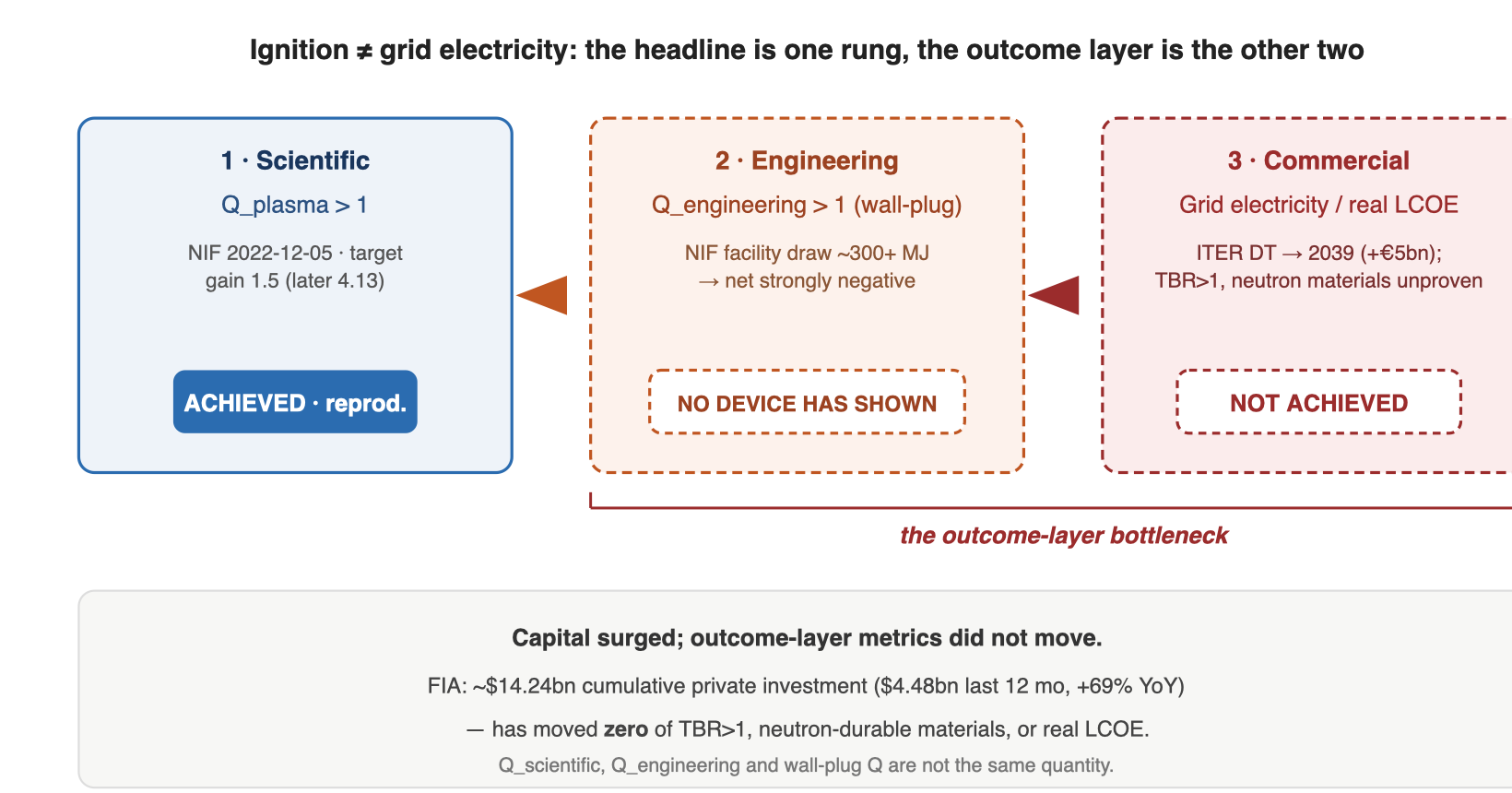
| Layer | Status (2026-07) | Verdict |
|---|---|---|
| Ignition / Q_plasma>1 (headline) | NIF 2022-12-05: 2.05 MJ → 3.15 MJ, target gain 1.5; later gain 4.13 (8.6 MJ, 2025-04) — demonstrated (LLNL) | Real, in one family |
| Wall-plug / Q_engineering | NIF 3.15–8.6 MJ out vs ~300+ MJ facility draw — strongly negative; no device has shown Q_engineering>1 | Bottleneck |
| Tritium fuel cycle (TBR>1) | No closed-loop tritium self-sufficiency demonstrated | Unproven |
| First-wall materials / neutron durability | No fusion-spectrum qualification facility operating (IFMIF planned) | Not demonstrated |
| Duty cycle / repetition rate | W7-X 43 s; ITER tens of seconds; NIF ~1 shot/day — far from generation | Bottleneck |
| LCOE / grid electricity | No operating plant → no measured LCOE; all figures estimated | Nonexistent yet |
| Private capital | FIA: ~$14.24bn cumulative, $4.48bn last 12 months (+69% YoY), 56 companies | Surged, but moved no outcome metric |
Deep dive
1. Background — the three-family stack and what is rate-limiting
- Magnetic confinement (milestone / engineering rate-limited): tokamaks (ITER, CFS SPARC) and stellarators (W7-X) confine the plasma magnetically. Tokamaks lead on the triple product, but ITER’s DT operation has been deferred to 2039 (2024 new baseline). CFS uses 20-tesla-class REBCO high-temperature-superconductor (HTS) magnets to shrink the device and targets Q>1 in SPARC (~2027). W7-X demonstrated a record long-pulse triple product (43 seconds) — steady-state potential, but not generation. Rate limiter: the gap from a milestone (Q_plasma, triple product) to an engineering balance (Q_engineering) and steady operation.
- Inertial confinement (wall-plug / rep-rate rate-limited): NIF demonstrated ignition (2022-12), but NIF is a research facility, not a power plant. Its 3.15 MJ (later 8.6 MJ) is against the target-delivered laser, and against the ~300+ MJ facility wall-plug the balance is strongly negative. NIF fires roughly once per day, far from the several-shots-per-second repetition rate generation needs. Rate limiter: wall-plug efficiency + repetition rate + target mass-production.
- Alternative concepts (proof-of-principle / physics rate-limited): FRC (Helion, TAE), MTF (General Fusion), Z-pinch (Zap), projectile/IFE (First Light and others). They claim compact, low-capital, direct electricity conversion (Helion) or non-tritium fuel (TAE’s p-11B aim), but most have not yet demonstrated even Q_plasma>1 and sit at proof-of-principle. Rate limiter: the multi-stage gap from proof-of-principle to a scientific-Q demonstrator to an engineering balance.
Common bottleneck = translating ignition/Q_plasma into Q_engineering/wall-plug, fuel cycle, materials and economics. All three families can (partly) claim “reached or approached a scientific milestone,” but they diverge at the outcome layer: whether that milestone breeds its own tritium, survives neutron damage, and delivers LCOE-competitive grid electricity under repeated operation.
2. What this landscape establishes — families, players and key metrics (announcement/paper-attributed)
| Family | Representative player | Key metric (source-attributed) | Status (demonstrated vs target/roadmap) |
|---|---|---|---|
| Magnetic / tokamak (public) | ITER (35-nation consortium) | 2024 new baseline: research operation 2034, DT operation 2039 (from 2035, +€5bn), tungsten first wall; target Q≈10 | Under construction — milestone deferred |
| Magnetic / tokamak (private) | Commonwealth Fusion Systems (SPARC/ARC) | SPARC up to 140 MW / 10 s, Q>1 target ~2027; 20 T REBCO HTS magnet demonstrated (2021-09); ARC 400 MWe (Virginia, early 2030s) | SPARC building, Q>1 not shown; ARC roadmap |
| Magnetic / stellarator | Wendelstein 7-X (IPP, Germany) | Record long-pulse triple product (2025-05-22), 43 s, energy turnover 1.8 GJ / 360 s, β~3% | Steady-state physics demonstrated — not generation |
| Inertial / laser (public) | NIF (LLNL) | 2022-12-05 ignition: 2.05 MJ → 3.15 MJ (target gain 1.5); later gain 4.13 (8.6 MJ, 2025-04) | Ignition demonstrated — not a plant (wall-plug negative) |
| Alternative / FRC (direct conversion) | Helion Energy | Microsoft PPA (2023-05): 50 MW, 2028 target, Polaris plant (WA); FRC, pulsed, direct electricity conversion, D-3He aim | PPA = roadmap, generation not shown |
| Alternative / FRC (beam), MTF, Z-pinch, IFE | TAE, General Fusion, Zap Energy, First Light / Pacific Fusion / Marvel / Xcimer | TAE p-11B (aneutronic) aim; General Fusion piston-compression MTF; Zap sheared-flow Z-pinch; various IFE/pulsed-power drivers | Proof-of-principle — Q>1 not shown |
| Industry anchor | Fusion Industry Association (FIA) | Cumulative investment ~$14.24bn (56 companies), last 12 months $4.48bn (+69% YoY), US leading; public funding rising | Industry data (association) |
2b. Family character — what each has (not) shown
- Magnetic confinement: leads on triple product and milestones, but the engineering balance and steady operation are incomplete. Public ITER shows the “always delayed” pattern (DT 2039, +€5bn); private CFS claims a shortcut via HTS magnets but SPARC Q>1 remains a target; W7-X demonstrated stellarator steady-state potential but not generation.
- Inertial confinement: the only family to demonstrate ignition (Q_plasma>1), but at a different layer from a power plant. NIF’s gain is against the target-delivered laser, not against the ~300+ MJ facility draw, and the repetition rate, target mass-production and energy recovery a plant needs are absent.
- Alternative concepts: claim low capital, compact size or non-tritium fuel, but most have not shown Q_plasma>1. Helion secured demand-pull (big-tech data centers) through its PPA, but 2028 is a roadmap, not a demonstration; TAE’s aneutronic p-11B needs far higher temperatures and is a long-term aim. Roadmap/PPA is not an operating plant.
3. The central commercial question — does the milestone shorten the path to grid electricity? (falsifiable)
The scientific milestones (NIF ignition, HTS magnets, the private-capital wave) have already appeared at the front of the outcome layer. Which of three hypotheses does the wave resolve into?
- (a) Milestone real, but the outcome layer keeps commercial fusion decades out. NIF ignition is wall-plug negative (3.15–8.6 MJ out vs ~300+ MJ draw) with no repetition rate or target mass-production; ITER DT is deferred to 2039 (+€5bn); no device has shown Q_engineering>1; TBR>1, neutron-durable materials and LCOE are all unproven or unmeasured. If true, ignition stays a science milestone while grid electricity slips to 2040–2050+. Falsified if any device demonstrates Q_engineering>1 together with TBR>1, neutron-durable materials and repeated operation.
- (b) This time is different — HTS magnets, private capital and reproduced ignition genuinely shorten the path. CFS’s 20 T HTS magnets shrink tokamaks (field is a strong lever on Q); NIF’s reproduced ignition suggests physics reproducibility; ~$14.24bn of private capital plus big-tech demand-pull speed engineering iteration. If true, first fusion electricity reaches the grid in the early 2030s (CFS ARC, Helion Polaris). Falsified if leading roadmaps (SPARC/ARC, Helion 2028) slip repeatedly without demonstration, or any of Q_engineering, TBR or materials proves a fundamental barrier.
- (c) Hype and shakeout — the private boom outruns the physics, PPAs/roadmaps slip, capital contracts, many startups founder, and only public science (ITER/NIF) plus a few survive (“always 30 years away”). Half a century of “30 years away”; most of the ~56 companies have not shown Q_plasma>1; aggressive schedules with weak verification pressure. Falsified if multiple startups hit real milestones (Q_plasma>1 → Q_engineering>1) on schedule and capital stays milestone-linked.
Current provisional position: none can be ruled out, and the post-series synthesis resolves to (a) and (c) coexisting — the milestone is real, but the outcome layer keeps commercial fusion decades out, while a shakeout is already visible (First Light abandoned its reactor program, −60%; GFUZ listed as a distressed SPAC). The decider for (b) is whether the compact HTS tokamak (SPARC) actually crosses Q>1 (~2027) and on to Q_engineering. Part 0 places all three side by side, falsifiably, rather than declaring one.
4. Neighbouring domains — where the firm’s cross-domain lens bites
- Computing power (data-center baseload demand): the 24/7 carbon-free baseload hunger of AI data centers is the largest demand-pull behind fusion’s private capital and PPAs (Helion–Microsoft 50 MW / 2028; big-tech among CFS investors). The firm’s “power is the real bottleneck” thesis sits upstream of fusion’s demand narrative — but a PPA or roadmap is not an operating plant.
- Energy storage (grid firming): fusion aims at firm/baseload power, but commercialization is decades out, so near-term firming falls to renewables + long-duration energy storage (LDES) + SMR. Next to “fusion solves baseload” sits the outcome-layer question of what firms the grid until then.
- Fission SMR (energy-reactor): small modular reactors target the same 24/7 carbon-free firm power, but at higher TRL and with a more advanced regulatory path (reactors are a demonstrated technology), making them an earlier baseload competitor. Fusion’s claimed “regulatory advantage” (less high-level waste besides tritium) is placed against SMR’s “already works” reality — though SMR first-of-a-kind projects have themselves stumbled.
5. Commercialization and competitive context (TRL, related companies)
- Maturity (TRL frame): ignition/Q_plasma>1 is demonstrated in one family, but engineering, fuel-cycle and materials maturity is early because no device has shown Q_engineering>1 and no plant is operating. The gating layers are engineering balance, tritium, materials and economics — not the headline milestone.
- ITER (public): 2024 new baseline defers DT operation to 2039 (+€5bn) with a tungsten first wall — the “always delayed” public-science pattern.
- Commonwealth Fusion Systems (private): SPARC targets Q>1 ~2027 on 20 T HTS magnets (demonstrated 2021-09); ARC (400 MWe, Virginia) is an early-2030s roadmap. Funding: $1.8B Series B plus an $863M B2 round.
- Helion Energy (private): the world’s first fusion PPA (Microsoft, 2023-05, 50 MW, 2028 target, Polaris plant, WA); FRC with direct electricity conversion and a D-3He aim. The 2028 date is a roadmap, not a demonstration.
- General Fusion (GFUZ): ★ post-series correction — the earlier “no listed pure-play” reading is overturned. General Fusion listed on Nasdaq as GFUZ (2026-07-13, Spring Valley SPAC, ~$1B, cash ~$150M), but as a distressed post-layoff SPAC (25%+ headcount cut before listing). The substantive picture holds: the leaders (CFS, Helion, TAE, Pacific Fusion) remain private; there is no large-cap pure-play; indirect exposure is via HTS suppliers and SMR adjacencies.
- Others (private): TAE (aneutronic p-11B aim), Zap Energy (sheared-flow Z-pinch), First Light (projectile IFE — reactor program abandoned), Pacific Fusion, Marvel, Xcimer — all proof-of-principle or early stage.
- Company implications are limited to neutral, source-attributed description; competitive statements are not buy/sell signals. Valuations and deal terms are attributed to company announcements and secondary reporting.
6. The skeptic’s bottom line
- Milestone ≠ power: NIF ignition (Q_plasma>1) is real and reproduced, but the facility’s wall-plug balance is strongly negative (3.15–8.6 MJ out vs ~300+ MJ draw), and no device has demonstrated Q_engineering>1.
- Refuted — “NIF’s net gain means power is imminent”: a common public-reporting confusion. The 3.15 MJ (later 8.6 MJ) is target gain against the target-delivered laser (2.05 MJ), not against the ~300+ MJ facility draw; NIF fires ~once per day with no energy recovery or target mass-production. Ignition demo is not grid electricity.
- Capital moved no outcome metric: private capital surged to ~$14.24bn (+69% YoY), but TBR>1, neutron-durable materials and real LCOE remain unproven — capital is not engineering progress.
- Do not inherit the hype from paper titles: SPARC Q>1, ARC 400 MWe and Helion 50 MW / 2028 are all targets or roadmaps, not operating plants.
- Neutral-framing note: to prevent misreading private-startup fates or “fusion is imminent” narratives as security or energy-market signals. There is no large-cap pure-play; GFUZ is a distressed SPAC.
7. What to watch (falsifiable)
- P1 — Q_engineering: if any device (SPARC most likely) crosses Q_plasma>1 to Q_engineering>1 (positive whole-plant balance), (b) “this time is different” strengthens; if leading roadmaps slip repeatedly without demonstration, (a) “decades out” strengthens.
- P2 — tritium and materials together: if a DT plant demonstrates closed-loop TBR>1 and a fusion-neutron-durable structural material, that signals a commercial path; if either proves a fundamental barrier, (a) strengthens — and watch whether alternative fuel cycles (Helion D-3He, TAE p-11B) provide a detour.
- P3 — funding vs milestone and demand-pull: if capital stays milestone-linked and data-center baseload demand-pull turns real PPAs into real power, (b) signals; if PPAs/roadmaps slip and capital contracts while many startups founder, (c) shakeout. Meanwhile, how much of near-term firm power renewables + LDES + SMR pre-empt will set fusion’s economic window.
References
- Lawrence Livermore National Laboratory. “Achieving Fusion Ignition” (2022-12-05, 2.05 MJ → 3.15 MJ, target gain 1.5). https://lasers.llnl.gov/science/achieving-fusion-ignition
- Lawrence Livermore National Laboratory. “National Ignition Facility 2024” (subsequent yields). https://annual.llnl.gov/fy-2024/national-ignition-facility-2024
- ITER Organization. “Updated Baseline Presented” (2024 new baseline; DT operation 2039, +€5bn, tungsten first wall). https://www.iter.org/node/20687/updated-baseline-presented
- Physics World. “ITER fusion reactor hit by massive decade-long delay and €5bn price hike.” https://physicsworld.com/a/iter-fusion-reactor-hit-by-massive-decade-long-delay-and-e5bn-price-hike/
- Wikipedia. “SPARC (tokamak)” (up to 140 MW / 10 s, Q>1 target ~2027; 20 T REBCO HTS magnet). https://en.wikipedia.org/wiki/SPARC_(tokamak)
- Helion Energy. “Helion announces world’s first fusion PPA with Microsoft” (50 MW, 2028 target, Polaris plant). https://www.helionenergy.com/newsroom/helion-announces-worlds-first-fusion-ppa-with-microsoft
- EUROfusion. “Wendelstein 7-X sets world record for long plasma triple product” (2025-05-22, 43 s, 1.8 GJ / 360 s). https://euro-fusion.org/eurofusion-news/wendelstein-7-x-sets-world-record-for-long-plasma-triple-product/
- Fusion Industry Association. “The global fusion industry in 2025” (cumulative investment, company count, 12-month total). https://www.fusionindustryassociation.org/in-the-news-the-global-fusion-industry-in-2025/
Disclosure
This post is for information only and is not investment advice.
COI note: this post describes public fusion programs (ITER, NIF/LLNL, W7-X/IPP) and private fusion companies (Commonwealth Fusion Systems, Helion, TAE, General Fusion [now listed on Nasdaq as GFUZ], Pacific Fusion, Zap Energy, First Light, Marvel, Xcimer) in a descriptive, neutral context. There is no large-cap pure-play fusion company; most are private/VC-backed, and indirect exposure runs through investors, off-takers and adjacent fission-SMR names. General Fusion’s GFUZ listing (2026-07-13) is a distressed post-layoff SPAC. Every Q-value, gain and funding figure is attributed to the reporting lab, company or association; company roadmaps and PPAs are separated from operating-plant demonstrations, and peer-reviewed or agency data is separated from company claims. Valuations and deal terms are attributed to secondary reporting. Scientific Q, engineering Q and wall-plug Q are not the same quantity; announced is not demonstrated; a PPA or roadmap is not an operating plant. Competitive statements are factual, neutral descriptions and are not buy/sell implications for any security. The author holds no position in, and has no financial interest in, the entities named.
Note: The Principal confirmed the neutral framing of this post on 2026-07-17 (charter §Escalation). All company/program statements are factual, neutral, and source-attributed — not buy/sell implications for any security.


Leave a Reply