Evidence-first notes on bioscience and deep tech, at the edge of the lab and the market. Information only — not investment advice. All temperatures, pressures, gains and timelines are attributed to the sponsoring laboratory or company; many are company announcements or trade-press reports rather than peer-reviewed data (noted inline). A “target gain” (a plasma-side ratio) is kept strictly separate from wall-plug efficiency and from any grid-electricity claim.
The 30-second version
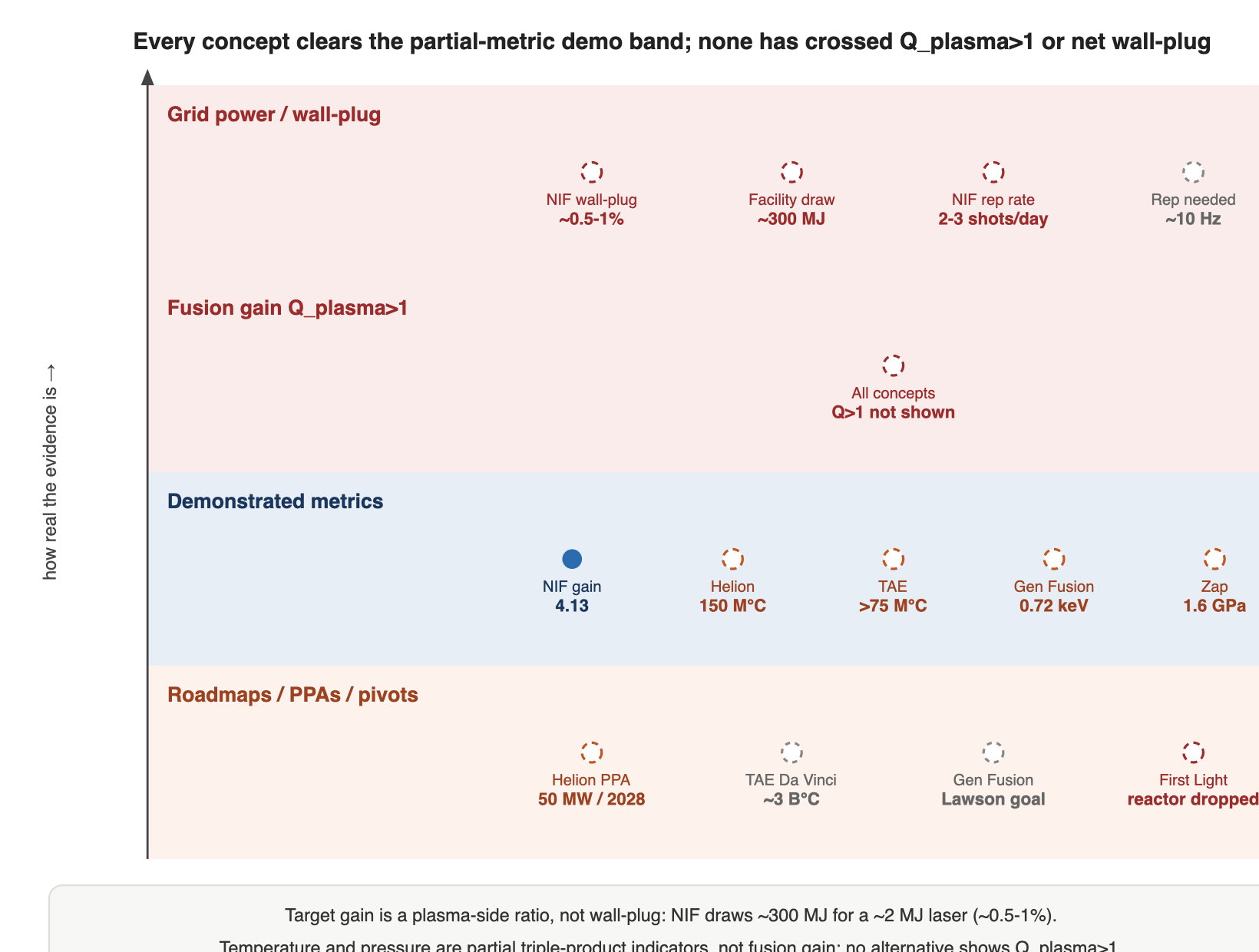
- What. The headline in this series is ignition, target gain and temperature records. The US National Ignition Facility (NIF, LLNL) kept improving its result — from the first controlled ignition in December 2022 (target gain 1.54) to a record 8.6 MJ of fusion yield from a 2.08 MJ laser on 7 April 2025 (target gain 4.13), across 11 cumulative ignitions (LLNL). Private alternative concepts announced partial records in parallel: Helion 150 M°C, TAE >75 M°C, General Fusion LM26 0.72 keV, Zap Energy FuZE-3 1.6 GPa (each company-attributed).
- So what. The result layer sits on a different plane. NIF’s 4.13 is a target gain (a Q_plasma-like ratio measured against the laser energy that reached the target) — not wall-plug. Producing that ~2 MJ laser draws roughly 300 MJ from the facility (wall-plug ~0.5–1%), so even 8.6 MJ is a strongly negative energy balance for the whole plant. NIF is a stockpile-stewardship weapons-physics facility firing 2–3 shots per day (a power plant needs ~10 Hz — four to five orders of magnitude apart). It is not a power path — the Part 0 “NIF net energy = power imminent” refutation holds even at gain 4.13.
- Now what. The alternatives show only partial metrics (temperature or pressure), and none has demonstrated Q_plasma>1. Helion’s net-electricity target (end of 2025) has no announced achievement, and its Microsoft 50 MW/2028 PPA is a roadmap, not an operating plant. Crucially, aneutronic fuel (p-¹¹B, D-³He) is NOT the “easy path around tritium” — the physics is harder (TAE’s Da Vinci targets an ion temperature of ~3 billion °C, requiring a far higher triple product and facing bremsstrahlung losses). And First Light Fusion dropped its own reactor (April 2025, pivot to amplifier licensing, valuation cut 60%+) — a concrete shakeout signal.
The five-minute read
Ignition is real — but NIF is a weapons-physics facility, not a power plant
The firm’s recurring lens — “the headline is the starting point; the real bottleneck is the result layer” — applies cleanly to inertial confinement. NIF has the only demonstrated inertial ignition, and it kept raising the gain: 1.54 (2022) to 4.13 (2025), 11 ignitions in total (LLNL). That reproducibility and yield growth are real physics. But three structural facts separate ignition from grid electricity. First, target gain is measured against the laser energy delivered to the target, while the facility spends roughly 300 MJ of electricity (about 477 MJ in the older configuration) to make that ~2 MJ laser — a wall-plug efficiency near 0.5–1%, so even 8.6 MJ is deeply net-negative for the plant. Second, NIF fires 2–3 shots per day; a power plant needs about 10 Hz, four to five orders of magnitude faster, with mass-produced targets, chamber recovery and energy recovery that NIF simply does not have. Third, NIF exists for stockpile stewardship (weapons physics), not electricity. “NIF ignited, so power is imminent” conflates a plasma-physics milestone with a plant-energy balance.
The alternative-concept boom — demonstrated milestone versus roadmap/PPA
Part 0 named the private alternatives; this part separates what each has demonstrated from what it has promised. The common thread: all claim smaller, cheaper, direct-conversion or aneutronic paths, each carries an unproven core, and none has demonstrated Q_plasma>1. Announced dates, PPAs and roadmaps are not operating plants.
| Company (concept) | Demonstrated (attributed) | Roadmap / PPA (promise) | Unproven core |
|---|---|---|---|
| Helion (FRC, pulsed, direct electricity conversion) | Polaris operating (2025); 150 M°C D-T fusion (Feb 2026, TechCrunch) | Net electricity target end-2025 (no announced achievement); Microsoft PPA 50 MW / 2028; Orion site started | Direct conversion, pulsed repetition, D-³He fuel cycle — none demonstrated; Q_plasma>1 not shown |
| TAE (beam-driven FRC) | Norman >75 M°C; real-time plasma control | Copernicus (net gain target); Da Vinci p-¹¹B, ion temp ~3 billion °C target; >$1.2B raised | p-¹¹B aneutronic needs a far higher triple product than D-T; Q_plasma>1 not shown |
| General Fusion (MTF, lithium liner) | LM26 ~8.4 M°C (0.72 keV) compressional heating (Jun 2026) | Next targets 1 keV → 10 keV → Lawson criterion | Mechanical liner compression, repetition, liner recovery — not demonstrated; Q_plasma>1 not shown |
| Zap Energy (sheared-flow Z-pinch) | FuZE-3 electron pressure 830 MPa (1.6 GPa total, Nov 2025) — SFS Z-pinch record | Century pilot (repetitive pulsed power, liquid-metal wall, high-duty cathode) | Q>1, repetitive operation — not demonstrated (1.6 GPa is a marker, not gain) |
| First Light (projectile / amplifier) | Prior projectile-fusion results; amplifier target tech | Apr 2025: dropped own reactor → amplifier licensing pivot; valuation cut 60%+ (IP Group £236M → £100M) | Own power path abandoned; amplifier-licensing commercial viability unproven |
Deep dive
1. Background — ignition versus a power plant, and the “gain” that is not wall-plug
Part 0 set a falsifiable central question: does a scientific milestone (ignition, Q_plasma>1) actually shorten the path to grid electricity, or does the result layer (Q_engineering / wall-plug, fuel cycle, materials, repetition rate, LCOE) keep commercialization decades away? This part applies that question to two series: INERTIAL (NIF) and ALT-CONCEPTS (Helion, TAE, General Fusion, Zap, First Light).
NIF’s ignition lineage is genuine and reproducible (LLNL, first-party):
| Shot date | Laser → target (MJ) | Fusion yield (MJ) | Target gain | Note |
|---|---|---|---|---|
| 2022-12-05 | 2.05 | 3.15 | 1.54 | First controlled fusion ignition |
| 2024-02-12 | 2.2 | 5.2 | 2.36 | Highest yield at the time |
| 2025-04-07 | 2.08 | 8.6 ± 0.45 | 4.13 | Record gain |
| 2026-06-20 | — | 7.9 ± 0.4 | ~3.8 | Reproduction |
2. What this landscape establishes — NIF is not a power path (three structural reasons)
Principle: temperatures, pressures, gains and dates are reported as in the source; a plasma-side ratio (target gain) is kept separate from engineering Q and from wall-plug; announced/PPA/roadmap is kept separate from operating plant.
- Wall-plug, not gain. LLNL states that “the lasers delivering the 2.05 MJ of energy took about 300 MJ to produce in the facility” (quote <150 chars). The older burning-plasma configuration drew roughly 477 MJ of electricity for a 1.8 MJ target and 1.3 MJ of fusion. Order-of-magnitude, facility consumption far exceeds fusion output; target gain 4.13 is a plasma/capsule indicator, not a plant-energy indicator.
- Repetition rate. NIF fires 2–3 shots per day (targeting roughly 400–700 shots per year, several hours per shot). Inertial fusion energy for power needs about 10 Hz — injecting a fresh target, aiming precisely, recovering the chamber and recovering energy every fraction of a second. That is four to five orders of magnitude beyond NIF.
- Purpose. NIF is a stockpile-stewardship (weapons-physics / high-energy-density science) facility. Fusion power is a derivative research goal, not the facility’s reason to exist. Its precision-machined targets (hohlraum plus capsule) are far from the mass-produced, low-cost targets a plant would require.
The conclusion: NIF’s ignition (gain 4.13) is a real advance in inertial-confinement physics, but for three reasons — negative wall-plug, 2–3 shots/day, and weapons-physics purpose — it is not a power-plant path. The Part 0 refutation (“NIF net energy = power imminent”) holds even at gain 4.13. Ignition demo ≠ grid electricity.
3. The central test — do these milestones shorten the grid path? (falsifiable)
Applying Part 0’s three hypotheses to the inertial and alternative data:
- (a) The milestone is real but the result layer keeps power decades away — best fits the current data. NIF reached gain 4.13 yet remains net-negative at the plant (wall-plug ~0.5–1%, ~300 MJ draw, 2–3 shots/day, weapons-physics facility). The alternatives demonstrate only temperature/pressure partial metrics, none shows Q_plasma>1, and their cores (direct conversion, aneutronic, mechanical compression, repetitive Z-pinch) are unproven. Falsification: if any alternative demonstrates Q_plasma>1 and shows direct conversion, repetitive operation and a fuel cycle together, (a) weakens. Not yet observed.
- (b) This time is different — the alternatives actually shorten the path — partial, weak. Helion’s direct electricity conversion could in principle skip the heat engine and the tritium blanket, and the capital and demand-pull are real (Microsoft PPA, Google/Chevron investment). But net electricity, Q_plasma>1 and aneutronic triple product are all undemonstrated. Strengthening condition: Helion demonstrates net electricity, or an alternative moves Q_plasma>1 → Q_engineering. Unmet.
- (c) Hype and shakeout — a partial signal is present. First Light’s abandonment of its own reactor and 60%+ valuation cut (funding shortfall) is a concrete case of private enthusiasm running ahead of the physics. Helion’s end-2025 net-electricity target has no announced achievement, and TAE’s ~3-billion-°C aim underscores how far the aneutronic goal sits from D-T. Falsification: if multiple alternatives hit Q_plasma>1 → Q_engineering on schedule with milestone-linked capital, (c) weakens. Partially unresolved (First Light supports (c); Helion/TAE/Zap not yet adjudicable).
Provisional position: (a) best fits the current data, with a partial (c) signal among the alternatives. Part 2 does not force a single verdict, but the narrative “ignition (gain 4.13) or a temperature record = commercial fusion imminent” is refuted by the present result-layer data.
4. The result-layer bottlenecks — aneutronic, fuel cycle and wall-plug
- Aneutronic (p-¹¹B, D-³He) is NOT the easy path — the physics is harder. D-T peaks in cross-section near 100–200 M°C (~10–20 keV). p-¹¹B (TAE’s aim) requires ion temperatures of billions of degrees (Da Vinci targets ~3 billion °C, hundreds of keV) and a substantially higher triple product, and at those temperatures bremsstrahlung losses approach the fusion output, narrowing the net-gain window. D-³He (Helion’s aim) also needs higher temperatures than D-T, and ³He is naturally scarce (Helion claims D-D side reactions generate and recycle ³He). Avoiding the tritium fuel cycle and neutron damage trades against making the ignition physics itself much harder — not a free shortcut.
- Direct conversion versus the heat engine. Helion’s direct electricity conversion (field change → induced current), if realized, skips the Carnot limit, the steam turbine and the tritium blanket — a large advantage, but undemonstrated. Tokamaks and NIF-type systems mostly rely on 14 MeV neutrons heating a blanket and driving a steam turbine, where heat-engine efficiency (~30–40%) further erodes engineering Q.
- Wall-plug and repetition — the fundamental result layer for inertial power. NIF’s ~0.5–1% wall-plug reflects flashlamp pumping; an inertial fusion power plant would need diode-pumped lasers (efficiency target ~10%+), ~10 Hz repetition, mass-produced low-cost targets and chamber recovery (debris, heat). NIF’s ignition does not solve any of these.
- No alternative concept has demonstrated Q_plasma>1. Helion’s 150 M°C, TAE’s 75 M°C, General Fusion’s 0.72 keV and Zap’s 1.6 GPa are partial indicators (temperature or pressure) that make up the triple product — not energy gain. The triple product (density × temperature × confinement time) must be met simultaneously for Q_plasma>1, and only then comes Q_engineering; both stages remain undemonstrated in the alternatives.
5. Commercialization and competitive context (TRL, related companies)
- Maturity (TRL frame): ignition physics is demonstrated at NIF, but a power path is not. For power, the gating layers are wall-plug/diode-pumped lasers, ~10 Hz repetition, target mass-production and the liquid-metal first wall (a materials/manufacturing problem) — all early-TRL.
- NIF / LLNL: public program, weapons-physics facility; ignition demonstrated (gain 4.13, 11 ignitions) but not a power-plant path.
- Helion (private): Polaris operating (2025); 150 M°C D-T (2026); net-electricity target end-2025 with no announced achievement; Microsoft PPA (50 MW/2028) and Orion site are demand-pull and capital, but a PPA and a groundbreaking are not an operating plant. Valuation ~$5.4B is secondary reporting.
- TAE (private): Norman >75 M°C, real-time control, >$1.2B raised (2025 Google/Chevron/NEA round). Final fuel p-¹¹B demands a far higher triple product than D-T.
- General Fusion [GFUZ] (private): LM26 0.72 keV compressional heating (2026); next targets 1 keV → 10 keV → Lawson — still at the entrance to ignition physics. (2025 restructuring: an approximately 25% staff reduction in May 2025 amid financing constraints, per Physics World and Business in Vancouver.)
- Zap Energy (private): FuZE-3 1.6 GPa (SFS Z-pinch record) — a marker toward Q>1, not gain; the Century pilot must still solve repetitive pulsed power and a liquid-metal wall.
- First Light Fusion (private): dropped its own reactor (April 2025), pivoted to amplifier licensing, valuation cut 60%+ (IP Group £236M → £100M) — a concrete (c) shakeout signal; amplifier-licensing viability unproven.
- No pure-play listed fusion stock exists. Indirect exposure runs through investors (Google/Alphabet, Chevron) and offtakers (Microsoft). Company statements are neutral, source-attributed description — not buy/sell signals. Deal and valuation details are secondary estimates attributed to trade-press reporting.
6. The skeptic’s bottom line
- Target gain ≠ wall-plug: NIF’s 4.13 is measured against the laser at the target; the facility draws ~300 MJ, so 8.6 MJ is net-negative for the plant — a weapons-physics facility at 2–3 shots/day, not a power path.
- Partial metric ≠ fusion gain: the alternatives’ temperatures and pressures are partial indicators; none has demonstrated Q_plasma>1.
- Roadmap/PPA ≠ operating plant: Helion’s net electricity is undemonstrated and the 2028 figure is a PPA.
- Aneutronic is harder, not easier: p-¹¹B and D-³He need far higher triple products than D-T (TAE Da Vinci ~3 billion °C) and face bremsstrahlung losses — avoiding the fuel cycle is a trade-off, not a shortcut.
- Shakeout signal: First Light’s reactor abandonment and 60%+ valuation cut supports hypothesis (c).
- Neutral-framing note: to prevent misreading private-company (Helion, TAE, General Fusion [GFUZ], Zap, First Light) success/failure or the NIF gain record as security or “commercial fusion imminent” signals.
7. What to watch (falsifiable)
- P1: An alternative concept (Helion or Zap most likely) demonstrates Q_plasma>1, or Helion demonstrates net electricity at Polaris/Orion → strengthens (b); if results stay at temperature/pressure partial metrics → strengthens (a).
- P2: TAE (p-¹¹B) or Helion (D-³He) actually reaches a triple product above D-T and exceeds bremsstrahlung losses to net gain → an aneutronic-shortcut signal; if not, the “fuel-cycle avoidance = easy path” narrative is refuted and (a) strengthens. In parallel, inertial power hinges on diode-pumped wall-plug, ~10 Hz repetition, target mass-production and the liquid-metal wall.
- P3: If alternative-concept capital stays milestone-linked and data-center baseload demand-pull converts real PPAs into real power → (b) signal; if further abandonments/strategy pivots (First Light-type), PPA slippage or valuation cuts continue → (c) shakeout. How much near-term firm power renewables + storage (LDES) and SMRs pre-empt sets the ceiling on the alternatives’ economic window.
References
- Lawrence Livermore National Laboratory. “Achieving Fusion Ignition.” NIF & Photon Science (ignition lineage; wall-plug ~300 MJ; target gain). https://lasers.llnl.gov/science/achieving-fusion-ignition
- Wikipedia. “National Ignition Facility” (shot lineage, 11 ignitions, stockpile-stewardship purpose, repetition rate). https://en.wikipedia.org/wiki/National_Ignition_Facility
- Wikipedia. “Helion Energy” (Polaris, net-electricity target, direct conversion, D-³He). https://en.wikipedia.org/wiki/Helion_Energy
- TechCrunch. 2026. “Fusion startup Helion hits blistering temps as it races toward 2028 deadline” (150 M°C D-T, 2026-02-13). techcrunch.com/…/fusion-startup-helion-hits-blistering-temps
- Helion Energy. “Helion Secures Land and Begins Building Site of World’s First Fusion Power Plant” (Orion site; PPA context). helionenergy.com/newsroom/helion-secures-land
- Wikipedia. “TAE Technologies” (Norman >75 M°C, beam-driven FRC, p-¹¹B/Da Vinci, funding). https://en.wikipedia.org/wiki/TAE_Technologies
- Carbon Credits. “Google and Chevron Back TAE Technologies as It Nears Fusion Power Breakthrough” (2025-06 round). carboncredits.com/…/google-and-chevron-back-tae-technologies
- General Fusion. “General Fusion Achieves Compressional Plasma Heating with LM26 Magnetized Target Fusion Machine” (~8.4 M°C / 0.72 keV). generalfusion.com/post/lm26-compressional-plasma-heating
- Zap Energy. “Zap Energy Exceeds Gigapascal Fusion Plasma Pressures on New Fusion Device FuZE-3” (830 MPa / 1.6 GPa, 2025-11). zapenergy.com/news/fuze-3-gigapascal-pressures
- World Nuclear News. “First Light Fusion switches strategy, drops plans to develop power plant” (2025-04 amplifier-licensing pivot). world-nuclear-news.org/articles/first-light-fusion-switches-strategy
- Climate Insider. 2025. “First Light Fusion scraps reactor plans, sees valuation slashed” (valuation cut 60%+; IP Group £236M → £100M). climateinsider.com/2025/04/28/first-light-fusion-scraps-reactor-plans
Disclosure
This post is for information only and is not investment advice.
COI note: this post describes a public program (NIF / LLNL, public) and private fusion companies (Helion, TAE, General Fusion [GFUZ], Zap Energy, First Light Fusion — all private) in a descriptive, neutral context. There is no pure-play listed fusion stock; indirect exposure exists only through investors (Google/Alphabet, Chevron) and offtakers (Microsoft). Every temperature, pressure, gain and timeline is attributed to the sponsoring laboratory or company; many are company announcements or trade-press reports rather than peer-reviewed data, and are labeled as such. A “target gain” (a plasma-side ratio) is distinguished from engineering Q and from wall-plug efficiency; announced dates, PPAs and roadmaps are distinguished from demonstrated results and operating plants. Private valuations (Helion ~$5.4B, First Light £100M) are secondary estimates. Quantitative claims are attributed to the vendor, laboratory or press report. Competitive statements are factual, neutral descriptions and are not buy/sell implications for any security. The author holds no position in, and has no financial interest in, the companies named — no financial interest.
Note: The Principal confirmed the neutral framing of this post on 2026-07-17 (charter §Escalation). All company/program statements are factual, neutral, and source-attributed — not buy/sell implications for any security.


Leave a Reply