Evidence-first notes on bioscience and deep tech, at the edge of the lab and the market. Information only — not investment advice, not medical advice.
The 30-second version
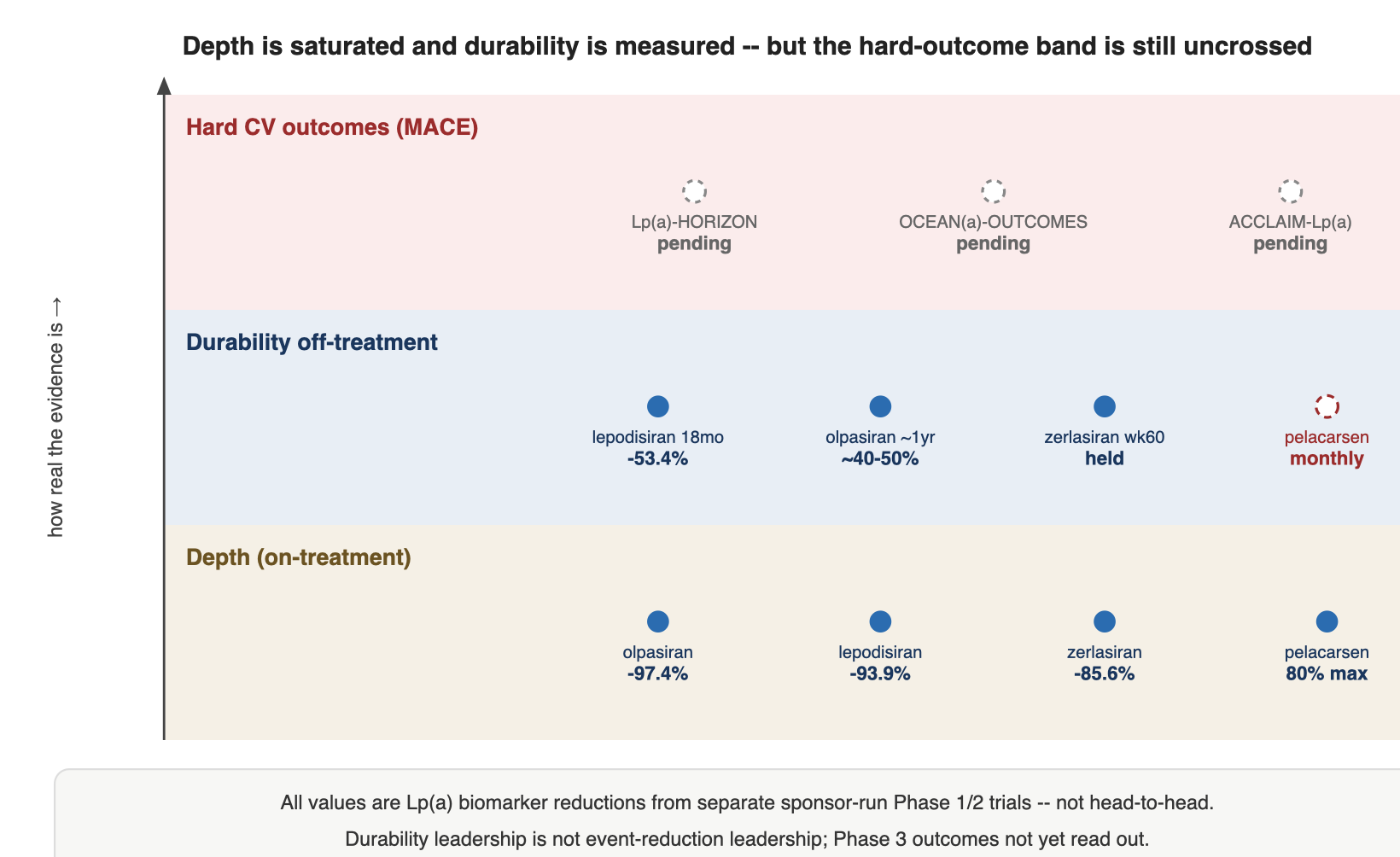
- What. Four nucleic-acid drugs that shut down hepatic apo(a) production — one antisense oligonucleotide (pelacarsen) and three siRNAs (olpasiran, lepodisiran, zerlasiran) — have already saturated the depth question. Across Phase 1/2 randomized trials they cut lipoprotein(a) by roughly 80–100% placebo-adjusted (olpasiran −97.4%, lepodisiran −93.9%, zerlasiran −85.6%, pelacarsen up to 80%). Depth is no longer where they differ.
- So what. The competitive front has moved to durability — how rarely a patient must be dosed. Lepodisiran was still 53.4% below baseline 18 months after a single injection; olpasiran and zerlasiran cover about half a year; pelacarsen (an ASO) is dosed monthly. Lower dosing frequency is the emerging differentiator on adherence and coverage — but this ordering comes from separate trials, not head-to-head comparisons.
- Now what. Every number here is a biomarker (Lp(a) concentration), not a hard outcome (cardiovascular events). A durability advantage is not an event-reduction advantage. Whether any of this lowers heart attacks and strokes is the Phase 3 outcome question (HORIZON, OCEAN(a)-OUTCOMES, ACCLAIM) — not yet read out — and is covered in Part 4.
The five-minute read
Depth is a settled game
Earlier work in this Lp(a) series established that lipoprotein(a) is a genetically-set, largely non-modifiable residual cardiovascular risk factor, and that only apo(a)-directed nucleic-acid drugs move it substantially. This part asks a narrower question. On how far you can lower Lp(a), the answer is essentially in: at their higher doses all four agents reach at least 80% placebo-adjusted reduction, and the three siRNAs reach roughly 90% or more. The Mendelian-randomization threshold from Part 1 (a large absolute reduction in high-baseline patients) is comfortably cleared on the biomarker. The gap between drugs on depth is now small.
Durability is the real front
Where the modalities separate is how long a single dose lasts, and therefore how often a patient must be injected. The antisense oligonucleotide pelacarsen has a shorter tissue half-life and is dosed monthly. The siRNAs, which co-opt the RISC machinery, last far longer: olpasiran and zerlasiran are built around roughly quarterly-to-semiannual dosing, and lepodisiran — engineered explicitly for long duration — held a meaningful reduction 18 months after one shot. Dosing frequency simultaneously drives adherence, the fraction of time a patient is actually covered, and commercial differentiation. The important caveat is that all of these figures are Lp(a) concentrations from sponsor-run trials, not clinical events.
| Drug (sponsor) | Modality | Representative reduction (placebo-adj) | Dosing | Durability (off-treatment) |
|---|---|---|---|---|
| pelacarsen (Novartis / Ionis) | ASO | 80% (20 mg weekly, max) | Monthly (80 mg in Phase 3) | Short — monthly dosing assumed |
| olpasiran (Amgen) | siRNA | −97.4% (75 mg q12w, wk36) | Quarterly (q12w) | ~40–50% still held ~1 yr after last dose, then reverts |
| lepodisiran (Eli Lilly) | siRNA (long-duration) | −93.9% (400 mg, day 60–180) | Semiannual to annual (potential) | −53.4% at 18 months after a single dose |
| zerlasiran (Silence Therapeutics) | siRNA | −85.6% (450 mg q24w, wk36) | Semiannual (q24w) | Reduction maintained through week 60 |
The one caveat that governs everything
None of these numbers is an event. The history of the CETP inhibitors is the cautionary parallel: an excellent biomarker effect that did not translate into fewer events. A durability race only matters commercially if the underlying outcome trials are positive. Until HORIZON, OCEAN(a)-OUTCOMES and ACCLAIM read out, depth and durability are the price of admission, not the verdict.
Deep dive
1. Background — one target, two RNA modalities
All four drugs shut down production of apolipoprotein(a) in the liver, the rate-limiting component of the Lp(a) particle. They differ in how they silence the message. Pelacarsen is a GalNAc-conjugated antisense oligonucleotide (ASO): it base-pairs with apo(a) mRNA and recruits RNase H1 to cleave it, blocking translation. Olpasiran, lepodisiran and zerlasiran are GalNAc-conjugated small interfering RNAs (siRNA) that route the target message into the RISC complex for cleavage. The target (hepatic apo(a) synthesis) is identical; the pharmacology of tissue residence — and therefore dosing frequency — is where the chemistry diverges. A cross-domain hook worth flagging: the durability differences are largely an oligonucleotide-chemistry story (2′-OMe / 2′-F sugar modifications, phosphorothioate backbone stabilization), i.e. a materials-science lever on a clinical endpoint.
2. What each trial established (attributed)
Principle: reductions, timepoints and doses are reported as in the source; all values are Lp(a) biomarker reductions, not hard outcomes; cross-trial figures are not head-to-head.
- pelacarsen — the prototype, at the cost of monthly dosing. Phase 2 (Tsimikas et al., NEJM 2020; NEJMoa1905239, N=286) tested five regimens with dose- and frequency-dependent placebo-adjusted reductions: 20 mg q4w 35%, 40 mg q4w 56%, 20 mg q2w 58%, 60 mg q4w 72%, and 20 mg weekly 80% (maximum) versus 6% on placebo. Injection-site reactions were the most common adverse event, with no significant difference from placebo in platelet, liver or kidney measures. Reaching the deepest reduction required weekly dosing — a structural durability disadvantage of the ASO modality. Phase 3 Lp(a)-HORIZON (NCT04023552) settled on 80 mg subcutaneously once monthly, a compromise between depth and adherence. Pelacarsen entered the clinic first but is dosed most frequently.
- olpasiran — deepest on-treatment, but it reverts off-treatment. Phase 2 OCEAN(a)-DOSE (NEJM 2022; NEJMoa2211023, N=281, ASCVD with Lp(a) >150 nmol/L) reported week-36 placebo-adjusted reductions of −70.5% (10 mg q12w), −97.4% (75 mg q12w), −101.1% (225 mg q12w) and −100.5% (225 mg q24w) — effectively complete suppression at 75 mg and above, among the deepest in the class. The off-treatment extension (JACC 2024) is the durability reality check: after the last dose at week 36, the 75 mg q12w reduction decayed to −76.2% / −53.0% / −44.0% / −27.9% at weeks 60 / 72 / 84 / 96, reverting toward baseline in a dose-dependent way, though ≥75 mg q12w still held roughly 40–50% about a year after the last dose. No new safety signal through week 96. Olpasiran is designed around quarterly dosing; Phase 3 OCEAN(a)-OUTCOMES (NCT05581303) tests whether that depth translates into events.
- lepodisiran — the durability frontier. Engineered as a long-duration GalNAc siRNA, with dosing frequency (potentially once or twice a year) as its explicit differentiator. Phase 2 ALPACA (Nissen et al., NEJM 2025-03-30; NEJMoa2415818, N=320, 66 centers) reported a 400 mg pooled placebo-adjusted reduction of −93.9% (day 60–180 time-averaged), versus 75.2% (96 mg) and 40.8% (16 mg). The differentiating data are on durability: a single 400 mg dose averaged 88.5% reduction over day 30–360, and two doses (baseline + day 180) averaged 94.8%; more strikingly, a single dose left Lp(a) 53.4% below baseline at 540 days (18 months), and two doses 74.2% below at 360 days. Thirty-five serious adverse events occurred but none were attributed to lepodisiran; injection-site reactions were mild and dose-dependent (0–12%). Phase 3 ACCLAIM-Lp(a) (NCT06292013, N≈12,500) is the only program to include a primary-prevention population — consistent with the practicality of low-frequency dosing across a large preventive population.
- zerlasiran — semiannual convenience, later but durable. A GalNAc siRNA from Silence Therapeutics (its mRNAi GOLD platform). Phase 1 APOLLO (JAMA 2024) showed a single dose still gave a median −30% (300 mg) / −29% (600 mg) at 365 days. Phase 2 ALPACAR-360 (AHA 2024 / JAMA, N=178, ASCVD with Lp(a) ≥125 nmol/L) reported week-36 placebo-adjusted LS-mean time-averaged reductions of −85.6% (450 mg q24w), −82.8% (300 mg q16w) and −81.3% (300 mg q24w), maintained through week 60, with mild injection-site reactions (day-1 mild pain 2.3–7.1%). Depth is somewhat lower than the other two siRNAs and its Phase 3 status is unverified, but semiannual (q24w) dosing targets a low-frequency position similar to lepodisiran’s. As a smaller biotech, Silence’s commercialization is more sensitive to partnering and financing.
3. Strengths and limits of the evidence
The strengths are real and replicated: four independent randomized trials, consistent 80–100% biomarker suppression, and — for lepodisiran and olpasiran — direct off-treatment durability data rather than modeling. The limits are equally clear. First, the four reduction figures come from different assays (intact particle versus apo(a)), baselines, placebo-adjustment definitions and timepoints, so ranking them is fragile; the summary table is an alignment, not a race. Second, lepodisiran’s 18-month figure is from a single-dose Phase 2 arm — the steady-state average reduction and trough coverage under repeat dosing still need Phase 3 confirmation before “once a year is enough” is more than an inference. Third, safety is immature: injection-site reactions dominate and no class-specific serious signal has emerged, but exposure is mostly under two years, so the large, long Phase 3 trials (HORIZON ~8,300; ACCLAIM ~12,500) are the real safety adjudication.
4. Neighbouring domains — chemistry as the clinical lever
The durability spread across these drugs is, mechanistically, an oligonucleotide-chemistry story rather than a target-biology one — they all hit the same apo(a) message. Sugar and backbone modifications that extend intracellular residence are what convert a monthly ASO into a potentially annual siRNA. That places a materials/chemistry variable directly upstream of an adherence-and-coverage clinical variable, and it generalizes: the same GalNAc-siRNA durability engineering underpins the broader hepatic-target RNA-therapeutic wave (for example in other lipid and metabolic targets).
5. Commercialization and competitive context
- Maturity: the class sits at roughly TRL 7 — large Phase 3 outcome trials are enrolling or running, and the biomarker and durability endpoints are demonstrated. Progression to TRL 8–9 is conditional on the outcome readouts, because the therapeutic goal (event reduction) is not yet validated.
- pelacarsen (Novartis / Ionis) — first into Phase 3; Lp(a)-HORIZON topline has been signaled for around H1 2026 (exact disclosure timing not independently confirmed here). Monthly dosing is a durability disadvantage on paper, but being first to a positive outcome would blunt that.
- olpasiran (Amgen) — deepest on-treatment suppression; OCEAN(a)-OUTCOMES is the depth-to-outcome test (readout year — 2026 vs 2027 — not independently confirmed here).
- lepodisiran (Eli Lilly) — the durability play; ACCLAIM-Lp(a) uniquely includes primary prevention, where low-frequency dosing is operationally attractive across a very large population.
- zerlasiran (Silence Therapeutics) — semiannual, low-frequency position; Phase 3 status is not independently confirmed here, and as a smaller company its path is more partnering- and financing-dependent.
- Company and competitive statements here are neutral, trial-attributed descriptions and are not buy/sell implications for any security.
6. The skeptic’s bottom line
- Surrogate risk sits above everything: the 80–100% reductions and the 18-month figure are all Lp(a) concentration. As with the CETP inhibitors, a superb biomarker effect may not translate into outcomes. The durability race is commercially meaningful only if the outcome trials are positive.
- Do not over-read durability: lepodisiran’s 18-month −53.4% is a single-dose Phase 2 result. The real coverage and average reduction at steady state under repeat dosing must be confirmed in Phase 3; “annual dosing is sufficient” is still an inference.
- The cross-trial comparison is a trap: differing assays, baselines, placebo-adjustment definitions and timepoints make any ranking fragile. The table’s ordering is convenience, not a head-to-head result.
- Safety is immature: beyond injection-site reactions, class-specific long-term signals are not yet judgeable given short exposure. The large Phase 3 trials are the real test.
- Conflicts of interest: all four programs are manufacturer-sponsored (Novartis/Ionis, Amgen, Lilly, Silence); every reduction figure is attributed to a sponsor-run trial.
- Verdict: proceed with caveats. Depth and durability are close to verified-clean, but clinical utility (event reduction) is unverified. The neutral, trial-attributed, “reduction ≠ events” framing must hold; re-adjudicate at HORIZON topline.
7. What to watch
- HORIZON topline (monthly ASO) — if positive, it suggests dosing-frequency disadvantage is not commercially decisive; the first outcome to read out reshapes the whole ordering.
- Lepodisiran steady-state durability in Phase 3 — whether repeat dosing holds ≥90% average reduction with no trough coverage gap on an annual-or-semiannual schedule. If troughs show meaningful loss, the “once a year” narrative weakens and the real gap to olpasiran’s quarterly dosing narrows.
- Class-specific long-term safety — whether injection-site dominance and absence of serious signals persist in large Phase 3 populations, and whether any hepatic/platelet/immunogenicity signal differentiates ASO from siRNA.
- Zerlasiran Phase 3 status and OCEAN(a)-OUTCOMES readout year — both currently unverified.
References
- Tsimikas, S., et al. 2020. “Lipoprotein(a) Reduction in Persons with Cardiovascular Disease (pelacarsen Phase 2).” New England Journal of Medicine 382: 244. Placebo-adjusted reductions up to 80%. https://pubmed.ncbi.nlm.nih.gov/31893580/
- O’Donoghue, M. L., et al. 2022. “Small Interfering RNA to Reduce Lipoprotein(a) in Cardiovascular Disease (OCEAN(a)-DOSE, olpasiran).” New England Journal of Medicine 387: 1855. 75 mg q12w −97.4%. https://www.nejm.org/doi/full/10.1056/NEJMoa2211023
- OCEAN(a)-DOSE investigators. 2024. Olpasiran off-treatment extension. Journal of the American College of Cardiology. Off-treatment reversion; ~40–50% held ~1 year after last dose. https://www.jacc.org/doi/10.1016/j.jacc.2024.05.058
- Nissen, S. E., et al. 2025. “Lepodisiran, a Long-Duration siRNA Targeting Lipoprotein(a) (ALPACA).” New England Journal of Medicine (2025-03-30; NEJMoa2415818). 400 mg −93.9%; single dose −53.4% at 18 months. https://www.nejm.org/doi/10.1056/NEJMoa2415818
- Nissen, S. E., et al. 2024. “Zerlasiran to Reduce Lipoprotein(a) (APOLLO, Phase 1).” JAMA. Single dose median −30% at 365 days. https://jamanetwork.com/journals/jama/fullarticle/2817348
- ALPACAR-360 investigators. 2024. Zerlasiran Phase 2 (AHA 2024 / JAMA). 450 mg q24w −85.6%. https://www.acc.org/latest-in-cardiology/articles/2024/11/13/21/17/mon-240pm-alpacar-aha-2024
- Lp(a)-HORIZON (pelacarsen Phase 3 outcomes trial). ClinicalTrials.gov NCT04023552. 80 mg monthly SC. https://clinicaltrials.gov/study/NCT04023552
Disclosure
This post is for information only and is not investment advice, and not medical advice. Treatment decisions should always be made with your own clinician.
COI note: this post describes listed pharmaceutical companies (Novartis, Amgen AMGN, Eli Lilly LLY, Silence Therapeutics, Ionis) and the clinical trials they sponsored in a descriptive context. All four programs are manufacturer-sponsored, and every reduction figure is attributed to the specific sponsor-run trial and journal. All values in this post are Lp(a) biomarker reductions, not hard cardiovascular outcomes (MACE); a durability advantage is not an event-reduction advantage. Cross-trial figures are not head-to-head comparisons. Competitive and depth/durability/dosing statements are factual, neutral descriptions and are not buy/sell implications for any security. The author holds no position in, and has no financial interest in, the companies named.


Leave a Reply