Evidence-first notes on bioscience and deep tech, at the edge of the lab and the market. Information only — not investment advice, not medical advice.
The 30-second version
- What. In 537 adults with early type 2 diabetes inadequately controlled on diet and exercise (mean duration 2.5 years, HbA1c 7.9%, BMI 35.8), 40 weeks of once-weekly retatrutide monotherapy — a triple GIP / GLP-1 / glucagon receptor agonist — met its primary endpoint (TRANSCEND-T2D-1, The Lancet, published online June 6, 2026). HbA1c fell 1.69% / 1.86% / 1.94% at 4, 9 and 12 mg versus 0.81% on placebo; body weight fell 11.5% / 13.9% / 15.3% versus 2.6%, with no plateau reached by week 40.
- So what. Read the two axes separately and they behave differently. On glucose, retatrutide reaches roughly 6.0% — statistically indistinguishable in practical terms from what tirzepatide reached in its own monotherapy trial (about 5.9%). On weight, the gap is wide (about 17% versus about 11%). The authors’ own reading is that GIP co-agonism has already pushed the glucose axis close to its floor, so the incremental glucagon component shows up as energy expenditure and weight rather than as further glucose lowering. They label this explicitly as hypothesis-generating.
- Now what. The remaining bottlenecks are not scientific. The sponsor stated on July 23, 2026 that the regulatory submission moved to Q1 2027, attributing the change to the time needed to complete manufacturing and quality-control documentation. Prespecified cardiovascular analyses from a separate obesity trial have not reached significance in either direction. And cost-effectiveness does not equal affordability: this class is already flagged for budget impact even where the QALY arithmetic clears.
The five-minute read
A deliberately clean design, and what that costs
TRANSCEND-T2D-1 is retatrutide’s first phase 3 trial in type 2 diabetes, and the design is unusually stripped down: no antihyperglycaemic medication for at least 90 days before screening (85% of participants were drug-naive), insulin-naive, mean disease duration 2.5 years, no background therapy. Randomisation was 1:1:1:1 across 4, 9 and 12 mg and placebo at 48 sites in the United States, Mexico and India, with dose escalation from 2 mg and sham escalation schedules to preserve blinding. That design removes confounding from background-therapy changes — a genuine strength — and simultaneously limits generalisation to the real type 2 diabetes population, which is typically longer-duration and on multiple agents. The authors state this limitation themselves.
The glycaemic floor
The most interesting sentence in the paper is in the Discussion, not the Results. Selective GLP-1 receptor agonism appears to hit an apparent floor around HbA1c 6.5%, whereas agents that include GIP co-agonism push into near-normoglycaemia below 6%. Retatrutide holds that lower level while removing more weight. If that structure holds, then in early type 2 diabetes the competitive axis of “a stronger glucose-lowering drug” is close to saturated, and differentiation moves to weight, composite endpoints, route and dosing convenience, and hard outcomes in the cardiovascular, renal and hepatic domains. Consistent with that reading, the investigators included a composite endpoint — HbA1c 6.5% or below and at least 10% weight loss — as a key secondary, reporting 41% / 56% / 64% versus 3% on placebo (risk differences 38.5 to 60.8, all P < 0.0001), and proposed that trials in this field consider adopting such composites. That is a proposal to move the endpoint architecture itself from a glucose-centred frame to a cardiovascular-kidney-metabolic one.
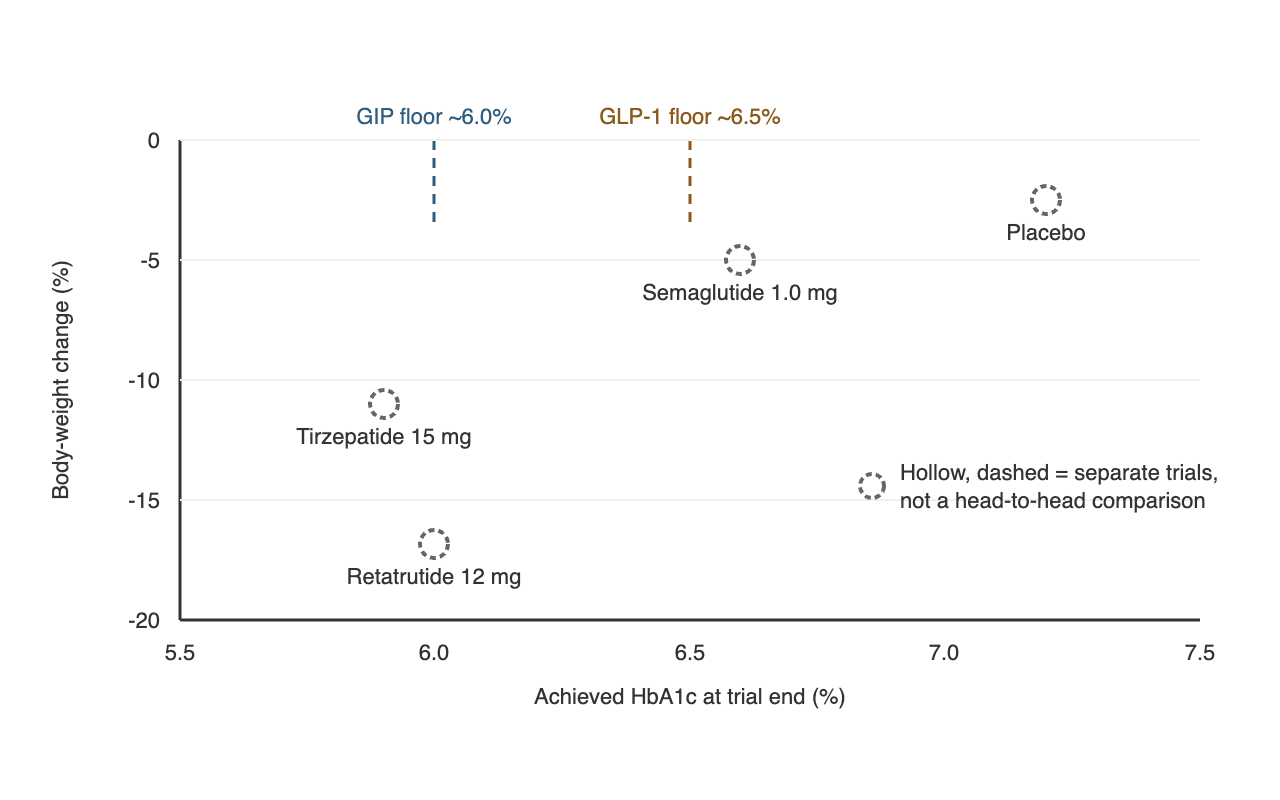
You have to read the placebo arm
Placebo HbA1c fell 0.81%, which is unusual — the placebo arm in SURPASS-1 moved in the opposite direction (+0.04%). The mechanism is in the estimand. The treatment-regimen estimand retains data after rescue medication is started, and 19% of the placebo arm (26 of 134) received rescue for severe hyperglycaemia, versus 1–7% on retatrutide. The practical consequence is that the placebo-adjusted treatment difference in this trial is systematically conservative, so placing this trial’s estimated treatment differences next to another trial’s estimated treatment differences produces a misleading picture.
That said, the correction should not be overstated in the other direction. Rescue reached only 19% of the arm, so it cannot arithmetically account for the whole 0.81%: at a realistic rescue effect of 1–2 percentage points, rescue explains roughly 0.2–0.4 points, perhaps a quarter to a half. The remainder is the ordinary placebo, lifestyle and regression-to-the-mean component of a drug-naive population with 2.5 years of disease — and that same component also lowers the achieved values in the retatrutide arms. So comparing achieved HbA1c across trials (about 6.0% versus about 5.9%) is cleaner than comparing adjusted differences, but it is still not a strictly equivalent comparison.
Safety
Gastrointestinal adverse events were class-typical and concentrated during dose escalation: diarrhoea 19–26%, nausea 16–26%, vomiting 15–18%, versus 4% / 4% / 2% on placebo, mostly mild to moderate. Discontinuation for any adverse event was 2–5% versus 0% on placebo, and discontinuation specifically for gastrointestinal reasons was 1% overall — lower than the 3% seen in phase 2, which the authors attribute to starting at 2 mg with stepwise escalation. There were no severe hypoglycaemia events, no adjudicated pancreatitis, no medullary thyroid carcinoma and no suspected drug-induced liver injury. The signal that does not fit the class label is dysesthesia — altered sensation, most often described as sensitive skin — in 15 participants (4%) versus none on placebo, severe in three, with two discontinuations. Pulse changed by +1.5 (9 mg) and +0.9 (12 mg) versus −1.1 bpm on placebo, a modest movement in this trial. Arrhythmia and conduction events (7 versus 0), cholelithiasis (4 versus 0) and malignancies (3 versus 1) all occurred at counts too small to interpret, and belong on the list to watch in longer trials rather than in the conclusions.
Deep dive
1. Background
Retatrutide (LY3437943) is a single peptide agonist at three receptors — GIP, GLP-1 and glucagon. Its phase 2 trial (N=281, 36 weeks, versus dulaglutide 1.5 mg) reported HbA1c reductions up to 2.16% and weight loss up to 16.9%. The open question for phase 3 was whether that signal survives a cleaner monotherapy design, and whether the third receptor buys anything the two-receptor agents do not already deliver. The relevant comparator context is that guidelines have been moving in this direction independently: the ADA Standards of Care 2026 position GLP-1 receptor agonists and dual GIP/GLP-1 agonists with substantial weight efficacy as preferred agents for type 2 diabetes with overweight or obesity, and note that sustained weight loss above 10% may be disease-modifying.
2. What this trial newly shows
Of 930 people screened, 537 were randomised (134 / 133 / 136 / 134); 490 (91%) completed 40 weeks of treatment and 504 (94%) completed the trial, with 94–99% reaching their assigned dose. Baseline: age 48.8 years, HbA1c 7.9%, disease duration 2.5 years, weight 96.9 kg, BMI 35.8, and 455 (85%) with no prior antihyperglycaemic medication.
| Endpoint (treatment-regimen estimand) | 4 mg | 9 mg | 12 mg | Placebo |
|---|---|---|---|---|
| HbA1c change | −1.69% | −1.86% | −1.94% | −0.81% |
| Estimated treatment difference vs placebo (95% CI) | −0.88 (−1.18 to −0.59) | −1.04 (−1.32 to −0.76) | −1.12 (−1.39 to −0.85) | — |
| HbA1c < 7.0% | 82% | 83% | 89% | 52% |
| HbA1c ≤ 6.5% | 75% | 76% | 83% | 40% |
| HbA1c < 5.7% | 35% | 40% | 37% | 14% |
| Body-weight change | −11.5% | −13.9% | −15.3% | −2.6% |
| Composite: HbA1c ≤ 6.5% and weight loss ≥ 10% | 41% | 56% | 64% | 3% |
| Triglycerides | −26.7% | −34.1% | −27.0% | −3.4% |
| Non-HDL cholesterol | −15.6% | −17.0% | −15.5% | −3.8% |
| Systolic blood pressure | −5.0 mmHg | −4.7 mmHg | −5.4 mmHg | −1.5 mmHg |
All primary and type-I-error-controlled secondary comparisons above were reported at P < 0.0001 unless otherwise noted. Under the efficacy estimand the figures are larger: HbA1c differences of −0.91 / −1.15 / −1.23, and weight changes of −11.5% / −15.5% / −16.8% versus −2.5%. The paper states explicitly that its confidence intervals are not adjusted for multiplicity and should not be used for hypothesis testing. Neither the glucose curve nor the weight curve had reached a plateau at week 40.
One internal inconsistency is worth flagging for accuracy rather than for interpretation: the Abstract gives the screening window as April 10, 2024 to April 21, 2025, while the Results section gives April 10, 2024 to February 20, 2026. This is most plausibly screening period versus overall trial period, but which reading is correct is unverified here. It does not affect any result.
3. Novelty, split by axis
On glucose, incremental. This trial reproduces a phase 2 signal in a cleaner design. Neither the mechanism nor the direction is new, and on the glucose axis retatrutide does not surpass the dual agonist: achieved HbA1c of about 6.0% at 12 mg against about 5.9% for tirzepatide 15 mg in SURPASS-1, and 35–40% reaching below 5.7% against 31–52% in SURPASS-1. A “most powerful glucose-lowering agent” framing is not supported by these data.
On weight in a diabetes population, a step change — but at hypothesis level. Weight loss of 15.3% (treatment-regimen) or 16.8% (efficacy estimand) with no plateau at 40 weeks has no precedent in type 2 diabetes monotherapy. The relevant context, which the paper’s introduction sets out, is that weight response is systematically attenuated in people with diabetes relative to those without: 66% versus 86% reaching at least 10% loss in STEP-UP with semaglutide 7.2 mg, and 70% versus 90% in SURMOUNT with tirzepatide 15 mg. The hypothesis this trial supports at phase 3 scale is that the glucagon receptor component offsets that attenuation.
4. Limits
- Placebo-arm contamination via the estimand. Discussed above; the operational rule is to cite achieved values and target-attainment rates from this trial rather than placebo-adjusted differences.
- Population representativeness. Three countries and 48 sites (United States 29%, Mexico 40%, India 31%), Hispanic/Latino 51–54%, American Indian/Alaska Native 34–38%. There is no European or East Asian representation. Eighty-five percent were drug-naive with 2.5 years of disease, which does not resemble the prevalent type 2 diabetes population. Applicability to East Asian phenotypes — lower BMI, more prominent beta-cell dysfunction — is untested here despite the trial using the Asian BMI cut-off of 23.
- Duration and absent hard outcomes. Forty weeks, with neither curve at plateau, means maximum effect, durability and rebound after discontinuation are all unmeasured. Lean-mass change was not assessed in this trial.
- Molecule-specific safety unresolved. Dysesthesia at 4% versus 0% is not explained by class-typical gastrointestinal effects and its mechanism is unknown. A 40-week trial of 537 people cannot adjudicate low-frequency events.
- Governance and conflicts. There was no trial-specific data monitoring committee; the programme relied on a committee reviewing unblinded safety from the obesity trials and applying recommendations across the programme. Six of ten authors are employees and shareholders of the sponsor, medical writing was in-house, and the sponsor participated in design, data collection, data review, analysis and drafting. The paper’s conclusion that retatrutide “could offer first-line treatment for early type 2 diabetes without background antihyperglycaemic medication” is a positioning claim that this trial’s design does not support, because there is no metformin comparator arm.
- Not read. The supplementary appendix (pages 1–49, including subgroup analyses, efficacy-estimand tables and detailed safety) and the accompanying Lancet Comment were not accessible for this analysis.
5. Connections to neighbouring domains
Process chemistry — the bottleneck is making the molecule, not the biology. What moved the regulatory timeline was not efficacy or safety but manufacturing and quality-control documentation, per the sponsor’s own description. For a lipidated peptide of this size, the plausible rate-limiting steps are synthesis yield, impurity profile, purification at scale, device and fill-finish capacity — though the specific step is not disclosed and the breakdown just given is inference, not company statement. The structural point is that “announced does not equal deployed” recurs here in a biopharma form, and the residual stack after the scientific milestone has a domain-specific name: chemistry, manufacturing and controls.
Machine learning — multi-target design as a ratio problem. Embedding three receptor activities in one peptide is a high-dimensional design problem in which the interesting variable is not affinity for any single target but the ratio among them. If the glucose axis really is saturated by GIP co-agonism while the increment lives on the glucagon axis, then the objective function for computational peptide design shifts from single-target affinity to multi-target ratio optimisation. Retatrutide itself is not an AI-designed molecule, and conflating the two would be an error; the relevance is to what the design objective should be, not to how this compound was made.
Health economics — cost-effectiveness and budget impact diverge structurally. A 2026 assessment placed existing agents in this class within conventional cost-effectiveness thresholds while warning of budget impact above $880 million per year at 1% coverage of the eligible population (secondary-source attribution; the underlying report was not read for this analysis). A more efficacious agent improves the QALY arithmetic and worsens the budget arithmetic simultaneously. Payers then face decisions of the form “cost-effective but unaffordable.” In Korea, where GLP-1 agents for obesity are entirely outside reimbursement, the same dilemma is currently handled by not deciding.
6. Development stage and commercial context
Technology readiness: TRL 7. Multiple pivotal phase 3 trials have met prespecified primary and key secondary endpoints in the target population, which meets the definition of system prototype demonstration in an operational environment. It is not TRL 8 because the regulatory submission is not complete and, per the sponsor, manufacturing and quality documentation is not finished; it is not TRL 9 because the product is not approved or marketed. The notable feature is that residual risk has migrated away from scientific efficacy toward manufacturing, cardiovascular outcomes and reimbursement.
Facts, stated as facts. Retatrutide is developed by Eli Lilly and Company. The programme runs in parallel across type 2 diabetes (TRANSCEND-T2D-1, the trial discussed here; -2, an 80-week comparison against semaglutide on background therapy; -3, 52 weeks in reduced kidney function) and obesity (TRIUMPH-1/2/3 plus complication-specific trials), with more than 2,050 participants enrolled per company materials.
The following figures come from company press releases and are not peer-reviewed; they are reproduced here with that attribution and without independent verification. TRIUMPH-1 reported 28.3% weight loss at 80 weeks with 12 mg (May 21, 2026). TRIUMPH-2 (type 2 diabetes with obesity, n=1,152, 80 weeks) reported 20.8% versus 4.0% on placebo, with HbA1c reductions up to 1.6% versus 0.2%. TRIUMPH-3 (severe obesity with established cardiovascular disease, n=1,949, 80 weeks) reported 21.6% at 9 mg and 22.6% at 12 mg versus 3.2%, with discontinuation of 9.8–13.5% versus 4.8%.
In the same release, prespecified cardiovascular analyses from TRIUMPH-3 were reported: MACE-5 at 44 versus 52 events, hazard ratio 0.82 (95.0% CI 0.55–1.22), and MACE-3 at 27 versus 23 events, hazard ratio 1.12 (0.64–1.96). Neither reached statistical significance, and the company attributed the wide intervals to fewer events than anticipated. Two things follow, and both should be stated plainly. First, with event counts this small, neither result establishes a cardiovascular benefit nor a cardiovascular harm; the data are close to uninformative in both directions. Second, the point estimate for the three-component composite sits above 1.0, which means cardiovascular neutrality has not been excluded — a fact worth recording as such, in a field where a competing agent has already demonstrated cardiovascular benefit in a dedicated outcomes trial. A dedicated cardiovascular outcomes readout is the event that would resolve this; until then the honest description is “not yet determined.”
Regulatory timeline. As of July 23, 2026 the sponsor stated that it plans to submit the retatrutide application in the first quarter of 2027, moved from an earlier position that had included it among 2026 submission candidates, and described the reason as needing additional time to complete and verify manufacturing and quality-control documentation (company comment reported by CNBC, July 23, 2026). Typical review timelines after submission would place any approval decision no earlier than late 2027 — that projection is press interpretation and is flagged as unverified here.
The competitive landscape, described neutrally. Tirzepatide is developed by the same company, so the relationship is internal rather than external. Novo Nordisk has oral semaglutide 25 mg approved for weight management (16.6% loss among adherent participants in OASIS 4, per company and press attribution) and cagrilintide/semaglutide under review; the axis of differentiation there is oral administration and access rather than maximal efficacy. Amgen’s maridebart cafraglutide combines GLP-1 agonism with GIP antagonism in a monthly or less-frequent antibody-peptide conjugate, with phase 3 readouts expected around 2027. That last one is the genuinely interesting scientific problem: retatrutide agonises GIP and MariTide antagonises it, and both produce weight loss. That unresolved paradox in GIP biology is a structural counterexample to any simple “more targets are better” narrative — which appears to be the question the accompanying Lancet Comment was aimed at, judging by its title alone, since its text was not accessible. Boehringer Ingelheim’s survodutide, a GLP-1/glucagon dual agonist, independently confirms the glucagon-liver axis, indicating that the glucagon component is not proprietary to a single compound.
7. The counterargument (skeptic block)
The firm’s skeptic gate returned proceed-with-caveats (conditional), close to but not at verified-clean. Every effect size, confidence interval, P value, funding statement and conflict declaration in the results section above was cross-checked against the full published text, with no discrepancies and no integrity flags — which is why this is not a hold. It is conditional because two axes that shape the narrative remain qualified. The following three statements are carried into this article as a condition of that gate:
- Nineteen percent of the placebo arm (26 of 134) received rescue medication, and the treatment-regimen estimand retains that data. The placebo-adjusted treatment differences from this trial must therefore not be placed alongside placebo-adjusted differences from other trials, including SURPASS-1.
- The reverse correction also has a limit: the 0.81% placebo change is not attributable in full to rescue, since rescue reached only 19% of the arm. A substantial share is the placebo, lifestyle and regression component of a drug-naive, 2.5-year-duration population — and that component also lowers achieved values in the retatrutide arms. So the cross-trial comparison of achieved HbA1c (about 6.0% versus about 5.9%) is likewise not a strictly equivalent comparison.
- Any statement that retatrutide matches these agents on glucose and exceeds them on weight is a cross-trial indirect comparison that the authors themselves label hypothesis-generating. The head-to-head trials (TRANSCEND-T2D-2; NCT06260722, NCT06662383) have not reported.
Three further notes from the same review. Baseline weight differed materially between the cohorts being compared (96.9 kg here versus 85.9 kg in SURPASS-1), and larger percentage weight loss in a heavier cohort is a common and unremarkable finding. Shorter disease duration in this trial (2.5 years versus 4.7) systematically favours glycaemic response, which if anything strengthens rather than weakens the observation that retatrutide did not surpass the dual agonist on glucose. And the mechanistic attribution — that GIP sets the floor while glucagon carries the weight effect — is an untested narrative in this trial, which contains neither a GIP-free nor a glucagon-free comparator.
Finally, the “achieving below 5.7%” figures describe people on active treatment. They are not remission, which requires maintenance after stopping the drug. Reporting that distinguishes the two is describing something this trial did not measure.
8. What to watch
- TRANSCEND-T2D-2, the 80-week head-to-head against semaglutide — the decisive test of the cross-trial hypothesis that this article has repeatedly flagged as unproven.
- TRANSCEND-T2D-3 in reduced kidney function, which is what would open the renal axis; at present there is no kidney evidence for this compound.
- A dedicated cardiovascular outcomes readout, which is what would resolve the MACE-3 point estimate discussed in section 6.
- Whether the Q1 2027 submission holds, and whether the manufacturing documentation issue resolves without further movement.
- Whether dysesthesia reproduces or worsens in the 80-week and extension trials, and whether a mechanism is identified.
- Body-composition data, specifically lean-mass loss, which this trial did not measure.
- Reassessment by cost-effectiveness bodies, and whether any reimbursement pathway opens in markets where this class is currently self-pay.
Update — 10 August 2026: a pre-approval access route, narrow by construction
Section 8 above flagged the Q1 2027 submission as the thing to watch. A separate development has since been confirmed, and it is worth recording precisely because the precise version is less dramatic than the reported one.
Eli Lilly operates a pre-approval expanded access programme for retatrutide, registered as NCT07629401 and listed with status “available”. The registry record was first posted on 5 June 2026 and last updated on 6 August 2026; what happened on 3 August was the company publicly confirming the programme and stating it was reviewing requests from clinicians, not the programme coming into existence.
The registered inclusion criteria are, in full: age 18 or older; refractory obesity defined as BMI at or above 35 kg/m² despite adherence to and tolerance of the highest available dose of chronic weight-management therapy; two or more serious or life-threatening obesity-related complications for which the patient is currently receiving standard of care; inability to participate in an ongoing trial of retatrutide or a comparable investigational medicine; and prior shared decision-making covering all standard options including bariatric surgery. The single exclusion is a medical contraindication.
Read plainly, that is a compassionate-use pathway scoped to people who have already exhausted licensed therapy and carry a documented complication burden — which is what pre-approval access is normally for. Clinician commentary reported in the trade press has characterised the criteria as unreachable for most people seeking the drug; that characterisation is theirs, and this article does not adopt it, but the narrowness itself is visible in the registered criteria and is not in dispute. Expanded access is not marketing authorisation, confers no efficacy or safety finding, and does not alter the submission timeline described above.
References
- Bajaj HS, Welch M, Shah P, Luna E, Jaouimaa F-Z, Liu B, Liu R, Chen Y, Patel H, Bartee A. 2026. “Efficacy and safety of retatrutide, a GIP, GLP-1, and glucagon receptor agonist, in people with type 2 diabetes and inadequate glycaemic control with diet and exercise (TRANSCEND-T2D-1): a double-blind, randomised, phase 3 trial.” The Lancet, online June 6, 2026; 2026;407(10546):2402–13. DOI 10.1016/S0140-6736(26)00967-0. PMID 42250575. NCT06354660. Funding: Eli Lilly and Company. https://doi.org/10.1016/S0140-6736(26)00967-0 (Full published text reviewed for this analysis; supplementary appendix not accessed.)
- “Multireceptor modulation in metabolic disease: are more targets better?” The Lancet Comment. DOI 10.1016/S0140-6736(26)01136-0. (Title confirmed; text not accessed — unverified.)
- Rosenstock J, Wysham C, Frías JP, et al. 2021. “Tirzepatide monotherapy (SURPASS-1).” The Lancet 398:143–55. https://doi.org/10.1016/S0140-6736(21)01324-6
- Sorli C, et al. 2017. “Semaglutide monotherapy (SUSTAIN 1).” The Lancet Diabetes & Endocrinology 5:251–60. (Cited via the primary paper.)
- Rosenstock J, Frias J, Jastreboff AM, et al. 2023. “Retatrutide phase 2 trial.” The Lancet 402:529–44. https://doi.org/10.1016/S0140-6736(23)01053-X
- Eli Lilly and Company press release, July 23, 2026, reporting TRIUMPH-2 and TRIUMPH-3 results, the prespecified MACE analyses, and Q1 2027 submission timing. Press release (company source, not peer-reviewed).
- CNBC, July 23, 2026, reporting the submission timeline change and the company’s stated reason. Report (article text not directly accessible for this analysis; cross-checked against search snippets and secondary reporting).
- American Diabetes Association Professional Practice Committee. “Standards of Care in Diabetes—2026,” §8 Obesity and Weight Management (Diabetes Care 2025;49(suppl 1):S166–82) and §9 Pharmacologic Approaches to Glycemic Treatment (S183–215). §8 · §9
- Cost-effectiveness and budget-impact figures for this drug class (approximately $57.8K–75.5K per QALY; above $880 million per year at 1% coverage) are attributed to secondary reporting of a July 2026 assessment; the underlying report was not read for this analysis.
Disclosure
This post is for information only and is not investment advice, and not medical advice. Treatment decisions should always be made with your own clinician.
COI note: The trial was sponsored by Eli Lilly and Company, which per the paper’s own funding statement participated in design, data collection, data review, analysis and drafting of the report. Six of the ten authors are employees and shareholders of the sponsor (F-Z Jaouimaa, B Liu, R Liu, Y Chen, H Patel, A Bartee), and medical writing support was provided in-house. The corresponding author reports institution-directed research funding from Abbott, Amgen, AstraZeneca, Boehringer Ingelheim, Eli Lilly, Ionis, Novartis, Novo Nordisk, Pfizer, Roche and Vertex, and speaker or advisory roles with Eli Lilly, Novo Nordisk and Roche; other authors report speaker fees, travel support, stock holdings or advisory roles with the sponsor and others. There was no trial-specific data monitoring committee. Mitigating factors are recorded alongside: the trial is peer-reviewed with confidence intervals and P values published in full, is registered (NCT06354660), and carries an individual-participant-data sharing commitment — which places it at the milder end of the self-reported-evidence spectrum, and distinct from figures sourced only from press releases. All TRIUMPH figures, the MACE analyses and the submission timeline in this article are attributed to company press materials and press reporting, not to peer review. Companies named in this article are described factually and this is not a solicitation to buy or sell any security. The author holds no position in, and no financial interest in, any company named.


Leave a Reply