Evidence-first notes on bioscience and deep tech, at the edge of the lab and the market. Information only — not investment advice, not medical advice.
The 30-second version
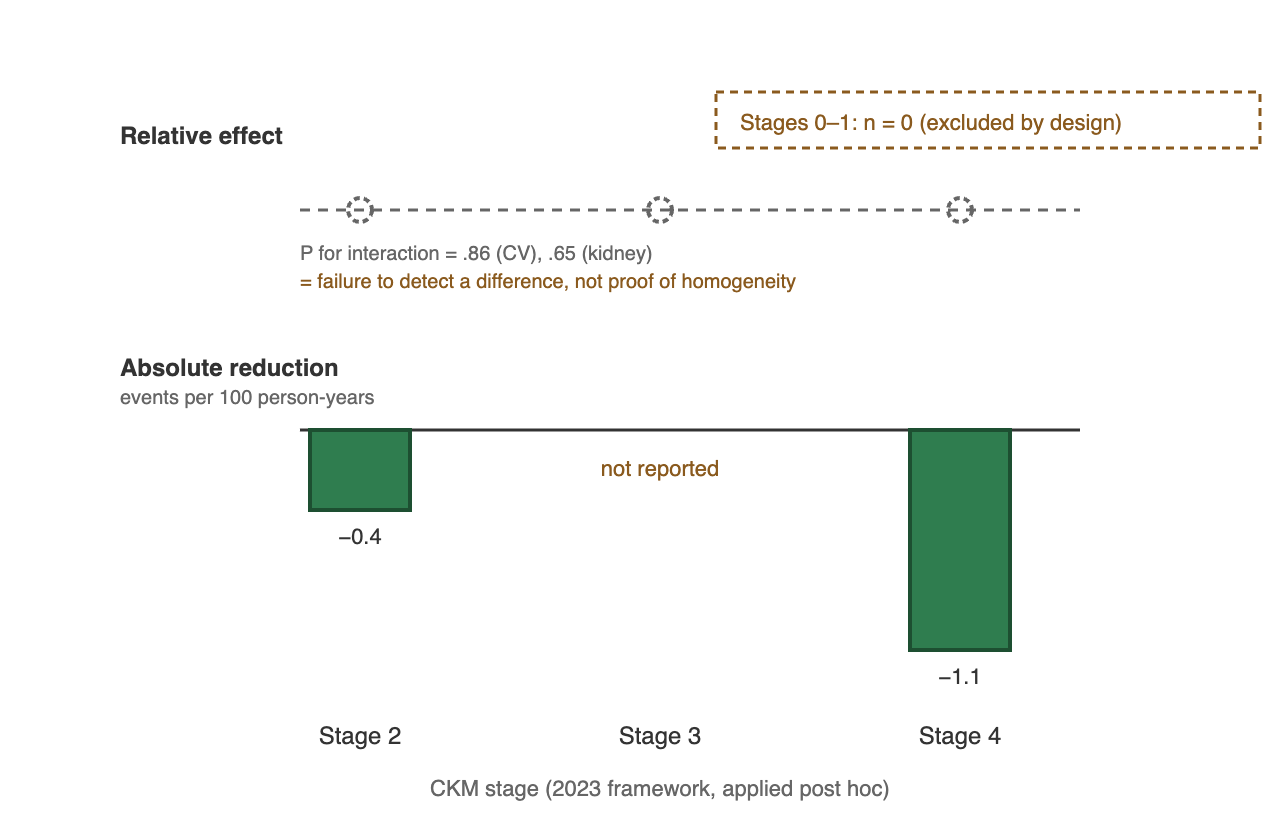
- What. A post hoc analysis of 12,990 people with type 2 diabetes and chronic kidney disease from two phase 3 trials, pooled and then re-classified using the American Heart Association’s 2023 cardiovascular-kidney-metabolic (CKM) staging framework (JAMA Cardiology 2026;11(7):679–684). Higher stage predicted worse outcomes (stage 4 versus stage 2: cardiovascular adjusted HR 1.87, 95% CI 1.56–2.24; kidney adjusted HR 1.96, 95% CI 1.43–2.69). Finerenone’s relative effect did not differ detectably by stage (P for interaction .86 cardiovascular, .65 kidney), while absolute reduction scaled with baseline risk (−1.1 versus −0.4 events per 100 person-years). At three years, CKM stage regression occurred in 11.4% versus 7.4% (adjusted OR 1.66, 1.30–2.13; P < .001).
- So what. Two of those three findings are not new. “Relative effect constant, absolute benefit proportional to risk” is the standard pattern in cardiovascular pharmacoepidemiology, seen with statins, RAS inhibitors and SGLT2 inhibitors. And a large P for interaction is not evidence of homogeneity — it is failure to detect heterogeneity, which is a different statement. The genuinely new element is the endpoint itself: CKM stage regression. That is where the analysis is most interesting and most fragile.
- Now what. The stage 2-to-3 boundary is defined by kidney risk categories that are a function of eGFR and albuminuria — and this drug’s best-established pharmacodynamic effect is a 32% reduction in urinary albumin-to-creatinine ratio, while its total eGFR slope in the parent analysis was essentially identical to placebo (−3.5 versus −3.6). So the treatment moves a variable that helps define the outcome. Whether stage movement predicts hard outcomes has not been established.
The five-minute read
What sits on top of what
Keeping the evidence layers separate matters here more than usual. The parent analysis is FIDELITY, a prespecified pooled analysis of two randomised, double-blind, placebo-controlled phase 3 trials (N=13,026), which reported a cardiovascular composite HR of 0.86 (95% CI 0.78–0.95) and a kidney composite HR of 0.77 (0.67–0.88). The paper discussed here is a post hoc analysis layered on top of that prespecified pooled dataset, conducted between September 2025 and March 2026 — years after the original trials ended — applying a staging framework that did not exist when those trials were designed. The framework was published in October 2023; the trials were registered in 2015. The data were not collected to answer this question; the question was fitted to the data afterwards.
Three findings, three different evidentiary weights
The prognostic axis holds up. Stage separates prognosis well, and that supports the framework’s prognostic validity in a trial population. It is also close to tautological on the cardiovascular endpoint, since stage 4 is defined as clinical cardiovascular disease — so “adjusted HR 1.87” partly restates “people with established cardiovascular disease have more cardiovascular events.” The kidney endpoint is a different matter: clinical cardiovascular disease predicting kidney events at adjusted HR 1.96 is a genuine cross-organ gradient, not a restatement.
The effect-modification axis is being over-read. Interaction tests typically require far larger samples than tests of a main effect. Splitting a trial population into three ordered categories after the fact and finding P = .86 does not license the phrase “consistent regardless of stage” in the sense most readers will take it. The precise defect is not low power in the abstract — with nearly 13,000 people and thousands per stratum, that claim would need support — but non-reporting: the abstract gives no per-stage hazard ratios, no per-stage confidence intervals, and no confidence interval around the interaction. So the range of stage-to-stage differences still compatible with these data cannot be quantified at all.
The absolute-benefit axis is the useful one. If the relative effect is roughly constant, absolute benefit tracks baseline risk, and it does: the absolute rate reduction is −1.1 per 100 person-years at stage 4 against −0.4 at stage 2. The practical reading is therefore not “use it regardless of stage” but “the number needed to treat is far more favourable at higher stage.” One caution on arithmetic: the ratio of those two figures exceeds the adjusted risk gradient of 1.87, which would not happen if the relative effect were perfectly flat, and −0.4 is rounded to one decimal place, so the ratio floats somewhere around 2.5 to 3.1. It is a derived and fragile number, not a reported one.
Where the new endpoint gets circular
In the staging framework, stage 2 is defined by metabolic risk factors and/or moderate-to-high-risk chronic kidney disease, and the stage 2-to-3 boundary runs through kidney risk categories that are themselves a function of eGFR and albuminuria. Finerenone’s canonical pharmacodynamic effect is a reduction in albuminuria: in the parent analysis, a 32% reduction at four months (least-squares mean change ratio 0.68; 95% CI 0.66–0.70). Meanwhile the parent analysis found that the total eGFR slope was essentially the same in both arms (−3.5 versus −3.6 mL/min/1.73 m² per year), with the difference appearing only in the chronic slope (−2.5 versus −3.7). Put those together and the likely engine of three-year stage movement is the albuminuria axis, not the filtration axis — which means a substantial part of “stage regression” may be the already-known surrogate effect crossing a category line and being reported as a new outcome domain.
Two qualifications keep this from being an accusation. The pathway to stage 3 also includes blood pressure and lipid components that are not circular in this way, so “substantially circular” is the accurate phrase, not “entirely.” And the structural point cuts deeper than the circularity: because every participant had type 2 diabetes — which by itself establishes stage 2 — no one could regress below stage 2, and stage 4 is defined by clinical cardiovascular disease, which does not reverse. The 11.4% versus 7.4% comparison therefore almost certainly reflects movement within the stage 3 stratum (n=3,275), though the actual denominators and the handling of competing risk from death are not verifiable from the abstract.
What the population cannot tell you
Everyone enrolled had type 2 diabetes and chronic kidney disease, was on a maximally tolerated RAS inhibitor, had serum potassium at or below 4.8 mmol/L and eGFR at or above 25. Three consequences follow. There are zero participants at stages 0 and 1, which is precisely where the preventive promise of a staging framework would live. There is no non-diabetic chronic kidney disease. And people at high risk of hyperkalaemia were excluded by design — relevant because in the parent analysis, investigator-reported hyperkalaemia ran 14.0% versus 6.9%, with 1.7% versus 0.6% discontinuing because of it. A title spanning “CKM stages” covers a population more than half of which is not in the data.
Deep dive
1. What was measured
Population: 12,990 participants, mean age 64.8 (SD 9.5), 3,932 women (30%) and 9,058 men (70%). Stage 2 n=3,864 (30%), stage 3 n=3,275 (25%), stage 4 n=5,851 (45%). Median follow-up three years, 48 countries, trials NCT02540993 and NCT02545049, funded by Bayer AG. The cardiovascular composite was cardiovascular death, non-fatal myocardial infarction, non-fatal stroke and heart-failure hospitalisation; the kidney composite was kidney failure, a sustained eGFR decline of at least 57% for at least four weeks, and death from kidney failure.
| Result | Value |
|---|---|
| Prognosis, stage 4 vs 2 — cardiovascular | adjusted HR 1.87 (95% CI 1.56–2.24) |
| Prognosis, stage 4 vs 2 — kidney | adjusted HR 1.96 (95% CI 1.43–2.69) |
| Effect modification by stage | P for interaction .86 (CV), .65 (kidney) |
| Absolute rate reduction, cardiovascular | −1.1 per 100 person-years (stage 4); −0.4 (stage 2) |
| CKM stage regression at 3 years | 11.4% vs 7.4%; adjusted OR 1.66 (1.30–2.13); P < .001 |
| CKM stage progression at 3 years | adjusted OR 0.89 (0.79–1.00); P = .05 |
Not reported in the abstract and therefore unverified here: within-stage hazard ratios and confidence intervals, per-stage safety including hyperkalaemia, the staging algorithm’s variable definitions and cut-points, handling of missing data, the denominators and competing-risk treatment for the progression and regression analyses, whether any multiplicity correction was applied, and who executed the statistical analysis. The full text is paywalled and the PubMed Central embargo runs to June 3, 2027.
2. Novelty, decomposed
Efficacy axis: no novelty. Constant relative effect with risk-proportional absolute benefit is the standard pattern. This paper shows it once more, for this drug against this staging variable.
Prognostic axis: confirmatory, partly tautological. Discussed above; the kidney gradient is the part that is not a restatement.
New-endpoint axis: genuinely new, and the weakest. CKM stage regression has not been validated as a surrogate. No evidence is offered that stage movement transfers treatment effect to hard outcomes in the sense that surrogate-validation criteria require, and nothing at abstract level establishes it.
It is also worth noting what this does not update. Against the parent analysis, the data and the endpoints are the same; what is added is a stratification variable and a new endpoint. The efficacy estimates themselves are unchanged. Against a 2024 pooled analysis of nearly 19,000 participants that already carried “cardio-kidney-metabolic” in its framing and included heart-failure trials, this paper covers a narrower population — type 2 diabetes with chronic kidney disease only. So the novelty of a “works across the CKM spectrum” message is low; what is new is the discrete-label re-description.
3. Where this sits against guidelines
The 2026 multi-society CKM guidance recommends a RAS inhibitor plus an SGLT2 inhibitor first-line for chronic kidney disease with type 2 diabetes and albuminuria, adding a non-steroidal mineralocorticoid receptor antagonist or GLP-1-based therapy when albuminuria persists. A post hoc analysis on a surrogate endpoint is not the class of evidence that changes a recommendation grade; its natural position is supporting material for language that already exists. The same applies to kidney-society and diabetes-association standards.
One adjacent gap has partly closed since this analysis was first written. A trial in non-diabetic chronic kidney disease (n=1,584) met its primary endpoint on eGFR slope at 32 months with a reduction in the secondary composite, presented as a late-breaker and published simultaneously in June 2026 — figures attributed to the sponsor’s release and secondary reporting, with the primary publication not read for this analysis. So the “no non-diabetic chronic kidney disease” limitation of the trial discussed here has been addressed elsewhere, even though it remains a limitation of this dataset.
A separate strand worth naming: a phase 2 trial combining this drug with an SGLT2 inhibitor reported a 52% albuminuria reduction at day 180 versus roughly 29–32% for either agent alone. That is encouraging and it is still surrogate-level. The broader observation is that the four-pillar cardiorenal treatment narrative is currently expanding on surrogate endpoints ahead of hard-outcome testing, and the real-world evidence layer is thinner still — one retrospective single-centre cohort in this space had n=51 with no control group.
4. Limits
- Post hoc on prespecified pooled. Stratification, interaction tests and the stage-movement endpoint are all after the fact, using a framework that postdates trial design.
- Multiplicity. Two interaction tests, two movement endpoints, plus unread per-stage estimates, with no alpha-control description in the abstract. The progression result — adjusted OR 0.89, CI upper bound touching 1.00, P = .05 — is a nominal borderline that would not survive any correction.
- Misclassification. The authors state that the analysis was not designed to evaluate CKM syndrome progression and that some data used for staging were not systematically collected, so certain stages may be underestimated. Without systematic subclinical cardiovascular assessment, stage 3 collapses toward being a function of kidney risk category — and if the staging variable is near-collinear with kidney severity, then “consistency across stages” may be a relabelling of the eGFR and albuminuria subgroup consistency the parent analysis already reported.
- Competing risk. Three-year stage movement requires surviving three years with data available. Higher-stage participants die more often, so the movement analysis is exposed to differential survivorship. Whether competing risk was handled is unverified.
- Population truncation. Discussed above — no stage 0–1, no non-diabetic chronic kidney disease, hyperkalaemia-prone participants excluded.
- Conflicts and self-report. Sponsor-funded with sponsor-employed authors; no independent reanalysis. Details in the disclosure below.
5. Connections to neighbouring domains
Computable phenotypes. The strongest cross-domain observation here comes from the paper’s own limitation statement: if staging data were not systematically collected even inside a large multinational randomised trial, then computing CKM stage from routine electronic health records — which is what any real deployment of a staging framework would require — is a harder problem than the framework’s clinical appeal suggests. A trial admitting it cannot reliably stage its own participants is direct evidence about the feasibility gap, not speculation about it.
Causal inference and heterogeneous treatment effects. The methodological weakness here is the classic one: subgroup interaction tests are underpowered instruments for the question people actually want answered, which is who benefits more. Modern heterogeneous-treatment-effect estimation is the natural alternative. This connection is real but low-specificity — it attaches to essentially any post hoc subgroup analysis, so it is worth noting and not worth over-weighting.
6. Development stage and commercial context
Two different readiness levels are in play, and conflating them is the main risk. The drug is approved and marketed — TRL 9 — having been approved in 2021 for chronic kidney disease with type 2 diabetes and expanded in July 2025 to heart failure with ejection fraction at or above 40%, on the basis of a 6,016-participant trial reporting roughly a 16% reduction in its primary composite. The concept being advanced in this paper — that CKM stage should be used to select or stratify treatment — has no prospective validation at all, which places it at TRL 4 to 5 as a decision tool. A marketed drug does not confer readiness on a framework for using it.
What can be stated as fact. The trials were funded by Bayer AG, which manufactures finerenone. Three authors are Bayer employees, and the PubMed affiliation list records three separate Bayer units, one of which is Bayer AG Global Medical Affairs (Berlin). That is a factual anchor, not an inference: a medical-affairs unit appears as a listed co-author affiliation on an analysis that generates the claims “consistent across all stages” and “stage regression.”
What is inference and is labelled as such. This publication describes the paper as functioning as evidence generation for positioning rather than as a basis for new approval. That characterisation is supported by the affiliation fact above and by the analysis being post hoc on a surrogate endpoint. The further step — that it is specifically aimed at reimbursement negotiation — is this outlet’s inference, with no payer submission or coverage document offered in support, and it should be read as such rather than as an established fact. Evidence generation of this kind is a normal and legitimate activity; the point worth recording neutrally is simply that the sponsor, rather than an independent group, owns the framing.
Adjacent competitive context, stated without ranking. A different mechanism in the same broad cardiorenal-metabolic space, an aldosterone synthase inhibitor, was approved in May 2026 for uncontrolled hypertension, reporting systolic reductions of 14.5 and 15.7 mmHg against 5.8 on placebo in its pivotal trial. It addresses a different indication and is named here only to record that the pathway is not static. Nothing in this article compares the two on efficacy, and nothing here should be read as a view on any company’s prospects.
7. The counterargument (skeptic block)
The firm’s skeptic gate returned proceed-with-caveats (conditional). Every figure in the abstract was independently cross-checked against the PubMed record with zero numerical discrepancies, the parent analysis is independently published and cross-checkable, and there are no integrity flags or retraction history — which is why this is not a hold. It is conditional because the decisive numbers sit outside the abstract behind a paywall and an embargo, and because two interpretive caveats drive the entire narrative. The following four statements are carried into this article as a condition of that gate:
- This is a post hoc analysis that applies a 2023 staging framework retrospectively to a prespecified pooled dataset. The authors state that the analysis was not designed to evaluate CKM syndrome progression, and that some of the data used for staging were not systematically collected.
- “Consistent across all stages” does not establish absence of heterogeneity; it reports failure to detect it. The abstract provides no per-stage hazard ratios, no per-stage confidence intervals and no interval around the interaction, so the magnitude of stage-to-stage difference still compatible with these data is not quantified. The full text is paywalled with a Central embargo to June 3, 2027.
- CKM stage regression is not a validated surrogate endpoint. The stage 2-to-3 boundary is defined by kidney risk categories built from eGFR and albuminuria; finerenone reduced albuminuria by 32% (ratio 0.68; 95% CI 0.66–0.70) while the total eGFR slope was essentially identical to placebo (−3.5 versus −3.6). Because all participants had type 2 diabetes, stage 2 cannot regress and stage 4 cannot reverse, so 11.4% versus 7.4% likely reflects category crossing within the stage 3 stratum.
- The progression result, adjusted OR 0.89 (95% CI 0.79–1.00; P = .05), is a nominal borderline, yet the source abstract’s own conclusion states progression as reduced. Unless multiplicity correction is confirmed, it should not be cited as an established effect. All figures in this article are self-reported from a sponsor-funded post hoc analysis with no independent reanalysis.
The same review corrected two over-readings in the firm’s internal draft, and both corrections are reflected above. An earlier version attributed stage movement partly to an acute early eGFR dip; that mechanism is weak, because the dip is offset by the chronic-slope benefit so that total slope equalises, and it therefore cannot plausibly drive a three-year endpoint. And an earlier version dismissed the prognostic finding as tautological across the board; that holds for the cardiovascular endpoint but overreaches for the kidney endpoint, where a cross-organ gradient of 1.96 is a real observation.
8. What to watch
- Per-stage hazard ratios and per-stage hyperkalaemia, if the full text becomes accessible — these are the two values that would convert “not detected” into something quantified.
- Whether any prospective trial actually randomises or stratifies treatment strategy by CKM stage, which is the only thing that would move the staging concept past its current readiness level.
- Hard-outcome trials for combination cardiorenal therapy, as opposed to further albuminuria readouts.
- Whether national guidelines adopt CKM staging language in a way that changes what gets reimbursed, as distinct from what gets recommended.
Update — 10 August 2026: the reimbursement question resolved, and not in the way the framing wanted
Section 8 above listed one thing to watch: whether national guidance would adopt cardiovascular-kidney-metabolic staging language in a way that changes what gets reimbursed, as distinct from what gets recommended. That question now has a first answer.
On 5 August 2026 NICE published final technology appraisal guidance TA1182, recommending finerenone within its marketing authorisation as an option for symptomatic chronic heart failure with preserved or mildly reduced ejection fraction in adults. NHS England must fund it within 90 days of publication where it is the most suitable option, and NICE estimates up to 280,000 people in England could be eligible. It is the second disease-modifying treatment recommended for this form of heart failure, after SGLT2 inhibitors.
The detail that matters for this article is what the decision runs on. Reimbursement opened on an ejection-fraction label indication derived from a dedicated heart-failure outcomes trial — not on a CKM stage. Nothing in the appraisal turns on the staging framework this paper applied post hoc. So the structural reading in section 6 holds and is if anything sharpened: the staging concept remains at a decision-tool readiness level with no prospective validation, while the money moved through the ordinary route of a licensed indication backed by a hard-outcome trial.
Two cautions on the figures. The 280,000 estimate is NICE’s own eligibility modelling, not an observed count. And a recommendation “within its marketing authorisation” carries the licence’s own conditions, so it should not be read as unrestricted funding. Source: NICE TA1182, published 5 August 2026.
References
- Post hoc CKM-staging analysis of the FIDELITY population. JAMA Cardiology 2026;11(7):679–684. PMID 42234437. Trials NCT02540993 and NCT02545049; funded by Bayer AG. (Abstract and PubMed record cross-checked for this analysis; full text paywalled, PubMed Central embargo to June 3, 2027.)
- FIDELITY prespecified pooled analysis of FIDELIO-DKD and FIGARO-DKD, N=13,026. European Heart Journal 2022. (Parent analysis; cardiovascular composite HR 0.86, 95% CI 0.78–0.95; kidney composite HR 0.77, 0.67–0.88; albuminuria ratio 0.68, 0.66–0.70.)
- FIDELITY eGFR slope analysis. Kidney International 2022. (Total slope −3.5 versus −3.6; chronic slope −2.5 versus −3.7, P < 0.0001.)
- Pooled cardio-kidney-metabolic analysis across FIDELIO-DKD, FIGARO-DKD and FINEARTS-HF, N=18,991. Nature Medicine 2024.
- 2026 multi-society cardiovascular-kidney-metabolic guidance. Journal of the American College of Cardiology 2026. DOI 10.1016/j.jacc.2026.03.056.
- Phase 2 combination trial of finerenone with empagliflozin. New England Journal of Medicine 2025. (Albuminuria −52% at day 180.)
- Trial in non-diabetic chronic kidney disease, n=1,584, presented June 5, 2026 with simultaneous publication. (Effect sizes attributed to the sponsor’s release and secondary reporting; primary publication not read for this analysis.)
Disclosure
This post is for information only and is not investment advice, and not medical advice. Treatment decisions should always be made with your own clinician.
COI note: The trials and this analysis were funded by Bayer AG, which manufactures finerenone. Of 17 authors, three are Bayer employees (Meike Brinker, Patrick Schloemer, Andrea Glasauer), and the PubMed affiliation list records three Bayer units including Bayer AG Global Medical Affairs (Berlin). Per the disclosure section: Brinker reports Bayer employment, Bayer stock ownership and a patent application relating to finerenone; Schloemer reports Bayer employment and pending patents; Glasauer reports Bayer employment. Among academic authors, Rajiv Agarwal reports personal fees and support from Bayer during the conduct of the work; John Ostrominski reports fees from Corcept and Bayer plus NIH grants; Gerasimos Filippatos reports Bayer consultancy and lecture fees during the work; Peter Rossing reports institution-directed Bayer research funding; Bertram Pitt reports multiple consultancies plus patent holdings and stock options. Other authors including Anker, Solomon and Vaduganathan report extensive pharmaceutical-industry relationships. Who executed the statistical analysis — sponsor statisticians or an academic group — and what data access the academic authors had are not described in accessible material and are recorded as unverified. Mitigating factors: the underlying data come from registered randomised trials, the principal efficacy estimates are consistent with the independently published parent analysis, and an academic statistical group participated — so this is not an inseparable conflict. Every quantitative figure in this article nonetheless originates from a sponsor-funded post hoc analysis and is self-reported, with no independent reanalysis. Companies named in this article are described factually and this is not a solicitation to buy or sell any security. The author holds no position in, and no financial interest in, any company named.


Leave a Reply