Evidence-first notes on bioscience and deep tech, at the edge of the lab and the market. Information only — not investment advice, not medical advice.
The 30-second version
- What. An exome-sequencing analysis of 1,032,116 people across America, Europe and Asia tested rare protein-coding variants against the triglyceride-to-HDL ratio, used as a biomarker of energy state (Nature, 5 August 2026). It identified 59 independent genes (P < 1.04 × 10⁻⁷), enriched for liver- and adipose-expressed regulators of energy balance — and 23 of them (39%) are already approved or clinical-stage drug targets. The standout new signal is FNIP1: ultra-rare protein-truncating variants (allele frequency 0.01%) associate with lower TG:HDL, lower liver fat, lower glycaemia, favourable fat distribution and around 60% lower odds of cardiometabolic disease.
- So what. As target discovery this is a genuine step change, and the 39% recovery of known targets is the closest thing to an internal positive control a study like this can have — the method found what it should have found. But FNIP1 itself sits at TRL 2. There is no compound, no IND, no trial. A direction, not a drug.
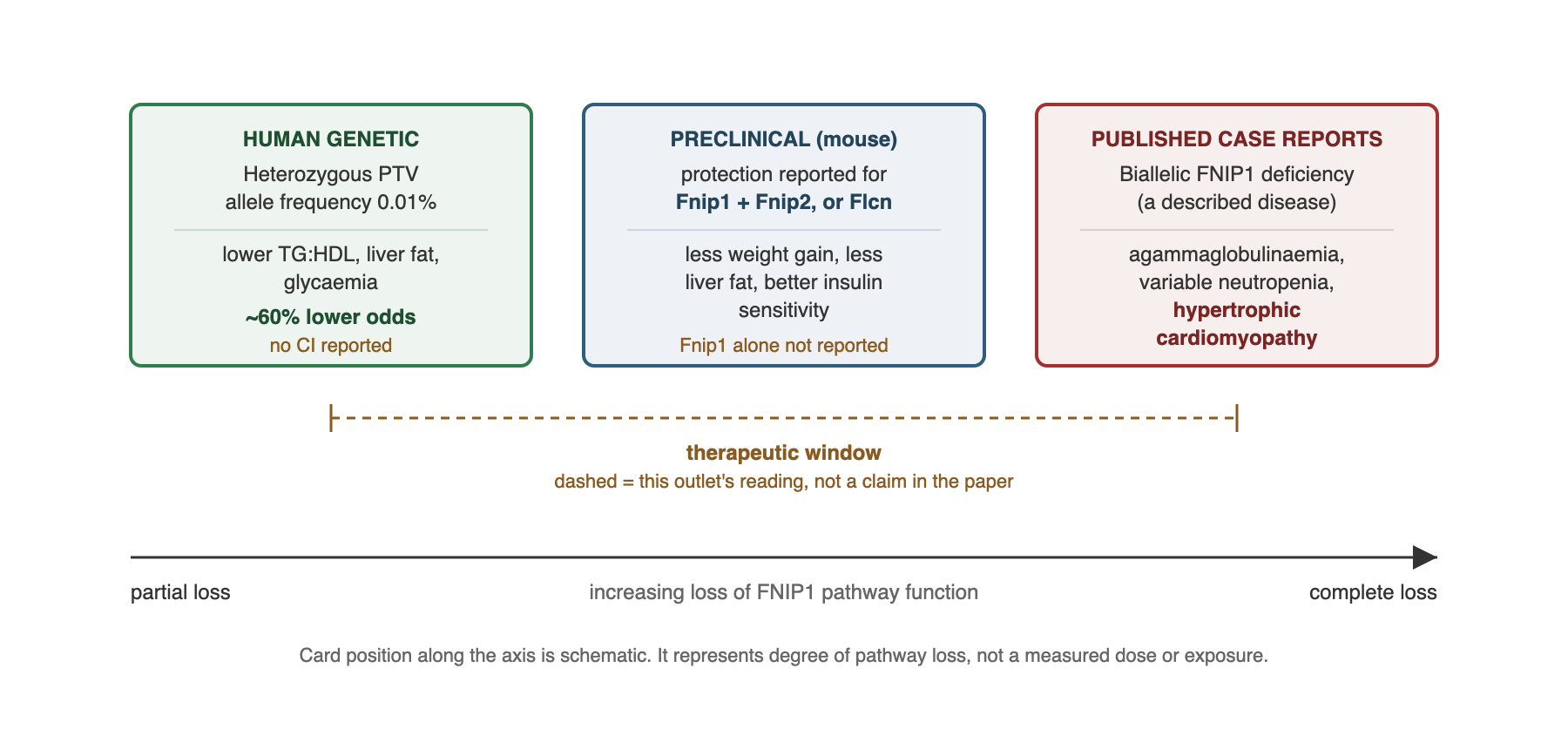
- Now what. The interesting problem here is not efficacy — it is the therapeutic window. In mice, the protective phenotype was reported when Fnip1 was knocked down together with its paralogue Fnip2, or when its interactor Flcn was knocked down. Meanwhile, in humans, biallelic FNIP1 deficiency is an already-described disease: agammaglobulinaemia, variable neutropenia and hypertrophic cardiomyopathy. Efficacy appears to want deeper inhibition; safety appears to forbid it.
The five-minute read
Why the phenotype choice is the real innovation
Most human-genetics target discovery in cardiometabolic disease has started from a single trait — LDL cholesterol, Lp(a), body-mass index. This study started instead from the TG:HDL ratio, treated as a proxy for energy state rather than for any one disease. That choice is what makes the result interesting: the genes it surfaced are enriched for liver- and adipose-expressed master regulators of energy balance, storage and metabolism, which is what you would want if the ratio really is reading out energy handling rather than lipid transport alone.
The 39% figure deserves attention for the same reason. When 23 of 59 hits encode targets that are already approved or in clinical development, the method has demonstrably recovered known biology. That raises the prior on the genes it found that are not already targets. It also, honestly, dilutes the novelty claim: how much is genuinely new depends on follow-up work on the other 36.
How to read “around 60%”
Three qualifications, and they matter more than the headline.
The precision is not reported. An allele frequency of 0.01% is ultra-rare. Even in a million people, carriers will number in the hundreds, and an odds ratio estimated in that stratum will carry a wide confidence interval. The abstract reports no 95% CI. Until the full text is read, “around 60%” is a point estimate and should not be used to rank this target against others.
Lifelong genetic exposure is not a drug effect. A partial loss of function present from conception is a different exposure from pharmacological inhibition started in middle age. Human genetics reliably tells you the direction of a target; it does not transfer the effect size. This is the same caveat that has attached to every genetics-derived cardiometabolic target of the past decade.
The discovery axis is a biomarker. The 59 genes were found against TG:HDL. Disease odds is a secondary layer on top of that. There is no outcomes trial, because there is no drug.
The part that decides whether this becomes a medicine
Two facts from the record, placed next to each other, describe the central development problem.
Efficacy appears to require broad inhibition. The mouse protection — less weight gain on a high-fat diet, less liver fat, better insulin sensitivity — is reported for hepatic knockdown of Fnip1 together with its paralogue Fnip2, or for knockdown of the interactor Flcn. The abstract does not report protection from knocking down Fnip1 alone. If paralogue redundancy is real, a selective FNIP1 inhibitor may simply not do enough.
Safety appears to forbid it. Complete FNIP1 loss in humans is not a hypothetical. Biallelic FNIP1 deficiency is a described monogenic condition, reported in multiple published cases and reviewed in 2025: a severe block in B-cell development with agammaglobulinaemia, variable neutropenia, and hypertrophic cardiomyopathy.
Put together: the efficacy evidence sits at the shallow end of the inhibition axis, the preclinical rescue sat further along it, and a described human disease sits further still. That is a narrow corridor to aim a drug into. And there is a second-order problem specific to this indication — the organ that marks the safety failure is the heart, which is also part of what the drug would be prescribed to protect. Pharmacovigilance for such a target does not look like pharmacovigilance for an ordinary metabolic drug.
One honest note on provenance: this combination is this outlet’s reading. The paper does not draw it. What the paper supplies is the mouse-knockdown condition; what the separate clinical literature supplies is the deficiency phenotype. Both are sourced below. The question that would settle it — whether heterozygous carriers show any immune or cardiac phenotype — is exactly what the full text would need to answer.
Why a good genetic target may still be a hard drug
The two cardiometabolic targets that human genetics is most often credited with — PCSK9 and ANGPTL3 — had a property that is easy to forget: both encode secreted proteins. That made them antibody-accessible, which is a large part of why they moved from association to approved medicine as quickly as they did.
FNIP1 does not have that property. It is an intracellular component of a protein complex, acting with folliculin to regulate mTORC1. Antibodies cannot reach it. That leaves small molecules aimed at a protein-protein interaction, or liver-directed oligonucleotides. Both are viable routes, and neither is the easy one; protein-protein interaction inhibitors in particular have a poor historical hit rate. The gap between “human genetics gave us a target” and “we can make a drug” opens up precisely here, and it is a gap about modality, not about biology.
Deep dive
1. What was measured
| Item | Value |
|---|---|
| Design | Exome-sequencing association, rare protein-coding variants |
| Sample | 1,032,116 people (America, Europe, Asia) |
| Primary phenotype | Triglyceride-to-HDL-cholesterol ratio, as an energy-state biomarker |
| Significant genes | 59 independent genes, P < 1.04 × 10⁻⁷ |
| Target enrichment | 23 of 59 (39%) encode approved or clinical-stage drug targets |
| FNIP1 variant class | Ultra-rare protein-truncating; allele frequency 0.01% |
| FNIP1 associations | Lower TG:HDL, lower liver fat, lower glycaemia, favourable fat distribution, ~60% lower odds of cardiometabolic disease |
| Human cell work | FNIP1 knockdown in primary human hepatocytes induced lipid breakdown and lysosomal gene expression |
| Mouse work | Hepatic knockdown of Fnip1 with Fnip2, or knockdown of Flcn: protection against weight gain, reduced liver fat, improved insulin sensitivity on a high-fat diet |
Not reported in the abstract and therefore unverified here: all confidence intervals; the number of FNIP1 protein-truncating variant carriers; the operational definition of “cardiometabolic disease”; covariates; ancestry-stratified estimates and heterogeneity; multiplicity handling beyond the stated threshold; whether heterozygous carriers show any immune or cardiac phenotype; and the result of knocking down Fnip1 alone. The full text is paywalled.
2. Novelty, split by axis
Discovery method: step change. Choosing an energy-state ratio rather than a disease as the discovery phenotype is the substantive move, and the enrichment for liver and adipose master regulators is the evidence that it worked.
FNIP1 mechanism: incremental. The FNIP1–folliculin–mTORC1 axis and its role in energy metabolism are established; a 2025 pharmacology review already discussed FNIP1 as a candidate target in type 2 diabetes. What is new is directional confirmation at the scale of a million people, not the discovery of the mechanism.
3. Limits
- Effect-size precision unknown. Allele frequency 0.01%, no confidence interval in the abstract.
- Lifelong exposure is not pharmacology. Direction transfers; magnitude does not.
- Biomarker discovery axis. No hard-outcome evidence exists, and cannot until a compound does.
- Therapeutic window. Discussed above — the efficacy and safety evidence point in opposite directions along the same axis.
- Modality constraint. Intracellular target; antibodies are not an option.
- Conflicts. Detailed in the disclosure below.
- Paywall. Every decisive number is behind it.
4. What to watch
- The 95% confidence interval and the carrier count, from the full text — these determine whether “around 60%” survives contact with its own uncertainty.
- Whether heterozygous carriers show any immune or cardiac phenotype. This single question decides how wide the therapeutic window actually is.
- The result of hepatic Fnip1 knockdown alone, which determines whether paralogue redundancy forces broader targeting.
- Any disclosed FNIP1 or FLCN inhibitor chemistry, and which modality it uses.
- Independent replication of the FNIP1 association in a cohort not contributing to this analysis.
- Follow-up on the other 36 genes — that is where the claim of genuine novelty will be settled.
References
- Hindy G, Adam RC, Sosina O, Pryce D, et al. (62 authors). 2026. “FNIP1 variants are associated with favourable metabolism in 1 million humans.” Nature, online 5 August 2026. DOI 10.1038/s41586-026-10864-2. PMID 42557317. https://doi.org/10.1038/s41586-026-10864-2 (Abstract cross-checked against the PubMed record for this analysis; full text paywalled and not read.)
- “Switching off the FNIP1 gene protects against metabolic disease.” Nature News & Views, 5 August 2026. DOI 10.1038/d41586-026-02391-x. (Title confirmed; text not read — unverified.)
- “FNIP1 Deficiency: Pathophysiology and Clinical Manifestations of a Rare Syndromic Primary Immunodeficiency.” Current Issues in Molecular Biology, 18 April 2025. DOI 10.3390/cimb47040290.
- “A novel mutation in FNIP1 associated with a syndromic immunodeficiency and cardiomyopathy.” Immunogenetics, 14 November 2024. DOI 10.1007/s00251-024-01359-3.
- “Clinical and Immunologic Features of a Patient With Homozygous FNIP1 Variant.” Journal of Pediatric Hematology/Oncology, 14 May 2024. DOI 10.1097/mph.0000000000002862. (Source for agammaglobulinaemia, variable neutropenia and hypertrophic cardiomyopathy in biallelic deficiency.)
- “Folliculin-interacting protein 1: From molecular structure to disease and therapeutic targets.” Biochemical Pharmacology, 27 November 2025. DOI 10.1016/j.bcp.2025.117571. (Source for the FNIP1–folliculin–mTORC1 mechanism and prior discussion of FNIP1 as a type 2 diabetes target.)
Disclosure
This post is for information only and is not investment advice, and not medical advice. Treatment decisions should always be made with your own clinician.
COI note: The study was led from the Regeneron Genetics Center, with 62 authors. The analysis runs on the company’s own large-scale exome resource, and the company’s stated business model includes deriving drug targets from human genetics — it has previously taken that route to market with PCSK9 and ANGPTL3. This publication is therefore simultaneously a scientific finding and an act of target staking, and both descriptions are factual. Mitigating factors are recorded alongside: the work is peer-reviewed in a journal with independent review, the discovery threshold and sample size are stated, and 39% recovery of already-known targets provides an internal check that does not depend on trusting the authors. Every quantitative figure in this article comes from the abstract; the full text is paywalled and was not read, so all confidence intervals and carrier counts are unverified. The biallelic-deficiency phenotype cited here comes from separate published clinical literature, not from this paper, and the juxtaposition of the two is this outlet’s reading. Companies named are described factually; nothing here is a solicitation to buy or sell any security, and the author holds no position in, and no financial interest in, any company named.
 Uthando Nethemba
Leave a comment