Evidence-first notes on bioscience and deep tech, at the edge of the lab and the market. Information only — not investment advice.
The 30-second version
- What. Fault-tolerant quantum computing has one dominant cost: the number of physical qubits and operations needed per useful logical qubit. Four results from 2026 push on that cost from three different directions — hardware that makes errors easier to detect, scheduling that reduces how often errors are introduced, and classical algorithms that move the target from the other side. Two are peer-reviewed; two are preprints.
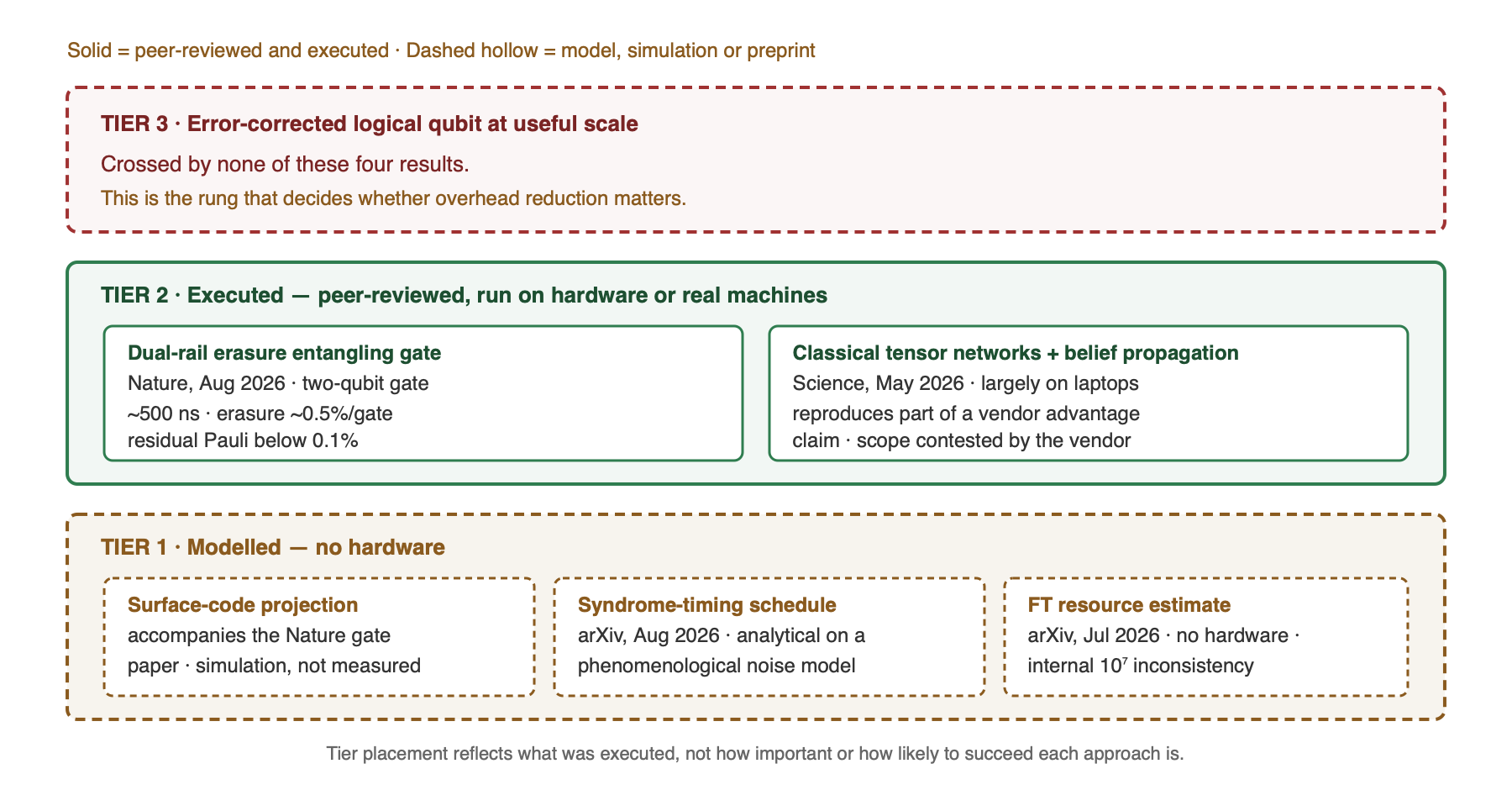
- So what. The interesting thing is not any single number. It is that the four sit on visibly different evidence tiers, and the tier is what determines how much weight each can carry. A demonstrated two-qubit gate is not a logical qubit. An analytical noise model is not a demonstration. A resource estimate ran on no hardware at all. Reading them as one cumulative story is the error to avoid.
- Now what. None of the four crosses the rung that actually matters — an error-corrected logical qubit operating at a useful scale. What they do supply is a clearer map of which lever moves the cost, and how much of the claimed movement is measured rather than modelled.
The five-minute read
Lever one: make the common errors detectable
The strongest of the four, on evidence tier, is a peer-reviewed hardware result. Published in Nature on 5 August 2026, it reports a two-qubit entangling gate for dual-rail cavity qubits — an erasure-qubit design in which the dominant noise channel is photon loss out of the computational subspace, which is detectable, rather than a Pauli error, which is not.
The point of erasure qubits is the error hierarchy. If the most common failure announces itself, the decoder knows where the damage is, and error-correction thresholds improve accordingly. The difficulty has always been that a hierarchy is easy to claim for an idle qubit and hard to preserve through an actual two-qubit gate. This paper’s contribution is that the hierarchy largely survives the gate.
The reported figures, taken from the abstract: gate duration about 500 ns; erasure rate approximately 0.5% per gate; residual Pauli errors below 0.1%; and a strong bias toward dephasing, with bit-flips described as practically non-existent at the 10⁻⁶ level.
Two things should travel with those numbers. First, this is a two-qubit gate. It is a component result, and the distance between a good two-qubit gate and a scaled logical qubit is exactly where this field has repeatedly lost time. Second, the paper’s forward-looking claim — that this enables a faster path to systems that suppress errors as they scale — is supported by surface-code simulations, which the abstract states plainly. Simulation is the right tool for that question; it is not a measurement, and it should not be quoted as one.
Lever two: measure the syndrome at the right cadence
The second lever costs no new hardware at all, which is what makes it interesting and also what limits it. A preprint posted to arXiv on 6 August 2026 observes that the interval between syndrome measurements is usually treated as a fixed clock cycle, when it is really a free control parameter with a trade-off on both sides: measure too rarely and idling errors accumulate; measure too often and you inject measurement-induced faults.
Working from a phenomenological logical-noise model, the authors show analytically that the optimal interval scales inversely with code distance, and that adopting it produces an exponential reduction in logical error rate relative to a constant-interval schedule.
This is an analytical result on a model, not a hardware demonstration. That is not a criticism — it is the correct description of what was done, and the paper does not pretend otherwise. But “exponential” is a word that travels badly. Whether the exponent survives contact with a real device depends on whether the phenomenological model captures the noise that device actually has, and the preprint has not been through peer review.
Lever three: the target moves too
The third direction is the one that quantum-advantage narratives tend to under-weight. Overhead is only meaningful relative to what a classical computer would need for the same problem — and that classical baseline is not fixed.
In May 2026, Science published a peer-reviewed classical method — tensor networks compressed with belief propagation, an inference technique dating to 1980s graphical models — that reproduced a substantial part of a disordered-spin-dynamics computation which a quantum-annealing vendor had, in March 2025, framed as beyond classical reach. Much of that work was done on ordinary laptops. The genuinely new technical step was extending tensor networks into three dimensions.
What it does not do matters as much. The vendor’s formal response identified four things the classical method did not reproduce: the most complex and highly frustrated lattice topologies; the largest physical scale actually run on hardware; the strongly coupled three-dimensional spin-glass regime where quantum correlations are highest; and the full set of measurements including higher-order observables. On that account the classical result is confined to low-entanglement, nearly-planar regimes. The paper’s own authors acknowledge belief propagation’s approximation trade-off. The accurate summary is not that a claim collapsed — it is that the boundary is contested and remains open. Bond dimensions, reproduced qubit counts and runtimes are not stated in the sources accessible for this article and are recorded as unverified.
A fourth item belongs here as context rather than evidence. A 45-page arXiv preprint from July 2026, by 31 authors at universities and national institutes, estimated the resources for fault-tolerant simulation of quantum dynamics and put the quantum-classical crossover at roughly 18–22 sites in one dimension. It ran on no hardware. It is also internally inconsistent in its headline sentence — the abstract says a tensor-network approach would need “about 100 years” for a 100-site system while the body says “about 10⁹ years” for the same setting, a seven-order-of-magnitude gap. Quote both figures or neither.
The company arc worth recording plainly
There is an organisational thread connecting two of these results, and it is worth stating factually because it is easy to tell badly in either direction.
The advantage claim that the Science paper partly reproduced classically was made by D-Wave, a company whose established platform is quantum annealing. In January 2026 that company announced an agreement to acquire Quantum Circuits Inc. for approximately $550 million — around $300 million in stock and $250 million in cash per the company’s release, with the transaction reported as closing in late January and recorded in an SEC filing. Rob Schoelkopf, a Quantum Circuits co-founder and a Yale physicist associated with the development of transmon and dual-rail qubit approaches, became chief scientist at the acquiring company. The Nature erasure-gate paper published in August 2026 comes from that combined organisation.
So the sequence is: a contested advantage claim on one architecture, followed by an acquisition that supplied a different architecture, followed by a peer-reviewed hardware result on that second architecture. Each of those is a fact; none of them implies anything about the others’ merit. In particular, a peer-reviewed gate-model result does not settle the annealing dispute, and the annealing dispute does not diminish the gate-model result. Readers should also note the ordinary context that the Nature paper is authored by company researchers and was accompanied by a company press release — which is normal practice and not a defect, but is the reason the numbers quoted here are taken from the paper’s abstract rather than from the release.
Deep dive
1. What each result actually established
| Result | Evidence tier | Key reported figures | Principal limit |
|---|---|---|---|
| Dual-rail erasure entangling gate (Nature, Aug 2026) | Peer-reviewed, hardware | ~500 ns gate; erasure ~0.5% per gate; residual Pauli < 0.1%; bit-flips at the 10⁻⁶ level | Two-qubit component result; scaling claim rests on simulation |
| Classical tensor networks with belief propagation (Science, May 2026) | Peer-reviewed, executed | Reproduces a substantial part of a disordered-spin-dynamics computation, largely on laptops; extends tensor networks to three dimensions | Vendor identifies four non-reproduced elements; scope contested |
| Optimal syndrome-measurement timing (arXiv, Aug 2026) | Preprint, analytical model | Optimal interval scales inversely with code distance; exponential logical-error reduction versus constant-interval schedules | Phenomenological model; no hardware; not peer-reviewed |
| Fault-tolerant resource estimate (arXiv, Jul 2026) | Preprint, no hardware | Quantum-classical crossover at roughly 18–22 sites in one dimension | Ran on nothing; seven-order-of-magnitude internal inconsistency in the headline sentence |
2. The asymmetry that does not get enough attention
Of the three levers, two act on the quantum side and one acts on the classical baseline. That asymmetry has a practical consequence: hardware improvements are slow, expensive and incremental, while a classical algorithmic improvement can move the boundary discontinuously and at almost no capital cost. The Science result is precisely that — a boundary shift produced by an algorithm, executed on laptops.
The resource-estimate preprint quantifies the same asymmetry from the other side. Using its own fitted scaling, increasing classical compute by a factor of a million shifts the crossover by only about 31 sites — a derived figure, an order-of-magnitude argument rather than a prediction, and a lower bound rather than an upper one, since quantum runtime also grows with system size. Buying more classical machines moves the line slowly and predictably. Writing a better classical algorithm can move it in one step.
3. What would actually change the picture
- An erasure-qubit result at logical rather than physical scale — the missing top tier. Component gate fidelity is necessary and not sufficient.
- Whether the syndrome-timing result survives peer review, and whether anyone implements the variable-interval schedule on a real device with real noise.
- Whether demonstrated surface-code cycle times approach the values assumed in resource estimates. The fastest published superconducting surface-code cycle is around 1.1 microseconds, and resource estimates in this space have assumed 500 nanoseconds.
- Whether belief-propagation tensor networks or neural-network quantum states get benchmarked against the same models used in the resource estimates. Their absence from those baselines is the single largest source of uncertainty in any crossover number.
- Whether any advantage claim gets stated for an industrially demanded problem, with a matched classical baseline published alongside it, rather than for a chaos benchmark.
References
- “An entangling gate for dual-rail erasure qubits.” Nature, 5 August 2026. DOI 10.1038/s41586-026-10822-y. PMID 42557378. https://doi.org/10.1038/s41586-026-10822-y (Abstract cross-checked for this analysis; full text paywalled. Authored by company researchers and accompanied by a company press release.)
- Tindall J, Mello M, Fishman M, Stoudenmire M, Sels D. “Dynamics of disordered quantum systems with two- and three-dimensional tensor networks.” Science, 21 May 2026. DOI 10.1126/science.adx2728. https://doi.org/10.1126/science.adx2728 (Flatiron Institute and Boston University; full text paywalled and not read for this analysis.)
- King AD, et al. “Beyond-classical computation in quantum simulation.” Science, March 2025. (The original advantage claim. The million-year and world-electricity framing comes from the accompanying company press release of 12 March 2025, not from the peer-reviewed text, and is attributed accordingly.)
- D-Wave Quantum Inc. formal response identifying four non-reproduced elements: most frustrated lattice topologies, largest tested physical scale, strongly coupled three-dimensional spin glass, and the complete higher-order observable set. (Company statement, reproduced here as the company’s position.)
- “Exponential logical-error reduction in quantum memories via optimal syndrome-measurement timing.” arXiv:2608.06242, submitted 6 August 2026. Preprint — not peer-reviewed. https://arxiv.org/abs/2608.06242 (Analytical result on a phenomenological logical-noise model; no hardware.)
- “Resource estimation for fault-tolerant quantum simulation of quantum dynamics.” arXiv:2607.16116v1, submitted 17 July 2026; 45 pages, 31 authors at universities and national research institutes. Preprint — not peer-reviewed. https://arxiv.org/abs/2607.16116v1 (Open access, read in full. Version 1 contains the seven-order-of-magnitude internal inconsistency described above; no funding or competing-interests statement.)
- D-Wave Quantum Inc. announcement of an agreement to acquire Quantum Circuits Inc., January 2026, approximately $550 million (about $300 million in stock and $250 million in cash), with closing reported in late January 2026 and recorded in an SEC filing. (Company release and filing; figures as stated by the company.)
- Google Quantum AI. 2024. Surface-code results reporting a cycle time of approximately 1.1 microseconds. Nature. DOI 10.1038/s41586-024-08449-y.
Disclosure
This post is for information only and is not investment advice.
COI note: The erasure-gate paper and the acquisition described here involve D-Wave Quantum Inc., a publicly listed company. The paper is authored by company researchers and was published alongside a company press release; for that reason every figure quoted from it is taken from the peer-reviewed abstract rather than from promotional material. The advantage claim discussed in the third section was made by the same company, and the quantitative framing of that claim — the million-year and world-electricity comparison — originates in company press materials, is attributed as such throughout, and is not presented as an independent finding. The company’s rebuttal of the classical reproduction is reproduced as its stated position, and this article’s conclusion is that the boundary is contested rather than that any claim has been refuted. The classical tensor-network paper comes from the Flatiron Institute (Simons Foundation) and Boston University, with no commercial conflict identified. The resource-estimate preprint has 31 authors at universities and national research institutes with no quantum-hardware vendor affiliations identified, and it contains a methodological self-dependency: the primitive responsible for its headline qubit reduction is a prior unreviewed preprint by one of its own co-authors. Companies and institutions named are described factually. Nothing here is a solicitation to buy or sell any security, nothing here should be read as a view on the prospects of any company, and the author holds no position in, and no financial interest in, any company named.


Leave a Reply