Evidence-first notes on bioscience and deep tech, at the edge of the lab and the market. Information only — not investment advice, not medical advice.
The 30-second version
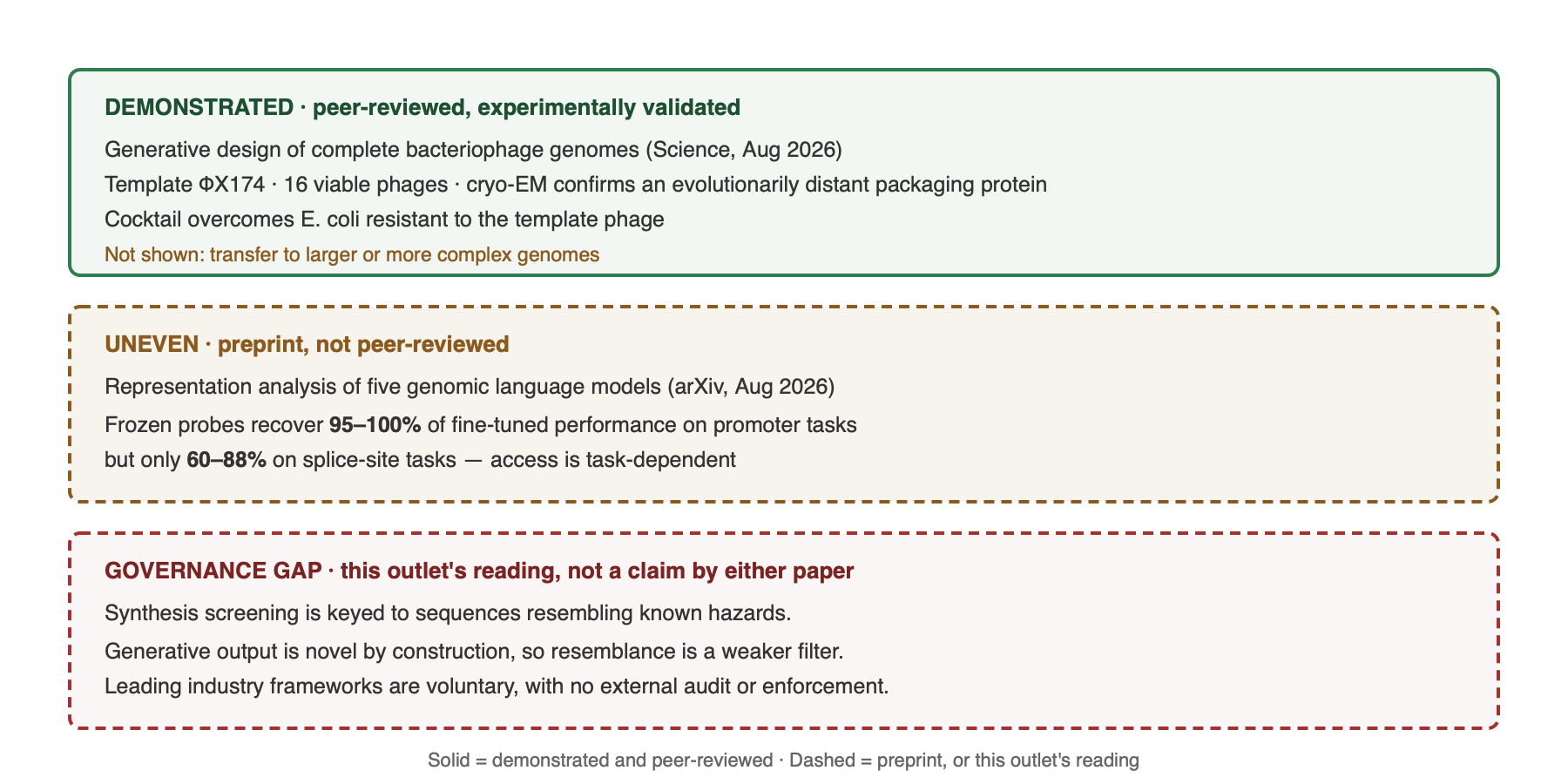
- What. A paper in Science (6 August 2026) reports the first generative design of complete bacteriophage genomes using genome language models. Working from the phage ΦX174 as a design template, the authors generated candidates with target host tropism; experimental testing yielded 16 viable phages with varied fitness in laboratory conditions. Cryo-electron microscopy confirmed one generated phage uses an evolutionarily distant DNA packaging protein, and a cocktail of generated phages overcame E. coli strains that had become resistant to the template phage.
- So what. The layer that moved is the important part. Sequence models have been annotating and predicting for years; this is generation at whole-genome scale with experimental validation — the thing actually assembled, and it worked. That is a different claim from a benchmark score, and it is the claim the field has been unable to make until now.
- Now what. Two qualifications belong in the same breath. First, an arXiv preprint posted the day before shows that genomic language models’ internal representations are unevenly accessible depending on the task — so “these models understand genomes” is not what has been established. Second, this is the capability that biosecurity screening regimes were not designed for, and that gap is a governance question rather than a scientific one.
The five-minute read
First, the two facts that stop this being misread
Headlines about AI generating viral genomes invite a specific misunderstanding, so the framing facts go first.
Bacteriophages infect bacteria, not people. They are the basis of phage therapy, an approach used against antibiotic-resistant bacterial infections. The paper’s own stated motivation is therapeutic: a route to phage treatments that can keep pace with bacteria evolving resistance. That is the opposite end of the risk spectrum from a human pathogen.
The design template is the most-characterised phage in molecular biology. ΦX174 has been the field’s reference organism for half a century — it was the first DNA genome to be sequenced, and among the first to be chemically assembled. Choosing it means working inside a very well-mapped space, not conjuring an unstudied agent.
Both of those are load-bearing. Without them, “AI designed a working virus” is a sentence that reads as far more alarming than what happened.
What actually changed
The interesting thing is not that a model produced sequences. It is that the sequences were built and worked. Sixteen viable phages emerged from experimental testing, with a spread of fitness profiles rather than a single lucky hit — which is what distinguishes a capability from an anecdote.
Two details in the abstract carry more weight than the count. The cryo-EM finding — that a generated phage uses an evolutionarily distant DNA packaging protein — indicates the model was not simply reproducing near-copies of the template; it assembled a functioning system from parts that do not co-occur in the reference. And the cocktail result, in which generated phages overcame bacteria already resistant to the template, is a functional demonstration rather than a structural one: the output does something the input could not.
What has not been shown is anything about generalisation beyond this class. ΦX174 is small and single-stranded. Nothing here demonstrates that the same approach transfers to larger, more complex genomes, and the paper does not claim it does. The full text is paywalled and was not read for this article, so the biosafety review and containment arrangements the authors describe are not summarised here — an absence worth noting rather than glossing.
The same week, a paper pointing the other way
On 5 August 2026, one day earlier, an arXiv preprint examined what genomic language models actually make accessible. It analysed five of them — DNABERT-2, Nucleotide Transformer, HyenaDNA, GENERATOR-v2 and Omni-DNA — under unified frozen-probing protocols across regulatory, epigenetic, promoter, splice-site and variant-effect tasks.
The pattern it reports is task-dependent and uneven. Frozen probes recovered 95–100% of fine-tuned performance on promoter tasks, but average splice-site recovery fell to 60–88%. In other words, information the models plainly contain is not uniformly reachable without task-specific adaptation.
These two papers are not directly comparable — different models, different tasks, and one is peer-reviewed while the other is a preprint that has not been. But read together in the same week they discipline each other. The generative result shows the capability is real at genome scale for a well-characterised template. The representation analysis shows that “genome language models understand genomes” remains too strong a summary of what these systems do. Capability is arriving unevenly, not as a general competence.
The governance question this raises
Biosecurity for synthetic biology has rested substantially on synthesis screening: providers check ordered sequences against databases of known hazards, and flag or refuse close matches. That architecture assumes the thing you are looking for resembles something already catalogued.
Generative genome design weakens that assumption by construction. The whole point of the method is to produce sequences that are functional without being copies — this paper’s own cryo-EM result is a demonstration that generated designs can assemble working systems from components that do not co-occur in the template. Applied to a therapeutic phage, that is the desired behaviour. As a general property of the technology, it means similarity-based screening is a weaker filter than it was.
Nothing in the paper suggests the authors were careless; well-run academic groups in this area work under institutional biosafety review, and the ΦX174 choice is consistent with a conservative approach. The gap is structural rather than about any individual group. And the frameworks currently proposed to close it are thin: the most prominent industry self-governance document in this space, published in July 2026 by a major AI laboratory, sets out principles for dual-use foundation models but contains no external audit, no binding commitment and no enforcement mechanism — a fact this publication recorded at the time. A capability demonstrated in a peer-reviewed journal now sits ahead of the governance written for it.
The honest framing is not alarm. It is that the screening layer and the generation layer are advancing on different clocks, and the second one moved this week.
Deep dive
1. What each paper established
| Paper | Status | Reported result | Principal limit |
|---|---|---|---|
| Generative design of bacteriophages with genome language models (Science, 6 Aug 2026) | Peer-reviewed; experimental | First generative design of complete phage genomes; ΦX174 template; 16 viable phages with diverse fitness; cryo-EM shows an evolutionarily distant packaging protein; cocktail overcomes template-resistant E. coli | One small, exceptionally well-characterised template; no demonstrated transfer to larger genomes; full text paywalled and not read here |
| Frozen but Not Always Accessible (arXiv, 5 Aug 2026) | Preprint; not peer-reviewed | Five genomic language models under unified frozen-probing protocols; 95–100% recovery of fine-tuned performance on promoter tasks, 60–88% on splice-site tasks | Probing measures accessibility, not presence — a low probe score does not prove the information is absent |
2. Why the pairing matters more than either alone
Published separately, each invites a different over-reading. The Science paper alone supports “genome models now design life.” The preprint alone supports “these models are shallower than claimed.” Both summaries are wrong in the same way: they treat capability as a single scalar.
What the pair actually shows is that generative capability at genome scale and representational accessibility for annotation tasks are different axes, and progress on one does not imply the other. A model can assemble a working genome for a well-characterised template while its embeddings remain patchy for splice-site prediction. Anyone forecasting from one axis to the other is extrapolating without warrant.
One caution on the preprint’s own framing: linear probing measures whether information is linearly accessible, not whether it is encoded. A weak probe result is evidence about reachability, not about absence, and the authors’ framing is consistent with that. It has also not been peer-reviewed.
3. What to watch
- Whether the generative approach is demonstrated on a genome materially larger or more complex than the template — the single question that determines whether this is a method or a milestone.
- Whether synthesis-screening providers and standards bodies respond with anything that does not depend on sequence similarity to a known hazard.
- Whether any binding — as opposed to voluntary — governance instrument attaches to genome-scale generative design.
- Whether the representation-accessibility result survives peer review, and whether it holds for the newer models used in generation rather than the five evaluated.
- Whether generated phage cocktails move toward regulated therapeutic development, which is where efficacy and safety evidence would actually have to be produced.
References
- King SH, Driscoll CL, Li DB, Guo D, Merchant AT, et al. (8 authors). 2026. “Generative design of bacteriophages with genome language models.” Science, 6 August 2026. DOI 10.1126/science.aec2657. PMID 42561074. https://doi.org/10.1126/science.aec2657 (Abstract cross-checked against the PubMed record for this article; full text paywalled and not read, so the paper’s biosafety and containment arrangements are not summarised here.)
- “Frozen but Not Always Accessible: A Representation Analysis of Genomic Language Models.” arXiv:2608.05329, submitted 5 August 2026. Preprint — not peer-reviewed. https://arxiv.org/abs/2608.05329 (Evaluates DNABERT-2, Nucleotide Transformer, HyenaDNA, GENERATOR-v2 and Omni-DNA under unified frozen-probing protocols.)
- Google DeepMind and Isomorphic Labs. “Bioresilience” dual-use framework, July 2026. (Company blog post, not peer-reviewed. Cited here as the most prominent industry self-governance document in this space; it sets out principles without external audit, binding commitment or enforcement — an assessment this publication made when the document was released.)
Disclosure
This post is for information only and is not investment advice, and not medical advice.
Editorial note on dual use: This article reports at the level of capability. It deliberately omits methods, model architectures, training or sampling procedures, sequence information and experimental protocols, and it links only to the papers’ own landing pages. That restriction is a decision by this publication, not a limitation imposed by the sources. Two de-escalating facts are stated prominently because omitting them produces a materially misleading impression: bacteriophages infect bacteria rather than humans and underpin phage therapy against antibiotic-resistant infection, and the design template is the most extensively characterised phage in molecular biology. The governance argument in the fourth section is this outlet’s reading and is not a claim made by either paper. COI: no conflict identified for the Science paper’s authors from the record consulted; author affiliations and funding could not be checked because the full text is paywalled, and that is recorded as unverified rather than as an absence of conflict. The self-governance document cited in the final section was published by a commercial AI laboratory and is treated as a company position, not as an independent standard.
 Uthando Nethemba
Leave a comment