Evidence-first notes on bioscience and deep tech, at the edge of the lab and the market. Information only — not investment advice. The paper discussed here is an unpeer-reviewed arXiv preprint (submitted 2026-08-11), and every comparison in it — including the one summarized below — is an in silico structural alignment and scoring exercise. No output from the retrieval baseline discussed here, and no output from any of the eight generative models it is compared against, was expressed, purified, or functionally tested in a wet lab anywhere in this paper.
The 30-second version
- What. The preprint builds a zero-training, CPU-only retrieval baseline called RetFold — it assembles protein backbones purely by retrieving and geometrically stitching together known domains from the CATH structural database — and tests it against eight published protein backbone generators (RFdiffusion, Chroma, FrameDiff, FoldFlow, FrameFlow, ProtPardelle, BoltzGen, PXDesign) on their “novel fold” claims.
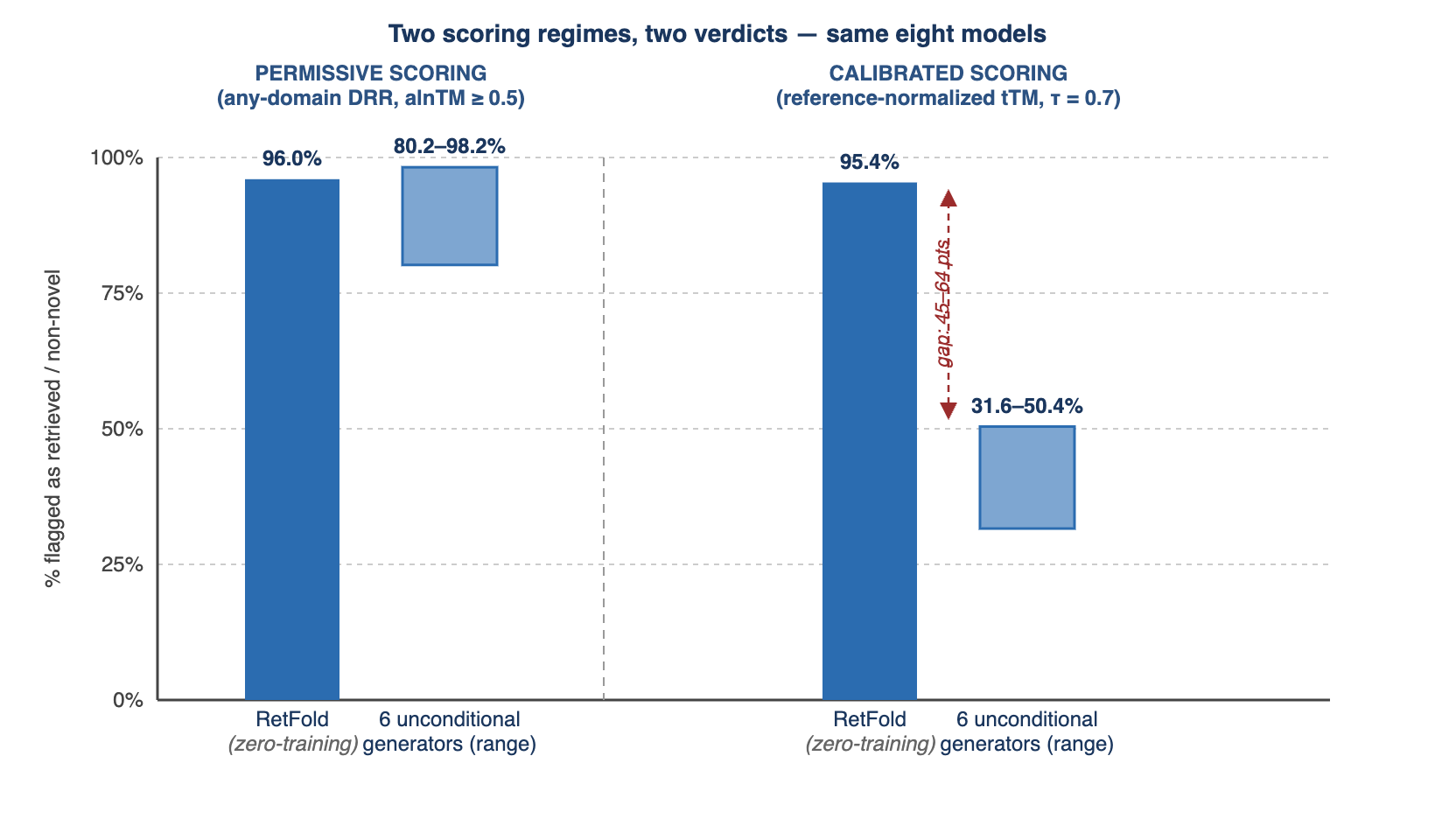
- So what. Under the field’s conventional scoring, RetFold is statistically indistinguishable from the eight learned models — it scores 96.0% on a domain-level retrieval metric, squarely inside the generators’ own 80.2–98.2% range. But the same authors then stress-tested whether that scoring rule can even tell a genuinely new fold from a recombination of known parts. In a negative-control test (34,653 queries, each fold’s own topology class removed from the reference database), the conventional score wrongly flagged 90.04% of truly novel folds as “retrieved” (AUC 0.809 — weak discrimination). Under a calibrated, reference-normalized score built to fix that (false-positive rate 5.38%, AUC 0.926), RetFold (95.4%) and the six unconditional generators (31.6–50.4%) separate cleanly.
- Now what. The paper’s own conclusion is procedural, not a verdict on generative models: novelty claims should report the calibration of the scoring metric behind them. Reading the title — “Is Retrieval All You Need?” — as a flat “yes” over-reads the paper by citing only the permissive-scoring result. Treating the calibrated result as full vindication of the eight generators over-reads it the other way. Both results sit in the same paper, and neither is optional.
The five-minute read
What a domain-retrieval rate actually measures
The field’s standard novelty check runs a generated backbone through a structure-search tool and reports full-chain similarity to the closest known structure — low similarity, the argument goes, means a new fold. This preprint’s authors point out that full-chain similarity conflates two different questions: does the generated protein pass basic designability checks, and at what structural scale does the novelty actually sit? A chain can look unfamiliar as a whole while being built from individually familiar pieces. Their metric, Domain Retrieval Rate (DRR), decomposes each generated backbone into domains (segmented with Merizo, cross-checked with Chainsaw) and asks what fraction of those domains align to an existing CATH S40 domain. Two thresholds matter: “any-domain” (at least one domain matches, permissive) and “all-domain” (every domain matches, strict). Any-domain rates run 80.2–98.2% across the eight models — high. All-domain rates for the six unconditional generators drop to 28.4–69.0%. In other words, “contains at least one recognizable known structure” is far more common than “is entirely built from known pieces.”
RetFold: a control with a known answer
RetFold needs no training and no GPU — it retrieves CATH domains via an ensemble of ESM-2, Foldseek 3Di, and ProstT5 embeddings, assembles a core domain plus two extension domains, and refines the joins with helix-linker geometry (1.98 seconds per structure, CPU-only, “two orders of magnitude” cheaper than a generative model run, per the authors). Because its composition is known by construction, any scoring rule that calls RetFold “novel” has a demonstrable blind spot. And the conventional rule does: RetFold scores 96.0% on domain-level DRR but only 20.0% on full-chain qTM ≥ 0.5 — a 76.0-point domain–full-chain gap. A backbone built entirely from known domains still reads as “new” to the conventional full-chain metric most of the time. That gap is the evidence the authors use to argue that reported novelty rates for the eight learned generators deserve the same scrutiny.
But the scoring rule itself needed a check
Here the paper goes a step further than a simple baseline comparison. The authors ask whether their own domain-level threshold (alnTM ≥ 0.5) can actually discriminate a real new fold from an assembly of known parts, using a negative control: leave-one-topology-out, where a query’s entire fold class is removed from the search database before retrieval is attempted (34,653 CATH queries). If the score works, a genuinely novel-relative-to-the-database fold should mostly fail to retrieve. Instead, alnTM still flagged 90.04% of these as “retrieved” — AUC 0.809, a weak discriminator. A reference-normalized version of tTM, calibrated at τ = 0.7, did much better: false-positive rate 5.38%, AUC 0.926.
Re-running the eight-model comparison under this calibrated criterion changes the picture: RetFold stays high (95.4%), but the six unconditional generators fall to 31.6–50.4% — the two groups land on opposite sides of the threshold. The paper’s stated conclusion is methodological, not a verdict either way: the authors argue that low full-chain similarity alone does not establish that a fold is genuinely new, and state directly that “novelty evaluation should report the calibration of the score it uses.” (direct quote, ≤150 characters, from the paper’s Conclusion and Discussion).
Reading the comparison fairly
Neither half of this result stands alone as the paper’s message. The permissive-scoring result is real and is the reason the calibration exercise exists at all; the calibrated result is also real and complicates any claim that the eight generators are “merely” retrieval. The deep dive below works through four specific objections to the RetFold comparison that the paper itself raises or that follow directly from its appendix, plus where this preprint connects to two other pieces this outlet has covered this cycle.
Deep dive
1. Background
Diffusion- and flow-matching-based protein backbone generators — RFdiffusion, Chroma, FrameDiff, FoldFlow, FrameFlow, ProtPardelle among the unconditional (fold-generating) class, BoltzGen and PXDesign among conditional (target-matched binder) tools — have driven a wave of “de novo fold” and “never seen in nature” claims since 2022–2023, largely built on this same evaluation practice: run a generated backbone through a structure-alignment tool, report the fraction below a full-chain similarity threshold to the closest known structure, and call that fraction “novel.” This preprint’s central move is to ask whether that practice measures what it claims to measure, using a domain-level decomposition and a purpose-built retrieval-only baseline as the instrument.
2. What this study newly shows
Three linked findings, each grounded in the paper’s own reported numbers. First, domain-level decomposition: any-domain DRR (at least one domain aligns, alnTM ≥ 0.5) runs 80.2–98.2% across all eight evaluated models, while all-domain DRR (every domain aligns) for the six unconditional generators falls to 28.4–69.0% — a large gap between “contains a known piece” and “is built entirely from known pieces.” Second, the RetFold control: a zero-training, CPU-only retrieval-and-assembly pipeline (1.98 s/structure) scores 96.0% domain-level DRR but only 20.0% on the conventional full-chain metric (qTM ≥ 0.5) — a 76.0-point gap that the authors use as direct evidence that the conventional metric under-detects retrieval. Third, and most consequential, a calibration study of the scoring rules themselves: a leave-one-topology-out negative control (34,653 CATH queries, each query’s own fold class excluded from the search database) shows that the permissive alnTM criterion misclassifies 90.04% of genuinely novel folds as “retrieved” (AUC 0.809), while a reference-normalized tTM criterion (τ = 0.7) achieves a 5.38% false-positive rate (AUC 0.926). Applying the calibrated criterion to the eight-model comparison separates RetFold (95.4%) from the six unconditional generators (31.6–50.4%). A fourth, smaller finding: standard designability screens (iPTM ≥ 0.6, pLDDT ≥ 70) did not detect near-identical copies of retrieved binder templates in the paper’s binder-design case study — pass rate tracked only the structural distance (RMSD) to the retrieved template, not whether the design was actually novel.
3. Methodological strengths and limits
Strengths. The design uses two independent controls to calibrate three separate scores (alnTM, qTM, tTM): a positive control with a known composition (RetFold itself) and a negative control with a known ground truth (leave-one-topology-out). This is methodologically close to a permutation-test sanity check, and it is hard to argue with the underlying logic — if a scoring rule fails to flag a control whose answer is known, that is a demonstrated flaw in the rule, independent of what one believes about generative models.
Four specific counterarguments to the RetFold comparison, all either stated by the authors themselves or following directly from their appendix:
- The binder-design case study is explicitly “leakage-permissive,” in the authors’ own framing. A homolog-exclusion filter was not applied to the search database; for one target (3sgb_EI) the database contained a near-identical complex (0.15Å RMSD from the query). Under that condition, 176 of 256 designs (68.8%) passed designability screening, and the pass rate fell monotonically as retrieved-template distance grew (100% at 0.15Å RMSD → 25.0% at 0.65Å). The authors explicitly warn against reading this case study as general evidence about the relative merits of retrieval versus learned priors.
- Two of the eight models are not doing the same task as the other six. BoltzGen and PXDesign are conditional, target-matched binder designers; the other six are unconditional fold generators. A conditional model’s low full-chain novelty (qTM 62.0–75.4% for these two) is structurally expected — it has to dock onto a fixed target — and treating all eight as one undifferentiated group risks reading a task-driven difference as a novelty-related one.
- RetFold’s reported rates are relative to CATH S40, a database the authors themselves describe as an incomplete snapshot. The paper states directly that reported retrieval/novelty ratios could shift if the reference database were expanded.
- RetFold cannot, in principle, design a genuinely new binding interface. The authors contrast this with hotspot-conditioned generative approaches (RFdiffusion-style), which can — at low and unpredictable success rates — target interfaces not present in any database. Retrieval succeeds or fails purely as a function of database coverage; it has no mechanism for producing something the database does not already contain.
Taken together, RetFold is a rigorous instrument for calibrating a scoring convention — the negative-control validation supports that use directly — but the appendix’s own self-described limits, plus the fact that the calibrated criterion separates RetFold from six of the eight models, argue against reading it as evidence that generative models are “equivalent to” retrieval.
4. Connections to neighboring domains
This finding shares an upstream lesson with a genome-language-model study covered here in 2026-W33 (companion representation-limits preprint): capability claims that are summarized as a single scalar mislead, because the underlying capability is not uniform (there, promoter recognition ran 95–100% while splice-site recognition ran only 60–88% for the same model class). This preprint pushes the same lesson one level further upstream: it is not just the capability that varies task-by-task, but the label “novel” itself that is a function of which scoring convention and calibration were used, not a fixed property of the generated structure.
A second connection runs to a 2026-W31 benchmarking study of six single-cell and spatial-transcriptomics foundation models, which found no universal winner and rankings that flipped with preprocessing, tokenization, and metric choices. That study showed evaluation instability within a fixed protocol; this preprint adds a related but distinct problem — a fixed protocol’s internal discriminative power can itself be weak and needs its own validation (the 90.04% false-positive rate on a negative control is a direct demonstration of that).
A narrower, explicitly bounded connection runs to a 2026-W34 companion piece on OptiPrime, a mechanistic machine-learning model for prime-editing outcome prediction. It would be tempting to read the two papers together as evidence that “pure black-box learning contributes less than commonly assumed,” with structured prior knowledge (a retrievable domain library here, an explicit mechanistic layer there) doing most of the work. This outlet does not draw that broader conclusion, and neither paper supports it — OptiPrime’s mechanistic layer sits on top of large-scale pretraining and learned components, not in place of them, and this preprint’s own calibrated criterion separates six learned generators from a pure-retrieval baseline. What the two papers do genuinely share is narrower and procedural: both make their central claim falsifiable by removing a component and showing the result changes, rather than asserting a contribution and stopping there — negative-control score calibration in this paper, and ablation of a mechanistic model layer in the OptiPrime paper.
5. Commercialization and investment angle
This paper is an evaluation-methodology study, not a technology being brought to market, so a TRL rating does not apply to it directly. The eight evaluated generative models remain research-tool status (roughly TRL 2–3): none of their outputs, and none of RetFold’s outputs, has been validated in a wet-lab experiment — expressed, purified, or functionally assayed — anywhere in this paper.
Two of the eight evaluated checkpoints have lineage to venture-funded companies, and the distinction matters for how that lineage should be read: RFdiffusion’s design approach traces to work associated with Xaira Therapeutics (co-founded by David Baker, reported to have raised $1B in 2024, privately held), and Chroma is the model developed by Generate:Biomedicines (privately held) — but this paper does not name, target, or evaluate either company’s production models; it tested publicly released academic checkpoints only, and no claim about either company’s technology or investment merit follows from this preprint. This outlet renders no judgment on either company’s technical capability or valuation.
Set that lineage question aside and there is a more general, firm-level observation (not a claim in the paper itself): in a field where venture capital narratives frequently lean on “de novo fold discovery” headlines, this paper’s domain-level decomposition and calibration procedure gives a due-diligence reader a more granular question to ask than a single “% novel” figure — namely, which scoring convention produced that figure, and was that convention itself validated against a negative control.
6. The counter-view
This outlet’s independent skeptic review of the underlying analysis concluded the sourcing was clean (direct comparison against the open-access preprint text, including appendix-level implementation details) but required the following caveat to be carried into any published summary, reproduced here in full:
This paper is an arXiv preprint (unpeer-reviewed), and every result in it is a computational structural alignment / in silico scoring exercise — neither the eight evaluated generative models nor the retrieval baseline (RetFold) underwent wet-lab validation anywhere in this paper. Reading the title (“Is Retrieval All You Need?”) as “yes” misreads the paper: under conventional scoring (full-chain qTM), the zero-training retrieval baseline is indistinguishable from the generative models, but under the authors’ own negative-control-calibrated criterion, the two groups separate on opposite sides of a threshold. The authors’ own conclusion is not “generative models equal retrieval” but a methodological requirement: novelty claims must report the calibration of the scoring metric used. In addition, reported retrieval/novelty ratios are relative to CATH S40, an incomplete database snapshot (stated by the authors), and could shift as the reference database grows. Xaira Therapeutics and Generate:Biomedicines, mentioned in this piece, are companies this paper does not evaluate; the lineage note is context added by this outlet, not a finding of the paper.
Two further replication-relevant points from that review are worth carrying forward. First, the two headline calibrated numbers that carry the paper’s more moderate conclusion — RetFold at 95.4% and the six unconditional generators at 31.6–50.4% — sit in the paper’s results body rather than its abstract; readers who want to verify them independently should check the primary source directly rather than take this summary as a substitute. Second, six of the paper’s seven authors have institutional affiliations that this outlet was unable to independently confirm from the publicly available preprint record (one author’s affiliation, Fudan University, was confirmed); this does not bear on the paper’s technical claims, which are calculations run on public checkpoints against a public database, but is noted for completeness.
Reading in the opposite direction is also a misread: the all-domain (strict) DRR figures for the six unconditional generators (28.4–69.0%) and the designability-screening blind spot (near-identical retrieved copies pass standard designability filters) remain real grounds for skepticism about novelty claims in this field, calibrated criterion or not.
7. Metrics to watch
- Whether any of the eight evaluated developer teams publishes a rebuttal or reinforcement of their novelty claims using this paper’s calibration frame.
- Whether the RetFold-versus-generator separation under the calibrated criterion holds up when reproduced against an expanded or alternative reference database beyond CATH S40 (the authors flag this as an open question themselves).
- The first case, from any lab, of a wet-lab expression and function validation of an output from any of the six unconditional generative models discussed here — at that point, and not before, “new fold” moves past a purely computational label for that specific structure.
References
- Xu, Tongyue, Yijie Zhang, Mutian He, Lingdong Shen, Zhihong Liu, Tianlei Ying, and Cheng Tan. 2026. “Is Retrieval All You Need? Assessment and Emergence of Novelty in Protein Structure Generation.” arXiv:2608.10598v1 (q-bio.BM), submitted August 11, 2026, CC BY 4.0. https://arxiv.org/abs/2608.10598.
- Hsu, Alvin, Peter J. Chen, Angus H. Li, et al. (corresponding author David R. Liu). 2026. “Mechanistic Machine Learning Enables Interpretable and Generalizable Prediction of Prime Editing Outcomes.” Nature Biotechnology, August 12, 2026. DOI: 10.1038/s41587-026-03261-7 (paywalled, not independently accessed by this outlet). Preprint version independently verified: bioRxiv, February 20, 2026, DOI 10.64898/2026.02.20.706353v1.
- [Author list and title not independently verified by this outlet — paywalled journal record]. 2026. Genome-scale bacteriophage generation study. Science, August 6, 2026. DOI: 10.1126/science.aec2657. Companion representation-limits preprint independently accessed: arXiv:2608.05329, submitted August 5, 2026, https://arxiv.org/abs/2608.05329.
- [Author list not independently verified by this outlet]. 2026. “Harmonized Benchmarking of Six Single-Cell / Spatial Transcriptomics Foundation Models: Context-Dependent Generalization, No Universal Winner.” arXiv:2607.17227 (q-bio.GN), submitted July 19, 2026. https://arxiv.org/abs/2607.17227.
Disclosure
This piece is for information purposes only and does not constitute investment advice.
The author discloses no position in any entity mentioned in this piece.
COI note. Of the seven authors of the primary paper discussed here, only one (Tianlei Ying, Fudan University) has an institutional affiliation independently confirmed by this outlet; the remaining six authors’ affiliations are unconfirmed. No financial relationship between the paper’s authors and the developers of the eight evaluated generative models (RFdiffusion, Chroma, FrameDiff, FoldFlow, FrameFlow, ProtPardelle, BoltzGen, PXDesign) was identified, and none has been ruled out — this is recorded as unconfirmed in both directions, not as “no conflict.” This piece discusses Xaira Therapeutics (privately held) and Generate:Biomedicines (privately held) as lineage context for two of the evaluated model families; neither company is named, targeted, or evaluated by the underlying paper, which tested only publicly released academic checkpoints, and this piece renders no positive or negative judgment on either company’s technology or investment merit. Any quantitative claim attributed to the paper’s authors in this piece (e.g., domain retrieval rates, false-positive rates, AUC values) should be read as the preprint authors’ own reported results, not independently re-derived by this outlet.


Leave a Reply