Evidence-first notes on bioscience and deep tech, at the edge of the lab and the market. Information only — not investment advice. The Nature Biotechnology version of the paper discussed here is paywalled and was not accessed by this outlet. Everything below marked “confirmed” was verified directly against the bioRxiv preprint (submitted 2026-02-20), which the authors carried forward, unchanged in authorship and central claims, to the August 12, 2026 journal publication. Statements sourced only from the Broad Institute’s own blog post are marked separately and are not treated as equivalent evidence.
The 30-second version
- What. A Broad Institute team (senior author David R. Liu) describes OptiPrime, a machine-learning model that predicts and helps design prime editing (PE) outcomes, in Nature Biotechnology (Aug. 12, 2026). Instead of regressing PE efficiency as a single opaque number, OptiPrime encodes the known biochemical steps of prime editing — nicking, reverse-transcriptase extension, 3′-flap resolution, and mismatch-repair (MMR) competition — as an explicit kinetic pipeline inside the model, trained on 297,962 measured PE outcomes and pretrained on 64 million synthetic edits. The contribution is demonstrated, not just asserted: removing the mechanistic time-evolution layer, removing the large-scale pretraining, or scrambling the order of the mechanistic steps each degrades performance — three separate ablations the authors report themselves.
- So what. In the bioRxiv preprint body (confirmed by this outlet), OptiPrime’s top-8 recommended pegRNA designs for a KIF1A pathogenic variant included one reaching 22% editing efficiency; the top-16 designs from two established competing predictors (PRIDICT2.0, DeepPrime) never exceeded 1%. In a Kif1a mouse model of a pediatric neurological disease, intracerebroventricular AAV delivery at birth produced average editing above 40% in bulk cortical tissue and above 70% in transduced (GFP+) cells at four weeks — a preprint-body-confirmed result, not a press-release-only claim.
- Now what. Scope note (demo/evidence gap): this is a single-locus (Kif1a), single-disease-model, single-mouse-cohort preclinical result. There is no clinical program, and generalization to other targets sits outside what the paper claims. The headline numbers above are confirmed only against the bioRxiv preprint — the final, peer-reviewed Nature Biotechnology text is paywalled and has not been cross-checked by this outlet. Separately, as a factual note and not an investment signal: senior author David R. Liu co-founded Prime Medicine, Inc. (NASDAQ: PRME), a publicly traded company built around the prime editing platform (see Disclosure).
The five-minute read
What “mechanism-encoded” means here, and why it matters that it’s an ablation
Prime editing runs through several biochemical steps in sequence: a pegRNA-guided nick, reverse-transcriptase extension that writes the intended new sequence, resolution of the resulting 3′-flap intermediate, and finally a competition inside the cell’s mismatch-repair (MMR) machinery that decides whether the edit is fixed or reverted. Prior predictors (PRIDICT, DeepPrime) take sequence features as input and regress a single efficiency number directly — a black box in, a percentage out. OptiPrime’s architecture is different: it predicts a kinetic rate for each of those biochemical steps with a dedicated sub-module, then combines them through an explicit time-evolution layer that simulates how the steps compound into a final outcome.
The reason this is worth taking seriously as more than framing is that the authors tested it by removal, not by assertion. Three separate ablations are reported in the preprint: swapping the time-evolution layer for a simple linear model, replacing the large-scale pretraining with random initialization, and scrambling the order in which the mechanistic steps are applied. In each case, the authors report that performance drops. That is a falsifiable form of claim — “we removed this component and the result got worse” — rather than a description of the architecture followed by strong aggregate numbers. Notably, the preprint does not report a numeric performance delta for each of the three ablations individually; what is confirmed is the direction (each ablation degrades results), not a quantified size of effect.
Where the headline numbers actually come from
Training used 297,962 measured PE efficiencies across 40 experimental conditions, on top of a 64-million-synthetic-edit pretraining run (HetFormer architecture). On a held-out test set, cross-validated correlation with true efficiency was r = 0.723, ρ = 0.775 — a routine train/test split. More consequential for benchmark credibility, the authors also ran an independently collected arrayed experiment on four pathogenic variants of a different gene, ATP1A3, not present in the training data, and report rank correlations between OptiPrime and the two competing tools of ρ = 0.326–0.604 — evidence that does not fully favor OptiPrime, but that was collected on genuinely new data rather than a held-out slice of the same pool.
The single sharpest number in the paper is the KIF1A pegRNA-design comparison: among OptiPrime’s top 8 recommended designs, one reached 22% editing efficiency; among the two competing tools’ top 16 combined, none exceeded 1%. That comparison used a total of 15 tested pegRNAs at a single locus, and — as discussed in the deep dive below — the comparison protocol (design count, evaluation criteria) was set by the developers of the winning model.
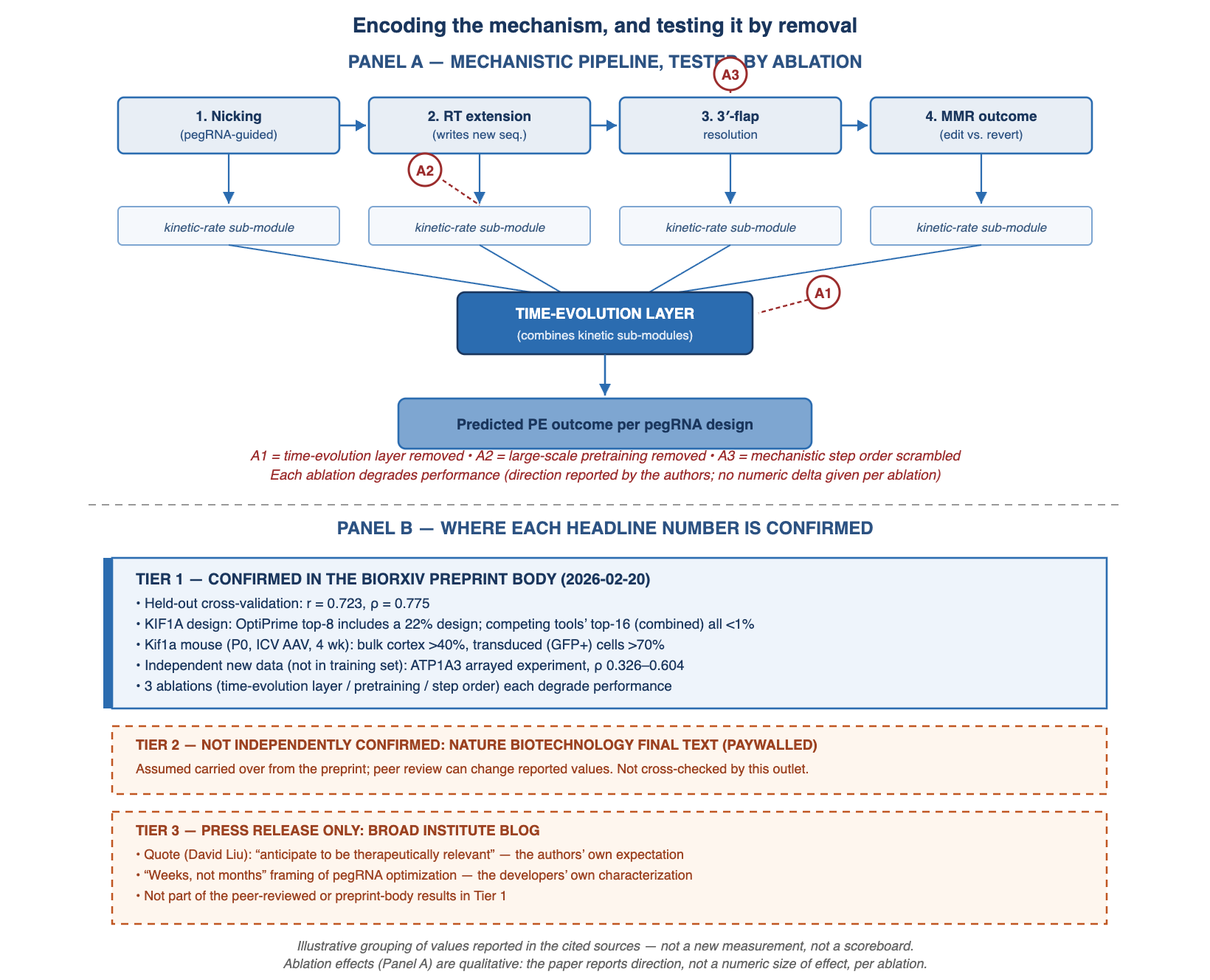
Reading the two evidence layers together
The point of separating Panels A and B is that they answer different questions. Panel A is about whether the mechanistic architecture itself does anything — and the ablation evidence for that is confirmed, preprint-body, and reasonably direct, even though it is qualitative rather than quantified. Panel B is about how much weight the specific headline percentages can bear — and there the honest answer is: as much as a single, self-run comparison at a single genetic locus, not yet checked against the peer-reviewed final text, can bear. The deep dive below works through both layers in more detail, including the asymmetry in how the benchmark comparison was designed, and where this preprint connects to a companion piece this outlet published the same week.
Deep dive
1. Background
Prime editing (PE), introduced by the Liu lab in 2019, writes precise edits into DNA using a fusion of a Cas9 nickase and a reverse transcriptase guided by an engineered pegRNA, without requiring a double-strand break or an exogenous DNA donor template. Editing efficiency, however, varies widely and unpredictably by target sequence and cell type, and designing an effective pegRNA for a given disease-causing variant has historically required testing many candidate designs empirically. Existing computational predictors (PRIDICT, DeepPrime, and their successors) address this by training sequence-to-efficiency regression models directly on measured outcomes. OptiPrime’s departure from that lineage is architectural: it decomposes PE into its known mechanistic steps — nicking, RT extension, 3′-flap resolution, MMR competition — and predicts a kinetic rate for each step individually before combining them. This general strategy, encoding known mechanism into a learned model rather than treating the process as an unstructured black box, has an established lineage in physics-informed and mechanism-informed machine learning across chemistry, climate modeling, and drug discovery; the novelty here is in the specific application and in how directly the authors test whether the mechanistic structure actually earns its keep.
2. What this study newly shows
Three linked findings, each grounded in the bioRxiv preprint’s reported numbers (confirmed by this outlet against the preprint text; not cross-checked against the paywalled Nature Biotechnology final version). First, the ablation evidence: removing the time-evolution layer, removing large-scale pretraining, or scrambling the order of the mechanistic steps each degrades performance, reported directly by the authors as three separate experiments — a falsifiable form of evidence for the value of the architecture, distinct from simply reporting a strong aggregate accuracy number. Second, the cross-validation and independent-data results: held-out correlation of r = 0.723 and ρ = 0.775, and — more consequential for generalization claims — a newly collected arrayed experiment on four ATP1A3 pathogenic variants (a gene and set of variants absent from training data) showing rank correlations of ρ = 0.326–0.604 between OptiPrime and the field’s prior tools. Third, and the number most likely to be quoted out of context, the KIF1A head-to-head: among OptiPrime’s top 8 recommended pegRNA designs, one reached 22% editing efficiency, while the top 16 designs (combined) from PRIDICT2.0 and DeepPrime never exceeded 1%. A fourth result sits in a different evidence tier: in vivo delivery in a Kif1algdg/+ mouse model of KIF1A-associated neurological disorder (KAND), where intracerebroventricular AAV administration at birth produced average editing above 40% in bulk cortical tissue and above 70% in transduced (GFP+) cells at four weeks — also confirmed by this outlet directly against the preprint body, not a press-release-only figure.
One limit on this outlet’s own reading should be stated plainly: the preprint’s in vivo results paragraph continues past the 70% GFP+ figure with at least one further quantitative claim that this outlet was not able to confirm in full. Only the two figures above (bulk cortex >40%, GFP+ cells >70%) are treated here as confirmed reads of that paragraph.
3. Methodological strengths and limits
Strengths. The ablation design is the paper’s methodological center of gravity: testing a mechanistic claim by removing the mechanism, rather than only reporting that a model with the mechanism scores well, is a stronger evidentiary standard than most claims of this kind meet. The independent ATP1A3 arrayed experiment, run on data not present in training, is a second genuine strength — it is exactly the kind of out-of-sample check that benchmark comparisons in this field often skip. Data availability (NCBI SRA, PRJNA1314411) and a stated plan to release code under a non-commercial license are both above the norm for this subfield.
Limits, stated symmetrically alongside the strengths above. The comparison that produces this paper’s single sharpest number — OptiPrime’s top 8 designs versus competitors’ top 16, at a single locus (KIF1A), using a total of 15 tested pegRNAs — was designed and run by the developers of the winning model. This outlet could not confirm whether OptiPrime, PRIDICT2.0, and DeepPrime were compared using identical training data, tuning effort, or evaluation protocol; that is exactly the kind of question a companion piece this outlet published the same week (on protein-generator novelty claims) argues should always accompany a reported performance number. The asymmetric design (top-8 vs. top-16) and the single-locus, 15-pegRNA scope of the headline comparison do not by themselves invalidate the result, but they do mean it should be read as a strong single case study rather than a settled general finding — a reading the independent ATP1A3 data and the three ablations partially, but only partially, support by testing the model in different ways.
4. Connections to neighboring domains
This paper connects most directly to a companion piece this outlet published the same week, on a preprint asking whether eight protein-backbone generative models’ “novel fold” claims survive a calibrated scoring check (“Is Retrieval All You Need?”). It would be tempting to read the two papers together as evidence that pure black-box learning contributes less than commonly assumed, with structured prior knowledge — an explicit mechanistic layer here, a retrievable structural-domain library there — doing most of the work. This outlet does not draw that broader conclusion, and neither paper supports it: OptiPrime’s mechanistic layer sits on top of 297,962 measured training examples and 64 million synthetic pretraining edits, not in place of them, and removing that large-scale learned foundation is not one of the three ablations reported. What the two papers do genuinely share is narrower and procedural, not substantive: both make their central methodological claim falsifiable by removing or stress-testing a specific component and reporting what changes, rather than asserting a contribution and stopping there — negative-control score calibration in the retrieval paper, and component-removal ablation in this one. That shared move, not a shared conclusion about how much learning matters, is the actual connection.
A second, narrower connection: this result is a candidate counterexample to a recurring pattern this outlet has tracked across AI-for-biology papers, in which strong benchmark performance does not generalize to real-world deployment. OptiPrime is one of relatively few cases in this outlet’s coverage to extend validation past a held-out benchmark split, through an independently collected new-gene arrayed experiment, to an actual in vivo mammalian result. That extension is real, but it remains bounded to a single locus and a single disease model, and this outlet is treating it as a candidate counterexample rather than a resolved one, pending independent replication.
5. Commercialization and investment angle
Two technology-readiness tracks need to be kept separate. The predictive software itself appears to already be distributed to researchers as a web tool (third-source references only; the exact URL and license terms were not independently confirmed by this outlet, so this detail is treated as unverified) — consistent with a research-tool deployment stage. The KIF1A therapeutic candidate is a different matter entirely: a single-locus, single-mouse-cohort preclinical result, with no toxicology, dosing, long-term follow-up, or regulatory pathway yet underway (roughly TRL 3–4).
This paper itself is an academic study from Broad Institute, Harvard, and HHMI-affiliated authors, funded entirely by non-profit and government sources named in the preprint (NIH Common Fund, HHMI, the Bill & Melinda Gates Foundation, the NIH IGNITE Program, NSF, and NSERC in Canada) — no commercial funding source is disclosed. Separately, and stated here as fact rather than as investment guidance: senior author David R. Liu is the inventor of prime editing and co-founded Prime Medicine, Inc. (NASDAQ: PRME), a publicly traded company whose core platform is prime editing; he also co-founded or advises Beam Therapeutics, Pairwise Plants, Exo Therapeutics, Chroma Medicine, and Nvelop Therapeutics, holding founder equity in each, per Broad Institute’s own, publicly and continuously posted outside-activities disclosure page. This paper does not name or evaluate Prime Medicine or any of these companies’ pipelines, and no claim about any of their technology or investment merit follows from it. The observation this outlet does make, at the firm level and not as a claim in the paper: a result that supports the general effectiveness of the prime editing platform was published by an academic team whose senior author co-founded the leading publicly traded company built on that same platform. That is disclosed as a conflict-of-interest fact requiring escalation under this outlet’s policy (see Disclosure), not as an accusation that the science is compromised — the funding, data, and code disclosures above run in the opposite direction.
6. The counter-view
This outlet’s independent skeptic review concluded the underlying comparison against the preprint text was sound and the evidence-tier separation was executed correctly, but required the following caveat to be carried into any published summary, reproduced here in full:
The paper’s headline quantitative results — a 22% efficiency design among OptiPrime’s top 8, versus all of competing tools’ top 16 designs staying below 1%, plus >40% bulk-cortex and >70% transduced-cell editing in mouse — are values confirmed in the bioRxiv preprint body and have not been cross-checked against the paywalled Nature Biotechnology published text. The in vivo result is a single-locus (Kif1a), single-disease-model, single-mouse-cohort preclinical finding; there is no clinical program, and generalization to other targets sits outside what the paper claims. The competing-model benchmark was designed and run by the developers of the winning model, and whether identical training data or comparable tuning effort was used across all three predictors was not confirmed. Senior author David R. Liu is the inventor of prime editing and a co-founder of Prime Medicine (NASDAQ: PRME), as well as a co-founder or advisor, with founder equity, at Beam Therapeutics, Pairwise Plants, Exo Therapeutics, Chroma Medicine, and Nvelop Therapeutics — disclosed on Broad Institute’s own public outside-activities page. This paper’s funding is entirely non-profit or government (NIH, HHMI, the Gates Foundation, among others), and its data are public (NCBI SRA, PRJNA1314411). The bioRxiv preprint’s competing-interest field states “the authors have declared no competing interest” — but that field describes the preprint only; this outlet was unable to access and has not confirmed the Competing interests statement in the published Nature Biotechnology version.
Two further points from that review are worth carrying forward, in both directions. Reading the paper as “AI has solved prime editing design” over-reads it — what is established is a design-efficiency improvement at specific tested targets (one KIF1A variant, four ATP1A3 variants), not a general solution for arbitrary targets. Reading it in the opposite direction — as merely a press-release claim wrapped in benchmark numbers — also over-reads it: the ablations, the held-out cross-validation, and the independent ATP1A3 data are preprint-body-confirmed evidence, not marketing copy, even though none of them, individually, resolves how much of the top-line 22%-vs-<1% gap reflects the mechanistic architecture specifically versus the benchmark’s asymmetric, self-run design. Finally, on the conflict-of-interest question specifically: this outlet is not asserting that the published paper’s own Competing interests disclosure is incomplete, only that it has not been independently verified — David R. Liu’s outside financial interests are a matter of continuous public record on Broad Institute’s own disclosure page, not information this outlet is surfacing for the first time, and that distinction matters for how the fact should be read.
7. Metrics to watch
- Direct comparison of the Nature Biotechnology final text against the bioRxiv preprint — specifically the 22%/<1% design-efficiency numbers, the >40%/>70% in vivo figures, and the journal’s Competing interests statement, once accessible to this outlet.
- Whether the KIF1A program advances into IND-enabling preclinical work (toxicology, dosing, a defined regulatory pathway) — the first concrete signal that this result is being treated as a therapeutic candidate rather than a proof-of-concept.
- Independent replication of the OptiPrime-versus-PRIDICT2.0/DeepPrime comparison by a laboratory not affiliated with the OptiPrime developers, ideally with a disclosed, matched comparison protocol.
- Confirmation of the reported non-commercial code release and its actual license terms, and of the predictive web tool’s public availability and terms of use.
References
- Hsu, Alvin, Peter J. Chen, Angus H. Li, et al. (corresponding author David R. Liu). 2026. “Mechanistic Machine Learning Enables Interpretable and Generalizable Prediction of Prime Editing Outcomes.” Nature Biotechnology, August 12, 2026. DOI: 10.1038/s41587-026-03261-7 (paywalled, not independently accessed by this outlet). Preprint version independently verified by this outlet: bioRxiv, February 20, 2026, DOI 10.64898/2026.02.20.706353v1.
- Xu, Tongyue, Yijie Zhang, Mutian He, Lingdong Shen, Zhihong Liu, Tianlei Ying, and Cheng Tan. 2026. “Is Retrieval All You Need? Assessment and Emergence of Novelty in Protein Structure Generation.” arXiv:2608.10598v1 (q-bio.BM), submitted August 11, 2026, CC BY 4.0. https://arxiv.org/abs/2608.10598. (Companion piece, this outlet, published the same week: https://uthandonethemba.com/2026/08/18/retrieval-novelty-protein-generation-scoring-calibration/.)
- [Author list and full citation not independently verified by this outlet]. “PRIDICT2.0.” Cited within the OptiPrime preprint as one of two comparison predictors for prime-editing efficiency; this outlet has not independently confirmed the underlying publication’s authors, venue, or date.
- [Author list and full citation not independently verified by this outlet]. “DeepPrime / DeepPrime-FT.” Cited within the OptiPrime preprint as the second comparison predictor for prime-editing efficiency; this outlet has not independently confirmed the underlying publication’s authors, venue, or date.
- [2nd source, press release]. “AI Model Streamlines Prime Editing.” Broad Institute blog, on or about August 12, 2026. Source of the David Liu quotations and “therapeutically relevant” framing discussed above; treated as press-release grade, not as a peer-reviewed or preprint source.
Disclosure
This piece is for information purposes only and does not constitute investment or medical advice.
The author discloses no position in any entity mentioned in this piece.
COI note. Senior author David R. Liu is the inventor of prime editing and a co-founder of Prime Medicine, Inc. (NASDAQ: PRME), a publicly traded company whose core platform is prime editing; he also co-founded or advises, with founder equity, Beam Therapeutics, Pairwise Plants, Exo Therapeutics, Chroma Medicine, and Nvelop Therapeutics. These relationships are disclosed on Broad Institute’s own, publicly and continuously posted outside-activities page (not information first surfaced by this outlet). This paper does not name, target, or evaluate Prime Medicine or any of these companies’ pipelines, and this piece renders no positive or negative investment judgment on Prime Medicine, Inc. (NASDAQ: PRME) or any other entity mentioned. The paper is funded entirely by non-profit and government sources (NIH Common Fund, HHMI, the Bill & Melinda Gates Foundation, the NIH IGNITE Program, NSF, and NSERC), and its underlying sequencing data are publicly available (NCBI SRA, PRJNA1314411). The bioRxiv preprint’s competing-interest field states the authors declared no competing interest; this describes the preprint only — the published Nature Biotechnology version’s Competing interests statement was not accessible to this outlet (paywalled, institutional-login redirect) and has not been independently confirmed. This piece does not assert that the published paper’s own conflict-of-interest disclosure is incomplete. Any quantitative claim attributed to the paper’s authors in this piece (efficiency percentages, correlation coefficients, in vivo editing rates) should be read as the preprint authors’ own reported results, not independently re-derived or re-measured by this outlet.


Leave a Reply