Evidence-first notes on bioscience and deep tech, at the edge of the lab and the market. Information only — not investment advice, and not medical advice. Both trials discussed below are peer-reviewed, randomized, double-blind, placebo-controlled phase 3 trials published in the New England Journal of Medicine. The comparison drawn between them is an indirect, cross-trial comparison — not a head-to-head randomized trial — and nothing in this piece should be read as a judgment on the value of either sponsor’s stock.
The 30-second version
- What. ACACIA-HCM, a phase 3, multinational, double-blind, placebo-controlled trial (n=517; aficamten 258 vs. placebo 259), met both pre-specified co-primary endpoints in symptomatic nonobstructive hypertrophic cardiomyopathy (HCM) — an indication with no approved drug therapy. At 36 weeks: the Kansas City Cardiomyopathy Questionnaire clinical summary score (KCCQ-CSS) improved by a between-group difference of 3.0 points (95% CI 0.5–5.5, P=0.02); peak oxygen uptake (pVO2) improved by 0.67 mL/kg/min (95% CI 0.22–1.11, P=0.003). Reversible left ventricular ejection fraction (LVEF) below 50% occurred in 10.5% of aficamten patients versus 0.8% on placebo; serious adverse events occurred in 20.2% versus 14.7%. Funded by Cytokinetics.
- So what. A year earlier, mavacamten’s ODYSSEY-HCM trial in the same indication did not meet either co-primary endpoint — yet its effect sizes were a KCCQ difference of 2.7 points (95% CI −0.1 to 5.6, P=0.06) and a pVO2 difference of 0.47 (95% CI −0.03 to 0.98, P=0.07). We independently retrieved both NEJM abstracts and cross-checked all four figures character-for-character; they match exactly. The two trials’ 95% confidence intervals nearly completely overlap, and their enrollment criteria line up almost exactly — LVEF ≥60%, NYHA class II–III, KCCQ-CSS ≤85, matching resting/provoked LVOT gradient thresholds, and an elevated NT-proBNP requirement — making this an unusually well-matched cross-trial comparison, though still not a head-to-head trial. The 3.0-point KCCQ difference sits below the commonly cited 5-point minimal clinically important difference (MCID) — but MCID is defined for an individual patient’s own change over time, not a between-group population average, so the two numbers describe different things and are not strictly comparable. And a claim central to any “disease-modifying” framing — that structural remodeling (left atrial volume index, P=0.058) and cardiovascular events (P=0.678) were both statistically unaffected — is not something we could confirm in the peer-reviewed paper itself; every one of those figures comes from a Cytokinetics press release, not the NEJM text.
- Now what. Where the two drugs do appear to separate is safety, not efficacy: reversible LVEF <50% occurred in 10.5% of aficamten patients (up to 72 weeks of exposure) versus 21.5% of mavacamten patients (48 weeks of exposure) — again, an indirect comparison, not a randomized head-to-head. A supplemental new-drug application for the nonobstructive indication is planned for the fourth quarter of 2026, per the sponsor (not yet submitted or approved). None of this is a verdict on either company’s stock or on which drug is “better.” It is a demonstration that a trial’s binary “met” or “missed” verdict does not track cleanly with the underlying effect size — and that regulatory success, clinically meaningful symptom change, and disease modification are three different layers of evidence that can point in three different directions inside a single, well-designed pivotal trial.
The five-minute read
Two trials, nearly identical numbers, opposite verdicts
Cardiac myosin inhibitors work by dialing down the heart’s contractility. In obstructive HCM, where a thickened septum narrows the outflow tract, that reduction in force directly relieves the pressure gradient — a clear mechanistic win, which is why mavacamten and aficamten are both already approved for that indication. Nonobstructive HCM has no such pressure gradient to relieve; there is only the drug’s blunting of an already-abnormal contraction. That is the backdrop against which ODYSSEY-HCM (mavacamten, 2025) missed both co-primary endpoints and ACACIA-HCM (aficamten, 2026) met both. Laid side by side, the two trials look far more alike than the “failed” and “succeeded” labels suggest:
| Measure | ACACIA-HCM (aficamten, 2026) | ODYSSEY-HCM (mavacamten, 2025) |
|---|---|---|
| n (drug : placebo) | 258 : 259 = 517 | 289 : 291 = 580 |
| Primary-endpoint timepoint | 36 weeks | 48 weeks |
| Max dose | 20 mg | 15 mg |
| KCCQ-CSS between-group difference | 3.0 (95% CI 0.5–5.5), P=0.02 | 2.7 (95% CI −0.1 to 5.6), P=0.06 |
| pVO2 between-group difference (mL/kg/min) | 0.67 (95% CI 0.22–1.11), P=0.003 | 0.47 (95% CI −0.03 to 0.98), P=0.07 |
| Placebo-arm KCCQ change | +8.4 (6.6–10.2) | +10.4 (8.0–12.8) |
| Reversible LVEF <50% | 10.5% vs. 0.8% | 21.5% (62/289) vs. 1.7% (5/291) |
| Enrollment: LVEF, NYHA, KCCQ ceiling, LVOT gradient, NT-proBNP | Match on all five axes | |
The width and position of the two confidence intervals are nearly identical — only the lower bound crossing zero, or not, separates a “did not meet” from a “met” verdict. That the trials also enrolled patients on nearly identical criteria strengthens rather than weakens this comparison: this is about as well-matched as an indirect, cross-trial comparison gets, and it still isn’t a randomized head-to-head. What we can rule out is a simple power problem — ODYSSEY was the larger trial (580 vs. 517) and its confidence intervals are a similar width, so the difference in verdict is not explained by ODYSSEY having fewer patients. What we cannot fully attribute it to is the 36-week versus 48-week primary timepoint either: in ODYSSEY, both the placebo arm (+10.4) and the treatment arm (+13.1 points, not shown above) rose by roughly the same 1.7–2.0 points relative to ACACIA’s arms — the whole cohort moved, not just the placebo group — so “a longer follow-up let the placebo effect catch up and erase the signal” is not what the numbers show. The honest reading is that the two trials, taken together, describe a heart-myosin inhibitor producing a modest, non-zero improvement in symptoms and exercise capacity in nonobstructive HCM — roughly 3 KCCQ points either way — and that a 36- versus 48-week endpoint, a 20 mg versus 15 mg ceiling, or simple sampling variation around a small true effect are the more likely explanations for which side of the P=0.05 line each trial landed on.
Where the drugs actually appear to differ
If efficacy doesn’t clearly separate the two agents, safety might: LVEF drops below 50% occurred about twice as often with mavacamten (21.5%) as with aficamten (10.5%), even though aficamten patients were followed for longer (up to 72 weeks vs. 48). That gap is the single largest, most directionally clear difference between the two trials — with the caveat that it, too, is an indirect comparison across different populations, dosing-titration protocols, and follow-up windows. Two further asymmetries matter for a fair reading: nearly all ODYSSEY patients who had an LVEF drop recovered (all but 3), so “reversible” is not a claim unique to aficamten; and ODYSSEY separately reported that 2.4% of patients dropped to LVEF ≤30%, a severity stratum the ACACIA abstract does not report at all — meaning a true severity-matched safety comparison between the two drugs is not possible from what is publicly reported. Two clarifications belong here, both taken from ODYSSEY’s own full text rather than a press release: within that trial the comparison was 21.5% (62 of 289) on mavacamten against 1.7% (5 of 291) on placebo, and the patients whose ejection fraction fell had a baseline value (65.2 ± 4.9%) essentially identical to those whose did not (65.9 ± 3.7%) — baseline function did not identify who was at risk. Ejection fraction returned to 50% or above after mavacamten was interrupted. The 21.5%-versus-10.5% contrast remains a cross-trial one: aficamten’s trial has not posted registry results, so its figure still rests on the published abstract, and the two trials’ placebo rates (1.7% and 0.8%) are not identical either.
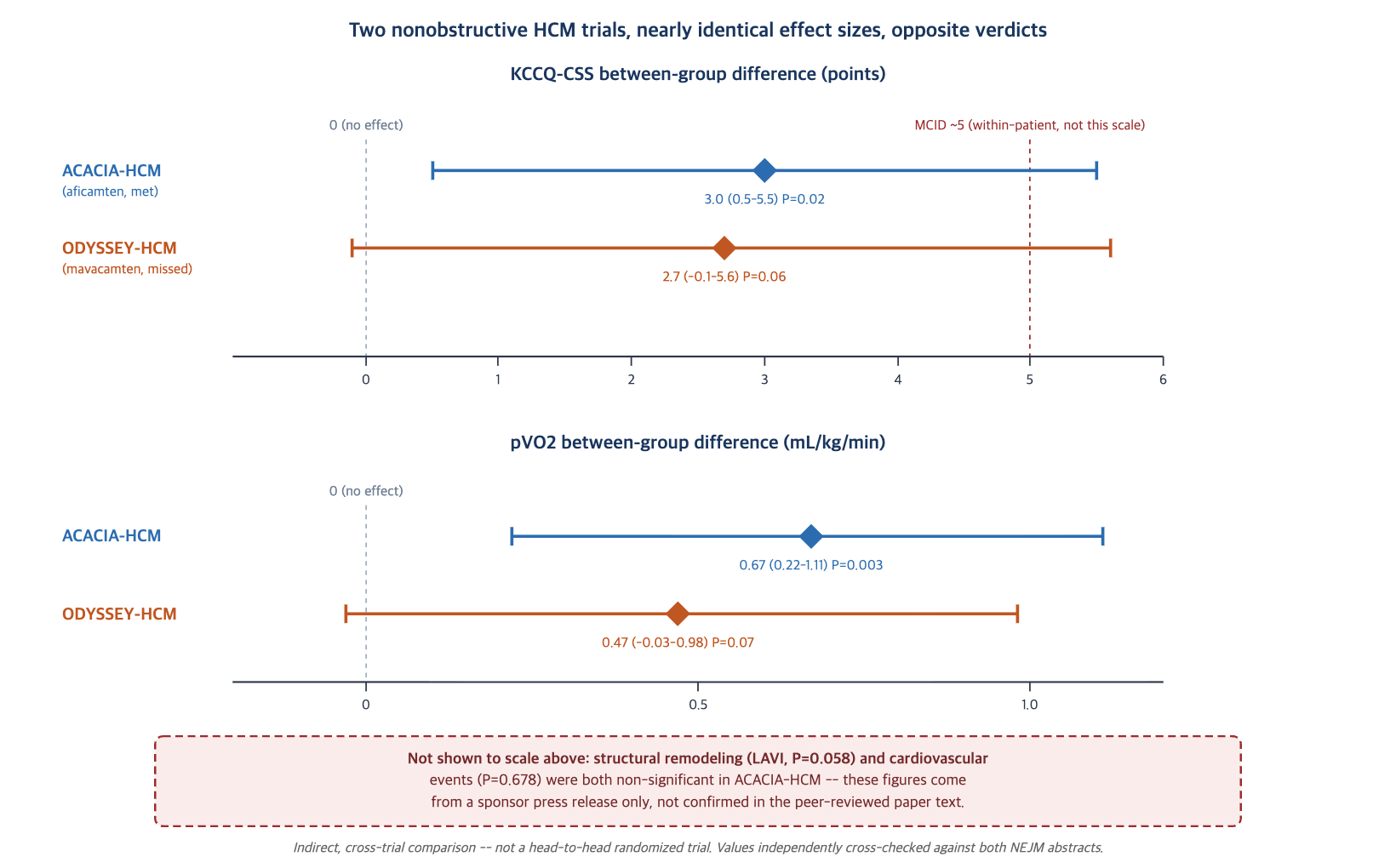
Two more points belong in the same paragraph as everything above, not a separate one. First, the peer-reviewed paper for ACACIA-HCM does not itself report the LAVI or cardiovascular-event p-values shown here — we obtained those from a Cytokinetics press release, and could not confirm the hierarchical statistical-testing order that determines whether that non-significant result formally affects the endpoints ranked below it. Second, this piece is companion to a separate analysis published in the same cycle that looks at a different heart-failure paper making a structurally similar mistake in reverse — reporting a narrow-looking interval and letting readers assume it describes individual-patient risk, when it describes something else. The two pieces are about the same underlying trap in different clinical layers, but each stands on its own.
Deep dive
1. Background
Hypertrophic cardiomyopathy splits into two forms with very different drug histories. In obstructive HCM, a thickened interventricular septum narrows the left ventricular outflow tract (LVOT) and creates a pressure gradient; cardiac myosin inhibitors relieve that gradient directly by reducing contractility, and both mavacamten (approved 2022) and aficamten (approved December 2025, brand name MYQORZO) now carry that indication. Nonobstructive HCM — roughly two-thirds of all HCM patients, per background epidemiology cited in these trials — has no LVOT gradient to relieve and, until ACACIA-HCM, no approved drug therapy of any kind; management has relied on off-label beta-blockers, verapamil, or disopyramide for symptom relief. Mavacamten’s own attempt at this indication, ODYSSEY-HCM, read out in 2025 and did not meet either co-primary endpoint. ACACIA-HCM (aficamten, NCT06081894), reported in the New England Journal of Medicine and presented at the ESC Congress Hot Line session in late August 2026, is the first positive pivotal trial in this indication.
2. What this study newly shows
ACACIA-HCM randomized 517 adults with symptomatic nonobstructive HCM (average age 55.1, 53.6% women) 1:1 to aficamten (starting 5 mg, titrated up to 20 mg, guided by echocardiography) or placebo for up to 72 weeks. Both co-primary endpoints, assessed at 36 weeks, were met: KCCQ-CSS rose 11.4 points on aficamten versus 8.4 on placebo (between-group difference 3.0, 95% CI 0.5–5.5, P=0.02); pVO2 rose 0.64 mL/kg/min versus −0.03 (between-group difference 0.67, 95% CI 0.22–1.11, P=0.003). Reported hierarchical secondary endpoints — sourced only from the sponsor’s press release, not independently confirmed in the paper — showed NYHA class improvement of at least one grade in 41.9% of aficamten patients versus 27.8% on placebo (P<0.001), a reduction in NT-proBNP, and non-significant results for LAVI (P=0.058) and time to first cardiovascular event (P=0.678). Reversible LVEF below 50% occurred in 10.5% of aficamten patients versus 0.8% on placebo; serious adverse events occurred in 20.2% versus 14.7%.
3. Methodological strengths and limits
Strengths. This is a pre-registered (NCT06081894), multinational, double-blind, placebo-controlled phase 3 trial with a pre-specified dual co-primary endpoint, peer-reviewed and published in NEJM alongside an ESC Hot Line presentation. Enrollment criteria are unusually well documented and, as noted above, nearly identical to ODYSSEY-HCM’s, which is what makes the cross-trial comparison in this piece more informative than a typical indirect comparison. Non-significant secondary results (LAVI, cardiovascular events) were disclosed rather than omitted — even if only in a press release — which is itself a data point in favor of the trial’s transparency.
Limits. We have not accessed the full paper: Methods, Statistical Analysis Plan, Figures, Supplementary Appendix, and Disclosure Forms are all behind a paywall, and every quantitative claim in this piece traces to the published abstract, ClinicalTrials.gov’s registration record, or (for secondary endpoints only) a sponsor press release. The hierarchical testing order and alpha-spending plan — which would determine whether NYHA and NT-proBNP results retain formal statistical significance once LAVI came back at P=0.058 — are not disclosed anywhere we could access. Reported sample sizes are inconsistent across sources (517 in the abstract, 518 in the press release, 516 in a conference summary); we use the abstract’s 517 throughout and flag the discrepancy rather than resolve it. The safety comparison against ODYSSEY-HCM is indirect: different follow-up duration (up to 72 vs. 48 weeks), different maximum dose (20 mg vs. 15 mg), and different sponsors and dosing-titration protocols. “Reversible” LVEF decline is the trial’s own characterization; recovery timelines and the proportion who fully recovered are not reported in the abstract we reviewed.
4. Connections to neighboring domains
The most exportable lesson here is not about hypertrophic cardiomyopathy — it is about reading “significant” and “non-significant” as a difference in kind rather than a difference in degree. The statistical truism that the difference between a significant and a non-significant result is not itself necessarily significant is a textbook caution, and this pair of trials is close to a clean, real-world illustration of it: same mechanism, same indication, near-identical enrollment, near-identical effect sizes, opposite regulatory verdicts. What appears to have actually separated the two trials is measurement design — a 36- versus 48-week primary timepoint and a higher maximum dose — not a clearly larger biological effect. That is a caution worth carrying into how any reader evaluates binary “pass/fail” trial readouts more broadly, in cardiology or elsewhere.
A second, narrower observation: the placebo arm’s KCCQ improvement (+8.4 in ACACIA, +10.4 in ODYSSEY) is comparable in size to, or larger than, the drug’s own effect over placebo. Patient-reported symptom scores appear to carry a structurally high noise floor in this indication. Whether objective, continuously measured endpoints — wearable-derived activity data, remote six-minute-walk testing, ambulatory heart-rate monitoring — could reduce that noise in future HCM trials is an open question this trial does not test, not a claim this piece is making about it.
5. Commercialization and investment angle
This paper tests one drug in one indication and evaluates no company’s stock. The table below is a factual map, kept separate from the trial’s own scientific claims.
| Layer | Facts (sourced) |
|---|---|
| Aficamten (brand MYQORZO) | Cytokinetics. Oral, selective, reversible cardiac myosin inhibitor. Approved for obstructive HCM in the U.S. (December 2025) and in China (NMPA, 2025); U.S. launch for that indication targeted for the second half of January 2026, per secondary reporting. |
| Nonobstructive HCM regulatory status | Not yet approved for this indication. A supplemental new-drug application is planned for the fourth quarter of 2026, per the sponsor’s announcement. |
| Regional partners | Bayer holds Japan development and commercialization rights (2024); Sanofi holds Greater China rights, acquired from Corxel (2024). Both are listed as collaborators on the trial’s ClinicalTrials.gov registration. Deal-value figures are from secondary sources and were not independently verified against the original contracts. |
| Mavacamten (brand CAMZYOS) | Bristol Myers Squibb. Approved for obstructive HCM (2022); its own nonobstructive-HCM trial, ODYSSEY-HCM, did not meet its co-primary endpoints (2025). If aficamten is approved in nonobstructive HCM, it would be the only approved drug in that specific indication, though this is a statement about regulatory status, not a judgment on either company’s prospects. |
TRL, with layers kept separate. As a nonobstructive-HCM therapy, aficamten sits at TRL 8 — a completed, positive pivotal trial with a regulatory filing planned but not yet submitted or approved; this is a different TRL than the drug’s already-approved obstructive-HCM indication (TRL 9), and treating the two as the same status is the most likely hype path around this molecule. As a disease-modifying therapy — in the sense of altering structural remodeling or reducing cardiovascular events — the evidence sits closer to TRL 3: LAVI and cardiovascular-event endpoints were both non-significant, and even that non-significance rests on a press release rather than the peer-reviewed paper.
6. The counter-view
This outlet’s independent review verified all four headline effect-size figures against both original NEJM abstracts (character-for-character match) and required the following caveat to be carried into any published summary, reproduced here in full:
Aficamten met both co-primary endpoints in symptomatic nonobstructive HCM, an indication with no approved therapy — that is a fact, and it comes first. But in the same breath: mavacamten’s effect size in the same indication a year earlier (ODYSSEY-HCM) was a KCCQ difference of 2.7 points and a pVO2 difference of 0.47, against aficamten’s 3.0 points and 0.67 — the two trials’ 95% confidence intervals nearly completely overlap (independently verified against both NEJM abstracts). The two trials’ enrollment criteria are nearly identical — LVEF, NYHA class, KCCQ ceiling, LVOT gradient thresholds, and NT-proBNP — making this an unusually well-matched cross-trial comparison, though still not head-to-head. The 3.0-point KCCQ difference is below the commonly cited 5-point minimal clinically important difference, but MCID is defined for within-patient change, so comparing it directly to a between-group mean difference conflates two different measurement levels. The statement that structural remodeling (LAVI, P=0.058) and cardiovascular events (P=0.678) were non-significant was not confirmed in the peer-reviewed paper itself — it rests entirely on a sponsor press release, and the hierarchical testing’s alpha-allocation and stopping rule were not confirmed. Where the two drugs actually appear to differ is not efficacy but safety — LVEF <50% occurred in 10.5% of aficamten patients (up to 72 weeks) versus 21.5% of mavacamten patients (48 weeks) — though ODYSSEY also reported LVEF ≤30% in 2.4% of patients, with no matching severity stratum reported for aficamten, making severity-level comparison impossible. The trial was sponsor-funded, and several of the paper’s authors are Cytokinetics employees. This is for informational purposes only and does not constitute investment or medical advice.
Two further points bear on how much weight this comparison can carry. First, the placebo-arm asymmetry deserves a precise reading: in ODYSSEY, both the placebo arm (+10.4) and the treatment arm (+13.1) rose by roughly 1.7–2.0 points relative to ACACIA’s respective arms — both groups moved together, and the between-group gap barely shifted (2.7 vs. 3.0). A “placebo response ate the 48-week signal” explanation is not supported by that pattern; the more accurate statement is simply that the group difference did not move much between the two trials, for reasons this comparison cannot fully identify. Second, an MCID-based “clinically unimportant” reading is itself incomplete: MCID compares to individual change, not group averages, and the trial’s own NYHA-improvement rate (41.9% vs. 27.8%) suggests a meaningful share of patients experienced change above typical MCID thresholds even though the group mean sat below 5 points.
7. Metrics to watch
- 72-week extension data from ACACIA-HCM, which the trial already collected but has not yet reported — whether the KCCQ and pVO2 differences widen or shrink at the longer timepoint bears directly on whether the 36-vs-48-week choice mattered.
- Disclosure of the hierarchical testing order and alpha-spending plan, which determines whether the NYHA and NT-proBNP secondary results retain formal statistical significance given LAVI’s P=0.058.
- Whether the FDA treats a 3.0-point KCCQ difference as clinically meaningful for labeling purposes in an indication with no existing approved therapy.
- Peer-reviewed (not press-release) publication of the LAVI and cardiovascular-event data, and of LVEF-recovery timelines.
- Real-world post-marketing LVEF-monitoring data, if the nonobstructive indication is approved.
References
- Masri, Ahmad, Martin S. Maron, Anjali Bhatia, et al. 2026. “Aficamten for Symptomatic Nonobstructive Hypertrophic Cardiomyopathy.” New England Journal of Medicine, published online August 28, 2026. DOI: 10.1056/NEJMoa2603021. ACACIA-HCM, NCT06081894. Funded by Cytokinetics. Paywalled; this piece is sourced from the publisher-deposited structured abstract, independently verified, not the full text.
- “Mavacamten in Symptomatic Nonobstructive Hypertrophic Cardiomyopathy.” 2025. New England Journal of Medicine. DOI: 10.1056/nejmoa2505927. ODYSSEY-HCM, NCT05582395. Funded by Bristol Myers Squibb. Independently retrieved and cross-checked against this piece’s cited figures.
- “Aficamten for Symptomatic Obstructive Hypertrophic Cardiomyopathy.” 2024. New England Journal of Medicine. DOI: 10.1056/nejmoa2401424. SEQUOIA-HCM, NCT05186818. Funded by Cytokinetics.
- Cytokinetics. 2026. “Cytokinetics Announces Positive Results from ACACIA-HCM Presented in Hot Line Session at ESC Congress 2026 and Published in NEJM.” Corporate press release. Source for all secondary-endpoint figures cited in this piece (NYHA, NT-proBNP, LAVI, cardiovascular events, discontinuations, sNDA timeline); not independently confirmed against the peer-reviewed paper.
- “Minimally Important Kansas City Cardiomyopathy Questionnaire Changes Across the Spectrum of Heart Failure Severity.” 2025. JACC: Heart Failure. DOI: 10.1016/j.jchf.2025.102587. Source for the commonly cited 5-point MCID figure; abstract-level attribution only, full text not independently reviewed for this piece.
Disclosure
This piece is for information purposes only. It does not constitute investment advice, and it does not constitute medical advice — nothing here should be used to make, or change, any treatment decision. Readers with questions about hypertrophic cardiomyopathy management should consult their own clinician.
The author discloses no position in any entity mentioned in this piece.
COI note. ACACIA-HCM was funded by Cytokinetics (NASDAQ: CYTK); 8 of the paper’s 46 co-authors are listed with Cytokinetics affiliations, a common but noteworthy feature of industry-sponsored pivotal trials. Bayer and Sanofi are listed as trial collaborators on ClinicalTrials.gov in connection with their regional licensing rights (Japan and Greater China, respectively); the terms of those licenses were not independently verified against original contracts. ODYSSEY-HCM was funded by Bristol Myers Squibb (NYSE: BMY). One ACACIA-HCM co-author, John A. Spertus, is widely credited as the original developer of the KCCQ instrument used as one of the trial’s two co-primary endpoints; this piece could not access the paper’s full Disclosure Forms to confirm how that relationship was reported, and treats this as a structural fact rather than an allegation of any disclosure failure. This piece contains statements that could read as unfavorable to Cytokinetics (effect size below the group-average MCID threshold; confidence intervals overlapping a trial that missed its endpoints) and statements that could read as unfavorable to Bristol Myers Squibb (a roughly two-times-higher rate of LVEF decline in the indirect safety comparison), alongside statements that could read favorably toward each. This piece renders no positive or negative investment judgment on any of the companies named; all are mentioned as neutral, factual context for a scientific and statistical comparison.
 Uthando Nethemba
Leave a comment