Evidence-first notes on bioscience and deep tech, at the edge of the lab and the market. Information only — not investment advice. This post covers a corporate topline announcement about a completed cardiovascular outcomes trial in a listed company’s pivotal asset. Every result-layer number below is attributed as a company statement; trial design, population, and pre-specified statistical structure are attributed to a peer-reviewed, open-access design paper. Where the two differ in resolution — what was said versus what was measured — that gap is the actual subject of this piece.
The 30-second version
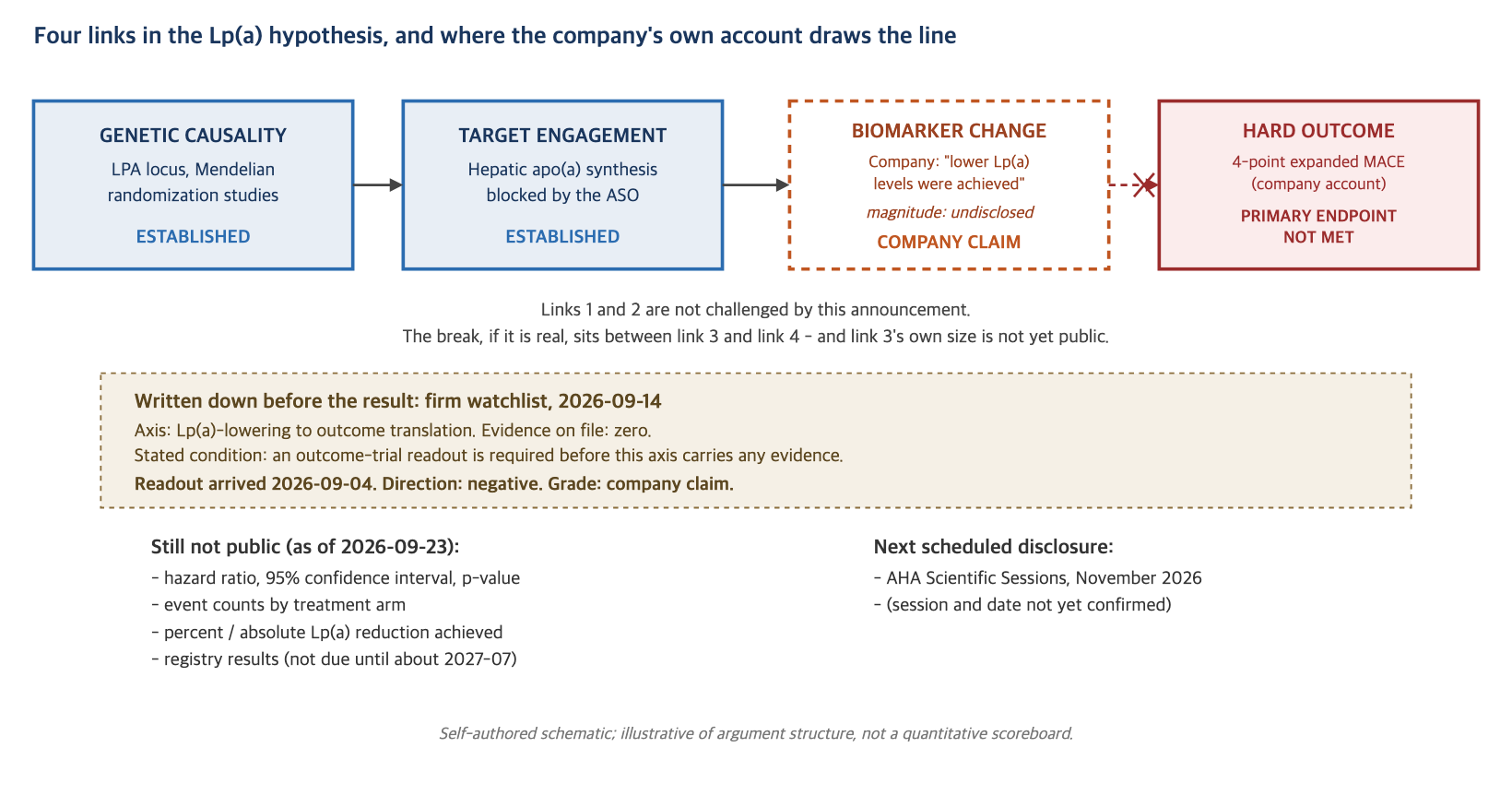
- What. On 2026-09-04, Novartis stated in a corporate press release — not a peer-reviewed publication, not a conference presentation, and not a clinical-trial-registry results posting — that Lp(a)HORIZON (NCT04023552), a phase 3 cardiovascular outcomes trial of pelacarsen (an antisense oligonucleotide against apolipoprotein(a)) in 8,323 patients with established cardiovascular disease and elevated Lp(a), did not meet its primary endpoint of reducing four-point expanded major adverse cardiovascular events (MACE). The same release states that “lower Lp(a) levels were achieved.” As of 2026-09-23, no hazard ratio, confidence interval, p-value, event count, or percent/absolute Lp(a) reduction has appeared in any public source, and the trial’s registry entry shows no results posted.
- So what. This is the first hard-outcome test, for any Lp(a)-targeting drug, of a roughly three-decade-old hypothesis — and the first direct readout points negative. The one serious rescue argument, “the achieved dose was too small,” is narrowed by the trial’s own design paper: the Mendelian-randomization threshold its authors cite for secondary prevention is a 50 mg/dL absolute reduction, and the identical dose has separately produced a 72% placebo-adjusted reduction in a different phase 3 population — which, applied to this trial’s median baseline, implies an expected reduction well above that threshold. None of this confirms how much the biomarker actually moved in this trial, because that number has not been disclosed.
- Now what. The firm’s own watchlist had, before this readout, an axis explicitly logged with zero evidence and a stated condition: an outcome-trial readout was required before that axis could carry any evidence at all. That condition is now met, with one negative-direction, company-claim-grade data point — which we are recording as exactly that, not as grounds to upgrade the axis to active. Four other outcome trials of Lp(a)-lowering drugs, across different modalities and dosing, remain open (expected readouts 2028–2031). Detailed data is expected at the American Heart Association Scientific Sessions in November 2026.
The five-minute read
What arrived on September 4 was not a result
A press release is not a results publication. Novartis’s statement says the trial “did not meet its primary endpoint of reducing the risk of cardiovascular events…” and that Lp(a) lowering “was achieved,” but it contains no hazard ratio, no confidence interval, no p-value, no event count, and no quantified Lp(a) reduction. We checked the press release text directly, the trial’s ClinicalTrials.gov entry (NCT04023552, status COMPLETED, primary completion 2026-07-16 actual, results posted: no), a statement from the National Lipid Association, and conference/earnings search — none contain the missing numbers. That is worth separating from a compliance question: under FDAAA, results-reporting to the U.S. registry is typically due about one year after primary completion, which places the deadline here around mid-2027. A press release that arrives before a detailed data presentation and before the registry deadline is not a disclosure violation; it is standard practice for a public company reporting a major trial outcome. We are simply declining to treat “the trial failed” and “the company announced a primary-endpoint miss, with no numbers attached” as the same sentence.
The subgroup that was not a subgroup
The trial had two co-primary endpoints, evaluated in (i) the full enrolled population (Lp(a) ≥70 mg/dL) and (ii) a pre-specified subgroup with Lp(a) ≥90 mg/dL, under a success rule stated plainly in the design paper: “Successful achievement of the primary objective requires meeting either or both primary objectives.” Novartis’s release describes a single, unqualified “primary endpoint” miss, which on its face implies both co-primaries failed — but the release also contains a qualifier that is easy to miss: it states the findings did not demonstrate reduced cardiovascular risk “in the overall study population,” without separately addressing the ≥90 mg/dL group. We treat the “both failed” conclusion as the firm’s own inference, of moderate strength, resting less on the release’s wording than on trial structure: per the design paper’s baseline table, the ≥90 mg/dL group comprises 6,540 of 8,323 randomized patients — 78.6% of the entire trial. That is not a minority enrichment subgroup; it is most of the study population, and the two co-primary analysis sets overlap by roughly four-fifths. A full-population result and a near-identical 78.6%-overlapping subset diverging meaningfully is possible in principle, but structurally unlikely.
The dose question the trial’s own design narrows
The design paper (Cho et al. 2025, open access) explains the dosing rationale by citing Mendelian-randomization literature: roughly 65–80 mg/dL absolute Lp(a) reduction is estimated to be needed for a meaningful relative-risk reduction in primary prevention, and roughly 50 mg/dL in secondary prevention — the setting this trial studied. The 80 mg once-monthly dose was chosen partly on the strength of a phase 2 result (Tsimikas et al. 2020, NEJM) showing an 80% placebo-adjusted Lp(a) reduction at a different regimen (20 mg weekly, n=286) with equivalent total monthly exposure. Separately, and more directly relevant, a different phase 3 trial at the identical 80 mg every-four-weeks dose — Lp(a)FRONTIERS APHERESIS, in an apheresis-treated population — measured a 72% placebo-adjusted Lp(a) reduction over 52 weeks. Applied to Lp(a)HORIZON’s median baseline of 108.2 mg/dL, a 72% reduction would be roughly 78 mg/dL — about 1.56 times the secondary-prevention MR threshold the design paper itself cites.
Three caveats, stated as plainly as the number above: this is an expected reduction for a median patient using a reference figure from a different trial, not the reduction actually measured in Lp(a)HORIZON, which remains undisclosed; the reference population (apheresis patients) differs in baseline characteristics and background therapy from Lp(a)HORIZON’s population; and the Mendelian-randomization threshold itself estimates the effect of lifelong exposure to lower Lp(a), which is not the same estimand as a multi-year drug trial — a translation this very trial is, in effect, the first direct test of. None of that changes the direction of the conclusion: on the numbers currently available, the “the dose was too small” rescue path looks narrow, though it is not closed until the actual achieved reduction is published.
Deep dive
1. Background: the causal chain, and the one link nobody had tested until now
Lipoprotein(a) has one of the strongest genetic causal cases in cardiovascular lipidology: it is largely determined by the LPA gene, its concentration is stable across life, and Mendelian-randomization studies and loss-of-function carrier data have consistently linked higher Lp(a) to higher cardiovascular risk. What has always been missing is the last link — whether pharmacologically lowering Lp(a) over a period of years, on top of modern background therapy, reduces cardiovascular events. Statins do not meaningfully lower Lp(a); until antisense and siRNA drugs entered late-stage trials, that link had never been directly testable. Lp(a)HORIZON is the first hard-outcome trial, for any Lp(a)-targeting drug, to report a readout on that link. It reported negative, in the direction that lowering did not reduce events — according to the company, and without the numbers that would let an outside reader judge the size or confidence of that negative result.
2. What the trial establishes, in design terms — all sourced to the peer-reviewed design paper
Lp(a)HORIZON randomized 8,323 patients 1:1 to pelacarsen 80 mg subcutaneously every four weeks or placebo, on top of optimized background lipid therapy, across 797 sites in 42 countries. Enrollment completed in July 2022; the registry lists primary completion as 2026-07-16, actual. Eligibility required established cardiovascular disease and Lp(a) ≥70 mg/dL; a pre-specified subgroup at Lp(a) ≥90 mg/dL was analyzed as a second co-primary population, under the stated rule that success required meeting “either or both” primary objectives. Baseline characteristics, as reported in the design paper’s Table 3: median age 59.7 years, 73.0% male, median Lp(a) 108.2 mg/dL, median LDL-C 64.6 mg/dL, high-intensity statin use 77.5%, ezetimibe or bile-acid sequestrant use 56.6%, PCSK9-inhibitor use 10.8%. Eligible index events were 81.5% myocardial infarction, 9.8% ischemic stroke, and 14.2% symptomatic peripheral artery disease.
3. The verification ladder — what is confirmed, what is a company claim, and what is simply not yet public
| Tier | Contents |
|---|---|
| Peer-reviewed / registry-confirmed | Trial design, population, dosing, co-primary endpoint definitions and success rule, baseline characteristics (design paper); registry status COMPLETED, primary completion 2026-07-16 actual, enrollment 8,323 actual (ClinicalTrials.gov) |
| Company claim (unquantified) | Primary endpoint not met; “lower Lp(a) levels were achieved”; detailed results expected at an upcoming medical congress |
| Not yet public | Hazard ratio, 95% CI, p-value; event counts by arm; percent and absolute Lp(a) reduction achieved; residual Lp(a) levels; actual median follow-up; secondary endpoints (3-point MACE, coronary heart disease composite, all-cause mortality); safety data; pre-specified subgroup results (including the ≥90 mg/dL group specifically); any decision on the program’s regulatory path |
On the registry gap specifically: under the U.S. FDAAA framework, results-reporting to ClinicalTrials.gov is typically due about one year after primary completion, which places the deadline here around mid-2027. The absence of a results posting as of September 2026 is consistent with that timeline and is not, on its own, a disclosure violation.
4. Two estimands wearing the same name
Mendelian randomization estimates the effect of lifelong, genetically determined exposure to lower Lp(a). A multi-year randomized drug trial estimates the effect of a pharmacological intervention started in adulthood, in patients who already have established disease. These are related questions but not identical ones, and the design paper’s own dosing rationale explicitly imports an MR-derived threshold (the 50–80 mg/dL figures above) into the RCT setting. Every Lp(a)-lowering program to date has made some version of that translation, because no direct RCT evidence existed to calibrate against. Lp(a)HORIZON is the first trial in a position to test whether the translation holds, and on the outcome layer, it has not (per the company). Whether the eventual explanation is an insufficient achieved reduction, an insufficient duration of exposure, or an estimand mismatch that the whole class shares, is not resolved by this trial alone — it will need to be triangulated against trials of different modalities, doses, and durations.
5. Counterarguments: could this trial simply not have been able to detect an effect?
(a) Background therapy was already intensive. Median LDL-C was 64.6 mg/dL; 77.5% of patients were on a high-intensity statin, 56.6% on ezetimibe or a bile-acid sequestrant, and 10.8% on a PCSK9 inhibitor. The design paper states, in its own words, that “CV risks other than Lp(a) are generally well-managed” in this population. Whether an independent Lp(a) increment remains detectable on top of an already-optimized LDL/apoB-lowering background — Lp(a) particles themselves carry apoB-100, so LDL-lowering therapy already partially overlaps the same pathway — is a legitimate, unresolved question, and probably the strongest counterargument available. A related but weaker claim, that follow-up was too short, does not hold up as well: enrollment completed in July 2022 and primary completion (actual) was reached in July 2026, meaning even the last-enrolled patients were followed roughly four years or more, against a minimum planned follow-up of 2.5 years.
(b) Was residual Lp(a) simply still too high? At a median baseline of 108.2 mg/dL, even a large percentage reduction leaves a nonzero residual — a 72% reduction, for example, would leave roughly 30 mg/dL, which some clinicians would still classify as elevated. This argument sits in tension with the dose-threshold comparison above: if the achieved reduction already exceeded the Mendelian-randomization secondary-prevention threshold cited by the trial’s own designers, then “the dose didn’t lower Lp(a) enough” and “lowering Lp(a) by this much doesn’t reduce events the way MR predicted” cannot both be the full explanation — and distinguishing between them requires the actual achieved reduction, which is not yet public.
(c) The more defensible reading may not be that the Lp(a) hypothesis is wrong, but that this modality, dose, and population did not show a benefit. Four other cardiovascular outcome trials of Lp(a)-lowering drugs remain open, testing different molecules (small-interfering RNA and an oral small molecule, as opposed to this trial’s antisense oligonucleotide), different doses, and, presumably, different achieved reductions, across both secondary- and primary-prevention populations. None of those programs’ own biomarker data is challenged by this result — what this trial tested, and what it reports failing, is specifically the translation from Lp(a) lowering to fewer cardiovascular events, not whether these drugs lower Lp(a) at all.
6. Commercialization layer: TRL, pipeline, and the 2028 gap
Maturity here needs two numbers, not one, because “the drug” and “the hypothesis it was built on” are at different stages:
| What | TRL | Basis |
|---|---|---|
| Asset (pelacarsen, the molecule) | 8 | Completed a randomized pivotal phase 3 in its intended population and operating environment: 8,323 patients, 797 sites, 42 countries, registry status COMPLETED, primary completion reached (actual). This describes the stage the program reached, not a value judgment — reaching regulatory approval in this indication on this data is not a live path unless the interpretation changes on fuller disclosure. |
| Hypothesis (Lp(a) lowering improves CV outcomes, secondary prevention, on optimized background therapy) | 2 | The first direct test returned a negative-direction result. Kept above TRL 1 (falsified) because effect size and confidence bounds are undisclosed, four confirmatory or other-modality trials remain open, and modality, dose, and achieved reduction all differ across the pipeline. |
On the companies: Novartis holds development and commercialization rights to pelacarsen, an antisense oligonucleotide originating from Ionis Pharmaceuticals’ platform. The press release made no statement about program discontinuation or a regulatory filing decision, and the registry entry lists the trial as completed on schedule (status COMPLETED, no early-stopping reason recorded) rather than halted. We are not speculating about either company’s internal decision-making or commenting on investment merit — both are outside the scope of a factual trial readout.
Pipeline, from the public registry, sourced independently of this trial’s outcome:
| Trial | Drug / modality / sponsor | N | Status | Expected primary completion |
|---|---|---|---|---|
| Lp(a)HORIZON (NCT04023552) | Pelacarsen, antisense oligonucleotide | 8,323 (actual) | COMPLETED | 2026-07-16 (actual) |
| OCEAN(a)-OUTCOMES (NCT05581303) | Olpasiran, siRNA | 7,297 (actual) | Active, not recruiting | 2028-03 |
| ACCLAIM-Lp(a) (NCT06292013) | Lepodisiran, siRNA | 17,300 (est.) | Active, not recruiting | 2029-03 |
| OCEAN(a)-PreEvent (NCT07136012) | Olpasiran, siRNA (primary prevention) | ~11,000 (est.) | Recruiting | 2031-10 |
| MOVE-Lp(a) (NCT07157774) | Muvalaplin, oral small molecule | 10,450 (est.) | Recruiting | 2031-03 |
The practical consequence is a gap: the next hard-outcome readout in this drug class is not expected until 2028 (OCEAN(a)-OUTCOMES). Until then, the field’s evidence base for the outcome-translation axis is, in effect, this single company-claim-grade announcement plus whatever detail follows at AHA in November 2026.
7. What to watch
- November 2026 — AHA Scientific Sessions. Detailed Lp(a)HORIZON data is expected here (exact session/date unconfirmed as of this writing). This should resolve most of the “not yet public” list in Section 3.
- ~July 2027 — FDAAA results-reporting deadline. If detailed data has not appeared by AHA, this is the backstop disclosure date.
- The single number that would most change this analysis: the achieved Lp(a) reduction. A disclosed reduction well below the ~50–80 mg/dL Mendelian-randomization thresholds discussed above would revive the “dose was insufficient” explanation. A reduction at or above those thresholds, with no cardiovascular benefit, would instead weigh against the MR-to-RCT translation itself — a finding with implications for every other trial in the table above, regardless of modality.
- 2028–2031: readouts from OCEAN(a)-OUTCOMES, ACCLAIM-Lp(a), OCEAN(a)-PreEvent, and MOVE-Lp(a), spanning different molecules, doses, and populations, will determine whether this result generalizes across the drug class or was specific to this trial’s modality, dose, or population.
References
- Cho L, Nicholls SJ, Nordestgaard BG, Landmesser U, Tsimikas S, Blaha MJ, Leitersdorf E, Lincoff AM, Lesogor A, Manning B, Kozlovski P, Cao H, Wang J, Nissen SE. 2025. “Design and Rationale of Lp(a)HORIZON Trial: Assessing the Effect of Lipoprotein(a) Lowering With Pelacarsen on Major Cardiovascular Events in Patients With CVD and Elevated Lp(a).” American Heart Journal 287. DOI 10.1016/j.ahj.2025.03.019, PMID 40185318. Open access (CC-BY); full text read directly.
- Madsen CM, Kamstrup PR, Langsted A, Varbo A, Nordestgaard BG. 2020. “Lipoprotein(a)-Lowering by 50 mg/dL (105 nmol/L) May Be Needed to Reduce Cardiovascular Disease 20% in Secondary Prevention.” Arteriosclerosis, Thrombosis, and Vascular Biology 40:255–266.
- Tsimikas S, Karwatowska-Prokopczuk E, Gouni-Berthold I, et al. 2020. “Lipoprotein(a) Reduction in Persons with Cardiovascular Disease.” New England Journal of Medicine 382:244–255. DOI 10.1056/NEJMoa1905239, PMID 31893580.
- Lp(a)FRONTIERS APHERESIS trial. 2026. European Heart Journal 47(25):3284–3294. DOI 10.1093/eurheartj/ehag073, PMID 41721795, open access (PMC13318419).
- ClinicalTrials.gov. NCT04023552 (Lp(a)HORIZON). Status COMPLETED, primary completion 2026-07-16 (actual), results posted: no (accessed 2026-09-23). https://clinicaltrials.gov/study/NCT04023552
- ClinicalTrials.gov. NCT05581303 (OCEAN(a)-OUTCOMES), NCT06292013 (ACCLAIM-Lp(a)), NCT07136012 (OCEAN(a)-PreEvent), NCT07157774 (MOVE-Lp(a)). Accessed 2026-09-23.
- Novartis. 2026-09-04. “Novartis announces Lp(a)HORIZON Phase III topline results for pelacarsen in patients with elevated Lp(a) and established cardiovascular disease” (press release). novartis.com
- National Lipid Association. 2026-09. Statement on topline results from the Phase 3 Lp(a)HORIZON trial.
Disclosure
This post is for information only and is not investment advice. It is not medical advice.
COI note: this post describes a completed pivotal trial sponsored by Novartis, of an asset originating from Ionis Pharmaceuticals’ antisense platform. The design paper’s own conflict-of-interest disclosures, read directly from the open-access full text, report that 5 of 14 named authors are Novartis employees (including stock-holding disclosures and a formal-analysis/data-curation role held by sponsor personnel), and that one author holds a dual academic/industry appointment at the originating company. The result-layer claims in this post (primary endpoint miss; “Lp(a) lowering achieved”) are attributed throughout as company statements, not as independently verified findings, precisely because of this structure. Design, population, and statistical-plan facts are drawn from the peer-reviewed, open-access design paper and are treated as a separate, higher-confidence tier. Novartis, Ionis, Amgen, and Eli Lilly are named here only in factual, descriptive contexts (sponsorship, trial registry data, program status); no capability ranking, motive, or investment implication is asserted for any of them.
Position: the author holds no position in, and has no financial interest in, any company named in this post.


Leave a comment