Evidence-first notes on bioscience and deep tech, at the edge of the lab and the market. Information only — not investment advice, and not medical advice. This piece covers two separate, publicly documented events in the same disease area: a completed, peer-reviewed phase 2b trial (not a simulation, not a preprint) and two national health-technology-assessment (HTA) determinations. The trial’s full text is paywalled; the specific numbers below are drawn from the publisher-deposited structured abstract and from the trial’s ClinicalTrials.gov results posting, both independently verified against the primary source, not from secondary summaries. This piece names two publicly listed companies, AstraZeneca and Bayer, in connection with a failed trial and an unfavorable reimbursement ruling, respectively; both are factual, publicly documented events, not this outlet’s opinion of either company, and nothing here is investment advice.
The 30-second version
- What. In a phase 2b trial (ENDEAVOR, ClinicalTrials.gov NCT04986202, sponsor AstraZeneca), the myeloperoxidase (MPO) inhibitor mitiperstat was given to 711 patients with heart failure and left ventricular ejection fraction above 40%, at 2.5 mg, 5 mg, or placebo, for 48 weeks. Both co-primary endpoints at 16 weeks missed: symptom score KCCQ-TSS changed by −1.4 points versus placebo (95% CI −3.9 to 1.2; P=0.29), and 6-minute walk distance by 3.8 meters (95% CI −3.1 to 10.8; P=0.28). No secondary endpoint improved. The one notable safety signal was a skin rash (3.6% on drug vs. 0.4% on placebo). The claim that mitiperstat “bound its target” comes from a different, earlier trial (SATELLITE, n=41, phase 2a), which showed MPO enzymatic activity suppressed to a specific-activity ratio of 0.25 versus placebo (95% CI 0.12 to 0.52; P<0.001) — whether the same degree of target engagement occurred inside ENDEAVOR itself is not confirmed in any public source we found.
- So what. This looks like an informative null, not simply “the drug was too weak”: target binding was demonstrated, dosing ran a full 48 weeks at two dose levels with no dose-response signal in either direction, and the 95% confidence interval’s upper bound (1.2 points on KCCQ, 10.8 meters on 6-minute walk) rules out a clinically meaningful benefit rather than merely failing to detect a small one. The same molecule also failed in COPD (event hazard ratio 1.07, 90% CI 0.87–1.32, with more pneumonia on drug: 7 vs. 2 cases, and the trial authors’ own published conclusion was that risks outweighed the benefits) and in MASH (liver enzyme change statistically indistinguishable from placebo, P=0.893). Three separate diseases, one shared premise — that neutrophil-driven oxidative inflammation is a druggable driver of the disease — failing three times points at the premise, not the molecule.
- Now what. Every mitiperstat/AZD4831 trial registered on ClinicalTrials.gov (14 total, checked 2026-09-14) is now completed or terminated; none are recruiting or active. We could not confirm any formal pipeline-discontinuation statement from AstraZeneca (their investor-relations pages were inaccessible to us), so we do not assert one. Separately, and in the same disease category: finerenone (Bayer) passed its own efficacy trial (FINEARTS-HF, rate ratio 0.84, 95% CI 0.74–0.95, P=0.007) but then split on a second, entirely different gate — national reimbursement review. Germany’s IQWiG ruled “additional benefit not proven” on August 3, 2026; the UK’s NICE recommended funding on August 5, 2026 — two days apart, on the same trial. The reason was not the effect size; it was disagreement over what the trial should have been compared against.
The five-minute read
A biologically clean hypothesis, tested at increasing scale
Heart failure with preserved ejection fraction (HFpEF) has, in the last five years, become a disease modern drugs can actually move: SGLT2 inhibitors and a nonsteroidal mineralocorticoid-receptor antagonist (nsMRA) lowered hospitalization and cardiovascular-death events in large outcome trials, and incretin drugs moved symptom scores substantially. Mitiperstat proposed a fourth mechanism — local oxidative and inflammatory injury, rather than systemic metabolism or hemodynamics. The biology behind it is coherent: myeloperoxidase, released by neutrophils, generates oxidants that reduce nitric-oxide availability, a pathway implicated in coronary microvascular dysfunction and myocardial stiffening — a textbook description of one leading HFpEF disease model. Mitiperstat is a mechanism-based, largely irreversible MPO inhibitor, and its developer had a clean, quantitative way to show it was hitting the enzyme: an ex vivo assay of neutrophil MPO activity after stimulation.
Where the chain of evidence actually broke
That assay is exactly where the program’s only unambiguous positive result sits. In SATELLITE (n=41), MPO-specific activity fell to a ratio of 0.25 versus placebo (P<0.001) — a clean, statistically overwhelming result. But the same small trial’s secondary measure of coronary microvascular function (coronary flow velocity reserve) showed no difference (ratio 0.97, P=0.568, though the placebo arm was only 5 patients). A separate, Mayo Clinic–sponsored acute hemodynamic trial (n=30) then tested the next link in the causal chain — exercise pulmonary-capillary wedge pressure — and found placebo numerically better than drug (−4 mmHg vs. −1 mmHg, P=0.040). Only then did the program scale to ENDEAVOR’s 711 patients testing symptoms and exercise capacity, which also came back null. In other words: sample size grew at every step of this causal chain, but the only step that reliably worked was the first one — binding the enzyme. Within ENDEAVOR itself, that binding step was never independently re-confirmed in any source we could access; the assumption that it held is inherited from SATELLITE, a different, much smaller trial.
One further, same-trial number is worth noting on its own terms: in ENDEAVOR’s registry results, the placebo arm’s own KCCQ-TSS score rose by 11.62 points from baseline to 16 weeks — larger than either active-dose arm’s own rise (10.70 and 9.81 points), and far larger than the roughly 1–2 point difference the trial was designed to detect. That is a within-trial comparison of drug arms to their own placebo arm, not a comparison to any other study; it illustrates how large non-specific movement (regression to the mean, trial-participation effects, more frequent clinical contact) can be on a patient-reported symptom score, and why a precise null result here (a narrow confidence interval, not merely a “no significant difference”) is more informative than a simple negative headline suggests.
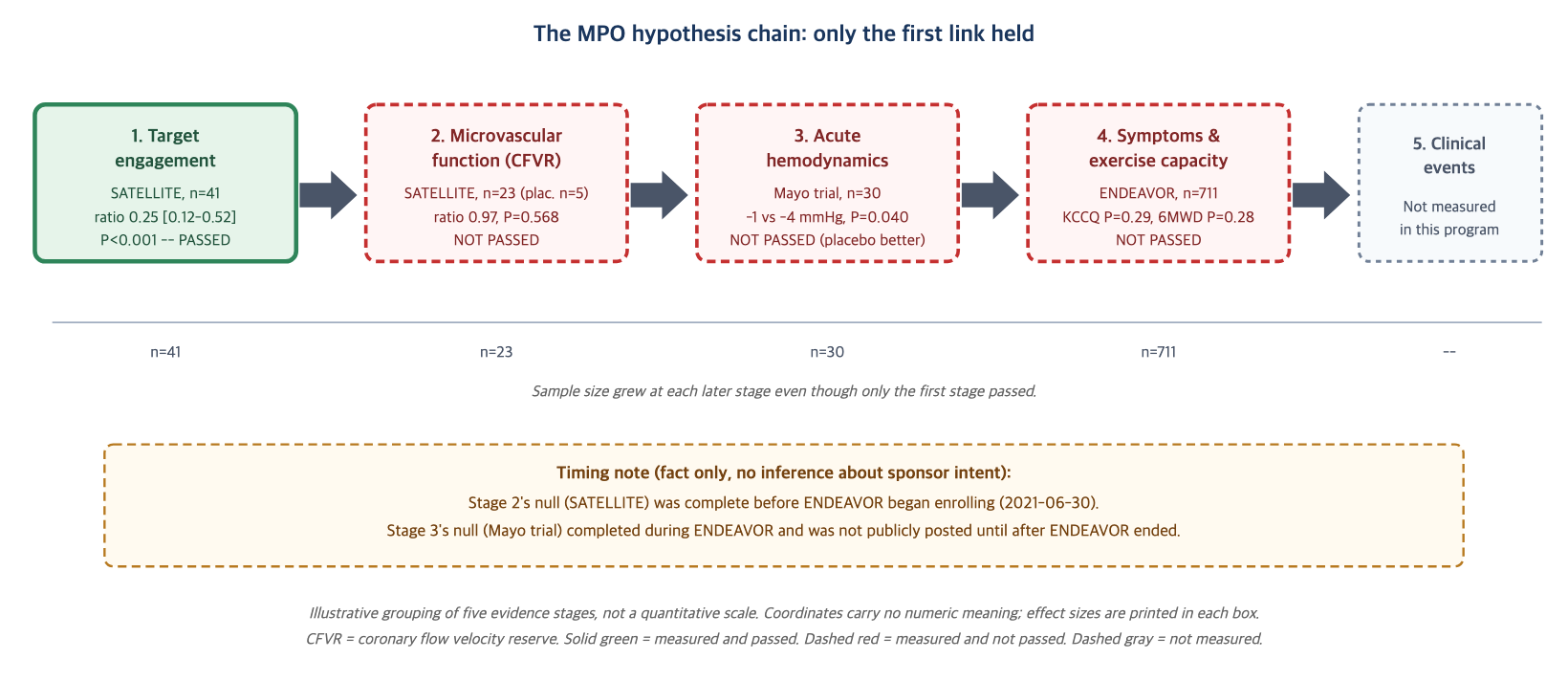
Self-authored diagram. Values as reported in each trial’s ClinicalTrials.gov results posting and, for SATELLITE’s target-engagement result, the same registry entry; independently verified against the primary source, not re-derived. This diagram covers the pre-clinical-through-symptom portion of the causal chain only; no trial in this program measured hard clinical events (hospitalization, cardiovascular death).
The second, unrelated gate: reimbursement
A separate story in the same disease area shows what happens after a drug clears the scientific gate mitiperstat never reached. Finerenone, a nonsteroidal mineralocorticoid-receptor antagonist from Bayer, met its primary endpoint in FINEARTS-HF (n=6,001): a composite of worsening heart-failure events and cardiovascular death, rate ratio 0.84 (95% CI 0.74–0.95, P=0.007). Germany’s IQWiG and the UK’s NICE then reviewed the same trial for reimbursement, two days apart, and reached opposite conclusions — not because they disagreed about the effect size, but because they disagreed about what the trial should have been compared against.
Deep dive
1. Background
HFpEF (left ventricular ejection fraction above roughly 40–50%) has historically been a graveyard for targeted drug development, in contrast to heart failure with reduced ejection fraction, where neurohormonal blockade has worked for decades. That changed only recently: SGLT2 inhibitors reduced hospitalization/cardiovascular-death composites in DELIVER (hazard ratio 0.82, 95% CI 0.73–0.92) and EMPEROR-Preserved (hazard ratio 0.79, 95% CI 0.69–0.90); the nonsteroidal MRA finerenone did the same in FINEARTS-HF; and incretin drugs (semaglutide in STEP-HFpEF, tirzepatide in SUMMIT) moved patient-reported symptom scores substantially. What unites those successes is that each intervention measurably changed systemic metabolism or hemodynamics. Mitiperstat proposed a different, more local mechanism: direct inhibition of myeloperoxidase, an enzyme released by activated neutrophils that generates reactive oxidants implicated in coronary microvascular dysfunction and myocardial stiffening in HFpEF’s dominant pathophysiological model.
2. What this trial newly shows
ENDEAVOR (NCT04986202) was a multicenter, randomized, double-blind, placebo-controlled phase 2b trial, sponsored by AstraZeneca, enrolling 711 patients across 18 countries (2.5 mg: 235 randomized/234 dosed; 5 mg: 240/240; placebo: 236/235), 45% women, mean age 72.4, registered as a sequential phase 2b/phase 3 design whose phase 3 portion, per the trial registry’s own text, “was never started.” Both co-primary 16-week endpoints missed by wide margins relative to their confidence intervals: KCCQ-TSS −1.4 points (95% CI −3.9 to 1.2, P=0.29) and 6-minute walk distance 3.8 meters (95% CI −3.1 to 10.8, P=0.28). No secondary endpoint (NT-proBNP, echocardiographic measures) reached significance either, and there was no consistent dose-response relationship between the 2.5 mg and 5 mg arms across any endpoint. Safety was broadly similar between arms, with the exception of a higher rate of maculopapular rash on drug (3.6% vs. 0.4%).
Three supporting trials, all independently verified against their own ClinicalTrials.gov results postings, round out the program’s picture: SATELLITE (NCT03756285, phase 2a, HFpEF, n=41, terminated early by AstraZeneca on the stated grounds that completing it would add limited further information) established target engagement but not downstream microvascular effect; a Mayo Clinic–sponsored acute hemodynamic trial (NCT03611153, n=30) found placebo numerically favored over drug on exercise pulmonary-capillary wedge pressure; and CRESCENDO (NCT05492877, COPD, n=381) and a MASH phase 2 trial (NCT05638737, n=112) both missed their primary endpoints as well, with the COPD trial’s own published authors concluding that risks outweighed the benefits, citing more pneumonia on drug (7 vs. 2 cases).
3. Methodological strengths and limits
Strengths. This was an adequately powered, well-conducted phase 2b trial with a pre-specified statistical plan, published peer-reviewed in Nature Medicine, and its sponsor made the full patient-level group data (not just the pooled headline numbers) publicly available through the ClinicalTrials.gov results-posting requirement — results that, when cross-checked, are internally consistent with the paper’s own abstract. That transparency, on a negative result for the sponsor’s own asset, is itself worth noting.
Limits. We could not access the full paper (it sits behind a journal paywall with no legal open-access copy available anywhere we searched), so several questions that would normally settle a “target failed vs. drug underdosed vs. wrong population” debate remain open: whether MPO enzymatic activity was directly re-measured inside ENDEAVOR itself is unconfirmed in any public source (only PK data appear in the registry); whether a pre-specified neutrophil-count-high subgroup (the trial used neutrophil count as a stratification factor, implying the sponsor expected an inflammatory-phenotype-dependent effect) showed any signal is likewise unconfirmed; and background SGLT2-inhibitor use at trial entry is not reported anywhere in the registry’s baseline module, which matters because ENDEAVOR enrolled during exactly the period (2021–2024) when SGLT2 inhibitors became standard HFpEF therapy. The trial population also skewed toward specific enrolling countries (the largest contributors were Bulgaria, Slovakia, and Japan; the United States contributed about 7% of patients), and whether the null result generalizes evenly is not something we can assess from the public data.
4. Connections to neighboring domains
This trial is a clean, quantitative case study for a question that extends well beyond cardiology: when a computational or biological pipeline optimizes for binding a target, does that tell you the target drives the disease? Mitiperstat is close to an ideal test case, because the target-engagement step (stage 1 in the diagram above) was unusually well demonstrated, with a clear enzymatic assay and a decisive result. Everything downstream of that step — microvascular function, acute hemodynamics, symptoms — failed anyway. Drug-discovery pipelines built around structure prediction and generative molecular design are, by construction, very good at the “does this molecule bind” question and mostly silent on “does hitting this node move the phenotype.” This trial’s history is a real-world illustration of exactly that gap, worth keeping in mind whenever a computational pipeline reports a strong binding or engagement metric as if it settles the therapeutic question.
A second, narrower connection: MPO’s role in HFpEF originated substantially from observational associations (high MPO levels correlating with worse outcomes). Programs built primarily on such associations are structurally vulnerable to reverse causation or confounding — inflammation as a marker of disease severity rather than a cause of it — and a genetically informed causal-inference check (for example, a Mendelian randomization study using MPO-related genetic variants) could in principle have flagged this risk before three separate phase 2 programs were run. We did not locate such a study in this review; whether one existed and was available at program start is an open, checkable question.
5. Commercialization and investment angle
This section states facts only; the underlying trials evaluate no company’s stock, and this outlet renders no investment judgment on either company named below.
| Entity | Facts (sourced) |
|---|---|
| Mitiperstat / AZD4831 (AstraZeneca) | All 14 mitiperstat/AZD4831 trials registered on ClinicalTrials.gov are completed or terminated as of our 2026-09-14 query; none are recruiting or active. We could not confirm any formal statement from AstraZeneca that the program has been discontinued (their investor pages returned an access error for us) — we do not assume discontinuation from registry status alone. |
| Adjacent HFpEF assets (facts, no comparison of efficacy claimed) | Dapagliflozin (AstraZeneca, DELIVER), empagliflozin (Boehringer Ingelheim/Eli Lilly, EMPEROR-Preserved), finerenone (Bayer, FINEARTS-HF), semaglutide (Novo Nordisk, STEP-HFpEF), tirzepatide (Eli Lilly, SUMMIT). We are not aware of another late-stage MPO-inhibitor program targeting HFpEF. |
| Finerenone (Bayer) — UK | NICE technology appraisal TA1182, published 2026-08-05, recommends funding for adults with symptomatic chronic HFpEF/HFmrEF; NHS England is required to fund within 90 days of final guidance. |
| Finerenone (Bayer) — Germany | IQWiG dossier assessment A26-42 (document dated 2026-07-30, published 2026-08-03) concluded additional benefit was not proven, on comparator-therapy grounds (below). The binding reimbursement decision rests with the Federal Joint Committee (G-BA), with an oral hearing held 2026-09-07 and a decision expected mid-October 2026. We do not estimate any revenue impact from either outcome; that is outside this piece’s scope. |
TRL, kept as two separate tracks rather than one number. As an asset, mitiperstat reached TRL 7 — the furthest stage it reached, having completed a fully enrolled, dosed, and analyzed phase 2b trial with an established pharmacokinetic and safety package. As the hypothesis it was built to test — that MPO inhibition produces clinical benefit in HFpEF — the evidence now sits at TRL 1: the underlying biological principle has been observed, but the specific causal claim has been falsified in a well-powered human trial, and reviving it would require a materially new argument (a different patient population, a different target-organ delivery strategy, or new causal evidence), not simply a bigger trial of the same drug in the same population. Reporting a single collapsed TRL number for this asset would misstate one of these two facts.
6. The counter-view
This outlet’s independent review of the public record surfaces four specific objections to the “informative null” framing above, reproduced here in full because each meaningfully qualifies the headline conclusion:
First, the two pre-ENDEAVOR signals this piece treats as early warnings are individually underpowered: SATELLITE’s microvascular-function result had a placebo arm of only 5 patients, and the Mayo trial’s unfavorable result came from a single 30-mg dose in 30 patients total. Neither, on its own, could statistically support a program-ending conclusion; the argument here is that a mid-sized confirmatory mechanistic trial should arguably have run before a 711-patient efficacy trial, not that either small trial alone proves the drug does not work. Second, whether MPO activity was actually suppressed inside ENDEAVOR is not confirmed by anything in the public registry, which reports only pharmacokinetic data, not a pharmacodynamic activity assay; if activity was not adequately suppressed at the tissue level (as opposed to in blood), an underdosing explanation remains technically open, though it cannot be evaluated without the full paper’s methods section. Third, ENDEAVOR used baseline neutrophil count as a stratification factor, implying investigators expected the effect to concentrate in an inflammatory phenotype; whether that pre-specified subgroup showed a stronger signal is unconfirmed by any source available to us, and if it did, the correct conclusion would be “wrong population,” not “wrong target” — though we note that post hoc subgroup signals of this kind carry their own, separate risk of over-interpretation. Fourth, on the reimbursement story: IQWiG’s ruling reflects a legitimate methodological standard (does the drug add benefit on top of optimized standard-of-care) rather than an arbitrary gate, and framing the IQWiG/NICE split as evidence that reimbursement gates are inconsistent risks unfairly discounting IQWiG’s function; this piece does not take a position on which agency reached the more defensible conclusion, only that the same trial produced opposite outcomes two days apart.
7. Metrics to watch
- Whether the full Nature Medicine paper (once accessible) reports a direct pharmacodynamic measure of MPO activity within ENDEAVOR itself, and whether the pre-specified neutrophil-count-high subgroup showed any signal — the two facts that would most directly settle “wrong target” vs. “wrong population/dose.”
- Whether AstraZeneca issues any formal statement on the mitiperstat program’s status, beyond the registry’s silent completion of all 14 trials.
- Germany’s G-BA final decision on finerenone’s HFpEF indication, expected mid-October 2026 — a concrete, dated event that will resolve whether IQWiG’s comparator-therapy objection changes German reimbursement, regardless of the UK outcome.
- Whether any other MPO-inhibition or neutrophil-targeted anti-inflammatory program in cardiovascular disease is initiated or discontinued following this result, as a signal of whether the field treats this as a molecule-specific failure or a target-class failure.
References
- Lund, Lars H., Sanjiv J. Shah, et al. 2026. Phase 2b trial results for the myeloperoxidase inhibitor mitiperstat in heart failure with mildly reduced or preserved ejection fraction (the ENDEAVOR trial). Nature Medicine, published online September 9, 2026. DOI: 10.1038/s41591-026-04615-z. PMID: 42717033. Full text paywalled with no legal open-access copy located; this piece is sourced from the publisher-deposited structured abstract (Europe PMC) and the trial’s own results posting below, independently verified verbatim, not the full article.
- ClinicalTrials.gov. NCT04986202 (ENDEAVOR). Results first posted August 27, 2025. https://clinicaltrials.gov/study/NCT04986202
- ClinicalTrials.gov. NCT03756285 (SATELLITE). https://clinicaltrials.gov/study/NCT03756285
- ClinicalTrials.gov. NCT03611153 (Mayo Clinic exercise-hemodynamics trial). https://clinicaltrials.gov/study/NCT03611153
- ClinicalTrials.gov. NCT05492877 (CRESCENDO, COPD). https://clinicaltrials.gov/study/NCT05492877; corresponding publication, European Respiratory Journal 2026, DOI: 10.1183/13993003.02567-2025.
- ClinicalTrials.gov. NCT05638737 (MASH phase 2). https://clinicaltrials.gov/study/NCT05638737
- Solomon, Scott D., et al. 2024. “Finerenone in Heart Failure with Mildly Reduced or Preserved Ejection Fraction” (FINEARTS-HF). New England Journal of Medicine 391 (16): 1475–1485.
- Institute for Quality and Efficiency in Health Care (IQWiG). 2026. Dossier assessment A26-42, finerenone (Kurzfassung), document dated July 30, 2026, published August 3, 2026. https://www.iqwig.de
- National Institute for Health and Care Excellence (NICE). 2026. Technology appraisal guidance TA1182, finerenone for treating heart failure with preserved or mildly reduced ejection fraction, published August 5, 2026. https://www.nice.org.uk/guidance/ta1182
- European Society of Cardiology. 2026. 2026 ESC Guidelines for the Management of Heart Failure. European Heart Journal, advance article, published August 28, 2026. Cited here for the retirement of the HFmrEF category, via secondary reporting; the full guideline text was not independently reviewed for this piece.
Disclosure
This piece is for informational purposes only. It does not constitute investment advice or medical advice; nothing here should be used to start, stop, or change any heart-failure treatment or any investment decision. Readers with questions about heart-failure management should consult their own clinician.
The author discloses no position in any entity mentioned in this piece.
COI note. This piece could not access the full paper’s Competing Interests and Funding disclosures directly from the journal, which sits behind a paywall; we obtained the complete competing-interests statement from the article’s PubMed deposit, a primary source, not a secondary summary. Of the paper’s 26 listed authors, 11 are identified as AstraZeneca employees, and several other authors, including the corresponding and first authors, reported research funding, consulting fees, or honoraria from AstraZeneca and other pharmaceutical companies; one author reported an equity holding in a separate company (AnaCardio) and a co-founder/board role at another (Us2.ai), both unrelated to mitiperstat. The remaining authors reported no competing interests. We note this direction is, in one respect, the opposite of the usual concern raised about industry-sponsored trials: the sponsor here published its own asset’s negative result, in full, in a peer-reviewed high-impact journal, with patient-level group data posted publicly — the pattern one would expect from selective reporting (a one-sided or minimized presentation of the negative result) is not what we observed. Separately, the dossier submitter for both the IQWiG assessment and the NICE appraisal of finerenone is Bayer. This piece renders no positive or negative investment judgment on AstraZeneca, Bayer, or any other company named above; all statements about trial results and regulatory/HTA determinations are drawn from public registries and published assessment documents, cited above.
 Uthando Nethemba
Leave a comment