Evidence-first notes on bioscience and deep tech, at the edge of the lab and the market. Information only — not investment advice. This post covers a peer-reviewed physics paper describing one subsystem of a neutral-atom quantum computer: how quickly a lost or used-up atomic qubit can be replaced from a reservoir without disturbing the qubits already mid-computation. It does not describe a fault-tolerant quantum computer, a working logical qubit, or an error-correction demonstration — the paper’s own authors say those pieces still need to be added, and we take them at their word.
The 30-second version
- What. A team at Princeton (the Thompson lab), publishing in Science on 2026-09-17, used metastable ytterbium-171 (171Yb) qubits held in optical tweezers to pull atoms from a reservoir at up to 500 extractions per second and fully reinitialize a tweezer array — single-atom loading, non-destructive imaging, and state preparation included — at 30 times per second. Measured against a no-reload control, the qubits already stored and computing during this process showed lifetimes and coherence times (T1, Ramsey T2*, and Hahn echo T2) that were statistically indistinguishable from the control, within the limits described below.
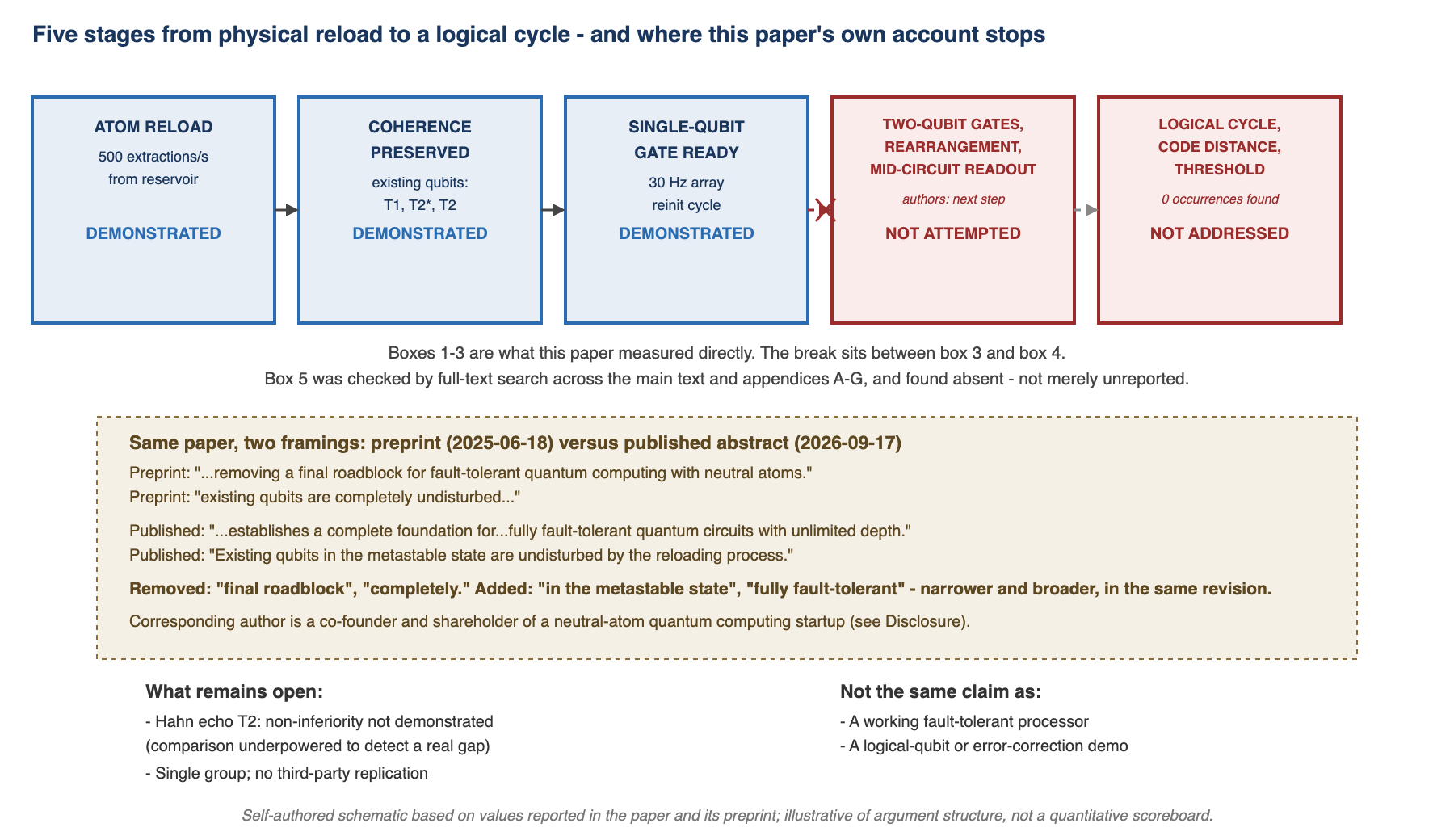
- So what. This is a laboratory subsystem demonstration, not a fault-tolerant quantum computing demonstration. The word “coherent” in the paper’s framing refers to the qubits already stored in the array, not to any property of the newly loaded atoms. Two-qubit gates, array rearrangement, and mid-circuit measurement — the operations that would actually connect a freshly reloaded atom to an ongoing computation — are not attempted here; the authors themselves describe these as separate additions still needed. We searched the full available text, including appendices, for any mention of a logical qubit, code distance, or error-correction threshold: there are none.
- Now what. This is a single-group result with no third-party replication. A contemporaneous preprint from a different set of authors attacks a related but mechanistically different problem — ancilla-qubit reuse in ground-state, rather than metastable-state, 171Yb — which points to atom loss becoming a shared concern across the field rather than to independent confirmation of these specific numbers. We are not moving this into our short list of actively tracked, high-confidence quantum results on the strength of one lab’s paper; we are recording it as the first peer-reviewed evidence point for an entity we had previously tracked only from a single non-peer-reviewed source.
The five-minute read
What “coherent” is actually doing in this title
The mechanism is more specific than the framing suggests. Newly loaded atoms sit in the ground state (1S0) while being cooled and imaged, and the preprint abstract attributes the protection of existing qubits to “the extreme isolation of the metastable qubit from cooling and imaging light” — meaning that light does not interact with atoms already parked in the metastable qubit state (3P0) that are mid-computation. So “coherent reloading” means the reloading process leaves the pre-existing, already-encoded qubits alone; it does not mean the newly arriving atom itself arrives in some useful coherent state relative to the computation. That distinction matters because it is exactly the property a fault-tolerant architecture needs from atom replacement — but it is a narrower claim than the title alone conveys.
Where the demonstrated chain stops
How fast is fast, compared to what
The one direct comparison the paper draws is against a prior approach that also preserved coherence during reloading, using two different atomic species so that one species’ cooling light physically could not touch the other’s qubit. That approach’s characteristic loading time was 90 milliseconds; this paper’s reload takes about 1 millisecond — the paper’s own description is “the characteristic loading time of 90 ms is considerably longer than typical gates and measurements”, and elsewhere calls the improvement nearly two orders of magnitude. But raw reload speed is not new by itself: separate groups had already reached comparable millisecond-scale continuous loading without preserving coherence at all. What this paper adds is the combination — comparable speed, achieved for the first time alongside a coherence-preservation guarantee, using a single atomic species split across two internal states (ground and metastable) rather than two different species. That is a narrower and more accurate description of the advance than “reload speed” alone.
Deep dive
1. Background: the one link neutral-atom fault tolerance still needs
Neutral-atom arrays held in optical tweezers are one of several hardware platforms being pursued for large-scale, fault-tolerant quantum computing, alongside superconducting circuits, trapped ions, and photonics. A recurring practical problem in this platform is atom loss: individual atoms escape their traps during long computations, and every lost atom has to be replaced before the array can keep running at full size. If replacement is slow, it caps how deep a quantum circuit can run before the array degrades — a real constraint on any architecture that wants circuits of, in principle, unlimited depth. Prior approaches to solving this either preserved coherence (protected the qubits already computing) at the cost of slow reloading, or reloaded quickly but without protecting coherence. This paper reports doing both in the same experiment, using a single atomic species, ytterbium-171, exploiting the large physical separation between its ground electronic state and a long-lived metastable state that can serve as a qubit.
2. What this paper newly shows
The measured results, as reported: atoms are extracted from a reservoir into optical tweezers at up to 500 per second, with no observed depletion of reservoir density even at the maximum extraction rate reported (about 7.3 × 10⁴ atoms per second). A full array reinitialization cycle — single-atom preparation, non-destructive imaging, cooling, and reinitialization into the metastable qubit state — runs at 30 times per second (up to 50 times per second when reusing a non-destructive measurement). Readout accuracy is reported as 96.44(13)% including atom loss and 99.27(10)% excluding it; the paper states directly, “The probability to record the correct outcome is 0.9644(13), which rises to 0.9927(10) when not including loss.” The central claim, however, is about the qubits not being reloaded: comparing a reload-in-progress condition against a no-reload control, lifetime (T1), Ramsey coherence time (T2*), and Hahn echo coherence time (T2) were reported as consistent between the two conditions (with the Hahn echo caveat below), attributed to the frequency isolation between the cooling/imaging light used on new atoms and the metastable state the existing qubits occupy.
3. Methodological strengths and limits
The strength of this result is that it is a single, integrated measurement rather than two separate claims stitched together: the same apparatus, in the same run, shows fast reload and undisturbed existing qubits at once. That is a meaningfully harder thing to demonstrate than either property alone, and it is why we treat the coherence-preservation numbers as the paper’s real contribution rather than the raw reload rate.
Two limits deserve equal weight. First, on the numbers themselves: reload-condition versus control T1 was 1.35(4) s versus 1.30(3) s, Ramsey T2* was 0.73(2) s versus 0.69(2) s — both consistent, with the reload condition if anything nominally higher. Hahn echo T2, however, was 5.4(9) s versus 7(1) s: the reload-condition point estimate is about 23% lower, with uncertainties of roughly plus-or-minus 17% and 14% respectively. Overlapping confidence intervals here mean the comparison lacked the statistical power to rule out a real difference of that size — not that the paper positively demonstrated equivalence. We describe this specific comparison as non-inferiority not demonstrated, rather than as a confirmed null result, and note that it is one of three coherence metrics reported, with the other two showing no such asymmetry.
Second, on framing: the paper’s June 2025 preprint stated the work was “…removing a final roadblock for fault-tolerant quantum computing with neutral atoms” and that existing qubits were “completely undisturbed.” The peer-reviewed published abstract, from September 2026, removes both “final roadblock” and “completely,” while adding a qualifier — the published sentence reads, in full, “Existing qubits in the metastable state are undisturbed by the reloading process.” — and separately introduces new language elsewhere describing “…establishes a complete foundation for the implementation of fast, fully fault-tolerant quantum circuits with unlimited depth.” In other words, one promotional phrase was narrowed out while another, broader one was added in, in the same revision. We read the corresponding author’s dual role — academic researcher and, per the paper’s own disclosure, co-founder and shareholder of a company commercializing neutral-atom hardware — as relevant context for why the framing bears watching, though the underlying measurements themselves passed peer review and were independently re-checked against both the preprint and the published abstract text for this review, with no numerical discrepancies found between the two versions.
4. Connections to neighboring domains
This result is a fresh instance of a pattern that shows up across quantum hardware platforms generally: headline milestones and the actual operating metrics that would make a fault-tolerant machine run are often reported as though they were the same layer, when they are not. The recurring lesson is that a milestone in one operating layer (in this case, physically replacing a lost qubit resource) does not automatically translate into progress at the layer that matters for a running fault-tolerant computation (logical cycles, code distance, and error-correction overhead).
A looser, illustrative parallel: the shift from a static, batch-loaded array to a continuously replenished reservoir architecture has a structural resemblance to how continuous (perfusion) processes in other fields replace batch processing to avoid throughput and steady-state limitations. We flag this only as an illustrative analogy, not a quantitative claim; we are not aware of any direct engineering transfer between the two.
5. The dissenting view: is atom loss even the main bottleneck?
The paper’s own framing — atom loss limits circuit depth, so faster replacement matters — has a serious counterargument, one the paper itself partly acknowledges. A substantial body of prior work in this field treats loss and leakage errors as comparatively easy to handle, precisely because they can be detected (heralded): a decoder that knows where an atom is missing needs less code distance to correct for it than for an undetected error. The paper states this directly: “the bias towards leakage and loss is in fact, preferable, as it results in lower error correction overhead.” If that view is right, the harder, unsolved problem for this hardware platform is not how fast a missing atom gets replaced, but how low the undetected error rate is on the operations that remain — principally two-qubit gate fidelity and measurement fidelity, neither of which this paper reports improving. The best published two-qubit gate fidelities and Rydberg-gate results in this same research area come from separate work not addressed here. We do not take a position on which bottleneck is more important in an absolute sense — loss and undetected Pauli-type errors are different failure modes that do not substitute for one another: slow loss replacement caps circuit depth directly, while poor gate fidelity accumulates logical error regardless of depth. This paper addresses the first problem. It does not address, or claim to address, the second.
6. Commercialization layer: TRL and companies
We assess two separate maturity levels here, because the reload subsystem and a complete fault-tolerant processor are not the same thing to rate. The reload-plus-coherence-preservation subsystem, demonstrated together in one apparatus, sits at roughly TRL 4: laboratory validation of an integrated subsystem. A complete processor incorporating this subsystem — with two-qubit gates, rearrangement, and mid-circuit measurement folded in, and connected to an actual logical-qubit error-correction cycle — remains at a lower system-level maturity, since none of that integration has been demonstrated. We would put a rough commercialization horizon for the integrated system, contingent on that integration succeeding, in the range of several years, a structural estimate rather than one drawn from the paper.
On companies, stated as fact and not as investment guidance: the corresponding author is a co-founder and shareholder of Logiqal, Inc., a privately held startup building neutral-atom quantum hardware, which by its own public materials treats this general line of work as directly relevant to its commercialization plans. Other neutral-atom hardware companies — including QuEra Computing and Atom Computing — are not authors on this paper and have no identified financial relationship to it. A separate preprint on a related but different atom-loss mitigation approach (ancilla reuse in ground-state, rather than metastable-state, qubits), authored by Muniz and colleagues, is cited in this paper’s discussion section as a brief note, not as replication of these results. No listed security is directly implicated by this specific paper; companies pursuing other quantum hardware modalities (trapped-ion, photonic) are a different technical layer entirely and are not discussed here as comparators.
7. What to watch
- Third-party replication. This result comes from a single research group. Independent reproduction of the coherence-preservation numbers, ideally in a different lab, would be the strongest confirmation available.
- Integration with two-qubit gates, rearrangement, and mid-circuit measurement. The authors describe these as necessary next additions. Whether coherence preservation survives once those operations are layered in, rather than measured in isolation, is the open question that actually bears on fault tolerance.
- Any future report connecting this reload rate to an actual logical-qubit error-correction cycle. Until a paper states how often atom replacement is needed per logical cycle, and what fraction of cycle time that consumes, the 30 Hz figure here has no established relationship to fault-tolerant performance.
- Whether the ancilla-reuse approach in the Muniz et al. preprint and this reservoir-reload approach converge, diverge, or are adopted by different parts of the field — two different technical solutions to a related problem, not two measurements of the same thing.
References
- Li, Yiyi, Yicheng Bao, Michael Peper, Chenyuan Li, and Jeff D. Thompson. 2026. “Fast, Continuous, and Coherent Atom Reloading in a Neutral-Atom Qubit Array.” Science 393 (6817): 1213–1216. DOI 10.1126/science.adz9952. PMID 42752129. Published version not open access; abstract read directly.
- Li, Yiyi, Yicheng Bao, Michael Peper, Chenyuan Li, and Jeff D. Thompson. 2025. “Fast, Continuous and Coherent Atom Replacement in a Neutral Atom Qubit Array.” Preprint, arXiv 2506.15633 (v1, 2025-06-18). Full text read directly.
- Muniz, J. A., D. Crow, H. Kim, et al. 2025. “Repeated Ancilla Reuse for Logical Computation on a Neutral Atom Quantum Computer.” Preprint, arXiv 2506.09936. Cited in the reviewed paper as a related, mechanistically distinct approach; not read in full by this review.
- Singh, K., et al. 2023. “Mid-Circuit Correction of Correlated Phase Errors Using an Array of Spectator Qubits.” Science 380: 1265–1269. DOI 10.1126/science.ade5337. Cited in the reviewed paper as the dual-species, coherence-preserving comparator.
- Gyger, Flavien, et al. 2024. “Continuous Operation of Large-Scale Atom Arrays in Optical Lattices.” Physical Review Research 6: 033104. DOI 10.1103/PhysRevResearch.6.033104.
- Norcia, M. A., et al. 2024. “Iterative Assembly of 171Yb Atom Arrays with Cavity-Enhanced Optical Lattices.” PRX Quantum 5: 030316. DOI 10.1103/PRXQuantum.5.030316.
- Peper, Michael, et al. 2025. “Spectroscopy and Modeling of 171Yb Rydberg States for High-Fidelity Two-Qubit Gates.” Physical Review X 15: 011009. DOI 10.1103/PhysRevX.15.011009.
- Evered, Simon J., et al. 2023. “High-Fidelity Parallel Entangling Gates on a Neutral-Atom Quantum Computer.” Nature 622: 268–272. DOI 10.1038/s41586-023-06481-y.
Bibliographic details (authors, titles, volumes, pages, DOIs) were checked against Crossref, arXiv and Europe PMC on 2026-09-27.
Disclosure
This post is for information only and is not investment advice.
COI note: the corresponding author of the paper covered here, Jeff D. Thompson (Princeton University), is disclosed in the paper’s own competing-interests section as a co-founder and shareholder of Logiqal, Inc., a privately held company developing neutral-atom quantum computing hardware. Logiqal’s own public materials describe neutral-atom and erasure-conversion-based architectures, of the general kind this paper’s results relate to, as central to its commercialization plans. The quantitative measurements in this post (reload rates, coherence times, readout accuracy) passed peer review at Science and were independently checked by this review against both the paper’s published abstract and its preprint; we found no numerical discrepancies between the two versions. Interpretive framing — specifically, phrases describing the work as removing a “final roadblock” for fault-tolerant quantum computing — is attributed in this post to the author’s preprint, not to the published, peer-reviewed abstract, which does not contain that phrase. This post makes no claim, positive or negative, about Logiqal’s commercial prospects; Logiqal is privately held and no listed security is discussed in this post. QuEra Computing and Atom Computing are named in this post only in factual, descriptive contexts (as other neutral-atom or quantum-hardware companies); none has an identified financial relationship to the paper covered here.
Position: the author holds no position in, and has no financial interest in, any company named in this post.


Leave a comment