Few-Shot Enhancer Design with Evo 2 (bioRxiv Preprint): Seven of Nine Designs Showed Expression in Mouse Cortex, Two Matched the Intended Cell Type (Small Proof of Concept, Not Peer Reviewed)
Analysis based on information available as of 2026-11-09.
30-second summary
- What: A bioRxiv preprint (posted 2026-10-30, revised 2026-11-04; ten authors; corresponding author Brian L. Hie, Stanford University and Arc Institute) reports that giving the genomic language model Evo 2 a few dozen example enhancer sequences as a prompt (in-context learning) yields new cell-type-specific regulatory DNA, and that reinforcement-learning post-training on a predictive model’s score improves the output. This is a preprint, not peer reviewed, and a small proof of concept: nine designed enhancers were tested in one mouse cortical cell type, seven drove detectable expression, and two matched the intended target (layer 5 extratelencephalic neurons, L5-ET), with two mice per designed enhancer. It is not a demonstration of a therapeutic promoter or an AAV product.
- So what: The figures “73%” and “95%” are not design success rates. They are the fractions of YFP-positive cells that were assigned to L5-ET for two designs (EvoCre6 and EvoCre7), against 68% for a natural enhancer; the numbers of cells and sections behind them are not available to us. The “30-fold” gain is the yield of sequences passing a predicted-specificity filter, not a measured-activity gain. All comparisons with DNA-Diffusion and regLM are in silico, so no external design method was compared in the wet lab. The abstract’s phrase “stronger activity than existing enhancers” is not quantified. All quantitative claims are the authors’ and have not been replicated independently.
- Now what: Read this as evidence that example-prompted generation plus a predictor-based reward can produce enhancers with measurable cell-type bias. It is not evidence that the method outperforms established design approaches. Watch for the supplementary data (cell and section counts, MPRA activity rates), a wet-lab head-to-head with other design methods, independent replication and the peer-reviewed version. TRL: 3.
5-minute read
What the authors did
Evo 2 is a publicly described autoregressive genomic language model; the authors work with the 7-billion-parameter version. In the first step the model receives a few dozen enhancer sequences active in a target cell type, written into the prompt, and then generates new sequences without any weight update. In the second step the authors post-train the model with a reinforcement-learning method (GRPO), rewarding sequences that a separate sequence-to-function predictor scores as specific to the target cell type. For human cell lines the predictor is Malinois; for the mouse experiments the reward is built on AlphaGenome, with cCRE and cell-type specificity terms.
What the results say
In human cell lines (K562, HepG2 and SK-N-SH), up to 40 designs per condition were tested by massively parallel reporter assay (MPRA), together with six natural and six synthetic top-specificity enhancers per cell line as positive controls. The authors report a mean Pearson correlation of 0.93 between two independent transfections and a mean r of 0.76 between Malinois predictions and measured activity. In several conditions the post-trained model produced sequences with higher measured specificity than base Evo 2. The comparison in the wet lab is therefore between base and post-trained Evo 2 and the controls. DNA-Diffusion and regLM were compared only in silico, using Malinois-predicted specificity and diversity. The preprint describes the yield gain from reinforcement learning as an increase “in the yield of sequences passing the predicted-specificity filter” of 30-fold. That is a computational filter pass rate and not a measured-activity gain.
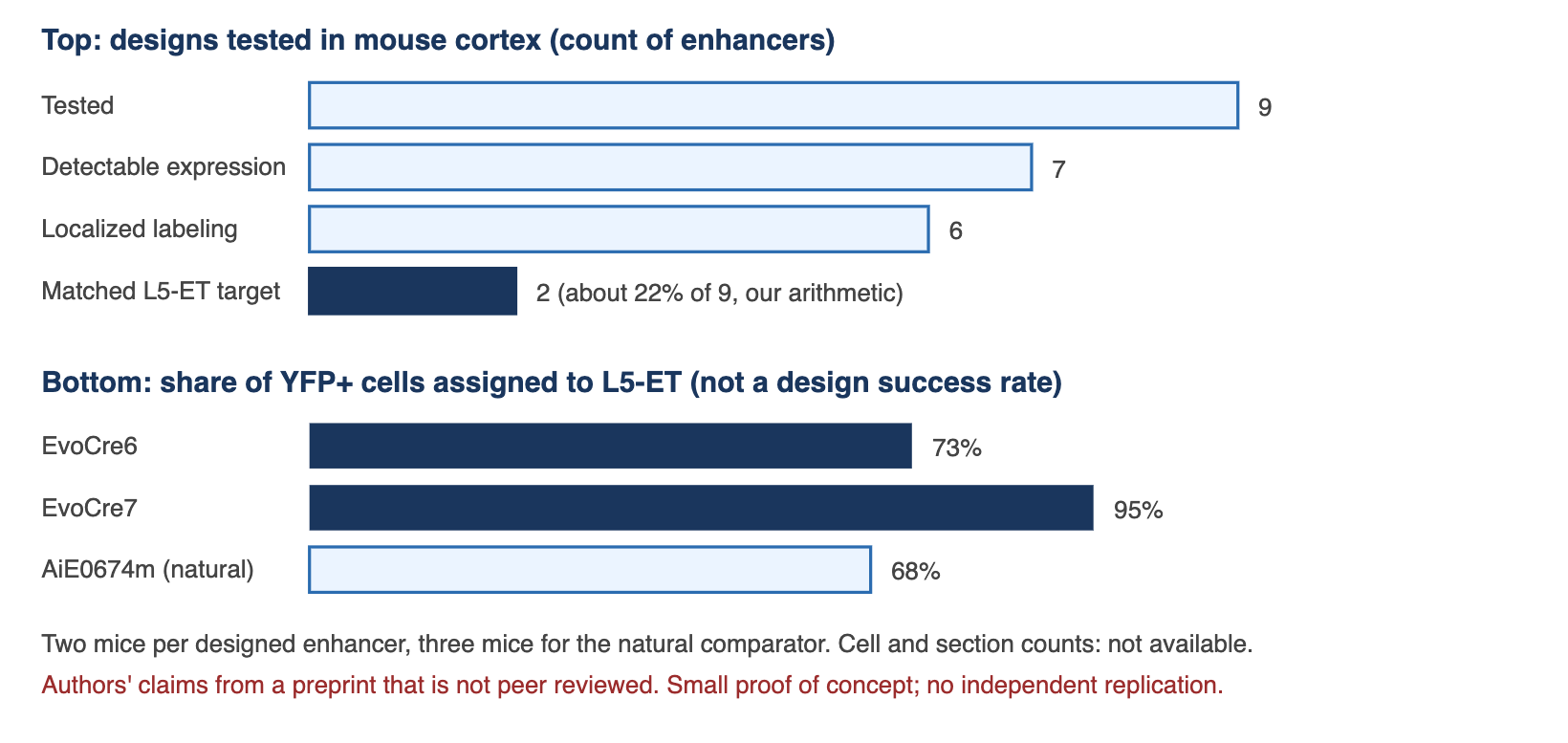
In mouse cortex, the authors packaged designed enhancers in AAV vectors driving a Cre reporter (EvoCre1 onward). They write that “Seven of the nine EvoCres tested drove detectable expression” and that six produced spatially localized labeling. Two designs, EvoCre6 and EvoCre7, labeled a pattern consistent with the intended L5-ET neurons, and 73% and 95% of YFP-positive cells were assigned to L5-ET, compared with 68% for the natural enhancer AiE0674m. The 5-point difference between EvoCre6 and the natural enhancer has no stated cell count or statistical test that we could find.
How far to take it
The defensible reading is narrow. Example-prompted generation, with a predictor-based reward, produced enhancers with cell-type bias in cell lines and in one cortical cell type. Whether the approach beats supervised generative baselines in measured activity is not tested in the wet lab. The abstract’s claim of “stronger activity than existing enhancers” rests on a dose-matched fluorescence description for a single design and is not quantified.
Deep dive
1. Background
Cell-type-specific enhancers matter because they decide where a transgene is expressed, which is relevant to gene-therapy vectors, to tools for neuroscience and to synthetic biology. Design methods range from sequence-to-function predictors used for in silico optimisation (for example gradient-based or in silico mutagenesis approaches), to supervised generative models trained on one cell type (regLM, DNA-Diffusion), to large language models trained on genomes. Evo 2 belongs to the last group. The question the preprint addresses is whether such a model, which was not trained for enhancer design, can be steered with a short list of examples, as large language models are steered in text, and whether a predictor-derived reward improves that behaviour.
Two features of the problem shape how to read the data. First, the predictors that supply rewards and filters (Malinois, AlphaGenome, Borzoi, Enformer) are themselves trained on measured regulatory data, so some of the evaluation is only partly independent of the optimisation. Second, in a design screen the fraction of candidates that work depends on the filter and on the activity threshold, so the denominators matter.
2. What this study newly establishes
The text below is based on our own reading of the bioRxiv full-text HTML for version 2 (the PDF could not be read directly; supplementary files were not read).
- In-context learning (ICL) for regulatory DNA. The authors state that prompting Evo 2 with a few dozen examples produces new, diverse enhancer sequences without additional training. Sequences were filtered for novelty against natural sequences (a BLAST and sequence-identity filter, as we read it), so the meaning of “new” is limited to that filter.
- Reinforcement-learning post-training. Post-training on predictor-based rewards raised the share of generated sequences passing a predicted-specificity filter by 30-fold. The filter classifies a sequence as specific if its predicted on-target score exceeds 4.0. This is a prediction-based criterion.
- Cell-line MPRA. Measured specificity was higher for the post-trained model than for base Evo 2 in several conditions (natural prompts in K562 and HepG2; synthetic prompts in HepG2 and SK-N-SH). SK-N-SH was held out of post-training. In the held-out line with natural prompts, the measured difference is not significant, according to the summary we read. Among the top six post-trained designs, the number that beat the controls was three of six conditions, and the remaining three conditions showed no significant difference (Student’s t-test, as relayed by the summarising tool we used for part of the text). We did not find a measured-activity hit rate or an activity threshold for the cell-line designs in the text; this may sit in the supplementary material, which we did not read.
- Mouse cortex. Seven of nine designs drove detectable expression, six gave localized labeling, and two matched L5-ET. The designed enhancers were infected into two mice each; the natural comparator was assessed “across three mice” according to the figure legend. The preprint states that EvoCre6 gave higher fluorescence than AiE0674m at the same viral dose (no quantification or test that we could find).
- Mechanism. In a 1-billion-parameter model, zeroing one attention head (L3H6), a candidate induction head, reduced Malinois-predicted enhancer activity (Benjamini-Hochberg adjusted p = 0.023 for 4-shot and 0.040 for 8-shot prompts), whereas a random head in the same layer (L3H7) served as a control. These values come from our summarising tool; the authors state that the mechanism is not fully resolved.
3. Strengths and limitations of the method
Strengths.
- The readout is experimental. MPRA in three cell lines and AAV expression in mouse cortex are external measurements, not purely computational scores.
- The cell-line assay shows high technical reproducibility (mean Pearson 0.93 between independent transfections, as reported).
- Several controls are described: a held-out cell line (SK-N-SH), a post-training control on random DNA (no functional design signal), a random-head ablation control and a chromosome split for the AlphaGenome-based classifier.
- The authors released code (github.com/evo-design/ICL_regulatory).
Limitations.
- No external wet-lab baseline. Wet-lab comparisons in the cell lines are between base and post-trained Evo 2 plus natural and synthetic positive controls. DNA-Diffusion and regLM are compared only in silico (on Malinois-predicted specificity and diversity), and FastSeqProp and in silico mutagenesis only in silico for the mouse designs. In those in silico comparisons the authors describe base Evo 2 as broadly comparable with the baselines. On measured activity, the preprint does not show that this approach outperforms existing design methods.
- Filter yield is not activity. The 30-fold figure is a predicted-specificity pass rate, as the authors write.
- Partial circularity. The cell-line pipeline rewards Malinois-predicted specificity and then filters candidates with a predictor of the same family before testing. The mouse pipeline rewards with AlphaGenome and selects with a separate Borzoi and Enformer ensemble, which the authors describe as an independent mechanism; all of these models are fine-tuned on related chromatin accessibility data, so the independence is partial (our reading). The MPRA measurement is an independent check, but the pass rate is not independent of the reward model.
- Small in vivo sample. Nine designs, two mice per designed enhancer versus three mice for the natural enhancer, two designs matching the target. No cell or section counts, and no statistical test, were found in the text. The rule used to choose which designs were tested (the labels run up to EvoCre11 while nine were tested) is not stated in the text we read.
- Denominator of 73% and 95% is unavailable. Without the number of YFP-positive cells, the number of sections and the classification pipeline, the 5-point difference between 73% and 68% cannot be interpreted.
- Cell-line hit rates are not reported in the text we read. The text we could access gives no fraction of designs with measured activity and no measured-activity threshold. The only threshold we found is the in silico one (predicted on-target score above 4.0). We did not read the supplementary files, so this absence is not confirmed.
- Possible overlap with pretraining data. We found no statement about overlap between the Evo 2 pretraining corpus and the prompt or evaluation sequences. Whether natural human enhancers were in the pretraining data is not addressed in the text we read.
- Data access. The authors state that “All source data will be made available from the corresponding authors upon request.”
- Version change. The author order differs between version 1 (2026-10-30) and version 2 (2026-11-04), with the corresponding author moving from first to last; the author count stays at ten. We did not compare claims between versions beyond noting that the abstract text appears the same.
4. Connections to neighboring domains
Gene-therapy vectors. A cell-type-specific enhancer is a component that sets where an AAV-delivered payload is expressed, and the paper tests designs in AAV in mouse cortex. The evidence covers one cell type and nine candidates. Any link to delivery specificity or toxicity in a therapeutic setting is a hypothesis and not shown by this paper.
Language-model interpretability. The authors use head ablation, a tool from interpretability work on text models, to probe ICL in a DNA model. The effect sizes are modest (adjusted p of 0.023 and 0.040) and the authors say the mechanism is not fully resolved, so this connection is suggestive and not established.
Other regulatory elements. Prompting with examples plus a predictor reward could in principle be applied to promoters, UTRs or splicing elements. The preprint tests enhancers only; this extension is our hypothesis.
5. Commercialization and investment perspective
TRL: 3. Cell-line and mouse proof of concept. We found no evidence of therapeutic-grade or product-stage development.
Timeline. No basis for a commercialization timeline; unverified.
Related companies (facts only). The corresponding author declares an outside interest in two privately held companies, Arpelos Biosciences and Genyro Inc., as a scientific co-founder (see Disclosure). The relationship, if any, between those companies and this work is not stated in the text we read. Evo 2 is a model from Arc Institute, a nonprofit research institute. We found no listed company directly connected to the study.
Availability. Code for the in-context and post-training scripts is on GitHub (evo-design/ICL_regulatory); we did not confirm its license. We did not find a statement that post-trained weights are released. Source data are available on request.
6. Counterarguments
- “Seven of nine” is detectable expression, not target specificity. Two of nine designs (about 22%, our arithmetic) matched the intended L5-ET pattern.
- 73% and 95% are cell-assignment fractions. They describe YFP-positive cells, not the probability that a design works. The natural comparator scored 68% in the authors’ own panel, and no cell counts or test are given for the difference.
- “30-fold” is a predicted-filter yield. The authors define it that way. It does not report a 30-fold gain in measured activity.
- The comparison set is narrow. DNA-Diffusion and regLM appear only in silico. A claim that the approach is better than existing design methods is not supported by measured data in this preprint.
- “Stronger activity than existing enhancers” is unquantified. The abstract’s phrase rests on a fluorescence description for one design at one viral dose.
- Reward and filter overlap. The predictors that supplied rewards and filters are related, so the pass rates should be read as partly self-referential, with MPRA and tissue data as the independent checks.
- Weak mechanistic evidence. The induction-head result depends on ablation effects with adjusted p-values of 0.02 to 0.04, and the authors do not claim a complete mechanism.
- Preprint and no replication. All headline numbers are the authors’ claims; the work is not peer reviewed and no independent group has replicated it.
7. Indicators to watch
- Supplementary material: number of YFP-positive cells and sections behind 73%, 95% and 68%, and the classification pipeline.
- Per-condition counts of designs with measured MPRA activity and the activity threshold used.
- A wet-lab head-to-head against regLM, DNA-Diffusion or other design methods at the same testing budget.
- Larger in vivo tests: more animals, more designs, more cell types, with statistics.
- Independent replication by groups outside the authors’ network using the released code.
- Changes between this preprint and a peer-reviewed version, particularly to the abstract’s “stronger activity” statement.
- Any disclosed license or collaboration between the authors’ institutions and the companies named in the competing-interests statement.
References
- Hao, et al. 2026. “Few-shot regulatory sequence design with a genomic language model.” bioRxiv, version 2, 4 November 2026 (first posted 30 October 2026; not peer reviewed). DOI: 10.64898/2026.10.28.762639. https://www.biorxiv.org/content/10.64898/2026.10.28.762639v2. Corresponding author Brian L. Hie. This is the source of all counts and quotations in this post.
- Other works named in the text (Evo 2, Malinois, AlphaGenome, Borzoi, Enformer, regLM, DNA-Diffusion, FastSeqProp) are mentioned as context. Their bibliographic details were not verified for this post, so they are not itemised.
Disclosure
- This article is for informational purposes only and is not investment advice.
- The author holds no position in any company named in this post.
- Competing interests (as stated in the preprint): the preprint states “B.L.H. acknowledges outside interest in Arpelos Biosciences and Genyro Inc. as a scientific co-founder” and “No other competing interest declared.” B.L.H. is the corresponding author (Stanford University and Arc Institute). Both companies are privately held. The text we read does not describe any relationship between those companies and this study.
- Funding (acknowledgements, as we read them): Silicon Valley Community Foundation (direct support for the project), Gates Foundation, an NIH Director’s New Innovator Award (award 1DP2CA325377-01 in Crossref), ARPA-H, Arc Institute, Schmidt Sciences AI2050, Stanford Center for Digital Health and Stanford HAI. We found no listed-company funder.
- Attribution of claims: all headline quantitative claims (seven of nine, 73% and 95%, 30-fold) are claims by the authors of a preprint that is not peer reviewed and have not been replicated independently. Percentages marked “our arithmetic” are our own calculation.
- Access: the preprint is open access. We read the full-text HTML of version 2, in part through a summarising tool, and re-checked the decisive sentences against the text. We did not read the PDF or the supplementary files, so statements that something is absent from the text are limited to what we read. The Arc Institute press page was not read.
- The figure in this article is an original drawing; no figure from the source was reproduced.


Leave a Reply