Entangled Logical Qubits on an IBM-Owned 120-Qubit Device: A University of Sydney-Led Preprint, with Post-Selection and Defective-Component Exclusion (Clifford Operations Only)
Analysis based on information available as of 2026-11-03.
30-second summary
- What: A six-author arXiv preprint (v1, 2026-10-23, not peer reviewed) reports surface-code logical qubits (code distance 3 and 5), a lattice-surgery logical Bell pair, and a three-logical-qubit teleportation on the superconducting device ibm_phoenix, which the paper describes as an IBM Nighthawk revision 2 chip. Five of the six authors are at the University of Sydney; one, Benjamin J. Brown, is at IBM Quantum and IBM Denmark. The device is IBM’s; the study is not an IBM-only result.
- So what: The headline numbers carry conditions. The logical error per round below 1% is the value after excluding poorly performing components (distance 5: 1.9% before, 0.9% after). The logical Bell fidelity above 93% was estimated from two measurement bases (XX and ZZ) on data kept only if the code was prepared cleanly (yield 40% +/- 2%). This is a device-level proof of concept with post-selection and defect exclusion, limited to Clifford operations, at most three logical qubits and two entangled ones. It is not a demonstration of fault-tolerant computing.
- Now what: Read it as an engineering data point on a commercially accessible device, not as a ranking of vendors. TRL 3. Watch for results without post-selection, non-Clifford operations, reproduction on other chips and days, and the peer-reviewed version.
5-minute read
What was done, and by whom
The preprint implements a rotated surface code, an error-correcting code that spreads one logical qubit over a patch of physical qubits, on a 120-qubit superconducting square lattice with fast qubit reset. The authors build logical qubits at code distance 3 and 5, join two of them by lattice surgery (a way of entangling code patches by temporarily merging them) to make a logical Bell pair, teleport states among three logical qubits, and run a separate stability experiment. Decoding uses BeliefMatching with a noise model estimated on the device.
Attribution matters here. The research group is mostly academic: five of six authors list the School of Physics at the University of Sydney, and one lists IBM Quantum (T. J. Watson Research Center) and IBM Denmark. The work is funded by the US IARPA Entangled Logical Qubits programme (cooperative agreement W911NF-23-2-0223). The paper calls ibm_phoenix a “commercially accessible device”; how the authors obtained access (collaboration or paid use) is not stated in the text we read.
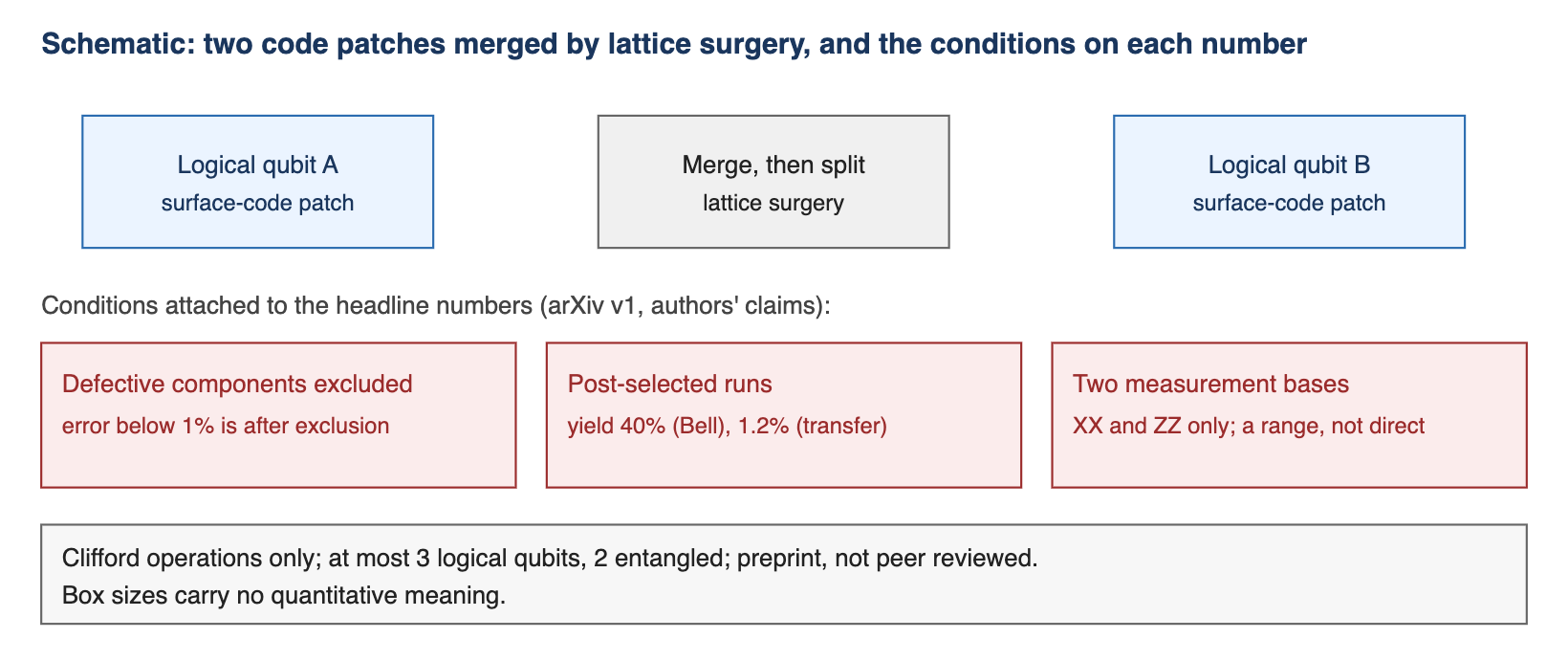
What the numbers say, and what they do not
Four values are easy to conflate, and they measure different things. (1) Logical error per round below 1%: for distance 5 the authors report that removing up to three qubits (ancilla re-purposing) halves the error from 1.9% to 0.9%; our review of the full text also found that distance-3 values before exclusion were roughly 1% to 2.6% depending on the patch location, so the below-1% figure is a post-exclusion value for both distances. (2) Logical Bell fidelity above 93%: estimated from XX and ZZ expectation values only, reported as upper and lower bounds; the Y-basis readout error was too large to use. The abstract and text say “above 93%”, and the figure caption describes upper and lower bounds without saying which one the quoted 93% is; the plotted values themselves were not read, so we treat the value as unsettled. (3) Post-selection yield: 40% +/- 2% for the Bell experiment and 1.2% for the Bell-pair transfer. On average that means roughly 2.5 and roughly 83 attempts per kept shot (1 divided by the yield; our arithmetic). (4) A stability-experiment figure of about 2×10⁻⁷, a time-boundary metric, not the error per round of a logical qubit. Reading it next to a roughly 1% per-round figure would overstate the result by a factor of about 50,000.
The paper reports no comparison of logical against physical error rates and does not claim to cross that threshold.
Deep dive
1. Background
Quantum error correction encodes one logical qubit in many physical qubits so that errors can be detected and corrected. The surface code is the most widely pursued scheme on superconducting hardware because it needs only nearest-neighbour interactions on a 2D lattice. Lattice surgery performs two-logical-qubit operations by merging and splitting code patches, and is the standard route to logical entanglement in this scheme. Operations of this kind (Clifford operations) are not sufficient for universal computing; non-Clifford operations, for example via magic states, are also needed.
The device is ibm_phoenix, which the authors describe as IBM Nighthawk revision 2, with 120 qubits on a square lattice and fast reset. Fast reset is relevant because leakage out of the computational states is a known limit on logical performance and the authors use reset to mitigate it.
2. What this study newly establishes
- Distance-3 and distance-5 logical memory with component exclusion. The authors report that removing a single ancilla in each distance-3 patch improved performance, and that removing up to three qubits in the distance-5 code halved the logical error per round, from 1.9% to 0.9%. The error rate was fitted over 50 syndrome-extraction rounds; the authors note that a short fit window can underestimate error because of leakage.
- Lattice-surgery logical Bell pair. Runs were kept only if the code was prepared without non-trivial detections (yield 40% +/- 2%). The merged code was 3×6 with 3 rounds and distance 3 maintained. For a Bell-pair transfer the post-selection yield was 1.2% and transfer fidelity 85.4% to 91.4%.
- Three-logical-qubit teleportation. Fidelities of 78% to 93% by state tomography; no process tomography was done.
- Stability experiment. A 4×4 patch over 170 rounds, with 8 failed decodings in 50 million runs, about 2×10⁻⁷ by the authors’ account. A walking circuit (resetting all qubits every second round) was used for this experiment only, not for the logical-qubit experiments.
The preprint states its own scope: logical qubits number at most three, entanglement involves two, and non-Clifford operations and industrially relevant problem sizes are left for the future. Whether any individual milestone here is a first is not something we verified, and we make no such claim.
3. Strengths and limitations of the method
Strengths.
- It uses a device that the authors describe as commercially accessible, which in principle allows others to test it.
- Unfavourable details are in the text: the dependence on post-selection, the 1.2% transfer yield, the use of only two bases, and coupler crosstalk described by the authors as small but significant.
- The diagnosis that individual defective components limit logical performance is practical information: in the distance-3 patches, exclusion of exactly one ancilla improved performance in each case, per the caption we read.
- The decoder is conventional (BeliefMatching for the main experiments, PyMatching for the large stability run), with the noise model estimated on the same device.
Limitations.
- Tuning. The combination of post-selection, component exclusion and noise-informed decoding may be specific to one chip on one set of days. Reproducibility across chips and days is open; this is our inference.
- Bell fidelity. A two-basis range rather than a direct fidelity measurement, with the bound type unresolved in the text (see above).
- Scope. Clifford operations only; small code distance (at most 5); the fraction of the device’s qubits excluded was not reported as far as we could tell.
- Internal inconsistency. The text and a figure caption list the removed qubits differently (55, 62 and 95 versus 62, 55 and 96). This looks like a typographical slip and does not affect the headline values.
- Version. arXiv v1 only, no peer review, no journal reference at the time of writing. Numbers and wording may change.
- Our reading. We read the extracted text of the full arXiv PDF (22 pages), including figure captions and the table in Figure 7. We found no competing-interests, data or code statement. We did not read the plotted values in the figure panels, including the Bell-fidelity figure.
4. Connections to neighboring domains
Materials and fabrication. The authors name individual qubits and coupler defects as limits on logical error suppression. If removing one poor component improves every patch, then device yield and defect distribution set a ceiling on logical performance, which links this paper to materials and process control for superconducting circuits. This is the strongest cross-domain link here.
Machine learning. The noise-informed decoding loop (estimate noise, feed a detector error model to the decoder) is a closed loop, but the decoder is not a learned model. We do not count this as an AI-and-quantum convergence signal.
Research funding. The work is supported by an IARPA programme whose name refers to entangled logical qubits. Government programme milestones are an external influence on research direction; we did not look up the programme’s terms.
5. Commercialization and investment perspective
TRL 3 (our assessment): a device-level proof of concept, Clifford-only, with post-selection. The paper offers no commercialization timeline and we do not infer one; the time to practical fault-tolerant algorithms is unverified.
Related companies (facts only). IBM (NYSE: IBM) owns the device and employs one of the six authors. Other superconducting-platform developers include Google Quantum AI (Alphabet) and Rigetti (listed); we found no direct relationship between Rigetti and this paper. Trapped-ion, neutral-atom and photonic developers such as Quantinuum, QuEra, Atom Computing and PsiQuantum pursue different approaches. We draw no investment inference, and we do not rank platforms.
6. Counterarguments
- The headline depends on conditions. Below 1% per round holds after excluding poor components, and the distance-3 values were also higher before exclusion. A 40% yield means about 2.5 attempts per kept shot and a 1.2% yield about 83. Fidelity read without those costs looks better than the whole procedure’s cost.
- The Bell figure is not fully pinned down. It is a two-basis range, and whether 93% is a bound on the post-selected data is not stated in the text. If it is an upper bound, the “above 93%” framing changes.
- Different quantities. The roughly 2×10⁻⁷ stability value and the roughly 1% logical error per round are not interchangeable; mixing them would inflate the result.
- Authorship and interests. The paper has no competing-interests statement, one author is an IBM employee, and the device belongs to IBM. The preprint’s quantitative claims are therefore the authors’ own and have not been independently reproduced.
- Extrapolation. Going from at most three logical qubits at distance 5 or below to fault-tolerant computing is not claimed by the authors, and it should not be inferred.
Required context: this result is a preprint that has not been peer reviewed. Of six authors, one is at IBM and five are at the University of Sydney. The below-1% logical error per round is the value after poorly performing qubits were taken out of the circuit (1.9% before, at distance 5). The logical Bell fidelity above 93% is a range estimated from two measurement bases on data from runs in which the code was prepared correctly (about 40%). Only Clifford operations were performed; non-Clifford operations and large numbers of logical qubits were not demonstrated.
7. Indicators to watch
- Logical error with no post-selection at increasing code distance, reported as an error-suppression factor.
- Non-Clifford operations, such as magic-state consumption, on the same platform.
- Reproduction on other chips and other days, and the fraction of qubits excluded.
- The peer-reviewed version: whether the Bell-fidelity bound type and post-selection status are stated in text, and whether values change.
- Disclosure of how the authors obtained access to the device, and a competing-interests statement.
- Releases of data and code.
References
- Robin Harper, Xanda C. Kolesnikow, Campbell K. McLauchlan, Georgia M. Nixon, Stephen D. Bartlett and Benjamin J. Brown (six authors, as printed in the PDF; Bartlett is marked as corresponding author). 2026. “Entangled logical qubits on a superconducting quantum processor” (preprint, v1, 23 October 2026). arXiv:2610.32347. https://arxiv.org/abs/2610.32347 (source of all numerical values in this article).
Disclosure
- This article is for informational purposes only and is not investment advice.
- The author holds no position in any company named in this post.
- Conflict-of-interest notes:
- Of the six authors, as read from the arXiv full text, Benjamin J. Brown is affiliated with IBM Quantum (T. J. Watson Research Center) and IBM Denmark; the other five (Harper, Kolesnikow, McLauchlan, Nixon, Bartlett) are affiliated with the School of Physics, University of Sydney. IBM is a listed company (NYSE: IBM). The device, ibm_phoenix, is owned by IBM.
- Funding named in the preprint: the IARPA Entangled Logical Qubits programme, cooperative agreement W911NF-23-2-0223 (three authors listed by initials).
- The preprint text contains no competing-interests statement, as far as we could find. How the authors obtained access to the device is not stated and remains unverified.
- All quantitative claims are the authors’ own from arXiv v1, partly from an author affiliated with the device owner, and have not been independently reproduced or peer reviewed.
- Our reading relied on the text of the full arXiv PDF; the plotted values in the figures were not read. The figure in this article is an original drawing.


Leave a Reply