Designing Proteins from Plain-Language Prompts (Nature): Activity in Each of Four Tasks, With One Active Design Among 29 Tested for GFP and 94 for PETase (Small Wet-Lab Proof of Concept)
Analysis based on information available as of 2026-11-03.
30-second summary
- What: A Nature paper published online on 2026-10-21 (senior author Fajie Yuan, Westlake University; 33 authors) describes Pinal, a roughly 16-billion-parameter model that turns a natural-language description of a protein’s function into a predicted structure and then into an amino acid sequence. The abstract reports that the intended function was observed in each of four tasks. This is a small wet-lab proof of concept: tens of selected candidates per task, a single laboratory team, and no comparison with the best-known enzymes or fluorescent proteins in the text we could read. It is not evidence of industrial enzyme performance, strain-level carbon fixation or a commercial protein product. We could not read the Nature full text (no legal open-access copy exists); all numbers below beyond the abstract come from the bioRxiv preprint, version 9 (2026-09-08). That the preprint and the Nature paper report the same figures is our inference, not a confirmed fact.
- So what: In the preprint, the intended function means that at least one design per task worked. For the fluorescent protein, 1 of 29 tested designs was active; for the PET-degrading enzyme (PETase), 1 of 94. For alcohol dehydrogenase (ADH), 8 designs were selected, 5 were expressed and purified, and all 5 purified designs showed detectable activity. For the metabolic H-protein, 5 of 20 synthesised designs were active, and the best one gave 1.7 times the glycine yield of the native E. coli protein in a reconstituted test-tube reaction (n=3). The computational scores partly rely on a tool (ProTrek) that was also used to build the training data, which the authors acknowledge.
- Now what: Read the headline as “natural language works as an input interface”, not as a statement about output reliability. Watch for the Nature full-text numbers, an independent replication, direct activity comparisons with known enzymes, and a stated license for the model weights. TRL: 3.
5-minute read
What the authors did
Pinal is a two-stage generative model. The first stage (T2struct) reads a text description and writes out a protein structure as a string of discrete structural tokens (Foldseek 3Di alphabet). The second stage (SaProt-T) takes the text and the structural tokens and writes the amino acid sequence. According to the abstract, the model was trained on 1.7 billion synthetically annotated protein-text pairs, and the authors tested four function classes in the laboratory: a fluorescent protein (GFP-like), a PET-degrading enzyme, alcohol dehydrogenase, and the H-protein of the glycine cleavage system, a component of a multi-enzyme CO2-fixation pathway.
What the numbers say
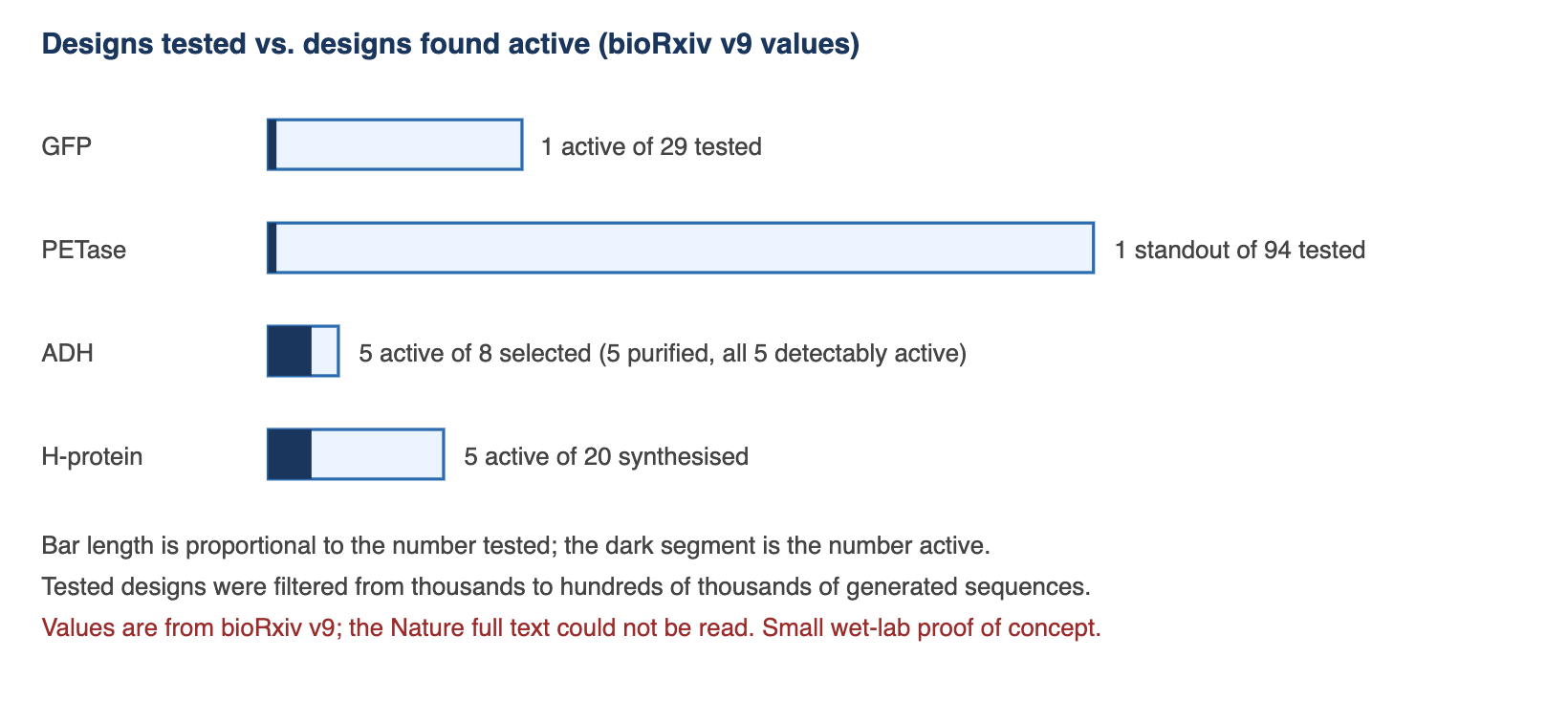
The Nature abstract states that the authors “observed the intended function in each case”, and that the H-protein design reached a 1.7-fold higher yield than the natural protein without iterative experimental optimisation. The abstract is not specific about how many candidates were tested per task. The preprint (version 9) is. Tested designs were selected through a funnel: for GFP, 50,000 generated sequences were filtered to 29 that contain the chromophore residues, and 1 of those 29 was active (named pinalGFP). For PETase, 200,000 were filtered to 2,416 and then to the top 94 ranked by text-protein semantic alignment; 1 of the 94 was a standout (pinalPETase36). For ADH, 8 designs were selected, 5 were expressed and purified, and all 5 purified designs showed detectable ADH activity. For the H-protein, 20 were synthesised, 14 were soluble, and 5 were active. The best H-protein (pinalH02) produced 11.1 mM glycine, 1.7 times the value for the native E. coli H-protein, in a reconstituted multi-enzyme test-tube reaction with three replicates.
Put as per-candidate rates, that is about 3% (1/29) for GFP, about 1% (1/94) for PETase, 5/8 selected for ADH and 5/20 for the H-protein (our arithmetic). The 95% Wilson confidence interval for 1/29 is roughly 0.6% to 17%, and for 1/94 roughly 0.2% to 5.8% (our calculation). The tested numbers are small, so these rates are imprecise.
How far to take it
The paper’s central claim is about an interface: plain language can steer protein generation, and the authors released code and weights. Whether it is more efficient than established routes (directed evolution, or other design models given the same experimental budget) is not addressed in the text we read, and we found no activity comparison against known PETases, ADHs or fluorescent proteins. The computational comparisons with other models rely in part on ProTrek, a scoring tool that was also used to generate and filter the training annotations. In the preprint’s own words, “this metric is not fully independent of the training-data generation procedure.”
Deep dive
1. Background
Protein design models have moved from structure-first methods toward sequence and multi-modal generative models. A common practical limitation is the input: specifying a target through a backbone, a motif or a fitness landscape requires expertise. Text-conditioned design asks for a description such as an enzyme class or a function, and returns candidate sequences. Earlier text-conditioned efforts exist (for example ProteinDT, which the authors use as a comparator), so the question this paper addresses is scale and evidence: whether a larger model trained on a large synthetic annotation set can produce working proteins across several unrelated function classes.
The wet-lab results should be read against how such screens work. A design pipeline generates many sequences, filters them by computational criteria, and tests a small number. The fraction of tested designs that work depends heavily on the filter and on the assay threshold for “active”. That is why the denominators matter.
2. What this study newly establishes
Confirmed against the published abstract (Nature, PMID 42907516). A 16-billion-parameter model, 1.7 billion synthetically annotated protein-text pairs, four tasks with the intended function observed in each case, two enzymes with catalytic activity, and a 1.7-fold H-protein yield over the natural protein. The affiliation list includes Shanghai Zelixir Biotech, Shanghai, China.
From the bioRxiv preprint, version 9 (2026-09-08; Nature full text not read).
- Architecture. A text-to-structure-token stage (T2struct) and a structure-plus-text-to-sequence stage (SaProt-T). The public model card lists T2struct at 15.5B parameters and 1.2B, and SaProt-T at 760M. The “16B” figure appears to be a sum of components, but we could not confirm how it is defined. For each prompt, 50 scaffolds were sampled and re-ranked by combined log-probability.
- Training data and compute. Synthetic annotations are built on UniProt 2023_03, AlphaFold DB and InterPro 101.0. The preprint reports “approximately 50,000 H800 Nvidia GPU hours” for training.
- Per-task counts. As in the figure above and the 5-minute read.
- Novelty of expressed sequences. Of 20 low-similarity designs, 17 (85%) expressed as soluble protein in E. coli; the authors are reported to state that this does not confirm function or structure.
- Computational comparisons. The authors report that, with keyword conditioning, Pinal recovers on average 77% of the keywords versus about 12% for ESM3. The prompt format for the ESM3 baseline was the authors’ choice. A separate benchmark is reported to place Pinal first on 11 of 14 metrics; we could not confirm who ran that benchmark.
- Sequence repetition. The share of sequences with a run of five or more identical residues was 60.2% for an intermediate model and 35.3% for the final model, against 4.0% in UniProt, so the generated distribution remains different from natural proteins on this measure.
3. Strengths and limitations of the method
Strengths.
- Four unrelated function classes were tested experimentally, including two enzymes, and the counts per task are reported in the preprint.
- Inference code and model weights are public, and a web server is available, so other groups can test the model on their own targets.
- The H-protein result is measured against a natural protein (E. coli H-protein) in the same assay, with three replicates.
Limitations.
- Per-candidate activity. Tested numbers are 29, 94, 8 and 20 designs, and activity counts are 1, 1, 5 and 5. “Intended function observed in each case” means at least one active design per task.
- No same-budget wet-lab comparator. In the text we read, the wet-lab controls are native proteins (for the H-protein) and negative controls. We found no experimental comparison with other design models (for example ESM3 or EvoDiff) at an equal testing budget, or with known PETases, ADHs or fluorescent proteins. ADH activity is described as detectable.
- The 1.7-fold figure. It comes from a reconstituted multi-enzyme test-tube reaction, three replicates, one native comparator, and the statistical test is not specified in the text we read. The preprint is inconsistent about the reaction time: the Extended Data Figure 10b legend says the product was measured after a 2 h reaction, and Methods 7.14.1 gives 42 degrees C for 12 h. We cannot tell which is correct.
- Circular evaluation. ProTrek served four roles: generating training annotations, filtering training data, scoring designs in the computational evaluation, and ranking the PETase candidates. The authors state that this metric is “not fully independent” of the data-generation procedure.
- Preprint versus paper. Crossref lists no preprint relationship for the Nature paper. The titles differ. The identification rests on matching model name, parameter count, data size, the four tasks, the 1.7-fold result and the senior author group. The preprint has 9 versions (v1 2024-08-02 to v9 2026-09-08), the last about six weeks before publication. The author list grew from 12 (v1) to 26 (v9) to 33 (Nature). We did not compare earlier versions with the Nature claims.
- What we read. For Nature: the abstract and metadata (Crossref, PubMed, Europe PMC). For bioRxiv v9: most of the full text. We have no access to the Nature Methods, Source Data or data-availability statements.
4. Connections to neighboring domains
Biosecurity. According to the preprint, inference code and weights are released, while the full training corpus and pipeline are available only under confidential access for editorial and peer review, with the stated reason being dual-use concern. The preprint also says the model was not trained or intended for viral protein design. The combination of public weights and function-conditioned generation, with a restricted training pipeline, is a concrete example of how access controls on biological design tools are currently split between artefacts. We did not assess how effective the restriction is.
Synthetic biology and carbon fixation. The H-protein is a component of a multi-enzyme CO2-fixation pathway. The reported 1.7-fold gain is a glycine yield in a reconstituted in vitro reaction. It does not describe flux, growth or carbon capture in an engineered strain, and any energy or carbon-capture application would need separate demonstration.
Materials and plastics recycling. A PET-degrading enzyme is the plastic-recycling hook. The preprint reports activity on a PET film (7 days at 40 degrees C) and a melting temperature of 56.84 +/- 0.29 degrees C for the standout design (summariser-derived values). Activity relative to known PETases was not reported in the text we read, so we treat this link as a hypothesis.
Text-conditioned generation beyond proteins. The architecture (language, then a discrete structural representation, then a sequence) could in principle be applied to other structure-defined materials. We found no direct evidence for this; it is our hypothesis.
5. Commercialization and investment perspective
TRL: 3. This is a laboratory proof of concept with small-scale screening. There is no evidence in the text we read of enzyme process development, scale-up or a product.
Timeline. No basis for a commercialization timeline; unverified.
Related companies (facts only). Two authors are affiliated with Shanghai Zelixir Biotech Co., Ltd., a privately held company: Liangzhen Zheng and Sheng Wang (preprint v9 affiliations; the company appears in the Nature affiliation list). The commercial relationship, if any, between that company and Pinal (investment, license or product) is unverified. The paper declares no competing interests. The model that Pinal is compared with, ESM3, is developed by EvolutionaryScale, also privately held. We found no direct link to any listed company.
Availability. Code is on GitHub (westlake-repl/Denovo-Pinal) under the Apache 2.0 license. Weights are on Hugging Face (westlake-repl/Pinal); the model card we read states no license for the weights. We could not confirm whether training code is public. Running the 15.5B component needs a GPU with 40 GB or more of memory, per the repository.
6. Counterarguments
- “In each case” is literally accurate and depends on the denominator. The preprint reports 1 of 29 (GFP) and 1 of 94 (PETase). The statement that the intended function was observed in each task means that, for each task, at least one of a few dozen to ninety-odd tested candidates worked. We could not check whether the Nature paper reports the same numbers because we could not read it.
- Interface versus reliability. “Programmable” describes the input channel. It does not describe how often an output works. Library screening (thousands to tens of thousands of variants) is the usual route for directed evolution, and this paper does not compare efficiency with it.
- Circular scoring. The computational advantage over ESM3 and other models is measured partly with a score that shaped the training data. The authors acknowledge this. The wet-lab results do not depend on that score, but the PETase candidates were chosen using it.
- The 1.7-fold figure is narrow. One reconstituted reaction, three replicates, one native comparator, and a reaction time reported as both 2 h and 12 h in the preprint.
- Preprint and paper may differ. The numbers here are version 9 values. Whether the Nature paper keeps them is unconfirmed.
- No independent replication. All headline quantitative claims are the authors’. We found no replication by another group.
- Prior art. Text-conditioned protein design predates this paper. What is distinctive is the scale of the synthetic training set, the number of function classes tested and the public release, not the idea of using text.
7. Indicators to watch
- The Nature full text or Source Data: per-task denominators, replicate experiments, the H-protein reaction time and the statistical test behind 1.7-fold.
- Direct activity comparisons with known PETases, ADHs and fluorescent proteins, and wet-lab comparisons with other design models at the same testing budget.
- Independent replication by groups outside the authors’ network, using the public weights.
- Per-candidate activity rates when the same pipeline is applied to new function classes that were not tuned for in the paper.
- A stated license for the model weights, and whether training code is released.
- Any disclosed licensing, investment or product relationship between the authors’ institutions and companies such as Shanghai Zelixir Biotech.
- Evidence for the H-protein in a strain or pathway context rather than in a reconstituted test-tube reaction.
References
- Dai, Fengyuan, et al. 2026. “Programmable design of functional proteins from natural language.” Nature, published online 21 October 2026. DOI: 10.1038/s41586-026-11205-z. https://doi.org/10.1038/s41586-026-11205-z. Senior author Fajie Yuan. Only the abstract and metadata were read.
- Preprint. “Toward De Novo Protein Design from Natural Language.” bioRxiv, version 9, 8 September 2026 (first posted 2 August 2024; not peer reviewed). DOI: 10.1101/2024.08.01.606258. https://doi.org/10.1101/2024.08.01.606258. Author list for this version not itemised here. This is the source of the per-task counts.
- Other works named in the text (ProteinDT, ESM3, EvoDiff, ProTrek, Foldseek) are mentioned as context, and their bibliographic details were not verified, so they are not itemised.
Disclosure
- This article is for informational purposes only and is not investment advice.
- The author holds no position in any company named in this post.
- Access: the Nature paper has no legal open-access copy that we could find, and we did not read its full text. The abstract and metadata come from Crossref, PubMed and Europe PMC. Detailed numbers come from the bioRxiv preprint (version 9), which was read through a summarising tool and re-checked on key values; the numbers cited in the 5-minute read were confirmed against the preprint text. Whether the Nature paper reports the same numbers is our inference.
- Authors and affiliations: 33 authors in the Nature record (26 in preprint version 9). Affiliations include Westlake University, HKUST (Guangzhou), the Shenzhen Institute of Synthetic Biology (Chinese Academy of Sciences), Tianjin Institute of Pharmaceutical Research, one author at the University of Washington, and Shanghai Zelixir Biotech (two entries in the Nature affiliation list), a privately held company. The commercial relationship between that company and Pinal is unverified.
- Competing interests: the Nature record and preprint version 9 state that the authors declare no competing interests. The Nature funding statement was not read; the preprint is reported to cite Chinese national research funding.
- Quantitative claims are the authors’ claims, per-candidate rates and confidence intervals are our arithmetic, and there is no independent replication.
- The figure in this article is an original drawing; no figure from the source was reproduced.


Leave a Reply