Microsoft’s Sequential-Diagnosis AI in Science: A Simulation Benchmark Score, and the Physician Comparison Uses a Different Case Set
Analysis based on information available as of 2026-11-03.
30-second summary
- What: A Science paper (volume 394, issue 6822, published 2026-10-22) by 15 authors, all affiliated with Microsoft, reports a prompt-based orchestrator called MAI-DxO on a benchmark the same group built, SDBench. According to the authors’ abstract, it reached 83.2% on 304 NEJM case records and 80.3% on 325 emergency-department cases, against 36.1% and 46.8% for physicians. This is a text-based, retrospective, offline simulation. It is not a test on real patients, not a prospective clinical deployment, and not evidence of clinical efficacy. I could not open the Science full text (the publisher site returned an access error), so the method details below come from a revised manuscript hosted on an author’s homepage, dated 2025-11-08, which has not been checked against the published text.
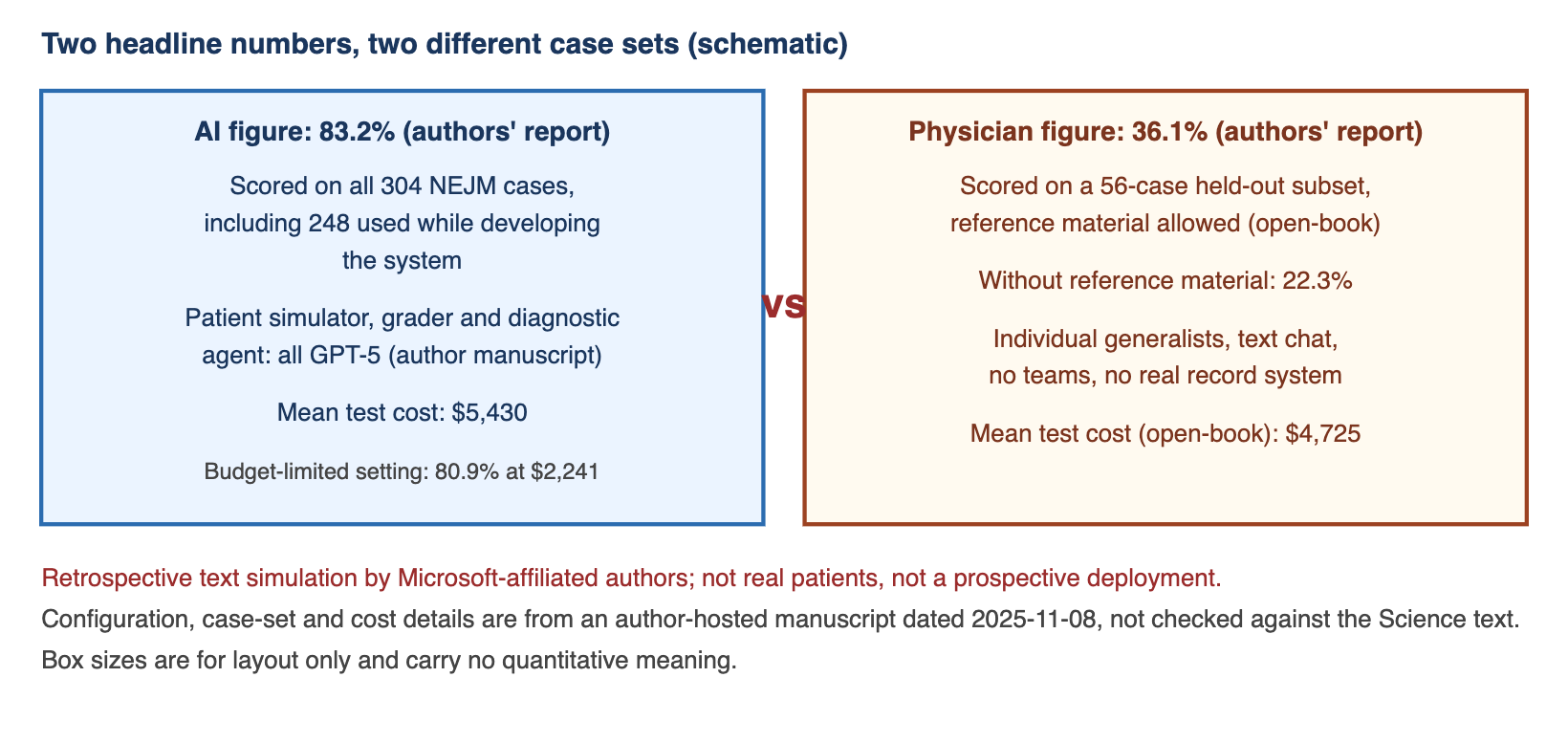
- So what: All figures are Microsoft-affiliated authors’ reports with no independent replication. By the authors’ manuscript, the AI score covers all cases, including those used to develop the system, while the physician score covers a 56-case held-out subset where physicians could consult reference material, so the two numbers do not describe the same case set. The configuration behind 83.2% had a mean test cost of $5,430, above the open-book physician mean of $4,725; lower cost than physicians is reported only for budget-limited configurations. The patient simulator, the grader and the main diagnostic agent were all GPT-5 models.
- Now what: Read it as a benchmark design for information-gathering under cost, not as a measure of diagnostic ability in practice. Watch for a public release of SDBench, scoring with a grader from a different model family, evaluation on real records, and comparison against physician teams. TRL: 3 (simulated proof of concept).
5-minute read
What the authors did
Most medical question-answering benchmarks hand the model a complete case and ask for a diagnosis. Real diagnosis is sequential: a clinician starts with a short presentation, asks questions, orders tests that cost money, and commits to a diagnosis. The paper converts 304 published NEJM Clinicopathological Conference cases (2017-2025) and 325 admitted-patient cases from the MIMIC-IV-ED database into an interactive task, SDBench. A diagnostic agent may request history or tests. A “Gatekeeper” model answers from the case file, and when a requested result is not in the original text, the Gatekeeper generates a plausible one. A “Judge” model scores the final diagnosis, and a diagnosis counts as correct at a score of 4 out of 5 or higher. Cumulative cost is tracked with a fixed visit fee plus test prices mapped from procedure codes to a 2023 price list from a single US health system.
MAI-DxO is not a new model. Per the authors, it is one language model prompted to play five roles (hypothesis generation, test selection, challenger, cost stewardship and checklist), developed with GPT-4.1, with the main reported results using GPT-5.
What it reports, and how to read the headline
The abstract’s four numbers (83.2% and 80.3% for the AI, 36.1% and 46.8% for physicians) match between the published abstract and the author-hosted manuscript. The manuscript indicates what sits behind them. The 83.2% is the MAI-DxO configuration without a budget limit, with GPT-5, at a mean cost of $5,430; the same GPT-5 with a minimal prompt scored 78.9% at $8,409. By simple subtraction, the gap between the orchestrator and its own baseline is 4.3 percentage points. The physician figure comes from the open-book group (reference sources such as UpToDate allowed) on the 56 held-out cases; the closed-book group scored 22.3%. The authors write: “AI agents are evaluated on all cases, while physician performance is shown only for the 56 held-out test set cases.”
So the ratio of about 2.3 (83.2 divided by 36.1, my arithmetic) is not a like-for-like comparison. The AI score for the 56 held-out cases alone appears only in a figure I could not read as text; the manuscript says only that absolute performance on that subset is comparable.
Cost works the same way. The 83.2% configuration cost more in tests than the open-book physician mean ($4,725). A lower cost than physicians is reported for budget-limited configurations, for example 80.9% at $2,241.
How far to take it
The authors themselves state that the work does not establish real-world clinical efficacy and that individual physicians, not expert teams, were the comparison. The result is best read as a score of an information-gathering policy inside one simulator, with the same model family playing the patient, the grader and the main diagnostic agent.
Deep dive
1. Background
Clinical language-model evaluations have mostly been static: a vignette, then multiple-choice or free-text diagnosis. That format hides two parts of practice, deciding what to ask and which tests to order, and the cost of those choices. NEJM Clinicopathological Conference cases are long, rare, teaching-oriented records and have been used as a hard diagnostic test for years. A sequential format asks a model to behave more like a clinician who must pay for each piece of information.
The study was first posted as an arXiv preprint (arXiv:2506.22405; version 1 on 2025-06-27, version 2 on 2025-07-02), which used an o3-based system. The Science version differs in model, case sets and physician comparison. That matters for anyone checking numbers, and it is covered in Section 3.
2. What this study newly establishes
Scope (from the published abstract and the author-hosted manuscript). The benchmark covers 304 NEJM cases and 325 MIMIC-IV-ED cases. Accuracy is the share of cases where the grader scores the final diagnosis at 4 or higher out of 5, and cost is accumulated against the price list described above. The paper’s main reported contribution is to put information-gathering cost on the same axis as accuracy.
Reported results (all by Microsoft-affiliated authors; no independent replication).
- MAI-DxO without a budget, GPT-5: 83.2% at a mean cost of $5,430. Minimal-prompt GPT-5: 78.9% at $8,409. An ensemble configuration: 84.5% at $8,945. Budget-limited configurations: 80.9% at $2,241 and 79.6% at $1,302.
- Physicians (open-book, 19 participants): 36.1% at $4,725 on the 56 held-out NEJM cases. Physicians (closed-book, 21 participants): 22.3% at $3,049.
- MIMIC-IV-ED: 80.3% for the AI in the abstract; the physician figure of 46.8% comes from 16 open-book physicians on a 71-case held-out set, per the manuscript.
- Across other base models, the authors report accuracy gains from the orchestration for most models, tested with a one-sided paired permutation test (10,000 resamples); the manuscript describes an average gain of 7.9 percentage points on the NEJM set and 4.4 on MIMIC. Confidence intervals for the headline scores were not available to me as text.
The direction reported, that structured orchestration raised accuracy while lowering test cost for the same base model, is a reasonable hypothesis about how to use language models for stepwise tasks. The size of the effect in practice is not established by a benchmark of this kind.
3. Strengths and limitations of the method
Strengths.
- Putting question and test choice, with cost, on the evaluation axis is closer to clinical workflow than a static question set.
- The authors report several base models rather than one, and disclose limits in the manuscript: no healthy or mild cases (so false-positive rates are not measured), text only, individual physicians rather than teams, and possible training-data exposure of the NEJM cases.
- A held-out set of 56 recent NEJM cases was reserved to limit contamination.
Limitations (statements about configuration, case sets, costs and model roles rest on the author-hosted manuscript dated 2025-11-08, before comparison with the Science text).
- Different case sets. The AI score includes the 248 validation cases that were used to develop the orchestrator, and the physician score is the 56-case held-out subset. The authors acknowledge that the orchestrator was iteratively developed on the validation cases.
- Cost and configuration. A single “lower cost” statement is not meaningful without naming the configuration. The abstract does not say which one it means.
- Same model family in three roles. The Gatekeeper, the Judge and the main diagnostic agent are all GPT-5. I did not find a cross-grading result using a grader from a different model family in the text I read; a model may favour outputs of its own family, and this study does not report a control for that. The grader validation described in the manuscript was done by in-house physicians on an initial study; whether it covered the GPT-5 grader is not stated.
- Synthetic test results. Where the case file lacks a requested result, the Gatekeeper generates one. The authors say this was more frequent in MIMIC-IV-ED, whose records are shorter. The share of generated responses is not reported in the text I read.
- Small held-out set. At roughly 80% accuracy on 56 cases, a simple binomial standard error is about 5 percentage points (my arithmetic, assuming independent cases), so small differences between configurations are hard to resolve.
- Contamination wording. The manuscript text says that the majority of held-out cases postdate model training cutoffs, while a figure caption uses a stronger phrase. The two are not equivalent.
- Baseline strength. The comparison baseline is a minimal prompt. I did not find a comparison against a carefully tuned single-prompt baseline.
- Interaction conditions. Physicians used a single-turn text interface; the AI could submit batches of questions and tests per turn.
- Version movement. The arXiv version 2 abstract reports about 80% for the AI and about 20% for physicians (a ratio near four), with an o3-based system and no MIMIC data. The Science abstract reports 83.2% and 36.1%, with physician results that now include an open-book group. The arXiv link therefore cannot be used as a source for the Science numbers.
What I read. I read the published abstract (Crossref and PubMed records) and the full text of the author-hosted manuscript (35 pages, dated 2025-11-08, including supplementary sections). The Science full text was not accessible (403 from the publisher site), so I have not compared the manuscript’s methods and numbers with the published version. Figure-only values could not be extracted as text. The competing-interest and funding declarations of the Science version are not verified; the manuscript has no such section, and its acknowledgements mention permission from the NEJM Group to use the cases and internal Microsoft contributors.
4. Connections to neighboring domains
Health economics. Because cost is part of the benchmark’s design, the paper connects to cost-effectiveness reasoning about diagnostic work-ups. The price input is a 2023 list from one US health system, so cost differences are best read as relative within the benchmark, not as expected savings in a given hospital. The authors describe the prices as approximations.
Simulator-dependent evaluation. The environment depends on a language model that invents unrecorded results, so scores can depend on the simulator’s behaviour. That is a loose analogy to other fields that evaluate models inside learned or synthetic environments. It is an analogy, and this paper does not test it.
5. Commercialization and investment perspective
TRL: 3. The work is a proof of concept in a controlled text simulation. I found no evidence in the paper of a product, an API, a regulatory pathway or a clinical deployment, and I do not estimate a timeline.
Companies (facts only). All 15 authors list Microsoft (Redmond, WA) as their affiliation; Microsoft is a publicly listed company. The main reported system uses GPT-5 models from OpenAI, which is privately held. Models from other developers were used as comparison base models. This post draws no investment conclusion about any of them, and no financial relationship between the study and any listed company other than the authors’ employer affiliation is documented in the sources I read.
6. Counterarguments
- The score measures a policy inside a simulator. An accuracy of 83.2% describes how an information-gathering policy performs when a language model plays the patient and another instance grades the answer. The ambiguity and omissions of real patients, which the authors list as limitations, are not part of the score.
- The headline comparison mixes case sets. The AI figure includes development cases and the physician figure is a 56-case held-out average.
- Cost advantage depends on configuration. The configuration with 83.2% cost more in tests than the open-book physician mean; the cost advantage is reported for budget-limited configurations.
- Self-preference is not controlled in the text I read. No cross-family grading result and no share of generated Gatekeeper responses were found.
- Vendor-authored and unreplicated. The system and the benchmark were designed and evaluated by the same company’s authors, with no external evaluator. SDBench is described in the manuscript as not publicly released, so independent reproduction has no stated path.
- Physician comparison is narrow. Individual generalists in a text chat, not specialists or teams, and the closed-book to open-book change (22.3% to 36.1%) shows that the comparison group definition moves the gap.
- Retrospective only. No prospective use and no real health records were involved, and the case mix is pathology-only, with no healthy or mild cases.
- Partial reading. The method details come from an author-hosted manuscript that has not been checked against the Science text.
7. Indicators to watch
- Public release of SDBench and replication by an independent group.
- Results with a grader and a patient simulator from model families different from the diagnostic agent, plus the share of generated (not recorded) test results.
- AI scores on the same 56 held-out cases that physicians saw, reported with confidence intervals.
- Evaluation on real electronic health records and prospective studies with clinician oversight.
- Comparison with specialist physicians and physician teams, and with a tuned single-prompt baseline.
- Measurement of false-positive behaviour on healthy or mild cases.
- The Science version’s data and code availability and competing-interest statements, once the full text can be read.
References
- Microsoft-affiliated authors (15 authors, all listed as Microsoft, Redmond, WA, in Crossref and PubMed; individual author names not verified for this post). 2026. “Sequential diagnosis with language models.” Science 394 (6822): 423-428. Published 22 October 2026. DOI: 10.1126/science.aeh7930. https://doi.org/10.1126/science.aeh7930. Abstract read; full text not accessed.
- Earlier preprint of the same project (arXiv:2506.22405; version 1, 27 June 2025; version 2, 2 July 2025). Author list and exact title not verified for this post. Version 2 reports different figures from the Science abstract and should not be used as a source for them. https://arxiv.org/abs/2506.22405.
- Revised manuscript hosted on an author’s homepage, dated 8 November 2025 (35 pages; file name sequential_diagnosis_LM.pdf). Relationship to the Science text not verified. https://www.erichorvitz.com/sequential_diagnosis_LM.pdf.
Disclosure
- This article is for informational purposes only and is not investment advice.
- The author has no interest in any company named in this post.
- Source access: The Science full text could not be accessed (the publisher site returned an access error). The abstract was read through Crossref and PubMed records. Methods, case sets, costs and model roles are taken from an author-hosted manuscript dated 2025-11-08, which has not been compared with the published text.
- Authors and affiliation (Crossref and PubMed): all 15 authors are affiliated with Microsoft, Redmond, WA, USA. Microsoft is a publicly listed company. The system under evaluation (MAI-DxO) and the benchmark (SDBench) were designed and evaluated by the same company’s authors, and no external independent evaluator is reported.
- Competing interests and funding: The Science version’s declarations could not be verified. The PubMed record has no competing-interest statement, and the author-hosted manuscript has no competing-interest or funding section.
- All quantitative claims (83.2%, 80.3%, 36.1%, 46.8% and the cost and configuration figures) are claims by the Microsoft-affiliated authors; there is no independent replication. Ratios, differences and the standard-error estimate are my own arithmetic.
- The figure in this article is an original drawing; no figure from the source was reproduced.


Leave a Reply