UBT251, a GLP-1/GIP/Glucagon Triple Agonist, in Type 2 Diabetes: A 24-Week Phase 2 Trial in China Shows HbA1c Falls Versus Placebo, With Confidence Intervals That Overlap Semaglutide 1 mg and No Direct Test Reported in the Abstract (Full Text Not Read)
Analysis based on information available as of 2026-11-03.
30-second summary
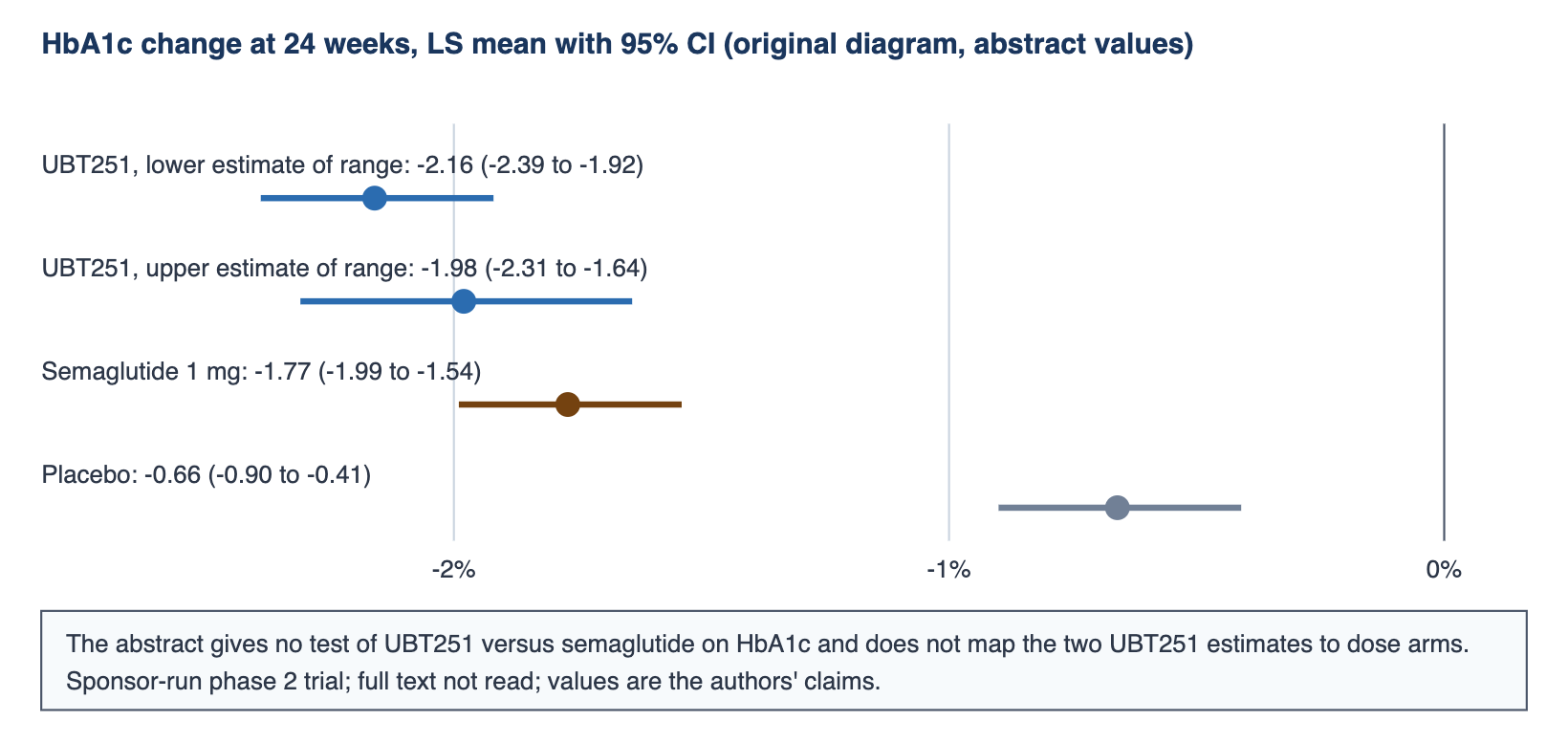
- What: A sponsor-run, multicentre, randomised phase 2 trial in Cell Metabolism (Zhou et al., 2026) gave 211 Chinese adults with type 2 diabetes (T2D) once-weekly subcutaneous UBT251 (four dose arms), semaglutide 1 mg, or placebo for 24 weeks. By the abstract, HbA1c changed by -2.16% to -1.98% with UBT251, -1.77% with semaglutide and -0.66% with placebo (least-squares means). The placebo-adjusted UBT251 difference was -1.50% to -1.32% (all P < 0.001).
- So what: The 95% confidence intervals for UBT251 and semaglutide 1 mg overlap, and the abstract reports no test comparing the two on HbA1c, so a glycaemic difference between them is not established by what we read. The trial registry lists no separate placebo arm, and whether the semaglutide arm was blinded is unverified. Surrogate endpoints only; no cardiovascular or kidney outcomes.
- Now what: This summary rests on the abstract, the registry entry, the conflict-of-interest statement and a company press release. We did not read the published full text (the publisher site returned HTTP 403), and a companion obesity phase 2 paper on the same drug, published in the same journal, was not collected by our weekly literature scan. All 25 authors have a financial relationship with the sponsor or the licensee. All efficacy figures are the sponsor-run trial’s and the authors’ claims, not independently replicated. Development stage: phase 2 complete; phase 3 not started (TRL 6).
5-minute read
What was tested
UBT251 is a once-weekly injectable peptide that activates three receptors: glucagon-like peptide-1 (GLP-1), glucose-dependent insulinotropic polypeptide (GIP) and glucagon. The trial enrolled adults aged 18 to 75 with HbA1c of 7.0% to 10.5%, managed on lifestyle alone or on stable metformin, with BMI 23.0 to 40.0 (registry inclusion criteria). Participants received UBT251 at 2 mg, 4 mg (starting at 0.5 mg), 4 mg (starting at 1 mg) or 6 mg, semaglutide 1 mg as an active comparator, or placebo. The primary endpoint was the change in HbA1c at 24 weeks; the registry primary outcome matches the abstract. Mean age was 48.4 years and 131 of 211 participants were men.
What the abstract reports
Against placebo, HbA1c fell more with every UBT251 arm. Fasting plasma glucose, two-hour postprandial glucose and waist circumference also differed from placebo (all P < 0.001; values not given in the abstract). For body weight, the abstract says the reduction was “significantly greater than both” placebo and semaglutide (all P < 0.05) and gives no numbers. The most common treatment-emergent adverse events were gastrointestinal; the abstract gives no frequencies.
How to read it
The placebo comparison is the clearly reported result. The semaglutide comparison is less certain. The UBT251 and semaglutide intervals overlap, the abstract gives no P value for that contrast, and we could not check whether it was a pre-specified test. Design details also remain open: the registry lists five arms (four UBT251 doses, each described with an “UBT251 Injection Placebo” note, and semaglutide 1.0 mg as active comparator) and no stand-alone placebo arm, while the abstract describes a placebo group. How placebo participants were assigned, and whether the semaglutide arm was blinded, are unverified. Group sizes, the estimand, handling of missing data and multiplicity control were not available to us.
Weight figures from the sponsor and licensee are discussed, with their attributions, in the deep dive.
Deep dive
1. Background
Dual and triple incretin-based agonists aim to add GIP and/or glucagon receptor activity to GLP-1 receptor agonism. Retatrutide (Eli Lilly), also a GLP-1/GIP/glucagon agonist, has reported phase 2 and phase 3 T2D data, so UBT251 is not the first molecule in this mechanistic class to reach human trials. We reviewed retatrutide’s T2D results in an earlier piece and did not re-check those figures for this article.
UBT251 was developed by The United Bio-Technology (Hengqin) Co., Ltd., a subsidiary of The United Laboratories International Holdings (HKEX: 3933). Per a March 2025 company announcement, Novo Nordisk holds exclusive rights outside Greater China (upfront payment of USD 200 million and milestones of up to USD 1.8 billion, as stated by the companies). The trial is registered as NCT07163624, with a Chinese registry number, CTR20250029, in the analysis record.
2. What this study newly establishes
Reported by the abstract.
| Measure | Value | Source |
|---|---|---|
| HbA1c change, UBT251 | -2.16% (95% CI -2.39 to -1.92) to -1.98% (95% CI -2.31 to -1.64) | Abstract |
| HbA1c change, semaglutide 1 mg | -1.77% (95% CI -1.99 to -1.54) | Abstract |
| HbA1c change, placebo | -0.66% (95% CI -0.90 to -0.41) | Abstract |
| Placebo-adjusted UBT251 | -1.50% to -1.32%, all P < 0.001 | Abstract |
| Fasting glucose, 2-hour postprandial glucose, waist circumference versus placebo | All P < 0.001; values not given | Abstract |
| Body weight versus placebo and semaglutide | “significantly greater than both”, all P < 0.05; values not given | Abstract |
The abstract does not say which dose arm produced -2.16% and which produced -1.98%. The four arms span 0.18 percentage points, and their intervals overlap. Whether UBT251 and semaglutide 1 mg differ on HbA1c cannot be concluded from the abstract: the intervals overlap and no direct test is given. The point-estimate gap at the extremes (-2.16% versus -1.77%) is about 0.4 percentage points.
Body weight, sponsor and licensee figures. The one place in this article where weight numbers appear is here. A joint press release by Novo Nordisk and The United Laboratories (2026-03-25) states a weight reduction of up to 9.8% with UBT251, 4.8% with semaglutide and 1.4% with placebo. These figures are from the press release, not from the paper. According to the release’s footnote they come from an ANCOVA using an efficacy estimand (“regardless of dose modification or changes to background metformin dose”), they refer to the highest-dose group (“up to”), and they have not been matched against the published full text. The same release gives baseline HbA1c 8.12%, body weight 80.1 kg and BMI 29.1, also as a company statement not matched to the paper’s tables.
Required caveat. The glycaemic results of this trial overlap semaglutide 1 mg in confidence interval, and the abstract does not present a direct test between the two. The maximum weight reduction of 9.8% comes from a joint press release of the sponsor and licensee (The United Laboratories and Novo Nordisk), refers to the highest-dose group on an efficacy estimand, and has not been checked against the paper’s full text. All authors have a financial relationship with the sponsor or the licensee.
Same drug, other trial. A second Cell Metabolism paper (DOI 10.1016/j.cmet.2026.09.021, PMID 42843337) reports a phase 2 trial of UBT251 in overweight or obesity. Our weekly literature scan did not collect it. We do not describe its content here.
3. Strengths and limitations
Strengths.
- Randomised, parallel-group design with a prespecified primary endpoint that matches the registry entry, and a marketed active comparator in the same trial.
- Four UBT251 dose arms, allowing a look at dose-response; peer-reviewed publication in an open-access (CC BY 4.0) article.
Limitations.
- Full text not read. Group sizes, randomisation ratio, placebo assignment structure, semaglutide blinding, estimand, multiplicity control, adverse-event frequencies and discontinuation rates are all unverified. An open-access copy exists; it was not retrievable from our environment (HTTP 403).
- Statistical status of the active-comparator contrast. No P value is given in the abstract for UBT251 versus semaglutide on HbA1c. For weight, “all P < 0.05” is given without information on multiplicity adjustment. With 211 participants in six groups, the average group size is about 35 (our arithmetic; actual allocation unverified), which would limit power for comparisons between active arms.
- Population and duration. Single country, mean age 48.4 years, 24 weeks, surrogate endpoints (HbA1c, weight), no cardiovascular or kidney outcomes.
- Registration timing. The ClinicalTrials.gov record was first submitted on 2025-09-01, after the stated start date of 2025-03-22. The registration date in the Chinese registry was not verified.
- Safety beyond gastrointestinal events. Heart rate, liver enzymes and amino-acid metabolism, which are of interest for glucagon-receptor activity, are not addressed in the abstract; their absence there is not evidence of absence.
- No independent analysis. Authors’ relationships are described in the Disclosure; no independent analytic group was identified.
4. Connections to neighboring domains
Health economics and licensing. The programme splits development by region: Greater China rights sit with the sponsor’s group and other regions with Novo Nordisk (company announcement, 2025-03). Evidence generation follows the same split. This trial is a China-only phase 2; the licensee has announced a global T2D phase 2 for the second half of 2026 (company statement; current status not verified). Novo Nordisk also manufactures the active comparator, semaglutide, and two of this paper’s authors are Novo Nordisk employees. That is a factual description of the structure, not a statement about effect on the results.
Clinical guidelines. Current T2D and cardio-kidney-metabolic (CKM) guidance for GLP-1-based therapy rests on agents with cardiovascular or kidney outcome evidence. UBT251 has none yet, so it has no position in guideline recommendations.
5. Commercialization and investment perspective
TRL 6. A phase 2 randomised trial is complete and peer-reviewed, giving a human efficacy signal on surrogate endpoints. Phase 3 has not started, so we do not rate it higher. The companies state that two phase 3 trials in China are planned (company statement).
Companies (facts attributed to sources).
- The United Bio-Technology (Hengqin) Co., Ltd. is the trial sponsor (registry: lead sponsor, class industry) and holds Greater China rights; its parent is The United Laboratories International Holdings (HKEX: 3933).
- Novo Nordisk holds exclusive rights outside Greater China under the March 2025 agreement (company announcement). It announced a global obesity phase 1b/2a trial of about 330 participants with topline results expected in 2027 (company statement, March 2026).
- Eli Lilly’s retatrutide, a GLP-1/GIP/glucagon agonist, is in phase 3 (earlier piece; status not re-checked).
This article does not estimate market size or probability of approval, and draws no investment inference.
6. Counterarguments and points of caution
- What the glycaemic data support. The abstract supports a placebo-adjusted HbA1c reduction. Concerning semaglutide 1 mg, the supportable wording is that the confidence intervals overlap and that no direct test is reported in the abstract.
- Weight rests on one non-paper source. The only weight numbers available to us come from the sponsor-licensee press release, with the estimand and dose-group qualifications stated above. An efficacy estimand, by definition, assumes continued treatment, and a treatment-policy estimand can give different values. Whether the paper reports one or both is unknown to us.
- Design questions. The registry’s five arms and the abstract’s placebo group need reconciliation. If the semaglutide arm was open-label, weight, which can be influenced by participant behaviour, would be a comparison with a different risk of bias. This is unverified and noted as a question.
- Relationships between parties. All 25 authors have a financial relationship with the sponsor or licensee. The primary endpoint is consistent between the registry and the abstract, which allows efficacy figures to be attributed and checked against the paper once the full text is read.
7. Indicators to watch
- Full-text confirmation, in this order: group sizes and placebo assignment; semaglutide blinding; weight by arm and estimand; multiplicity control; glucagon-receptor-related safety (heart rate, liver enzymes).
- Whether a pre-specified UBT251 versus semaglutide contrast on HbA1c exists in the paper or supplement.
- Posting of results on ClinicalTrials.gov (NCT07163624), which showed no results at the time of our check.
- Start and design of the Chinese phase 3 trials and of Novo Nordisk’s global T2D phase 2.
- Any independent replication and any cardiovascular or kidney outcome data.
References
- Zhou, Zhiguang, et al. 2026. “UBT251, a novel triple GLP-1, GIP, and glucagon receptor agonist, in adults with type 2 diabetes: A multicenter, randomized phase 2 trial” (title per Crossref). Cell Metabolism. First online publication date 2026-10-26 (Europe PMC); volume and pages not verified. DOI: 10.1016/j.cmet.2026.10.010. PMID 42933400. Author list: 25 authors (PubMed and Crossref concur); first-author status of Zhou not verified.
- Companion paper, same journal: UBT251 in adults with overweight or obesity, phase 2 (authors and full title not verified; not read). DOI: 10.1016/j.cmet.2026.09.021. PMID 42843337.
- ClinicalTrials.gov. NCT07163624. Record accessed 2026-11-03. clinicaltrials.gov/study/NCT07163624.
- Novo Nordisk and The United Laboratories International Holdings. 2026. Joint announcement, 2026-03-25 (press release PDF). doc.irasia.com/listco/hk/unitedlab/press/p260325.pdf.
- Novo Nordisk. 2025. Licensing announcement, March 2025. novonordisk.com (news details, id 915958).
- Retatrutide in T2D (Eli Lilly; TRANSCEND-T2D-1): cited from our earlier article on that trial; citation details not re-verified for this piece (not verified).
- Only the Cell Metabolism abstract, the trial registry entry, the PubMed conflict-of-interest statement and the press release were read directly. The full text was not read, and fewer than three papers were read directly, so the literature base is thinner than a full review would require.
Disclosure
- This article is for informational purposes only and is not investment advice, and it is not a basis for clinical decisions.
- The author holds no position in any company named in this post.
- Reading scope. The published full text (open access, CC BY 4.0) was not read because the publisher site returned HTTP 403. This article is based on the abstract, PubMed author, affiliation and conflict-of-interest data, Crossref metadata, the trial registry entry and a joint company press release. Supplementary material was not read.
- Conflict-of-interest notes (from the PubMed conflict-of-interest statement, PMID 42933400, checked 2026-11-03):
- Four authors (Zhang Haiyan, Su Tao, Ling Wei and Yan Huiru) are employees of Zhuhai United Laboratories and provide clinical services to the trial sponsor, United Bio-Technology (Hengqin), an affiliate of their employer.
- The sponsor has filed a patent application based in part on the results of this trial; the same four authors are named as inventors.
- Two authors (Lasse Hjort Kyneb Jakobsen and Nicolas Belmar Nazal) are Novo Nordisk employees. Novo Nordisk holds exclusive rights to UBT251 outside Greater China (company announcement, March 2025) and manufactures semaglutide, the active comparator.
- The remaining authors received research funding from the sponsor. By the statement’s wording, all 25 authors have a financial relationship with the sponsor or the licensee.
- The registry lists the lead sponsor as United Bio-Technology (Hengqin), class industry.
- All efficacy figures are claims from a sponsor-run trial and its authors and have not been independently replicated. The weight figures (up to 9.8%, 4.8% and 1.4%) are claims of a joint press release by the sponsor’s parent and the licensee.
- This publication uses an AI model in its production workflow; we note this for transparency.
- The figure in this article is an original drawing; no figure from the source was reproduced.


Leave a Reply