A Preprint Reports 3.26 Percentage Points Greater 16-Week Weight Loss When Linafexor Is Added to Low-Dose Semaglutide in 62 Adults: A Small Proof-of-Concept Trial With a Low-Dose Comparator, Labelled Phase 2 in the Paper and Phase NA in the Registry
Analysis based on information available as of 2026-11-03.
30-second summary
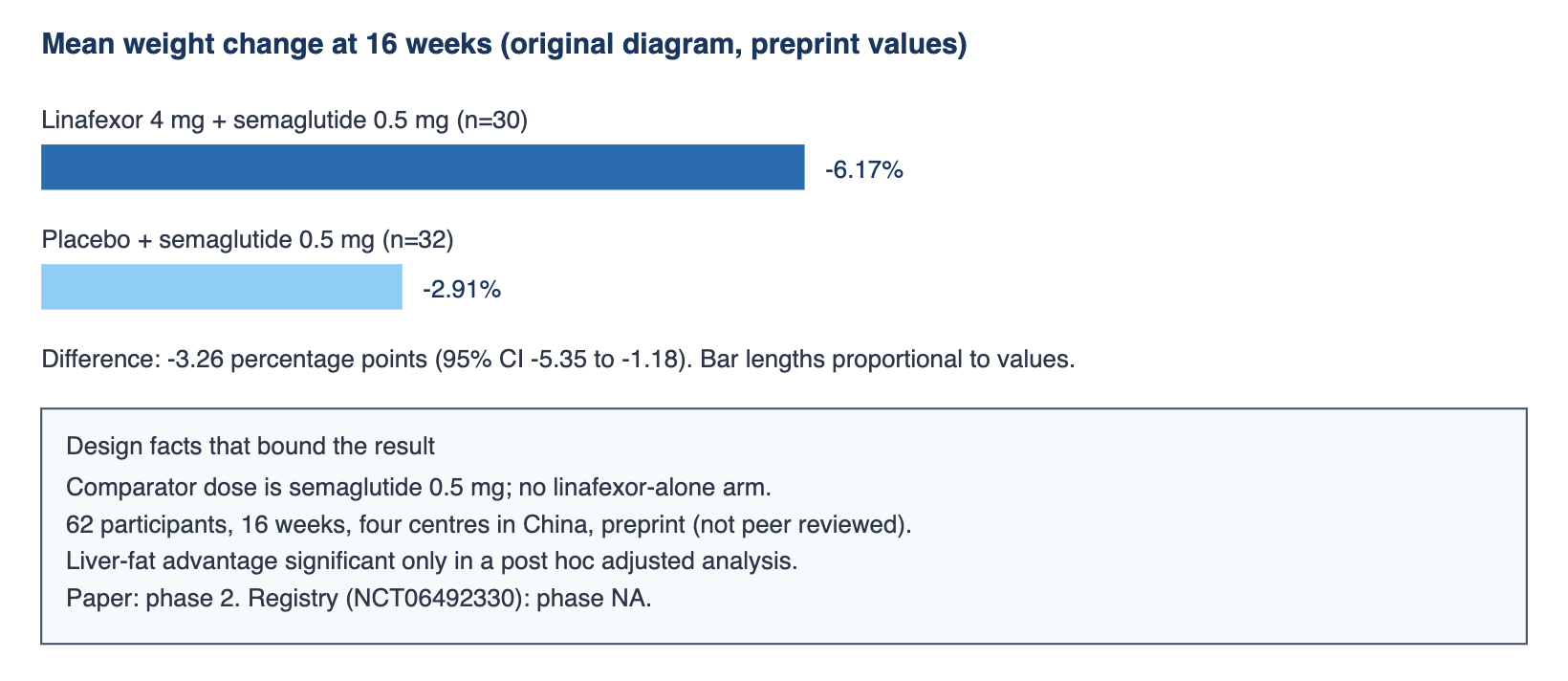
- What: A not-yet-peer-reviewed preprint (medRxiv, posted 2026-10-21) randomised 62 adults with obesity, type 2 diabetes (T2D) and MRI-defined metabolic dysfunction-associated steatohepatitis (MASH) at four Chinese centres to oral linafexor 4 mg daily or placebo, both on top of semaglutide 0.5 mg weekly. Mean 16-week weight change was -6.17% versus -2.91%, a difference of -3.26 percentage points (95% CI -5.35 to -1.18; P=0.003). The paper calls the trial phase 2; ClinicalTrials.gov (NCT06492330) lists the phase as NA.
- So what: The comparator is semaglutide 0.5 mg, below the 2.4 mg dose used for obesity, and there is no linafexor-alone arm. The liver-fat advantage was not significant in the unadjusted comparison and reached significance only in a post hoc adjusted analysis. Muscle findings rest on bioimpedance (BIA). Any adverse event occurred in 70.0% of the linafexor group and 56.2% of the placebo group.
- Now what: This is a 62-person, 16-week proof-of-concept with surrogate endpoints. It does not show superiority over standard-dose semaglutide, an effect of linafexor alone, histological MASH improvement or long-term safety. Co-authors include employees and a founder of the drug’s developer. All figures are the preprint authors’ claims.
5-minute read
What was tested
Linafexor (also called CS0159) is a farnesoid X receptor (FXR) agonist designed, according to the developer, to be short-lived in the body (half-life under one hour) so that exposure is pulsatile. FXR agonists have been studied for MASH for years. The question here was whether adding linafexor to semaglutide improves weight loss in adults who tend to respond modestly to GLP-1 receptor agonists. Participants were aged 18-65 with BMI 30-45, treatment-naive T2D (HbA1c 7.0-10.5%) and MASH defined by biopsy or liver fat (MRI-PDFF) of 10% or more. Screening included 100 people; 62 were randomised (30 linafexor, 32 placebo). Both arms received open-label semaglutide 0.5 mg weekly; the linafexor and placebo tablets were masked.
What came out
The primary endpoint was percent weight change at 16 weeks, analysed under a trial-product estimand (the on-treatment period before discontinuation or rescue therapy). The linafexor arm lost 6.17% and the placebo arm 2.91%. A weight loss of 5% or more was reached by 53.3% versus 28.1% (odds ratio 2.92; 95% CI 1.02 to 8.37; P=0.046). Visceral fat area on MRI fell by 35.60 cm² versus 13.95 cm². HbA1c fell by 1.98 versus 2.28 percentage points, a difference the paper reports as not significant.
How to read it
Three design facts bound the reading. First, the control arm received semaglutide 0.5 mg, below the 2.4 mg dose used for obesity; the authors themselves note that comparison with the standard dose would be the most clinically relevant. Second, with no linafexor-alone arm, the weight difference cannot be separated into an effect of linafexor itself and an interaction with semaglutide. Third, the liver-fat result: the unadjusted difference in MRI-PDFF change was -7.77% (95% CI -18.86 to 3.32), and the reported additional 11.5% relative reduction comes from a post hoc multivariable-adjusted analysis that the Methods describe as exploratory. Muscle findings come from BIA rather than imaging. Adverse events occurred in 70.0% versus 56.2%; gastrointestinal events in 23.3% versus 18.8%.
Reading scope: we read the full preprint text (JATS XML). Extended Data, Supplementary material and the table bodies were not read, so values located there, including the treatment-policy estimand results, are not checked.
Deep dive
1. Background
FXR is a bile-acid-activated nuclear receptor that regulates hepatic lipid and glucose handling. Agonists have been developed for MASH, and the preprint’s authors state that about twenty candidates have failed or been withdrawn (an author statement we did not check against other sources). Obeticholic acid is the best-known earlier example; we did not verify its regulatory history for this piece. The preprint’s premise is that a short-exposure FXR agonist combined with a GLP-1 receptor agonist could add weight and liver benefit without the pruritus and liver-enzyme problems reported with earlier FXR agonists. In this trial pruritus was reported by 2 participants in the linafexor arm and 1 in the placebo arm, and the authors report no rise in alkaline phosphatase or bilirubin.
Registry record NCT06492330 was first submitted on 2024-06-25 and the study began on 2024-07-19, so registration was prospective. The record lists Shanghai Jiao Tong University School of Medicine as lead sponsor, with study drug supplied by Cascade Pharmaceuticals (linafexor) and Novo Nordisk (semaglutide). Primary completion is listed as 2025-02-28; the preprint was posted about twenty months later.
2. What this study newly establishes
Design. Randomised (1:1, central allocation, stratified by baseline BMI below or at least 35), parallel-group, double-blind for the linafexor/placebo tablets, with open semaglutide in both arms. Participants: mean age 37.3 years, 69% male, weight 100.2 kg, BMI 34.3, HbA1c 8.6%, liver fat 21.0%. One participant in each arm was lost to follow-up. The sample-size calculation assumed a standard deviation of 2.5% and a 2-point difference at 80% power (25 per arm, 30 allowing for dropout). Secondary endpoints had no multiplicity adjustment, as the paper states.
Efficacy. The primary result is given above. Other reported differences between arms (linafexor minus placebo): ALT -12.83% (95% CI -24.76 to -0.91), GGT -20.01% (-28.18 to -11.85), visceral fat area -13.85 cm² (-24.52 to -3.17; P=0.035; -16.8 cm² after post hoc adjustment). Liver stiffness (VCTE) differed by -0.99% (-3.8 to 1.8), not significant. Fat mass by BIA fell 3.66 kg versus 1.58 kg, not significant per the paper. Triglycerides did not differ significantly.
Body composition. The paper reports a skeletal muscle mass change of -0.31 kg in the linafexor arm and describes a favourable fat-to-muscle loss ratio. The ratio is computed from the linafexor arm alone while the fat-mass difference between arms was not significant, and the main text gives no placebo-arm muscle change. Measurement was by bioimpedance (InBody).
Safety. Any adverse event: 70.0% (linafexor) versus 56.2% (placebo). Gastrointestinal events: 23.3% versus 18.8%. Vomiting: 0 of 30 versus 2 of 32. Serious adverse events after treatment ended: 3 versus 1, none judged related by investigators. The authors present tolerability as a main point of the combination. That statement should be read next to the figures above: overall adverse-event frequency was numerically higher with the combination, and because the comparator is also low-dose semaglutide, the trial does not test tolerability relative to higher semaglutide doses.
Cost claim. The Discussion states that the combination “could lower drug costs by roughly 80%”. This is the authors’ arithmetic based on using about one fifth of the semaglutide dose; it does not include the cost of linafexor.
Pharmacokinetics. The pulsatile-exposure rationale is supported by a pharmacokinetic sample of 9 participants. The main text contains no target-engagement biomarker such as FGF19 or C4 (a bile-acid synthesis marker). A 66-species bile-acid panel is reported, with associations analysed by generalised estimating equations; these are correlational.
3. Strengths and limitations
Strengths.
- Randomised, placebo-controlled, with matched-appearance tablets and prospective registration; registry and paper agree on the primary endpoint.
- Imaging-based liver fat (MRI-PDFF) and visceral fat measurement rather than weight alone.
- The authors state several limitations, including the comparator dose and the lack of histology.
Limitations, as facts of the design and reporting.
- Comparator dose. Semaglutide 0.5 mg in both arms; the result does not address standard-dose semaglutide.
- No linafexor-alone arm. Contribution of linafexor itself cannot be separated from interaction.
- Size and duration. 62 participants, 16 weeks, one country, treatment-naive T2D, mean age 37.3 years, 69% male. Weight loss had not plateaued at 16 weeks (paper). The lower confidence bound of the odds ratio for 5% weight loss is 1.02.
- Variance assumption. Our arithmetic from the reported confidence intervals gives an observed standard deviation of about 4%, versus 2.5% assumed in the sample-size calculation; the observed difference (3.26) was larger than the assumed one (2).
- Liver fat. Significant only after post hoc multivariable adjustment (exploratory per Methods); unadjusted comparison included zero.
- Body composition. BIA-based; no placebo-arm muscle change in the main text.
- MASH definition. MRI-PDFF of 10% or more, without histology (acknowledged by the authors).
- Primary estimand. The primary analysis is the trial-product estimand. A treatment-policy estimand analysis is described as consistent, but its values are in Extended Data, which we did not read.
- Registry versus paper. The paper describes a phase 2 trial; the registry lists the phase as NA. Registry secondary outcomes including PHQ-9, SF-36, itch scales, insulin and C-peptide, kidney function and fibrosis markers have no results in the main text. Supplementary material was not read, so whether they are reported elsewhere is not checked.
- Not peer reviewed. Single version (v1).
4. Connections to neighboring domains
Health economics. A combination’s value depends on both drugs’ prices. The 80% figure reflects only the reduction in semaglutide dose; with linafexor’s cost absent, the net saving is not computable from the paper. The same applies to any comparison of cost per percentage point of weight lost.
Chronopharmacology and PK design. A deliberately short half-life to limit receptor desensitisation and hepatotoxicity is a design choice that connects to pulsatile dosing in other fields. In this paper it is supported by exposure data from 9 participants, not by a target-engagement biomarker.
Cardiovascular-kidney-metabolic (CKM) context. The population has obesity, T2D and hepatic steatosis together, a common CKM phenotype. The trial has no cardiovascular or kidney outcome data, and kidney-function measures listed in the registry are not in the main text.
5. Commercialization and investment perspective
Readiness. TRL 5 by our assessment: a small randomised human proof-of-concept with surrogate endpoints, one country and 16 weeks. Registry phase is NA, so the development stage is described differently in the two sources.
Companies. Linafexor is developed by Cascade Pharmaceuticals (Shanghai). We could not verify from a primary source whether it is publicly listed; secondary databases describe it as private. A prior linafexor trial in NASH (NCT05591079; sponsor Cascade; 12 weeks; enrolment 99; completed 2023-11-09) was identified in the registry; in a limited search (registry summary and one web search, not exhaustive) we did not find published results. Semaglutide is supplied by Novo Nordisk in this trial. Combination development in MASH and obesity is active in several directions (GLP-1-based agents, liver-targeted agents); we did not check individual programmes. We draw no investment inference.
6. Counterarguments and framing checks
- “More than double the weight loss.” This is a ratio (6.17% versus 2.91%). The absolute difference is 3.26 percentage points, and the comparator is low-dose semaglutide.
- “The main advance is tolerability.” Gastrointestinal events were 23.3% versus 18.8% and any adverse event 70.0% versus 56.2%. A tolerability comparison against higher-dose semaglutide was not tested.
- “6.17% is a size usually seen only at much higher semaglutide doses.” This is a cross-trial comparison across different populations and durations.
- Liver fat. The additional 11.5% reduction was not significant before adjustment and was derived in an exploratory post hoc model.
- Glycaemia. HbA1c fell numerically less with the combination (-1.98 versus -2.28), not significant. The data show no glycaemic advantage.
- Reporting path. Several registered secondary outcomes are absent from the main text; the preprint followed primary completion by about twenty months.
- Prior trial. We did not find results for the earlier 99-person NASH trial; absence from our search is not evidence of absence.
Caveat for readers. The control arm received semaglutide 0.5 mg (below the 2.4 mg obesity dose) and there was no linafexor-alone arm, so these results do not show superiority over standard-dose semaglutide or an effect of an FXR agonist on its own. The additional 11.5% reduction in liver fat was not significant in the pre-specified unadjusted comparison and was significant only in a post hoc exploratory adjustment. Any adverse event occurred in 70.0% of the linafexor group and 56.2% of the control group. This is a preprint, not yet peer reviewed, whose co-authors include a stakeholder-founder of the developer (see Disclosure).
7. Indicators to watch
- A peer-reviewed version, with the treatment-policy estimand values, the Supplement, and secondary outcomes registered but absent from the main text.
- A trial against semaglutide 2.4 mg and a linafexor-alone arm.
- Histology-based MASH endpoints and trials of 52 weeks or longer.
- Target-engagement biomarkers (FGF19, C4) and larger pharmacokinetic samples to test the pulsatile-exposure rationale.
- Publication or disclosure of results from NCT05591079.
- Pricing information for linafexor, which would allow the combination cost claim to be computed.
- Correction or harmonisation of the registry phase field relative to the paper.
References
- Zhang Y, Chen Y, Huang S, et al. (21 authors in total). 2026. “Linafexor, a Pulsatile FXR Agonist, Augments Low-Dose Semaglutide for Weight Loss in Adults with Obesity, MASH, and Type 2 Diabetes.” medRxiv, posted 21 October 2026 (preprint, v1, not peer reviewed; CC BY-NC-ND 4.0). DOI: 10.64898/2026.10.18.26365821. URL: medrxiv.org/content/10.64898/2026.10.18.26365821v1. (Full text read; author list as recorded in our source analysis, not re-verified here.)
- ClinicalTrials.gov. NCT06492330. Registry record accessed 2026-11-03. clinicaltrials.gov/study/NCT06492330.
- ClinicalTrials.gov. NCT05591079. Registry record accessed 2026-11-03. clinicaltrials.gov/study/NCT05591079. (Registry summary only.)
- Obeticholic acid history, current MASH drug labelling and the preprint’s statement on prior FXR candidates: not verified against primary sources for this article; no citations are given.
- Only the preprint above and the two registry records were examined directly. Fewer than three papers were read, so the literature base for this piece is thinner than a full review would require.
Disclosure
- This article is for informational purposes only and is not investment advice, and it is not a basis for clinical decisions.
- The author holds no position in any company named in this post.
- Conflict-of-interest notes (from the preprint’s declarations of interests, funding and author contributions):
- Authors and the developer. Of 21 authors, three (Rong Deng, Guanguan Zhao, Gaihong Wang) are employees of Cascade Pharmaceuticals. H. Eric Xu is a founder and stakeholder of Cascade Pharmaceuticals and is one of three corresponding authors (with Weiqing Wang and Guang Ning). Per the author contributions, Xu took part in data interpretation, drafting and critical revision and had full data access; Zhao and G. Wang took part in study design and Deng in drafting. The remaining authors declare no relevant conflicts.
- Funding. Cascade Pharmaceuticals, the National Key R&D Program of China (2022YFC2703105), the National Natural Science Foundation of China (82495181, 82495184) and the Chinese Academy of Sciences Strategic Priority Research Program (XDB37030103).
- Registry. Lead sponsor is Shanghai Jiao Tong University School of Medicine; study drug supplied by Cascade Pharmaceuticals (linafexor) and Novo Nordisk (semaglutide).
- All quantitative results are the preprint authors’ claims, produced with the involvement of authors affiliated with the developer, and have not been peer reviewed. We read the full preprint text; Extended Data, Supplementary material and table bodies were not read.
- Use of AI. This publication uses an AI model in its production workflow; we note this for transparency.
- The figure in this article is an original drawing; no figure from the source was reproduced.


Leave a Reply