ICER’s 2026-10-01 Evidence Report on Aldosterone Synthase Inhibitors for Hypertension: An Indirect Comparison (NMA) Detects No Blood-Pressure Difference From Existing Drugs, With Wide Credible Intervals; the 2026-10-29 Committee Vote Is Not Reflected
Analysis based on information available as of 2026-11-03.
30-second summary
- What: The Institute for Clinical and Economic Review (ICER) published an Evidence Report on 2026-10-01 assessing two aldosterone synthase inhibitors (ASIs), baxdrostat (AstraZeneca) and lorundrostat (Mineralys Therapeutics), for hypertension not controlled on current therapy. In its network meta-analysis (NMA, an indirect comparison), the Evidence Report states that both ASIs lowered systolic blood pressure (SBP) versus placebo and that it found no significant additional reduction versus mineralocorticoid receptor antagonists (MRAs), amiloride or amlodipine. The report states that the 95% credible intervals are wide enough to include clinically important differences in either direction. This is a health technology assessment (HTA) document, not new trial data.
- So what: ICER reports that no outcome data (cardiovascular events, kidney disease, mortality) exist yet for ASIs, so its cost-effectiveness model translates an SBP change into outcomes by assumption. ICER estimates $833,000 per quality-adjusted life year (QALY) for baxdrostat versus spironolactone, using list price (wholesale acquisition cost, WAC) as net price. For lorundrostat, which was not FDA approved at the time of the report, ICER used baxdrostat’s price as a stand-in price.
- Now what: All figures here are as of ICER’s 2026-10-01 Evidence Report. The Midwest CEPAC committee vote of 2026-10-29 and the final report (scheduled for 2026-11-30) are not reflected. “No difference detected” is not evidence of equivalence or inferiority. Several figures could not be independently re-extracted from the report text (see Reading scope).
5-minute read
What ICER assessed
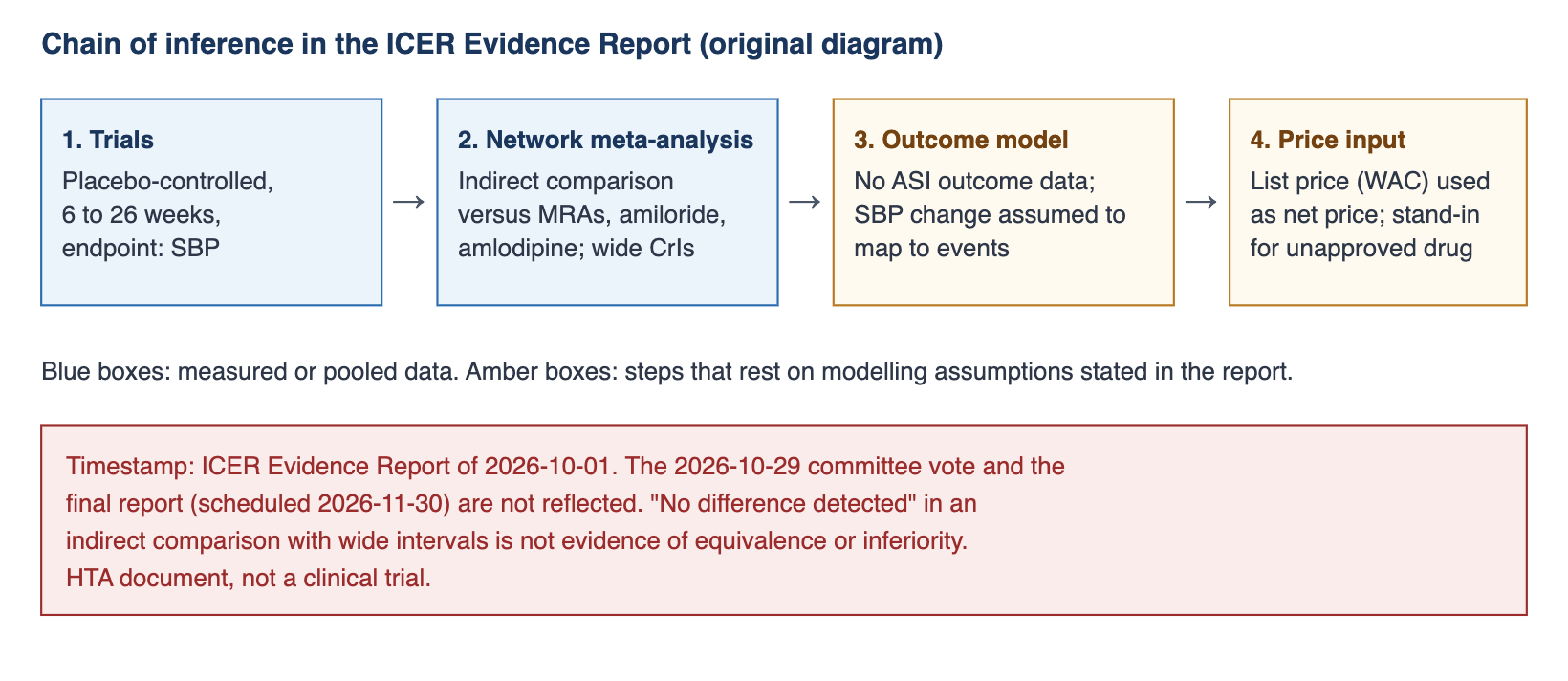
ICER evaluated baxdrostat and lorundrostat in three populations of adults whose blood pressure is not at target: (1) resistant hypertension; (2) uncontrolled on two drugs and intolerant of a third first-line agent; (3) uncontrolled on two drugs and not yet tried on a third first-line agent. According to the report, Population 2 has no dedicated data and was assumed to have the same effect as Population 1. The evidence consisted mostly of placebo-controlled trials lasting 6 to 26 weeks. Comparators were spironolactone, eplerenone and amiloride (Populations 1 and 2) and amlodipine (Population 3).
What the Evidence Report states
In Population 1, ICER’s NMA found significant SBP reductions versus placebo for baxdrostat, lorundrostat, spironolactone, eplerenone and amiloride, in a range of -6.6 to -11 mmHg. It found no significant additional reduction for the ASIs versus the MRAs or amiloride, but it states that the 95% credible intervals were wide and include clinically important differences in both directions. In Population 3, reductions versus placebo ranged from -8.3 to -10.1 mmHg, and ICER reports no significant difference between the ASIs and amlodipine.
On safety, ICER reports hyperkalaemia and hyponatraemia as common. In 54-week data for pooled baxdrostat (1 mg and 2 mg), the report states that 9.5% of participants had potassium above 6.0 mmol/L (placebo 0.8%) and 5.7% discontinued because of hyperkalaemia. ICER also states that outcome data for ASIs are not yet available, whereas the comparator drugs have outcome evidence.
How to read it
The caveat that governs the whole piece: the assessment below is ICER’s, as of the 2026-10-01 Evidence Report, and the 2026-10-29 committee vote and the 2026-11-30 final report are not reflected. “No difference” in blood-pressure lowering means that, in an NMA rather than a direct comparison, the credible intervals were too wide to detect a difference. It does not establish equivalence or inferiority. The cost-effectiveness figures assume list price as net price, and for lorundrostat, which was not approved at the time of the report, they use baxdrostat’s price as a stand-in price.
Reading scope: we downloaded the Evidence Report PDF and read the executive summary and tables using a basic text-extraction method. Some pages lost characters and sentence fragments, so we used values only where they were intact or agreed in two places in the report. The vote result of 2026-10-29 was not available to us as text. The supplement (individual NMA estimates) was not read, and manufacturer comments were not read.
Deep dive
1. Background
Aldosterone synthase inhibitors block the enzyme that produces aldosterone, a different mechanism from MRAs such as spironolactone and eplerenone, which block the receptor. The report describes baxdrostat (brand name BAXFENDY, AstraZeneca) as FDA approved on 2026-05-18, at a recommended 2 mg once daily, or 1 mg where hyperkalaemia or hyponatraemia risk is high. We take the approval date from ICER’s report, which cites the prescribing information; we did not check it against FDA records. Lorundrostat (Mineralys Therapeutics) was described in the report as not yet FDA approved and under FDA consideration. The report cites a Mineralys announcement of 2026-03-09 for acceptance of the new drug application. A review-decision date of 2026-12-22 appears in secondary sources only, and we did not confirm it against a primary source.
ICER is a US non-profit that publishes evidence and value assessments. This assessment was reviewed by its Midwest CEPAC committee, with a public meeting on 2026-10-29 and a final report scheduled for 2026-11-30, according to the ICER assessment page.
2. What this assessment newly establishes
This is a synthesis, not a new study, so what it adds is a formal value judgement and a structured evidence grading. All statements below are ICER’s.
Evidence of blood-pressure effect. The Evidence Report states the SBP reductions versus placebo given above (-6.6 to -11 mmHg in Population 1; -8.3 to -10.1 mmHg in Population 3) and states that the ASIs did not differ significantly from the MRAs, amiloride or amlodipine in the NMA. For Population 3, the report describes the difference versus amlodipine as very small.
Evidence ratings. The report’s executive summary table (ES1) lists the following net health benefit ratings. For baxdrostat versus lorundrostat (Populations 1 and 2, and Population 3), the rating is I, insufficient evidence. For the ASIs versus spironolactone, eplerenone or amiloride (Populations 1 and 2), it is P/I, promising but inconclusive. For the ASIs versus amlodipine (Population 3), ICER’s table lists C-. We read the C- entry but could not reproduce it by independent re-extraction, and the full wording of the C- definition was lost in our text extraction, so this entry carries lower confidence than the others. As we read the report, one basis for the P/I rating is that ASIs may be better tolerated than spironolactone (for example, less gynaecomastia), but the direct comparison trials are short, so ICER’s conclusion is held open.
Safety. The potassium figures are those in the summary above (9.5% above 6.0 mmol/L and 5.7% discontinuation in pooled 54-week baxdrostat data).
Cost-effectiveness. The report uses a baxdrostat list price of $900 per 30 tablets (RedBook WAC), or $10,950 per year, as the net price, because no discount information was available. For lorundrostat, the same price is used as a stand-in price, since the drug is not approved. ICER estimates, per QALY and per equal-value life year (evLY): baxdrostat versus spironolactone $833,000 and $781,000; versus eplerenone $2,077,000 and $1,954,000; versus amiloride $851,000 and $800,000. For lorundrostat on the stand-in price, ICER estimates $1,419,000 and $1,327,000 versus spironolactone, $1,492,000 and $1,403,000 versus amiloride, and describes it as more costly and less effective than eplerenone. ICER did not model the comparison with amlodipine, because the ASIs were rated comparable or inferior. The $833,000 to $2,077,000 per QALY range for baxdrostat agrees with a trade-press report on the earlier August draft; we have not compared the draft and final versions line by line.
Health benefit price benchmark (HBPB). ICER reports an HBPB of $1,400 to $2,500 per year for baxdrostat and $760 to $1,600 per year for lorundrostat. For baxdrostat, ICER states that this corresponds to a discount from list price of 77.2% to 87.4%. We could not reproduce the HBPB ranges independently, and the stated discount is internally consistent only approximately at the lower end (1 minus $1,400 over $10,950 is about 87.2%). We understand the HBPB to be defined relative to a cost-effectiveness threshold range that ICER conventionally sets at $100,000 to $150,000 per QALY or evLY, but we did not confirm this definition in the report text. The range depends on the threshold used: the trade-press report on the August draft described a different range at a different threshold. The HBPB figures should therefore be read as ICER’s, under ICER’s stated threshold, and not as a price recommendation by us. ICER also reports a budget impact threshold of $821 million and a health inequality impact (HIDI) score of 1.2 for Black Americans.
3. Strengths and limitations of the method
Strengths.
- The source is a primary HTA document with a published method, and the structure of the evidence (three populations, named comparators, explicit price inputs) is transparent.
- The report reports where it lacks data (for example, Population 2) and says it assumed equal effect to Population 1, rather than leaving the gap implicit.
- It grades evidence separately from value, so a reader can see that the cost-effectiveness numbers sit on top of a limited evidence base.
Limitations, as stated by ICER. No outcome trials exist, so the model uses SBP as a surrogate and assumes the treatment effect persists. The NMA is an indirect comparison across short trials (6 to 26 weeks) with varied background therapy. ICER’s trial diversity rating describes racial and ethnic representation as Fair in many trials, with Black and Asian participants under-represented, and US enrolment data were not public. Evidence is limited for important subgroups, including advanced chronic kidney disease.
Limitations we would add.
- Price assumption. Using WAC as net price means the cost-effectiveness ratios would change if real net prices differ. The lorundrostat ratios are not based on any actual lorundrostat price.
- Reading scope. Our text extraction lost characters on some pages. The C- grade and the HBPB ranges are single-path reads on our side, and the supplement, manufacturer comments, the 2026-10-29 vote and any differences from the August draft were not reviewed.
- Timing. The vote and final report may change tone or numbers.
4. Connections to neighboring domains
Health economics and modelling. Because no outcome data exist, the translation from SBP to cardiovascular and kidney events is a modelling assumption, with scenarios over 10 and 20 years, as described in the report. This is the same structural question that arises for other surrogate-driven therapies, for example lipoprotein(a) lowering, where a biomarker change must be mapped to outcomes before outcome trials report. The link is an analogy in method, not a pooling of evidence.
Policy and access. The report includes a health inequality impact measure (HIDI) and a budget impact threshold, showing equity and affordability metrics entering an HTA quantitatively. Comparing this approach with health technology assessment elsewhere, for example in Korea, would be a useful methodological exercise; we have not done it here.
Clinical guidelines. ICER states that adding an MRA is recommended for resistant hypertension (it cites a guideline we did not identify). We have not compared this against current European or Korean hypertension guidelines or KDIGO 2021 blood pressure in CKD in this piece.
5. Commercialization perspective
Development stage. On our scale (TRL 1 to 9, where 9 is marketed), baxdrostat is at 9, based on the FDA approval date ICER reports. Lorundrostat is at about 8, with a new drug application under FDA consideration at the time of ICER’s report. These are descriptions of status, not forecasts.
Companies and prices, as facts only. The assessed products are baxdrostat (AstraZeneca) and lorundrostat (Mineralys Therapeutics). ICER used a baxdrostat WAC of $900 per 30 tablets. For comparison, ICER lists generic spironolactone at roughly $43 to $171 per year (its Table 4.4), with eplerenone, amiloride and amlodipine also available as comparators. ICER’s lorundrostat figures use a stand-in price, not a price set by the manufacturer. We have not checked whether outcome trials of ASIs in chronic kidney disease or heart failure are under way. This article does not assess either company’s prospects and draws no investment inference from ICER’s findings.
6. Counterarguments and cautions
- “No difference” is not equivalence. The indirect comparison has wide credible intervals that, per ICER, include clinically important differences in both directions. The finding supports neither superiority nor inferiority of the ASIs.
- Cost-effectiveness depends on inputs. The figures assume WAC equals net price, assume the blood-pressure effect persists, and for lorundrostat use another drug’s price. Different inputs would produce different ratios.
- Threshold definitions. HBPB ranges change with the threshold used; the trade-press report on the earlier draft described a different range at a different threshold. Readers should not compare HBPB figures across documents without checking the threshold.
- Surrogate endpoint. ICER notes the absence of outcome data. That absence is a gap in evidence, not a negative result for ASIs.
- The report is a draft stage of a process. The committee vote of 2026-10-29 and the final report are not reflected here. Manufacturer comments, which the report says are solicited, were not read by us.
- ICER’s funding. ICER states that its largest single funder is Arnold Ventures and that this assessment received no funding from insurers, pharmacy benefit managers or life sciences companies. It also states that about 20% of its overall income comes from a separate Policy Summit programme, roughly half from insurers and PBMs and half from life sciences companies. These are ICER’s self-reported statements, which we have not independently confirmed.
7. Indicators to watch
- The result of the 2026-10-29 Midwest CEPAC vote and any change between the Evidence Report and the final report scheduled for 2026-11-30, including whether the evidence ratings and HBPB ranges change.
- Outcome trials of ASIs (cardiovascular, kidney, heart failure), which would address the main data gap ICER identifies.
- Actual net prices and payer coverage, and whether ICER’s price stand-in for lorundrostat is replaced by a real price after any FDA decision.
- Direct comparison trials of ASIs against spironolactone or amlodipine, and longer-term safety data, particularly hyperkalaemia and its monitoring burden.
- Data in advanced chronic kidney disease and in more diverse populations.
References
- Lin, G. A., K. Suh, D. Nikitin, J. J. Carlson, M. Richardson, M. Phillips, S. Sanchez, and D. M. Rind. 2026. Aldosterone Synthase Inhibitors for the Treatment of Hypertension: Effectiveness and Value. Evidence Report, Institute for Clinical and Economic Review, 1 October 2026. No DOI. URL: icer.org/wp-content/uploads/2026/10/ICER_Hypertension_EvidenceReport_For-Publication_100126.pdf. (Executive summary and tables read via text extraction with some losses.)
- Institute for Clinical and Economic Review. 2026. Hypertension assessment page (schedule, committee, public meeting and final report dates). URL: icer.org/assessment/hypertension-2026/.
- Trials named in the ICER report (BaxHTN, Launch-HTN, Advance-HTN) are described here only as ICER describes them; we did not read them, and we did not verify their journal citations, so none is cited by author or journal.
- Only the ICER Evidence Report and assessment page were read directly for this article; the trials are cited as ICER describes them. Fewer than three primary papers were read directly, so the literature base for this piece is thinner than a full review would require.
Disclosure
- This article is for informational purposes only and is not investment advice, and it is not a basis for clinical decisions.
- The author holds no position in any company named in this post.
- Conflict-of-interest notes:
- Source. The source is a report by an HTA organisation, not a vendor. ICER states that it is an independent non-profit, that its largest single funder is Arnold Ventures, and that this assessment received no funding from insurers, pharmacy benefit managers or life sciences companies. It states that about 20% of its overall income goes to a separate Policy Summit programme and comes from insurers and PBMs and from life sciences companies in roughly equal parts. These are ICER’s own statements and were not independently confirmed.
- Assessed manufacturers. The two assessed products are made by listed companies, AstraZeneca (baxdrostat) and Mineralys Therapeutics (lorundrostat). The report states that manufacturers are invited to comment; we did not read their comments.
- Report authors. The authors listed in the suggested citation are Lin, Suh, Nikitin, Carlson, Richardson, Phillips, Sanchez and Rind. Their individual disclosures were not reviewed.
- Price inputs. Cost-effectiveness figures rest on ICER’s price assumptions: list price (WAC) treated as net price for baxdrostat, and baxdrostat’s price used as a stand-in price for lorundrostat, which was not approved at the time of the report.
- Attribution. All ratings, effect estimates, prices and cost-effectiveness figures in this article are ICER’s, as stated in its 2026-10-01 Evidence Report. They are not our estimates or judgements.
- The figure in this article is an original drawing; no figure from the source was reproduced.


Leave a Reply