Autonomous Error Correction on a Single Trapped-Ion Logical Qubit: A 12.9x Lifetime Ratio Under Injected Magnetic Noise, While Break-Even in Ambient Conditions Remains Statistically Unsettled (arXiv v1 Values)
Analysis based on information available as of 2026-11-03.
30-second summary
- What: A 16-author team (affiliations read from the preprint: University of Science and Technology of China and Zhejiang University) reports in Nature Physics (online 2026-10-23) an autonomous quantum error correction (QEC) scheme on two trapped calcium-40 ions. One ion holds a single logical qubit in a four-level spin code; the other is a cooling ancilla. No mid-circuit measurement or feedback is used. We could not read the published version. Every number below is from the authors’ arXiv v1 preprint (2504.16746); whether the published version keeps them is unverified.
- So what: “Break-even” here means a lifetime ratio, Lambda = logical lifetime divided by the lifetime of the best physical qubit among the levels forming the code in the same ion (Lambda greater than 1). Lambda = 12.9 +/- 2.6 was obtained with deliberately injected magnetic noise (about 10 Hz bandwidth, about 16 nT standard deviation). In ambient conditions Lambda = 2.3 +/- 1.4, roughly 0.9 standard deviations above 1, so break-even there is not statistically established. This is a device-level proof of concept: one logical qubit, a dephasing-only memory, no logical gates, no multi-qubit logic, and the headline number comes from the noise-injected condition.
- Now what: Treat it as a memory demonstration of measurement-free QEC, not as evidence of fault-tolerant computation, and not as comparable by number to surface-code results. TRL 3. Watch for tighter ambient-condition statistics, logical gates, two logical qubits, an error-per-cycle metric, and independent reproduction.
5-minute read
What was built
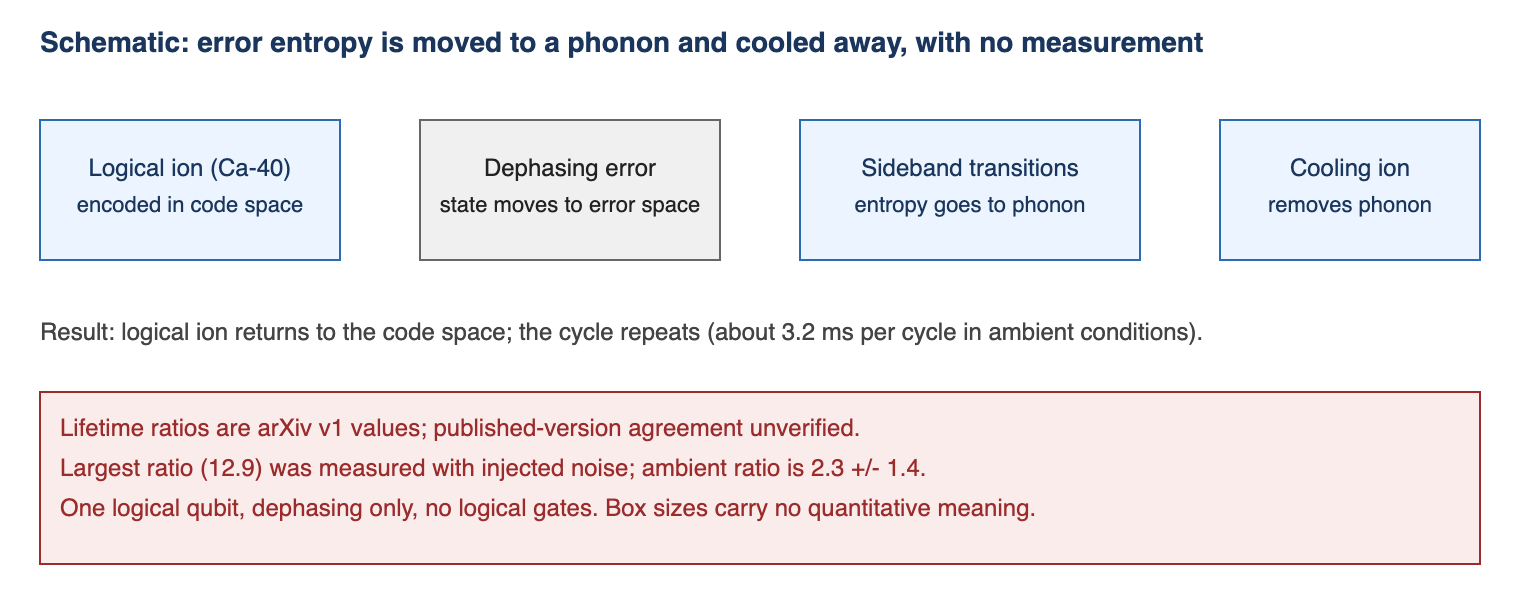
Conventional QEC measures error syndromes mid-circuit and applies a classical correction. This work removes the measurement step. A logical qubit is encoded in four Zeeman levels of the 32D5/2 manifold of one calcium-40 ion. Engineered Raman sideband transitions move the entropy created by an error into the ion pair’s shared vibrational (phonon) mode, and a second ion, laser-cooled, carries that entropy away. Error correction is thus a continuous-style reservoir process rather than a measure-and-fix loop. The code corrects only first-order dephasing errors.
What the numbers say, and what they do not
The authors estimate lifetimes by fitting the decay of process fidelity, then compare the logical qubit with the best physical qubit formed from the code’s own levels. In ambient conditions the logical lifetime is 60.9 +/- 33.0 ms against 26.0 +/- 5.4 ms, giving Lambda = 2.3 +/- 1.4. The authors attribute the large uncertainty to substantial ambient noise fluctuations. With injected noise, 11.6 +/- 1.9 ms against 0.9 +/- 0.1 ms gives Lambda = 12.9 +/- 2.6.
Two points matter for interpretation. First, the 11.6 ms logical lifetime under injected noise is shorter than the 26.0 ms physical lifetime in ambient conditions, so 12.9 is a relative gain inside a deliberately degraded environment, not an absolute lifetime extension. Second, the comparison is to a same-ion reference, not to a platform-wide best qubit and not to an error-per-cycle figure, so it cannot be ranked against surface-code or bosonic-code results by number.
Deep dive
1. Background
“Break-even” in QEC generally asks whether an error-corrected logical qubit outlasts the best uncorrected qubit available. Earlier superconducting-circuit demonstrations (Sivak et al. 2023; Ni et al. 2023) used bosonic codes in cavities, and surface-code experiments report logical error per cycle. Those are different platforms and different metrics. Trapped ions offer long coherence and high-fidelity operations, but standard syndrome extraction needs mid-circuit measurement of ancilla ions, which is slow and can disturb neighbouring ions. Measurement-free, or autonomous, schemes try to avoid that by engineering dissipation: the system is arranged so that errors relax back into the code space, much like a cooled oscillator relaxes to its ground state.
This paper implements such a scheme with two calcium-40 ions in a cryogenic linear Paul trap. The logical qubit is a four-level spin code in the D5/2 Zeeman manifold (mS = +/-1/2, +/-3/2). The second ion provides sympathetic cooling. A concurrent trapped-ion effort (DeBry et al., arXiv:2503.13908) is described by the present authors as reporting a 1.5x logical lifetime gain relative to an ancilla-encoded alternative; this is our paraphrase of their text, and the two results use different definitions.
2. What this study newly establishes
A measurement-free logical memory with a lifetime ratio above 1 under injected noise. The authors report encode and decode process fidelities near 98%, and full autonomous-cycle process fidelities of 0.92(2) starting from the error space and 0.98(1) starting from the code space (arXiv v1 values). The cycle time is about 3.2 ms in ambient conditions; in the injected-noise condition the idle time is shortened to 0.12 ms.
Conditions are stated by the authors. The noise is white noise with a 10 Hz cutoff and a standard deviation of about 16 nT. The arXiv abstract itself says the extended lifetime of roughly 11.6 ms is obtained under injected low-frequency noise. The lack of that qualifier is mainly in the paper’s title (“Beating the break-even point”) and in secondary summaries, not in the abstract.
Ambient-condition result. Lambda = 2.3 +/- 1.4 sits (2.3 – 1)/1.4, about 0.9 standard deviations, above 1. The authors do not claim statistical significance for it. We therefore describe ambient-condition break-even as suggested but unsettled.
An error budget. For the ambient condition the preprint tabulates total infidelity of 6.7% (starting in the error space) and 2.2% (starting in the code space). The largest contributors are phonon frequency drift (2.6%), laser intensity fluctuation (1.7%) and AC Stark shift (1.4%).
3. Strengths and limitations of the method
Strengths.
- No mid-circuit measurement, feedback or post-selection, which removes a classical-control latency and a measurement overhead.
- The authors state the noise-injection parameters and report uncertainties, and the error propagation is internally consistent: 60.9/26.0 is about 2.34 and 11.6/0.9 is about 12.9, with propagated errors close to the stated 1.4 and 2.6.
- The ambient-condition uncertainty is reported openly rather than rounded away.
Limitations.
- Scope. One logical qubit on one ion, a memory only. Logical gates, entanglement between logical qubits and concatenation are not demonstrated and are described as future work.
- Error coverage. The authors write that “our code can correct only the first order error”. Second- and third-order dephasing, and other error types, are not corrected.
- Noise dependence. The gain is largest for low-frequency magnetic noise, which the code targets. Performance against higher-frequency or laser-phase noise was not shown.
- Metric. Lifetimes are inferred from fitted process fidelity, not measured as a logical error rate per cycle. The reference is the best physical qubit among the code’s own levels; the other, shorter-lived ancilla-type qubit is not the benchmark.
- Version. The paper was received 2025-05-18 and accepted 2026-09-07, about 16 months of review. Numbers or wording may have changed in the published version, which we did not read. The statistics for the ambient-condition ratio are the first thing worth checking.
- Independence. All results are from a single group; there is no independent reproduction.
4. Connections to neighboring domains
Control engineering. Replacing a measure-and-correct loop with engineered dissipation resembles reservoir engineering in control theory: the stabilisation is built into the physical dynamics, so classical-processor latency is not in the loop. That is a real conceptual link. Whether it scales is not shown, since a second ion and one shared phonon mode serve a single logical qubit.
Sensing and precision measurement. The test used magnetic-field noise, which invites a link to magnetically limited sensors and memories. The authors do not propose a sensing application, and the injected noise is a test condition. We regard this link as weak and draw no conclusion from it.
Other QEC platforms. The same word, break-even, is used for cavity-based bosonic codes and for surface-code experiments, but the metrics differ (lifetime ratio against a same-system reference versus error per cycle). Numerical rankings across them are not meaningful.
5. Commercialization and investment perspective
TRL 3. A single-qubit, device-level proof of concept whose headline value comes from an artificially noisy condition. The paper offers no commercialization timeline, and we do not infer one.
Related companies. No author is listed with a company; the work comes from universities and is funded by Chinese public programmes. Trapped-ion hardware vendors such as IonQ (listed) and Quantinuum (private) work on QEC with their own methods, but we found no direct relationship to this paper. We draw no investment inference. A scale-up path would require showing multiple logical qubits that share cooling modes, plus logical gates, none of which is in this paper.
6. Counterarguments
- The headline depends on injected noise. Lambda = 12.9 is a relative gain in a deliberately degraded environment. With that noise, the corrected logical lifetime (11.6 ms) is below the uninjected physical lifetime (26.0 ms). A code designed against low-frequency dephasing is expected to do well against low-frequency dephasing, so the injected-noise gain says more about design match than about general robustness. This is our inference.
- Ambient break-even is not established. At 2.3 +/- 1.4, the interval reaches below 1 within one standard deviation. The authors attribute the width to ambient fluctuations; more data or a quieter apparatus would be needed to settle it.
- The reference is relative. Comparing with the best physical qubit among the code’s own levels is a legitimate definition but not the strongest conceivable one, and it prevents cross-platform comparison.
- Scaling. Sharing phonon modes and cooling capacity across several logical qubits is an open issue; we could not confirm how far the authors discuss it.
- Version risk. The values here are from the preprint. Sixteen months of review may have altered the statistics or the framing.
7. Indicators to watch
- Published-version values of the four Lambda inputs and the wording on ambient-condition statistics.
- A repeat of the ambient measurement with a tighter confidence interval on Lambda.
- Logical gates, and two entangled logical qubits, in the same scheme.
- Reporting of logical error per cycle, enabling comparison with other platforms.
- Performance under other noise spectra, including higher-frequency magnetic noise and laser phase noise.
- Independent reproduction by another trapped-ion group, and comparison with the concurrent work of DeBry et al.
References
- Li, Yi, Qingyuan Mei, Qing-Xuan Jie, et al. (16 authors; the preprint lists Chang-Ling Zou, Yiheng Lin and Jiangfeng Du as corresponding authors). 2026. “Beating the break-even point with autonomous quantum error correction.” Nature Physics, first online 23 October 2026. DOI: 10.1038/s41567-026-03486-y (author list and title matched in Crossref; text not read).
- Li, Yi, Qingyuan Mei, Qing-Xuan Jie, et al. 2025. “Beating the break-even point with autonomous quantum error correction” (preprint, v1, 23 April 2025). arXiv 2504.16746. https://arxiv.org/abs/2504.16746 (source of all numerical values in this article).
- DeBry, Kyle, Nadine Meister, Agustin Valdes Martinez, Colin D. Bruzewicz, et al. 2025. “Error correction of a logical qubit encoded in a single atomic ion.” arXiv:2503.13908. https://arxiv.org/abs/2503.13908 (title and authors matched in the arXiv listing; not read in full by us, described only as the preprint cites it).
- Sivak et al. 2023 and Ni et al. 2023 (superconducting-platform break-even demonstrations) are named for context only; their bibliographic details were not verified for this piece and are not itemised.
Disclosure
- This article is for informational purposes only and is not investment advice.
- The author holds no position in any company named in this post.
- Conflict-of-interest notes:
- The 16 authors are affiliated, as read from the arXiv preprint (the published-version affiliations were not available to us), with laboratories at the University of Science and Technology of China (Hefei) and with Zhejiang University (Institute of Quantum Sensing). The three corresponding authors use USTC email addresses. No commercial vendor or listed-company affiliation was identified.
- Funding named in the preprint and matched by three funder records in Crossref: National Natural Science Foundation of China (grants 92165206, 92265210, 12204052), together with the Innovation Program for Quantum Science and Technology, an Anhui Province programme and a National Key R&D Program.
- The published-version metadata carries a statement that the authors declare no competing interests. The preprint contains no such statement.
- All quantitative claims are the authors’ own, are from the arXiv v1 preprint, and have not been independently reproduced. The article passed peer review at Nature Physics (accepted 2026-09-07), but we did not see the review or the published text.
- Our reading relied on the preprint’s full text; the Nature Physics page could not be accessed. The figure in this article is an original drawing.


Leave a Reply