A Neural Triage Decoder for Two Ultra-High-Rate qLDPC Codes: A Phenomenological-Noise Simulation Preprint, with Latency Measured on One GPU Against Mostly Single-Threaded CPU Baselines
Analysis based on information available as of 2026-11-09.
30-second summary
- What: A five-author arXiv preprint (v1, 2026-10-29, not peer reviewed; the arXiv comment describes it as 5 pages and 4 figures with Methods) proposes a neural-network decoder, which the authors call Triage, for two quantum LDPC (qLDPC) codes of about 1,100 physical qubits each. At a physical error rate of 1.5%, the authors report estimated logical error rates of 9.33×10⁻¹¹ and 5.08×10⁻¹⁰ per qubit per round, against 4.43×10⁻¹⁰ (BP-OSD) and 1.76×10⁻⁹ (Tiered decoder) for the comparison decoders. All authors are at academic institutions in China and declare no competing interests.
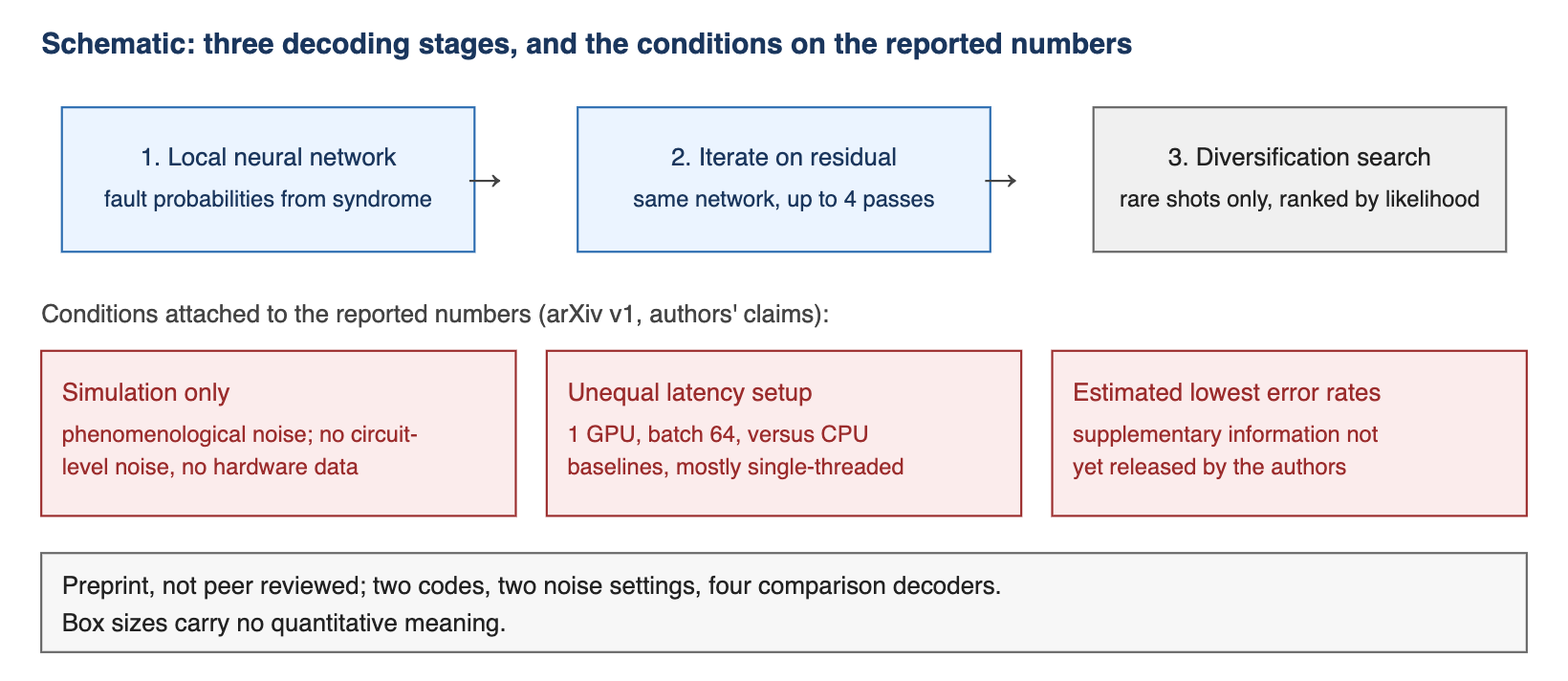
- So what: This is a software simulation under a phenomenological noise model. It is not a hardware experiment, it does not use circuit-level noise, and it does not show real-time decoding. The reported 28x and 343x latency gains compare one NVIDIA GPU, at batch size 64, with CPU baselines run on a host with two 56-core Xeon processors, mostly on a single thread. The lowest error rates are called “estimated” by the authors, and the supplementary information that would document the theory and statistics has not yet been released.
- Now what: Read it as an algorithm-level data point (TRL 2). Watch for the supplementary information, circuit-level noise results, single-shot latency, implementation on FPGA or similar hardware, and independent reproduction.
5-minute read
What was done
Quantum LDPC codes are error-correcting codes that encode many logical qubits in one block with fewer physical qubits per logical qubit than the surface code. Their practical difficulty is decoding: converting the measured error syndrome into a correction accurately and quickly. The preprint targets two large codes: a lifted-product code, [[1122,148,d≤20]] (called LP20), and a Kasai code, [[1152,580,d≤12]]. Each block holds 148 and 580 logical qubits respectively.
The Triage decoder works in three stages. First, a neural network that passes messages locally over the code’s Tanner graph (a bipartite graph linking checks and fault mechanisms) predicts the probability of each fault. Second, the same network is applied again to the remaining syndrome, up to four times. Third, for the rare shots that still have no solution consistent with the syndrome, a diversification step perturbs priors and symmetries to generate candidate corrections, which are ranked by likelihood. The network is trained at a single physical error rate (2%) and tested at other rates, all in simulation.
What the numbers say, and what they do not
At a physical error rate of 1.5% the authors report, for LP20 and Kasai respectively, estimated logical error rates of 9.33×10⁻¹¹ and 5.08×10⁻¹⁰ per qubit per round for Triage. The comparison values are 4.43×10⁻¹⁰ for BP-OSD (LP20) and 1.76×10⁻⁹ for the BP-relay-MLE Tiered decoder (Kasai). Triage’s full-decoder cost at batch size 64 is 2.37 ms and 12.3 ms per shot, against CPU means of 815 ms and 349 ms, which the authors summarise as speedups of about 343x and 28x.
Three conditions govern how to read these figures. First, the noise is phenomenological: data errors and noisy syndrome measurements, followed by a final perfect syndrome extraction. Second, the latency comparison is between one NVIDIA GPU and a CPU host with two Intel Xeon Platinum 8481C processors (56 cores each, 112 cores in total), on which BP and relay-BP ran single-threaded and only the Tiered decoder’s solver used eight threads. The values are amortized over a batch of 64; single-shot latency and sustained throughput were not measured, as the authors state. Third, the lowest logical error rates are labelled “estimated” by the authors. Figure 3 reports roughly 0.04 to 40.96 million shots per point for LP20 and 0.24 to 20.48 million for Kasai, with error bars from 95% Clopper-Pearson intervals. Whether the lowest points are directly measured or extrapolated cannot be established until the supplementary information is released.
Deep dive
1. Background
Quantum LDPC codes are discussed as a route to lower physical-qubit overhead per logical qubit than the surface code. The preprint’s introduction identifies decoding accuracy and latency as bottlenecks for such codes. The standard algorithmic decoder families used as comparison here are belief propagation with ordered-statistics post-processing (BP-OSD) and relay-style belief propagation, and the Tiered decoder adds an exact most-likely-error (MLE) stage. Neural decoders are attractive because their inference parallelises on GPUs, which is the explanation the authors give for the latency reduction.
The authors write that neural-network decoders had not yet been demonstrated for high-rate qLDPC codes. We did not verify the prior literature, and we make no claim that this is a first.
2. What this study newly establishes
- Accuracy on two large codes, in simulation. At p = 0.015, the reported Triage logical error rates are lower than those of the comparison decoders on both codes (values above). The paper’s summary wording is “comparable to or better than”; at these two points Triage is lower.
- Latency. Reported amortized costs of 2.37 ms and 12.3 ms per shot at batch size 64. The ratio to the CPU means is the authors’ calculation: 815/2.37 is about 344 and 349/12.3 is about 28 by our arithmetic, consistent with their figures. The comparison conditions are described above.
- Robustness to mismatched priors. When the decoder’s assumed fault probabilities are perturbed multiplicatively with a relative spread of 0.5, the authors report that the block logical error rate of the neural front end changes by a factor of about 1.01 (LP20) and 0.98 (Kasai), while the algorithmic baselines rise by about 1.6 to 2.1 times. Only the prior values are perturbed, not the noise structure, and two prior realisations were used per spread for most settings.
- A theoretical limit on single-pass decoding. The authors state a theorem that, for a class of CSS codes, even an exact bitwise maximum-a-posteriori decoder leaves a residual syndrome with a probability that scales as a power of p. The full proof is in the supplementary information, which the authors say will come in a second update; we could not check it.
The training uses a single physical error rate of 2%, online simulation, error-weighted sampling, a bank of failure cases (“mistake bank”) and symmetry augmentation. The trained network and the test data come from the same simulated noise model.
3. Strengths and limitations of the method
Strengths.
- It tests two structurally different codes at a scale of hundreds of logical qubits per block, rather than a small code.
- The paper states several of its own limits: circuit-level gadgets and experimental data are named as next steps, and single-shot latency and FPGA deployment are not measured.
- Methods report the hardware for each side of the latency comparison, so the asymmetry can be read from the paper itself.
- All authors declare no competing interests, and the acknowledgements disclose both a vendor academic licence and the use of AI in the project and writing (see Disclosure).
Limitations.
- Noise model. Phenomenological noise omits gate and ancilla error propagation. Generalisation to circuit-level noise, noise correlations and drift is untested.
- Latency comparison. One GPU at batch 64 versus CPU baselines, mostly single-threaded on a 112-core host. The speedup depends on hardware and parallelisation choices and is not a measurement of algorithmic advantage alone. Whether GPU implementations of the baselines exist, or how well they were tuned, was not established from the paper. The GPU is named as an H200 in the Figure 3 caption and as an H-series GPU in Methods.
- Lowest error rates. The authors call the values “estimated”.
- Same-group comparison. The comparison setting and algorithmic baselines come from arXiv:2604.16209, “Towards ultra-high-rate quantum error correction with reconfigurable atom arrays” (C. Zhao, C. Duckering, A. Gu, N. Maskara and H. Zhou, as printed in the preprint’s reference list). Its first author, C. Zhao, is also a corresponding author of the present preprint. This is stated as a fact of the comparison; it is not evidence of any impropriety.
- Scale. Codes of about 1,100 physical qubits with distance at most 12 or 20. Scaling to larger codes is not shown; the complexity statement is the authors’.
- Theory and abstract. The theorem’s proof and the finite-instance certificate are in the unreleased supplementary information. The abstract contains wording, including a broad performance characterisation and the theoretical claim, that we do not repeat here because the body text and the supplementary information do not yet let us check them.
- Version. arXiv v1 only, no peer review. Numbers and wording may change in the announced update.
- Our reading. We read the arXiv full text, Methods, acknowledgements and reference list. We did not read plotted values in the figure panels. The data and code statements say material is available on request; we did not obtain it.
4. Connections to neighboring domains
Machine learning. The decoder is a message-passing network over a sparse graph, trained with failure-aware sampling and symmetry augmentation. Decoding becomes an ML inference workload that maps onto GPUs. The authors’ Discussion also speculates about AI agents improving decoders; no evidence is presented for that and we do not use it as a link.
Semiconductors and high-performance computing. Because the latency figures depend on the GPU-versus-CPU setup, the paper illustrates that real-time decoding is partly a compute-hardware question. The authors list FPGA deployment and single-shot latency measurement as future work. This is the stronger of the two cross-domain links here.
5. Commercialization and investment perspective
TRL 2 (our assessment): an algorithmic proof of concept in software simulation. The preprint offers no commercialization timeline and we do not infer one.
Related companies (facts only). No author lists a company affiliation. The work used NVIDIA GPUs for the neural decoder timing, and acknowledges an academic licence for the COPT solver provided by Cardinal Operations for the MLE decoder. These are product-use facts; the preprint describes no financial relationship with either. The preprint’s introduction cites qLDPC work generally and does not discuss specific company roadmaps. We draw no investment inference.
6. Counterarguments
- Simulation, not hardware. Phenomenological noise, no circuit-level noise, no experimental syndrome data. The authors name circuit-level gadgets and experimental data as central next steps.
- The latency ratio is a function of the setup. One GPU against single-threaded CPU baselines on a 112-core host, at batch size 64. A 343x or 28x ratio under these conditions should not be read as the speed ratio between the algorithms.
- The lowest error rates are estimates. The authors use that word, and the shot counts per point (up to about 41 million for LP20) are small relative to the quoted rates. The supplementary information is not yet public.
- Same-group baseline. The comparison setting and baselines come from a prior paper whose first author is this paper’s corresponding author.
- Scope of the comparison. Two codes, two noise settings and four comparison decoders; one training error rate; the same simulated noise for training and testing.
- Unverified theory. The full proof of the single-pass limit is in supplementary information that has not been released.
Required context: this result is a preprint that has not been peer reviewed. It is a software simulation under phenomenological noise and does not demonstrate hardware operation, circuit-level noise handling or real-time decoding. The reported latency reduction compares one GPU at batch size 64 with CPU baselines that ran on a 112-core host, single-threaded except for an eight-thread solver stage in the Tiered decoder; single-shot latency and sustained throughput were not measured. The lowest logical error rates are described by the authors as estimated, and the supplementary information is not yet released, so whether those points are measured or extrapolated cannot be confirmed. The comparison setting and baselines come from a prior paper whose first author, C. Zhao, is also a corresponding author of this preprint.
7. Indicators to watch
- Release of the supplementary information, including the theorem’s proof, the finite-instance certificate and training details, and any change in numbers in the announced update.
- Re-evaluation under circuit-level noise and on experimental syndrome data.
- Single-shot latency and sustained throughput, and FPGA or other dedicated-hardware implementations.
- Comparisons that give baselines equivalent hardware and parallelism, including GPU implementations.
- Independent reproduction by groups other than the authors.
- Scaling to larger codes and distances, and the peer-reviewed version.
References
- Hong-Ye Hu, Zhenlai Wang, Binzhao Luo, Tao Xiang and Chen Zhao (as printed in the PDF; corresponding authors marked: Hu, Xiang, Zhao). 2026. “Fast and accurate neural triage decoding of ultra-high-rate quantum LDPC codes” (preprint, v1, 29 October 2026). arXiv:2610.40490. https://arxiv.org/abs/2610.40490 (source of all numerical values in this article unless stated otherwise).
- C. Zhao, C. Duckering, A. Gu, N. Maskara and H. Zhou. 2026. “Towards ultra-high-rate quantum error correction with reconfigurable atom arrays.” arXiv:2604.16209. https://arxiv.org/abs/2604.16209 (identified from the reference list of the preprint above; we cite it by author and arXiv ID and did not use its numerical results).
Disclosure
- This article is for informational purposes only and is not investment advice.
- The author holds no position in any company named in this post.
- Conflict-of-interest notes:
- The five authors (Hu, Wang, Luo, Xiang, Zhao), as read from the arXiv full text, are affiliated with the Institute of Physics (Chinese Academy of Sciences), the University of Chinese Academy of Sciences and the Eastern Institute of Technology (Ningbo). No commercial or listed-company author affiliation was identified. The preprint states: “All authors declare no competing interests.”
- Funding and support named in the acknowledgements: an IOP CAS startup fund, an Eastern Institute of Technology startup fund, the Shanghai Artificial Intelligence Laboratory Pioneer Program, and computing resources from the EIT HPC Center.
- The Tiered baseline’s exact solver, COPT, was used under an academic licence provided by Cardinal Operations, as the acknowledgements state. The preprint describes no financial relationship. The acknowledgements also state: “We acknowledge the use of AI in this project and writing.”
- The comparison setting and algorithmic baselines come from arXiv:2604.16209, whose first author, C. Zhao, is also a corresponding author of this preprint.
- All quantitative claims are the authors’ own from arXiv v1, were obtained in simulation, and have not been independently reproduced or peer reviewed.
- Our reading relied on the arXiv full text; plotted values in the figures were not read and the supplementary information was not available. The figure in this article is an original drawing.


Leave a Reply