Analysis based on information available as of 2026-11-17.
30-second summary (the published Nature full text was paywalled and not read; detail comes from the abstract and the earlier arXiv preprint)
- What: AutoDNA is a laboratory in which a set of LLM-based agents plans experiments, writes instrument-control code and runs more than 20 instruments through robotic arms and pipetting. According to the published abstract, it coordinated more than 11,000 steps, sped up concurrent protocol execution 3.2-fold, and was demonstrated on four applications, including identification of a clinically detected KRAS G13D mutation. The definitions behind these numbers could not be verified.
- So what: This is a systems-integration demonstration built and run by one group in its own laboratory. Per-application replicate counts and success rates are not available in anything we read. “No manual intervention” excludes reagent and consumable refills, and the 3.2-fold gain is against sequential execution on the same system, not against other platforms.
- Now what: Read the published full text and Extended Data for repeat-run counts, failure handling, the LLMs used, and code availability before treating this as evidence of autonomous science.
Source note: headline figures are from the PubMed structured abstract of the Nature article. Every other figure is labeled “preprint v1 value” and has not been confirmed against the published version.
5-minute read
What was built
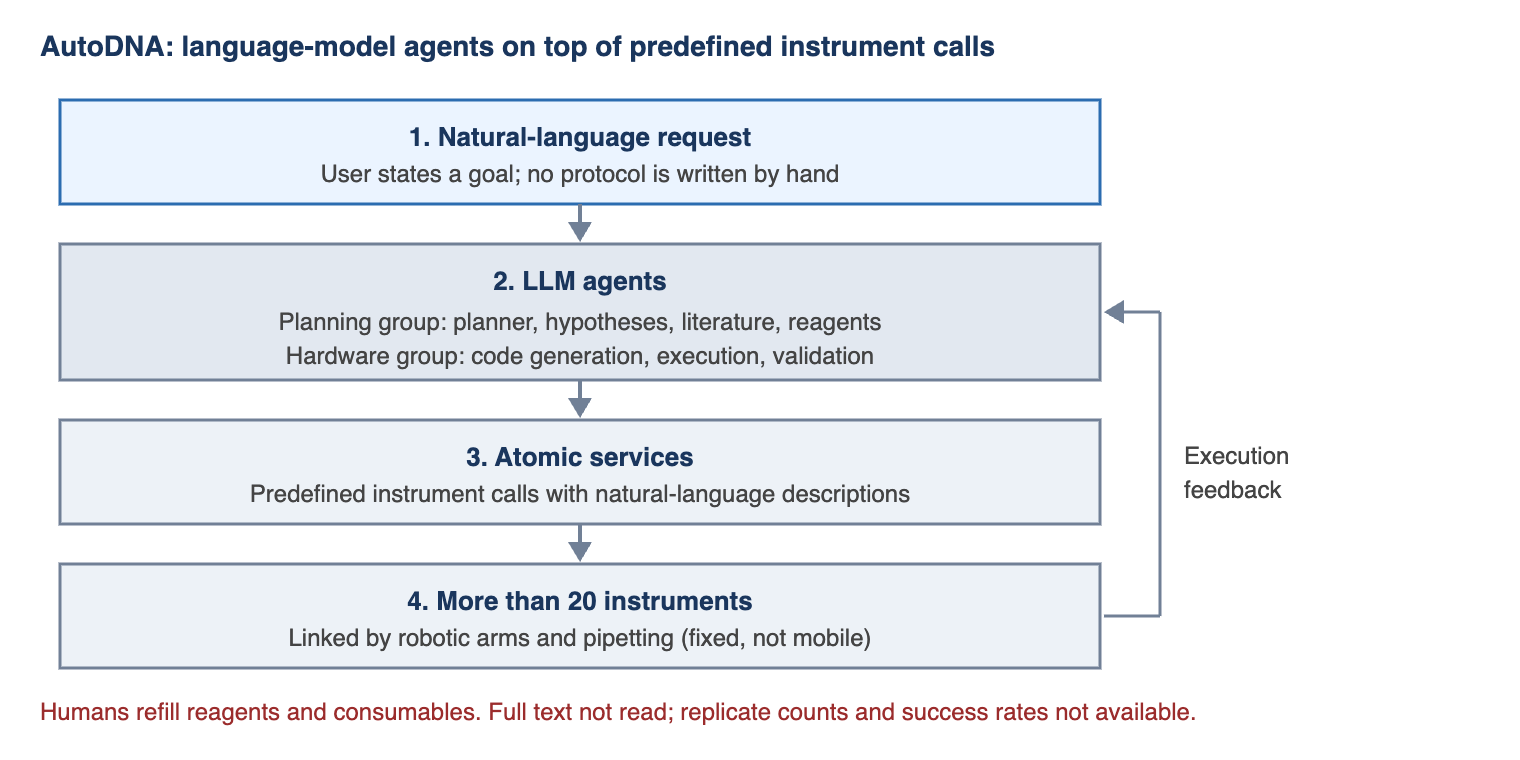
AutoDNA is described as an “AI-native” laboratory for nucleic acid work. A user makes a request in natural language. A planning group of agents (experiment planner, hypothesis proposer, literature researcher, reagent manager) turns it into a protocol. A second group (a program developer and a hardware executor and validator) generates and checks the control code that drives the hardware. The hardware is a fixed laboratory setup: pipetting and robotic arms moving tubes between instruments such as thermocyclers, fluorometers, heater-shakers, magnetic racks, centrifuges and a sequencer.
The design choice the authors emphasize is abstraction. Instrument functions are extracted from instrument documentation and wrapped as Python objects with natural-language descriptions, which the authors call “atomic services” (for a thermocycler, for example, setting a temperature and starting a run). The agents write and correct code against this layer.
What the authors report
The published abstract states that the system coordinated more than 11,000 steps across more than 20 instruments, with human involvement limited to hardware maintenance such as refilling reagents and consumables. In four applications, the authors report that enzymatic DNA synthesis yield matched expert optimization, concurrent protocols ran 3.2-fold faster, one cycle of DNA data storage recovered the original digital content exactly, and a clinically detected KRAS G13D mutation was identified and validated. The abstract concludes with a “blueprint towards science-as-a-service.” We could not verify how “3.2-fold” and “steps” are defined.
The earlier preprint (arXiv v1) gives more detail, for three applications. These are preprint v1 values and may have changed in the published paper. In the preprint, the agent-optimized synthesis of an 8-mer sequence reached a reported yield above 98% and an average stepwise yield of 97.7%, compared with prior manually optimized literature results. Parallel proposals cut exploration time 3.60-fold (1,434.7 to 398.7 minutes) relative to sequential execution on the same system. A DNA storage read-write cycle took 162.9 hours and 9,365 hardware steps, and the 78 synthesized strands were read back and recovered as the original content.
How far the result reaches
Two things limit the reading. First, the physical work is a set of predefined instrument calls; the language model plans and writes code but does not learn contact manipulation, so this is not evidence for a robotics foundation model. Second, the preprint describes what looks like a single run per application, with no repeat counts or failure rates in the portions we read. The one self-correction example (an agent fixing a missing step that would have run instruments on empty wells) is an anecdote, not a rate. A reasonable reading is: LLM agents orchestrated an existing multi-instrument biology workflow for roughly a week of instrument time, and the integration itself is the contribution.
Deep dive
1. Background
Self-driving laboratories have so far been most visible in chemistry and materials; the AutoDNA preprint cites autonomous chemistry work (Burger et al., Nature, 2020, and Dai et al., Nature, 2024) as context. Nucleic acid workflows are a demanding target because they chain many instruments (thermal cycling, magnetic separation, fluorescence readout, sequencing) with timing and liquid-handling constraints. DNA data storage and enzymatic DNA synthesis are active areas where automation has also been explored (the preprint cites prior automated DNA storage work and DNA-DISK, published in PNAS in 2024). We did not re-verify these cited works against their primary publications for this piece.
2. What this study adds
Per the published abstract (doi:10.1038/s41586-026-11228-6), the claim is a laboratory operated through natural-language requests, with agent roles split between experiment planning and hardware execution, coordinating more than 20 instruments over more than 11,000 steps. The preprint adds the atomic-service abstraction and agent-based code correction as the enabling design. We are not claiming novelty beyond what the sources say, and we did not verify any “first” or “fully autonomous” framing.
Versions differ. Going from preprint v1 to the published abstract, the reported step count moved from 9,365 (one application) to “more than 11,000” (system-wide, as far as we can tell), the concurrency gain from 3.60-fold to 3.2-fold, applications from three to four (KRAS G13D added), and authors from 12 to 15. The title changed from “…biomolecular engineering” to “…biomolecular operations.” Because we could not read the published Methods, we cannot say which definition each number uses. The preprint v1 and the Nature article are linked by inference (shared system name, overlapping authors, matching applications), not by an official preprint relation in the Crossref record.
3. Strengths and limitations of the method
Strengths: real hardware rather than simulation; a long continuous run (162.9 hours in the preprint’s storage experiment); an explicit abstraction layer that makes the agent-to-instrument interface inspectable; and several different application types on one platform, which is a more informative test of integration than a single protocol.
Limitations of the evidence available to us:
- Published full text not read. Nature access was paywalled and no legal open-access copy was found. Methods, Extended Data, supplementary material and code and data availability statements were not read.
- Demonstration scale. The preprint text suggests one execution per application. Success rates, failure modes and manual recovery counts are not reported in what we read.
- Definition of autonomy. The authors’ “no manual intervention” excludes reagent and consumable refills. Refill frequency and any intervention logs were not available to us.
- Benchmark choice. The synthesis comparison is one 8-mer sequence against literature results, not a same-condition manual control. The preprint reports “yield over 98%” and “97.7% average stepwise yield” as separate metrics, which should not be merged.
- Throughput baseline. The 3.2-fold (published) and 3.60-fold (preprint) figures compare concurrent with sequential execution on the same platform. They are not measured against other autonomous platforms.
- DNA storage “exact recovery.” Whether error-correcting codes or read coverage contributed was not determined from the portions we read, so the figure does not directly state raw synthesis or sequencing fidelity. In the preprint, deletions were the main error type (2.35% deletions, 0.25% insertions, 0.12% substitutions, nanopore-based; preprint v1 values).
- KRAS G13D. Only one abstract sentence was available. Sample number, ethics approval and the comparison method are unverified.
- Language model identity. The preprint text we read does not state which LLMs were used.
4. Connections to neighboring domains
AI and machine learning. The central technique is an LLM agent that turns instrument documentation into control code and revises it from execution feedback. This is a software-agent pattern applied to a physical setting, and the relevant open questions are reliability and error recovery rather than raw capability. The reading that fits the evidence is “LLM orchestration of existing automation,” not “autonomous robot.”
Biotechnology and diagnostics. A single platform running enzymatic synthesis, RPA-based nucleic acid detection and DNA storage suggests that protocol optimization, assay workflows and data-storage read-write can share automation infrastructure. Whether the same abstractions transfer to another laboratory’s instruments, from documentation alone, is untested in what we read.
Chemistry and materials self-driving labs. The preprint cites these as context. We found no performance comparison between AutoDNA and those systems, so we draw only a thematic connection.
5. Commercialization and investment perspective
For information only; not investment advice.
- Maturity. We assess this at roughly TRL 4: an integrated prototype validated in a single laboratory. There is no evidence in what we read of multi-site operation, long-term uptime or quality-control systems. This is our assessment, not the authors’ claim.
- Business model. The abstract frames the work as a blueprint toward “science-as-a-service.” We found no customers, pricing, regulatory approach (biosafety, data integrity) or commercialization timeline in the sources, so we do not estimate one.
- Related organizations (facts only). The authors are affiliated with Shanghai Jiao Tong University (computer science and chemistry units). One author lists an additional affiliation with Yuanzi Zhishu Technology Co. Ltd (Shanghai), and one with the Jiaxing Key Laboratory of Biosemiconductors and Xiangfu Laboratory. The business of the company and any relationship to AutoDNA were not verified, and we did not check whether it is listed. We found no directly exposed listed company in the sources.
6. Counterpoints and caveats
- AutoDNA is a systems-integration demonstration built and run by one group in its own laboratory with LLM agents coordinating existing automated instruments. Replicate counts and success rates per application were not available to us.
- “No manual intervention” excludes reagent and consumable refills. A long continuous run measures duration of operation, not maturity of unattended operation.
- The 3.2-fold speedup is relative to sequential execution on the same system. It is not a head-to-head comparison with conventional or competing platforms.
- The abstract’s phrase “blueprint towards science-as-a-service” and the “AI-native” framing are the authors’ and are large relative to the demonstrated scale. We read them as aspiration.
- Numbers moved between the preprint and the published abstract (steps, speedup, application count). Until the published Methods are read, treat preprint values as provisional.
- No independent replication is known to us.
7. Indicators to watch
- From the published full text: repeat-run counts, success versus attempted runs, number of agent errors and corrections, and the definition of “steps” and of the 3.2-fold gain.
- Which LLMs, versions, costs and latencies were used.
- Release of code, atomic-service definitions and data.
- Logs of human intervention (refill frequency, manual recovery events).
- Portability: whether the abstraction can be generated from documentation for a different instrument set, in another laboratory.
- Extension to longer or more varied DNA sequences, and detail on the KRAS G13D validation (sample numbers, reference method, ethics).
References
- Wu, Mingyu, Zhaoguo Wang, et al. (15 authors). 2026. “An AI-native experimental laboratory for autonomous biomolecular operations.” Nature, first published online 2026-11-04. https://doi.org/10.1038/s41586-026-11228-6 (PubMed PMID 42983087; abstract and metadata only, full text not read).
- AutoDNA preprint authors (12 authors). 2025. Preprint, arXiv:2507.02379v1, posted 2025-07-03. https://arxiv.org/abs/2507.02379 (full text read; title differs from the published version).
- Burger, Benjamin, et al. 2020. “A mobile robotic chemist.” Nature 583: 237–241. https://doi.org/10.1038/s41586-020-2442-2
- Dai, Tianwei, et al. 2024. “Autonomous mobile robots for exploratory synthetic chemistry.” Nature 635: 890–897. https://doi.org/10.1038/s41586-024-08173-7 (both cited in the AutoDNA preprint as context).
Disclosure
- This article is provided for information only and is not investment advice.
- The author holds no position in any company named in this post.
- Conflict-of-interest notes. The published article declares no competing interests (PubMed record; consistent with the Crossref assertion). The article has 15 authors, up from 12 in the preprint. One author lists an additional affiliation with Yuanzi Zhishu Technology Co. Ltd, Shanghai; its business, its relationship to AutoDNA and any ownership or commercialization plans were not verified. The funding source was not identified, because the preprint has no acknowledgments and the published full text was not read. All quantitative claims above are author-reported; no independent replication is known to us.
- This piece was written from the published abstract, article metadata and the full text of the arXiv preprint v1. The published Nature full text was not read.
- The figure in this article is an original drawing; no figure from the source was reproduced.


Leave a Reply