Analysis based on information available as of 2026-11-17.
30-second summary (in silico benchmarks; structure labels used for pretraining are themselves predictions; published main text not read)
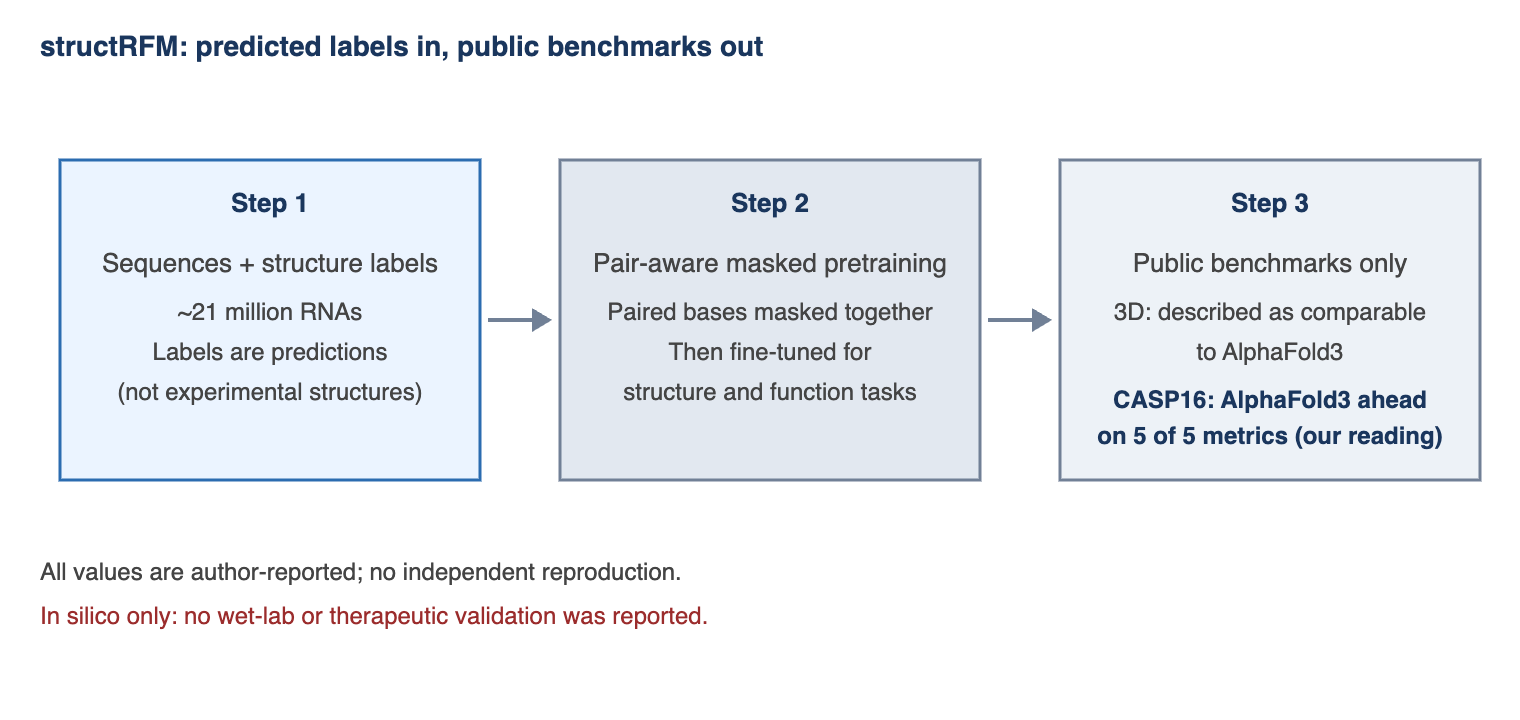
- What: Zhu and colleagues (Nature, 2026-11-04) pretrained a BERT-style RNA language model on about 21 million RNA sequences from RNAcentral, each paired with a computationally predicted secondary structure. Base-paired positions are masked together during training. The authors report gains on secondary-structure prediction, a tertiary-structure pipeline built on the model (Zfold), and several function-prediction tasks. Data, code and checkpoints are public.
- So what: The published abstract describes tertiary-structure performance as comparable to AlphaFold3 on CASP15-natural, CASP16 and RNA-Puzzles. In our reading of the supplementary tables, AlphaFold3 is ahead on all five reported metrics for CASP16, the newest target set (author-reported, read once, not independently re-checked). Gains from adding structure to pretraining are modest (roughly 3 to 15% against a same-data control, per the authors), and on one secondary-structure benchmark the teacher predictor BPfold alone scored the same as structRFM.
- Now what: Treat this as a useful open resource and a clean ablation, not evidence of generalization beyond known RNA families. Watch for independent reproduction, evaluation on low-similarity new targets, and any wet-lab test of the function predictions.
Source note: we read the published abstract, the publisher’s public Supplementary Information, Reporting Summary and Peer Review File, and the Research Square v1 preprint in full. We did not read the published Results and Methods. Where a number comes from the preprint rather than the published paper, it is labeled.
5-minute read
What was built
RNA foundation models are language models pretrained on large collections of RNA sequences. A recurring question is whether adding structural information, which determines much of how an RNA behaves, helps beyond sequence alone. structRFM tests this with a simple idea: each training sequence is annotated with a predicted secondary structure, and when a base is masked, its paired partner is masked too, so the model must infer both from the surrounding context. The structure enters through the masking rule rather than through an extra loss term. In the published version the structure labels come from an ensemble of three predictors (ViennaRNA, CONTRAfold and BPfold).
What was found
The most useful design choice is a control: the authors trained a version without structure information (structRFM-minus) on the same data. Against that control, they report improvements of roughly 3 to 15% depending on the task, and some of the tertiary-structure comparisons are not statistically significant (for example P=0.057 for one CASP16 metric and P=0.64 for one RNA-Puzzles metric, with only 8 to 20 targets per set and no multiple-comparison correction visible).
On tertiary structure, the published abstract states “performance comparable to AlphaFold3 across CASP15-natural, CASP16 and RNA-Puzzles.” In the supplementary table as we read it, structRFM-based Zfold is ahead of AlphaFold3 on some RNA-Puzzles metrics (for example RMSD), while AlphaFold3 is ahead on all five CASP16 metrics. By our own tally of the table, AlphaFold3 leads in 10 of 15 target-set-by-metric cells and structRFM in 5. We could not re-read that table a second time, so treat this tally as unverified.
How far the result reaches
The benchmarks are retrospective and computational. The structure labels used for pretraining are predictions, not experimental structures, so errors in the teacher tools can be inherited. In the authors’ own table for the bpRNA-TS0 test set, the teacher predictor BPfold alone scored 0.670 against 0.669 for structRFM, which suggests pretraining did not move beyond the teacher there. The model also takes inputs of at most 512 nucleotides. These results do not show that the model generalizes to RNA families or designs far from its training data.
Deep dive
1. Background
Language models trained by masking tokens have been applied to RNA sequence collections (examples named in the paper’s comparisons include RNA-FM, RNAErnie, RiNALMo and ERNIE-RNA). Predicting RNA structure is harder than for proteins: experimentally solved RNA structures are scarce, and AlphaFold3 (Abramson et al., 2024) extends structure prediction to nucleic acids. structRFM asks whether predicted secondary structure, which is cheap to generate at scale, can serve as a training signal that improves downstream tasks.
2. What this study adds
Reported by Zhu et al. (Nature, doi:10.1038/s41586-026-11210-2), as read from the abstract and public supplementary files:
- A dataset and model release. Roughly 21 million sequence-structure pairs, code (MIT license on GitHub) and checkpoints are public. Per the preprint’s Methods, sequences up to 512 nucleotides from RNAcentral v24.0 were used.
- A structure-aware masking rule. If a masked base is paired, its partner is masked too, with the structure-masking ratio raised during training. The preprint states no auxiliary structure loss is used.
- Secondary structure. In the published supplement (read once), structRFM scores 0.890 on ArchiveII600 and 0.669 on bpRNA-TS0 using the INF metric. The comparison values for RNAErnie (0.876, 0.620) and RNA-FM (0.849, 0.647) are captioned as taken from the RNAErnie paper. The same-data control scores 0.851 and 0.630. The teacher BPfold alone scores 0.823 and 0.670. We could not confirm whether the baseline values were recomputed or copied, or whether the metric definitions are identical across rows.
- Tertiary structure. Zfold replaces the input features of trRosettaRNA with structRFM features. Target sets are small: 20 (RNA-Puzzles), 12 (CASP15, of which 8 natural) and 13 (CASP16).
- Function tasks. On IRES identification, structRFM reaches F1 0.701 against 0.678 for the same-data control. The preprint reported a much larger F1 improvement, but that figure was measured against IRESfinder, whose AUROC in the table is 0.449 (below chance), and the authors say the two comparison tools could not be retrained. In the published supplement the RiNALMo row shows 0.500 on every metric, which looks like a failed or single-class run and is not a meaningful comparison (our interpretation). For non-coding RNA classification, structRFM (F1 0.979) is close to RNA-FM (0.972).
Version history. The work exists in several versions. The Research Square preprint v1 (posted 2025-08-29, 9 authors) carried a different title and a different model; bioRxiv hosts three versions (v1 2025-08-07, v2 2026-05-14, v3 2026-10-29, the last with the published title). Between the first preprint we read and the published paper, the labels were changed from a single predictor to an ensemble, metrics were swapped (F1 to INF, RMSD to a corrected RMSD), CASP16 was added, and the AlphaFold3 framing changed from an explicit advantage on RNA-Puzzles to “comparable.” We did not read bioRxiv v3, which could fill in items we could not verify (parameter count, ensemble weights, pretraining compute in the published version). The pretraining compute we know of is the preprint’s statement of about 400 hours on two A100 80GB GPUs, which may not carry over to the published model.
3. Strengths and limitations of the method
Strengths:
- A same-data, structure-free control isolates the effect of the masking rule better than most foundation-model papers.
- Open data, code and weights allow reuse and reproduction.
- The peer review file shows that review pushed the authors to add metrics and a newer target set, and the published abstract is more conservative than the preprint’s.
Limitations:
- Predicted labels. Pretraining structures come from computational tools. Reviewers raised error propagation; the authors responded with the ensemble but did not run a self-distillation experiment, citing compute cost.
- Teacher parity. On bpRNA-TS0, the teacher BPfold alone matches structRFM (0.670 vs 0.669 in the authors’ table). BPfold was developed by the same first-author group, so the strongest baseline is a self-comparison.
- Modest and partly non-significant gains. Gains over the control are a few percent on several tasks, with small target sets and visible non-significant cells. A reviewer noted that gains are often “a few hundredths” and suggested the main driver may be the training data. The authors report equal training data for the controls (except IRES), but no experiment trained a different RNA language model on the same 21 million sequences.
- Similarity to training data. In the authors’ similarity analysis, only about 30% of CASP15 and CASP16 targets have low maximum similarity (below 0.4) to the training database, and the authors state that performance on RNA-Puzzles, which have higher mean similarity, is better. The largest advantage over AlphaFold3 therefore appears where similarity is highest. We did not read the comparison values for the 436 new Rfam families the authors tested.
- Length and range. Inputs are capped at 512 nucleotides; longer RNAs use overlapping windows (reported for lncRNA classification, not for structure). The authors state weaker results for synthetic RNAs and long bacterial RNAs, and non-canonical base pairs were excluded from pretraining.
- Baseline selection. Evo 2 was not compared; the authors state this was due to task suitability and poor frozen-transfer results, which we cannot check.
- Self-run comparator. AlphaFold3 outputs were generated by the authors through the web server (accessed 2025-07-05 per the Reporting Summary); run settings such as seeds and templates are not stated in what we read.
- Possible transcription issues. A function-task table lists an accuracy value that does not match its recall and F1; we could not tell whether this is a typo. The secondary-structure values for the control in the review response and in the preprint’s F1 table coincide in a way we could not explain.
4. Connections to neighboring domains
Protein and genomic language models. Injecting predicted labels through masking rules could in principle transfer to protein models (predicted structure) or genomic models (predicted regulatory annotations). This paper’s own results indicate the required checks: a teacher-only baseline and a test for inherited label errors. That is our extrapolation, not a result of the paper.
Benchmark hygiene. The shift between versions (new pretraining, new metrics, a withdrawn comparison framing) is a worked example of why preprint numbers should not be carried into discussion of the published paper without re-checking. The same pattern, where a strong baseline narrows an apparent lead, appears in discussions of other biological foundation models; we regard this as a loose parallel and do not combine the results.
RNA therapeutics (hypothesis). IRES and non-coding RNA classification are upstream tasks for circular RNA and RNA-therapeutic design. The paper reports in silico classification only; nothing in it tests a design or a biological effect.
5. Commercialization and investment perspective
For information only; not investment advice.
- TRL. About 3: proof of concept on public benchmarks plus open research resources. No wet-lab, therapeutic or industrial pipeline evidence is reported.
- Timeline. No basis in the sources for a commercialization timeline; unverified.
- Developers. The authors are at the University of Science and Technology of China and Zhejiang University (academic). Code is MIT-licensed. We found no licensing partner or company affiliation.
- Related models (facts only). AlphaFold3 is described in a Nature paper (Abramson et al., 2024) associated with Google DeepMind and Isomorphic Labs. Evo 2 was excluded from the comparison. RiNALMo, RNA-FM and RNAErnie are from academic groups.
6. Counterpoints and caveats
- The published abstract says “comparable” to AlphaFold3; the earlier preprint we read described a clear advantage on RNA-Puzzles. The published wording replaces that framing, and the supplementary values (our reading, single pass) show AlphaFold3 ahead on all CASP16 metrics. Any comparison to AlphaFold3 should rest on the published wording.
- Pretraining labels are predictions, and the teacher BPfold alone matched structRFM on bpRNA-TS0. This limits how much of the performance can be credited to what the model learned beyond its teacher.
- Structure-pretraining gains are small, tertiary-structure sample sizes are 8 to 20 targets, and several cells are not statistically significant.
- The IRES improvement reported in the preprint was against a comparator with below-chance AUROC; against the same-data control the gain is about 3 percentage points of F1.
- All numbers are author-reported. The AlphaFold3 results were run by the authors, and the strongest baseline (BPfold) is from the same group.
- We did not read the published main text, and we did not read bioRxiv v3. Parameter count, ensemble details and published-version compute are unverified.
- The authors declare no competing interests, which was consistent across three sources we checked.
7. Indicators to watch
- Independent reproduction of the secondary-structure and Zfold results from the released code and weights.
- Performance on future blind targets with low similarity to the training database (for example a later CASP round), against AlphaFold3 run with documented settings.
- A control in which another RNA language model is pretrained on the same 21 million sequences.
- Teacher-only baselines reported alongside any model that learns from predicted labels.
- Wet-lab tests of IRES or non-coding RNA predictions.
- Details from the full published text and bioRxiv v3: parameter count, ensemble weights, pretraining compute.
References
- Zhu, Heqin, et al. 2026. “An open structure-guided RNA foundation model for generalizable prediction.” Nature, published online 2026-11-04. https://doi.org/10.1038/s41586-026-11210-2 (PubMed PMID 42983082; main text not read; abstract, public Supplementary Information, Reporting Summary and Peer Review File read).
- Research Square preprint of the same work, posted 2025-08-29, titled “A fully open structure-guided RNA foundation model for robust structural and functional inference,” rs-7321052/v1 (CC BY 4.0). https://www.researchsquare.com/article/rs-7321052/v1 (full text read; earlier version, differs from the published paper).
- bioRxiv preprint of the same work, versions v1 (2025-08-07), v2 (2026-05-14) and v3 (2026-10-29, published title). https://doi.org/10.1101/2025.08.06.668731 (listed from the bioRxiv API; versions not read).
- Abramson, Josh, et al. 2024. “Accurate structure prediction of biomolecular interactions with AlphaFold 3.” Nature 630: 493–500. https://doi.org/10.1038/s41586-024-07487-w
- Zhu, Heqin, et al. 2025. “Deep generalizable prediction of RNA secondary structure via base pair motif energy.” Nature Communications 16. https://doi.org/10.1038/s41467-025-60048-1 (BPfold, described by the authors as the teacher predictor).
- Code and data: GitHub heqin-zhu/structRFM (MIT license); Zenodo dataset 10.5281/zenodo.18272040 and code v0.0.8 10.5281/zenodo.18274292, as stated in the paper’s availability statements (not opened).
Disclosure
- This article is provided for information only and is not investment advice.
- The author holds no position in any company named in this post.
- Conflict-of-interest notes. The authors are affiliated with the University of Science and Technology of China and Zhejiang University and report funding from the National Natural Science Foundation of China, a National Key R&D Program of China project, and Jiangsu, Suzhou and Shenzhen programs. They declare no competing interests (publisher page, PubMed and the preprint agree). The teacher predictor BPfold was developed by the same first-author group, and the AlphaFold3 results were generated by the authors through the public web server. All quantitative claims above are author-reported values with no independent reproduction.
- This piece was written without reading the published main text; supplementary-table values were read once and not independently re-extracted, and the 10-of-15 tally is the author’s own count.
- The figure in this article is an original drawing; no figure from the source was reproduced.


Leave a Reply