Analysis based on information available as of 2026-11-17.
30-second summary (the published Nature full text was paywalled and not read; every number below comes from the published abstract or the medRxiv preprint, and is author-reported)
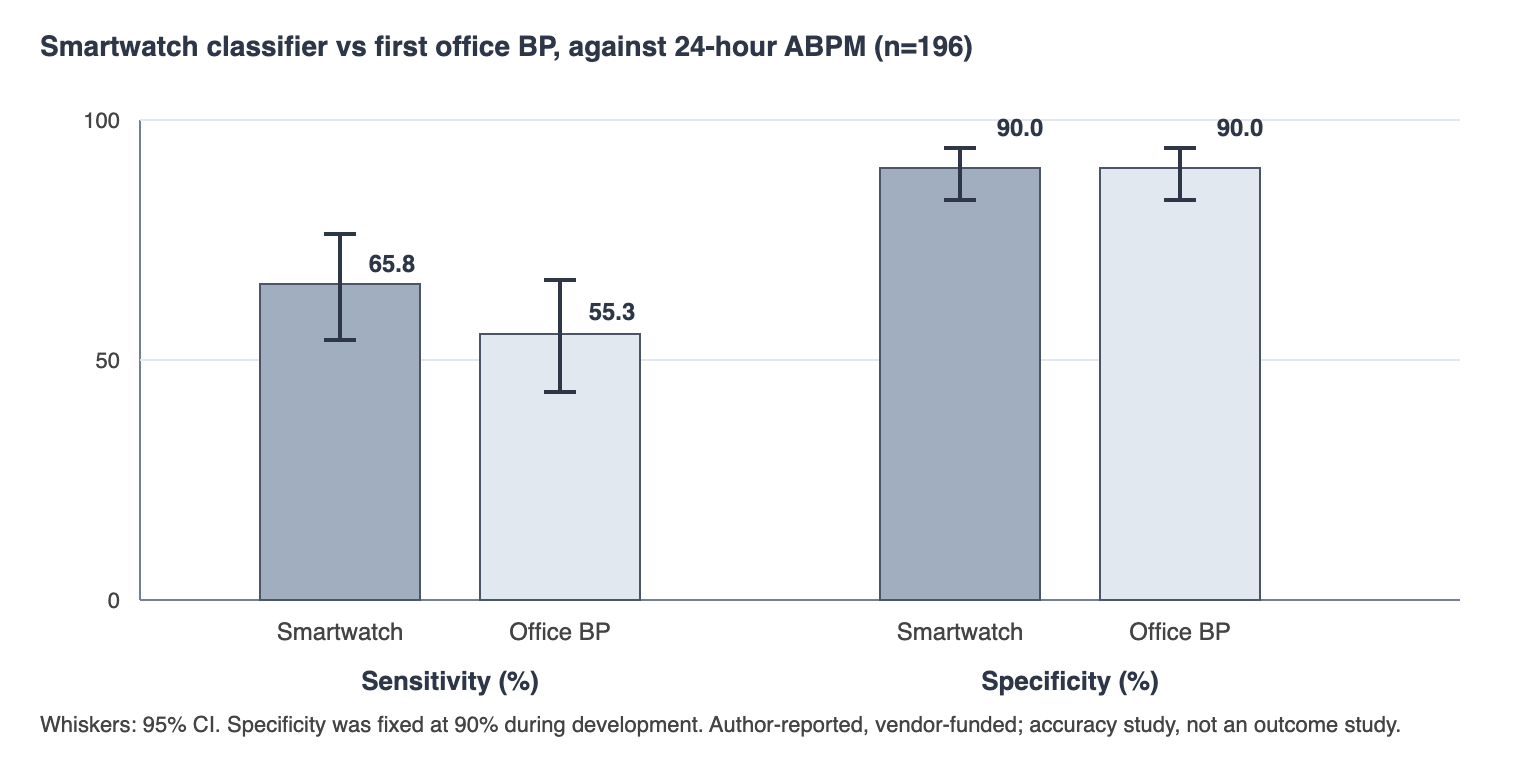
- What: In a prospective validation of 196 adults without cardiovascular disease or antihypertensive treatment, a machine-learning classifier reading photoplethysmography (PPG) and accelerometer signals from a Pixel Watch 3 worn for 7 days detected hypertension, defined by 24-hour ambulatory blood pressure monitoring (ABPM), with sensitivity 65.8% (95% CI 54.0 to 76.3), specificity 90.0% (83.2 to 94.7) and positive predictive value 80.6% (68.6 to 89.6). A first office blood pressure reading gave 55.3%, 90.0% and 77.8% (published abstract and preprint).
- So what: This is a diagnostic-accuracy study of a screening signal, not an outcome study and not a real-world screening deployment. The study was funded by Alphabet, and 15 of 16 authors are Alphabet employees (preprint disclosure); the results have not been independently replicated. The 90% specificity is an operating point fixed during development, and the sensitivity difference from office blood pressure (65.8% vs 55.3%) comes with widely overlapping confidence intervals. Whether such alerts improve diagnosis or cardiovascular events was not tested.
- Now what: Treat it as evidence for “prompting a cuff-based check,” which is how the published abstract frames the conclusion. Watch for the full published text (preprint-to-journal changes), independent replication, and any randomized outcome evidence.
Source note: the decisive figures (sensitivity, specificity, PPV, sample size, wear period, reference standard) were checked against both the published abstract and the preprint and agree. Other values are drawn from the preprint only and are labeled as such. The published version’s Methods, supplementary tables and Competing interests statement were not read.
5-minute read
What was tested
Hypertension is frequently undiagnosed, and many people with it have little contact with clinicians. Cuffless wearables have struggled with absolute blood pressure estimates because those need per-person calibration. This study sidesteps that: it does not estimate a blood pressure value. It asks a binary question, whether a person’s 24-hour average blood pressure is at or above 130/80 mmHg, and uses the answer only to suggest a visit.
Per the preprint, the model is a one-dimensional convolutional encoder (about 5.1 million parameters) that reads 15-second PPG and accelerometer-magnitude waveforms. It was pretrained without labels on about 492,000 hours of data from 2,109 participants in Fitbit studies, then topped with a simple logistic regression trained on 663 people who had 24-hour ABPM. The classification threshold was set in development to give 90% specificity. Validation took place at five US institutions in adults without cardiovascular disease or antihypertensive drugs: 296 were enrolled and 196 were analyzed, mostly because of missing ABPM data (preprint).
What was found
Against 24-hour ABPM, the classifier flagged about two thirds of people with hypertension while keeping false alarms to about one in ten of those without it. A first office reading, at the same 90.0% specificity, flagged about 55%. The two sensitivity intervals (54.0 to 76.3 vs 43.4 to 66.7) overlap widely, and the preprint reports no superiority test, so the accurate summary is “similar, with a numerically higher point estimate,” not “better than office measurement.”
How far the result reaches
This is a vendor study: Alphabet funded it and 15 of 16 authors are Alphabet employees (preprint disclosure), and no independent group has replicated it. The participants had no cardiovascular disease or treatment, and ABPM-defined hypertension prevalence was 38.8% (preprint), likely higher than in a general screening population, which would lower the real-world positive predictive value. The test measured accuracy only. The published abstract itself concludes by “prompting at-risk individuals toward clinical assessment and confirmatory diagnosis using established cuff-based methodologies.”
Deep dive
1. Background
Guideline diagnostic pathways for hypertension typically move from office readings to out-of-office confirmation (home monitoring or ABPM). Hypertension is an upstream driver of chronic kidney disease, heart failure and atherosclerotic events, so under-detection matters from a cardio-renal-metabolic perspective. Consumer wearables measure PPG routinely, and earlier cuffless approaches tried to estimate blood pressure values, which tends to require individual calibration and mostly tracks relative change. The authors instead frame the task as opportunistic screening: a passive binary signal that might send someone for a cuff-based assessment. According to the preprint, a competitor’s PPG-based hypertension notification feature has already received FDA clearance; we did not read the cited regulatory document, so the point stands as the authors’ statement.
2. What this study adds
Reported in the published abstract and the preprint (Di Achille et al., Nature, doi:10.1038/s41586-026-11336-3; medRxiv, doi:10.64898/2025.12.10.25341972):
- A prospective, multicenter validation against 24-hour ABPM (reference threshold at or above 130/80 mmHg) rather than against home blood pressure, in free-living wear for about 7 days.
- Use of the accelerometer signal, including its ballistocardiographic content, as a model input alongside PPG (preprint).
- A head-to-head comparison in the same cohort with office readings (reference thresholds in the preprint: 140/90 mmHg for office, 135/85 mmHg for home).
- Sensitivity 65.8%, specificity 90.0%, PPV 80.6% for the classifier vs 55.3%, 90.0%, 77.8% for the first office reading (abstract and preprint agree, including confidence intervals).
Preprint-only details: the positive likelihood ratio was reported as 6.6 (3.8 to 11.5) and the negative likelihood ratio as 0.4 (0.3 to 0.5); of 26 false negatives, 17 were also missed by office blood pressure; of 12 false positives, 9 met some hypertension criterion, notably nocturnal readings (the authors’ interpretation, though by definition these remain false positives). The classifier score correlated with 24-hour systolic pressure at r=0.66, and the authors report no error association with age, sex, body mass index or skin tone (supplementary table, not read by us). The preprint’s demographics-only comparator (age, sex, body mass index) had sensitivity 34.2% at the same specificity. By our assessment this is an incremental methodological advance, not a new category of measurement.
Preprint and blog only, removed from the published abstract. The preprint and the developer’s blog also report a confirmatory-testing subgroup (N=48). The published abstract does not include those numbers, and we could not check whether the full published text retains them. Its confidence intervals are very wide (for example, specificity 58.7 to 99.8 in the preprint), so we do not use it for any conclusion here. Per the same comparison of versions, the published abstract also dropped a phrase about “initial and confirmatory screening” and narrowed the conclusion to prompting a cuff-based assessment, which suggests a narrower claim in the journal version.
3. Strengths and limitations of the method
Strengths: a prospective multicenter design; a strong reference standard (24-hour ABPM); a diverse validation cohort per the preprint (mean age 41.9 years, 55.6% women, 34.2% non-Hispanic Black, 16.8% Hispanic, about 35% with darker skin tones); free-living wear of 7.3 days at 14.7 hours per day on average; and a same-cohort comparison with office and home measurements.
Limitations as the analysis states them:
- Specificity is a design choice. The 90% value was fixed in development by choosing a threshold, and office blood pressure also lands at 90.0%. The comparison is therefore sensitivity at matched specificity. The preprint does not explain whether the match was by design or coincidence, and no formal superiority test is reported.
- Missing data. 100 of 296 enrolled participants were excluded, mostly for missing ABPM (33.8%). The authors report no baseline differences, but whether missingness is unrelated to blood pressure cannot be confirmed from the preprint.
- Selected population. No cardiovascular disease and no treatment; 68.4% had a prior elevated office reading and hypertension prevalence was 38.8% (preprint). Positive predictive value depends on prevalence, so we expect it to fall in a general screening setting (our inference, not stated by the authors).
- Sensitivity depends on blood pressure level. Per the preprint, sensitivity was 89.5% when the cutoff was 145/90 mmHg and 52.8% at 125/75 mmHg, so borderline hypertension is mostly missed. That sits uneasily with an “early detection” narrative.
- Single-vendor evidence. Funding, authorship, device and pretraining data all trace to one company group, and no independent replication exists. No trial registration number appears in the preprint.
- Accuracy, not outcomes. Only the first link of the chain (alert, visit, diagnosis, treatment, fewer events) was tested; the authors themselves note that randomized evidence is needed.
- Access. We did not read the published full text, supplementary tables or Competing interests statement; whether any numbers changed between versions beyond the abstract is unverified.
4. Connections to neighboring domains
Machine learning. The design, label-free pretraining of an encoder on participant-contrastive objectives followed by a thin supervised head trained on a few hundred labeled people, resembles the foundation-model pattern seen in other biological data. The practical consequence is that clinical performance is tied to the distribution of the pretraining data (here, Fitbit research participants), which readers should keep in mind when generalizing.
Computed surrogates for standard measurements. A computed proxy that stands in for, or precedes, a standard measurement raises the same questions wherever it appears, for instance in computed coronary physiology: which operating point was chosen, in which population, and against which reference. Here the stage is screening rather than a procedure, so we record this as a thematic parallel only and do not combine the results.
Clinical practice (CKM). If it held up, a passive signal would sit before the office reading in the diagnostic pathway. Because sensitivity falls at borderline blood pressure levels, its reach into the early, asymptomatic range that matters most for kidney and heart-failure prevention is limited on current evidence. We did not compare against guideline recommendation wording.
5. Commercialization and investment perspective
For information only; not investment advice.
- TRL. About 6 for the classifier (prospective multicenter validation in real-world wear). There is no regulatory clearance for this algorithm that we could verify and no outcome evidence.
- Alphabet/Google (publicly listed). Funder, employer of 15 of 16 authors, maker of the validation device, and owner of the Fitbit data used for pretraining. The company’s research blog says the study helped inform a blood pressure trends feature in its Health app, and on the same page describes the work as early feasibility research that does not indicate any existing or upcoming commercial feature. We do not reconcile the two statements; the identity and regulatory status of any shipped feature relative to this algorithm are unverified.
- Apple (publicly listed). The authors state that a PPG-based hypertension notification feature from this company is FDA-cleared (cited regulatory document not read). The authors also cite performance figures for that feature, but those come from a different reference standard (home blood pressure), a different observation window (about 30 days vs about 7 days) and a different population, so they are not a head-to-head comparison and we do not use them for any ranking.
- Actual gates to commercialization. Regulatory classification of screening-alert software, integration into a clinical pathway (who receives and acts on an alert), and outcome evidence.
6. Counterpoints and caveats
- This is a vendor study: Alphabet funded it, 15 of 16 authors are Alphabet employees (preprint), and the numbers have not been independently replicated.
- The 90% specificity was fixed during development, and the sensitivity difference from office blood pressure (65.8% vs 55.3%) carries confidence intervals that overlap widely. No superiority test was reported in the preprint.
- This is a hypertension-screening accuracy study. Whether the alert improves diagnosis, treatment or cardiovascular events was not tested.
- The decisive numbers were checked against the published abstract and the preprint, but the published full text was not read, so differences in the body of the journal version cannot be excluded.
- The N=48 confirmatory subgroup has extremely wide intervals and was not retained in the published abstract; we do not rely on it.
- Cross-study comparisons with other vendors’ features involve different reference standards and durations and should not be read as rankings.
7. Indicators to watch
- The published full text: differences from the preprint, the Competing interests statement, supplementary error analyses by skin tone and blood pressure category, and whether the confirmatory-testing subgroup was retained.
- Independent replication in a cohort not funded or staffed by the vendor, ideally including older adults and treated patients.
- A trial registration or randomized study measuring whether alerts increase confirmed diagnoses and reduce events.
- Regulatory status of any consumer feature derived from this work, and whether its algorithm matches the published classifier.
- Reporting of positive predictive value at general-population prevalence, and of performance in borderline blood pressure ranges.
References
- Di Achille, Paolo, Lu Cai, …, Stephen P. Juraschek, Pradeep Rudrapatna, Mark Thompson, and Ming-Zher Poh. 2026. “Opportunistically Detecting Signs of Hypertension on a Consumer Smartwatch.” Nature. https://doi.org/10.1038/s41586-026-11336-3 (PubMed PMID 42988369; abstract only).
- Di Achille, Paolo, et al. 2025. “Opportunistically Detecting Signs of Hypertension on a Consumer Smartwatch” (preprint, version 1, 2025-12-15). medRxiv. https://doi.org/10.64898/2025.12.10.25341972
- Di Achille, Paolo, and Ming-Zher Poh. 2026. “Detecting signs of hypertension using wearable sensors.” Google Research blog, 2026-11-05 (company statement). https://research.google/blog/detecting-signs-of-hypertension-using-wearable-sensors/
Disclosure
- This article is provided for information only and is not investment advice.
- The author holds no position in any company named in this post.
- Conflict-of-interest notes. Per the preprint’s Competing interests section, the study was funded by Alphabet Inc and/or a subsidiary; 15 of the 16 authors are Alphabet employees who may own stock as part of standard compensation; the one author outside the company (Beth Israel Deaconess Medical Center/Harvard) has no financial relationship stated in that declaration. The pretraining data came from studies conducted by Fitbit, an Alphabet subsidiary, and the validation device is a Google product. The published version’s Competing interests statement was not read, so we cannot confirm it matches the preprint. All quantitative claims above are vendor/author-reported values; the company blog is a company statement.
- This piece was written from the published abstract, the preprint full text and the company blog; the published full text was not read.
- The figure in this article is an original drawing; no figure from the source was reproduced.


Leave a Reply