Analysis based on information available as of 2026-11-16.
30-second summary (non-comparative randomized phase 2; subgroup defined after treatment; ctDNA analyses exploratory and funded by the assay company)
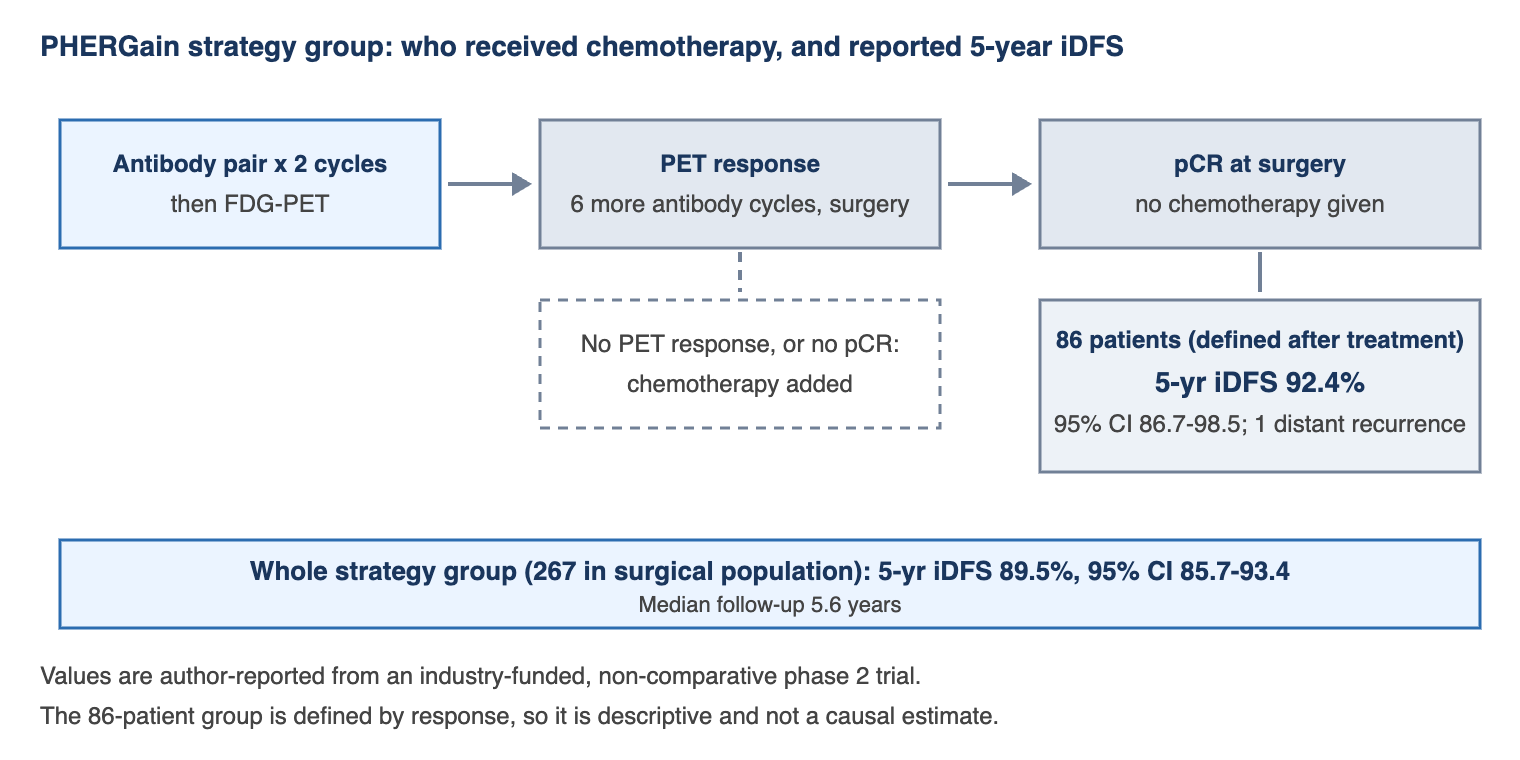
- What: In PHERGain, patients with HER2-positive stage I-IIIA early breast cancer received trastuzumab plus pertuzumab (with endocrine therapy if hormone-receptor positive), and chemotherapy was added only if the interim FDG-PET scan showed no response or if no pathological complete response (pCR) was found at surgery. In this strategy group (267 patients in the surgical population), the 5-year invasive disease-free survival (iDFS) was 89.5% (95% CI 85.7 to 93.4). Among the 86 patients who had a PET response and a pCR and so never received chemotherapy, 5-year iDFS was 92.4% (86.7 to 98.5), with one distant recurrence.
- So what: These numbers describe durability of a response-guided strategy. They do not show that omitting chemotherapy is non-inferior: the trial was not designed to compare arms, and the 86-patient group is defined by good response after the fact. The authors describe such subgroup analyses as “descriptive rather than as causal”. The strategy cohort also behaves, in effect, as a single-strategy cohort with a small number of events.
- Now what: Early disappearance of circulating tumor DNA (ctDNA), measured with a tissue-free methylation assay, was associated with pCR (48.4% vs 22.0%) and with 5-year iDFS. These analyses are exploratory, were not adjusted for multiple comparisons, and the assay maker co-funded them. Using ctDNA to decide who skips chemotherapy would need separate prospective testing, as the authors indicate.
Source note: figures come from the open-access full text of the Nature Medicine paper and were cross-checked against the PubMed record and the original 2024 Lancet report. Extended Data figure contents were not independently verified.
5-minute read
What was tested
Standard treatment for early HER2-positive breast cancer combines chemotherapy with HER2-directed antibodies. PHERGain asked whether some patients could be spared chemotherapy by selecting them on early response. In the strategy group, patients first received two cycles of trastuzumab plus pertuzumab. An FDG-PET scan then sorted them: PET responders continued the antibody combination for six more cycles and went to surgery, and PET non-responders switched to chemotherapy. After surgery, patients without pCR also received chemotherapy. A smaller comparison group received docetaxel, carboplatin and the two antibodies from the start. Randomization was 1:4 between the comparison group and the strategy group, and the design was non-comparative, so the comparison group serves as an internal reference rather than a hypothesis test.
What was found
With a median follow-up of 5.6 years, the strategy group had a 5-year iDFS of 89.5% (95% CI 85.7 to 93.4) and a 5-year overall survival of 98.1% (96.5 to 99.8). The internal reference group (63 patients in the surgical population) had a 5-year iDFS of 96.7% (92.2 to 100); because of the non-comparative design and 1:4 allocation, the authors state that arm differences cannot be judged. In the strategy group, 14 patients (5.2%) had a distant recurrence within the iDFS events, compared with 2 (3.2%) in the reference group. For the three-year value reported earlier, see the note in Deep dive section 3.
In the exploratory ctDNA work, 801 of 932 plasma samples (85.9%) were sequenced successfully. ctDNA that cleared early in treatment was associated with a higher pCR rate (48.4% vs 22.0%, P=0.003), and none of the 28 patients with ctDNA still detected before surgery had a pCR. Patients with detectable ctDNA at baseline had a lower 5-year iDFS (86.7% vs 97.1%), but the multivariable hazard ratio of 2.9 had a confidence interval of 0.9 to 9.6 that includes 1 while being reported with P=0.043, so we read it as borderline.
How far the result reaches
The results support a limited statement: after PET response and pCR, patients who skipped chemotherapy in this trial had favorable 5-year outcomes. They do not show that chemotherapy can be safely omitted in any given patient, because good-prognosis tumors are the ones that respond. The design also predates adjuvant T-DM1 for residual disease, which is part of current practice (as the authors note).
Deep dive
1. Background
HER2-positive breast cancer has a high rate of pCR after dual HER2 blockade, which prompted interest in reducing chemotherapy for responsive tumors. PHERGain (NCT03161353) is a randomized, open-label, multicenter phase 2 trial that tests a PET-guided strategy. The original primary analysis reported a 3-year iDFS of 94.8% (95% CI 91.4 to 97.1) (Pérez-García et al. 2024, The Lancet). The new paper extends follow-up to 5 years, adds a pre-specified secondary endpoint (the registry lists 3-, 5- and 7-year iDFS among secondary outcomes), and adds exploratory ctDNA analyses. A protocol amendment in 2022 allowed the extension, and patients had to consent again. The data cutoff was 2024-11-04.
2. What this study adds
Reported in the paper (Pérez-García et al., doi:10.1038/s41591-026-04723-w):
- Durability of the response-guided strategy: 5-year iDFS 89.5% (85.7 to 93.4) in the strategy group.
- A descriptive group of 86 patients with PET response and pCR who received no chemotherapy: 5-year iDFS 92.4% (86.7 to 98.5), 5-year distant disease-free survival 98.7% (96.3 to 100), and one distant recurrence within iDFS events.
- Exploratory ctDNA associations with pCR and iDFS using a tissue-free methylation assay (Guardant Reveal) that reads about 3,000 differentially methylated regions and returns a detected / not-detected call per sample.
Baseline ctDNA status was not associated with pCR (41.7% vs 38.1%, P=0.583), but it tracked stage (detected in 33.3% of stage I and 93.2% of stage III) and nodal status (87.8% node-positive vs 55.0% node-negative). In terms of novelty, we rate the paper as incremental: the strategy was already reported, and the additions are longer follow-up and exploratory biomarker work.
The authors compare their result with other trials (NeoSphere, BERENICE, PEONY) and caution that cross-trial comparisons should be read carefully; we do not rank those figures here.
3. Strengths and limitations of the method
Strengths: randomized, multicenter, with a pre-specified secondary endpoint at 5 years, a median follow-up of 5.6 years, and an explicit estimand framework (strategy-level estimand for the strategy group per ICH E9(R1); conditional descriptive estimands for response-defined subgroups). The decisive figures were consistent between the publisher full text and PubMed.
Limitations:
- Non-comparative design. The reference group is not a hypothesis-testing control. A difference in distant recurrence (5.2% vs 3.2%) cannot be judged, as the authors state.
- Subgroup defined after treatment. The 92.4% figure comes from patients selected by PET response and pCR, a favorable-biology group. It may reflect tumor biology rather than the effect of omitting chemotherapy.
- Re-consent attrition. Of 250 strategy-group patients who completed 3 years, 215 (86.0%) agreed to the extension; the rest were censored. The authors flag possible attrition bias, and we could not compare baseline characteristics of those who did not re-consent.
- Follow-up intensity. Follow-up relied on simple clinical evaluations, so asymptomatic recurrences may be under-detected (authors’ statement).
- ctDNA analysis resolution. Exploratory, no correction for multiple comparisons, 14.1% of samples without a usable result, and a tumor-uninformed assay. The multivariable baseline hazard ratio (2.9, 95% CI 0.9 to 9.6) is reported with P=0.043; the methods use Firth penalized Cox models, which may explain a mismatch between a Wald-type interval and the P value, but we could not confirm that, so we quote the numbers as printed.
- Internal inconsistency in the 3-year reference value. The original Lancet report gives 3-year iDFS as 94.8% (95% CI 91.4 to 97.1), and the Discussion of this paper uses 94.8%. The abstract and Results of this paper give 94.3% (95% CI 90.9 to 96.8), which differs from the original report. Whether this is a re-estimate at a later cutoff or a typographical error is not stated and we could not determine it. The 5-year values are unaffected.
- Funding and author context. See the conflict-of-interest notes in the Disclosure below.
Not verified: values inside the Extended Data figures, and the baseline characteristics of patients who did not re-consent.
4. Connections to neighboring domains
Machine-learning classifiers. The ctDNA call comes from a methylation classifier that issues a binary detected / not-detected result per plasma sample. The threshold chosen for that classifier sets sensitivity, and therefore what counts as ctDNA “clearance”. A clinical conclusion about clearance and pCR is thus tied to the model’s operating point, which is the same structural issue that arises whenever a wearable or imaging classifier feeds a clinical decision.
Cardio-renal-metabolic design transfer (analogy only). Response-adapted designs, in which treatment intensity follows an early biomarker response, are uncommon in cardio-renal-metabolic trials. The PHERGain treatment of strategy-level estimands and its warnings about post-baseline subgroups could be a template if such a design were tried, for example with albuminuria or natriuretic-peptide response. This is a methodological analogy and not a finding of the paper.
5. Commercialization and investment perspective
For information only; not investment advice.
- F. Hoffmann-La Roche (publicly listed). Manufacturer of trastuzumab and pertuzumab and funder of the trial.
- Guardant Health (publicly listed). Provides the Guardant Reveal assay, funded the ctDNA analyses, and the ctDNA analyses were performed centrally with its assay. Regulatory and reimbursement status of Guardant Reveal for breast cancer was not verified.
- MEDSIR. The sponsor of record (class “other” in the trial registry), an academic research organization.
- Competing approaches. The authors discuss tumor-informed MRD assays as an alternative to the tissue-free approach; the paper does not name companies for them.
- Readiness (TRL). The response-guided de-escalation strategy is at about TRL 6 (demonstrated in a randomized phase 2, before any confirmatory trial). ctDNA-guided treatment decisions are at about TRL 4 (exploratory prognostic association only, no interventional evidence). The component drugs, FDG-PET and the assay are commercially available. Guideline adoption of chemotherapy-free strategies would plausibly follow confirmatory data over several years, which is our judgment, not a statement from the paper. The successor trial PHERGain-2 (small HER2 3+ node-negative tumors, including T-DM1) is the next step the authors point to.
6. Counterpoints and caveats
- The 92.4% figure belongs to a post-treatment subgroup. Good outcomes in tumors that respond completely do not show that chemotherapy was unnecessary for them.
- The drop from the 3-year value (94.8% in the original report) to 89.5% at 5 years is read by the authors as consistent with ongoing recurrence risk in HER2-positive disease, and hormone-receptor-positive tumors, about two-thirds of the population, are known for later recurrence, so longer follow-up is needed.
- The ctDNA findings are hypothesis-generating. Associations with pCR were strong for early clearance but absent for baseline status, and the iDFS hazard ratios have wide intervals.
- The assay supplier co-funded the analysis and an affiliated author performed the experiments. The paper’s competing-interests section does not list that author individually. These are facts about disclosure, not evidence of bias, and they mean the ctDNA results would benefit from independent replication.
- The trial pre-dates routine adjuvant T-DM1 for residual disease, so the “no pCR, then chemotherapy” step differs from today’s standard.
7. Indicators to watch
- 7-year iDFS in the registry’s secondary outcomes, and any update on late recurrences in hormone-receptor-positive disease.
- Results of PHERGain-2 and other trials testing PET- or pCR-guided chemotherapy omission, ideally with a comparator arm.
- Independent replication of ctDNA clearance as a predictor of pCR, including tumor-informed assays.
- Prospective trials in which ctDNA status itself changes treatment, rather than being observed.
- Any published reconciliation of the 3-year iDFS value in the paper’s abstract.
References
- Pérez-García, José Manuel, Javier Cortés, …, and Antonio Llombart-Cussac. 2026. “5-Year Outcomes of Chemotherapy De-escalation in HER2-Positive Early Breast Cancer and Exploratory Circulating Tumor DNA Analyses from the Randomized Phase 2 PHERGain Trial.” Nature Medicine. https://doi.org/10.1038/s41591-026-04723-w (PubMed PMID 42957778; open access, CC BY-NC-ND 4.0).
- Pérez-García, José Manuel, et al. 2024. “3-year invasive disease-free survival with chemotherapy de-escalation using an 18F-FDG-PET-based, pathological complete response-adapted strategy in HER2-positive early breast cancer (PHERGain).” The Lancet 403: 1649–1659. https://doi.org/10.1016/S0140-6736(24)00054-0 (PubMed PMID 38582092; abstract checked).
- ClinicalTrials.gov. NCT03161353 (PHERGain). Accessed 2026-11-16. https://clinicaltrials.gov/study/NCT03161353
Disclosure
- This article is provided for information only and is not investment advice.
- The author holds no position in any company named in this post.
- Conflict-of-interest notes. The paper states that the trial was supported by F. Hoffmann-La Roche and that the ctDNA analyses were supported by Guardant Health, and that the funders had no role in study design, data collection and analysis, decision to publish or manuscript preparation. Roche manufactures the study drugs, and Guardant Health provides the ctDNA assay used. Many authors declare consulting, speaker or research funding relationships with pharmaceutical companies. Some authors are listed as co-inventors on a licensed patent (US 2019/0338368 A1) concerning prediction of response to dual HER2 blockade without cytotoxic therapy, a topic that overlaps the trial strategy. The sponsor of record, MEDSIR, employs several authors. An author affiliated with Guardant Health performed the ctDNA assay experiments according to the Author contributions section; the paper’s competing-interests statement does not list that author individually and ends with a general statement that the other authors declare no competing interests. All quantitative claims above are author-reported values from an industry-funded trial.
- The figure in this article is an original drawing; no figure from the source was reproduced.


Leave a Reply