Analysis based on information available as of 2026-11-16.
30-second summary (abstract-only: the full NEJM text was paywalled and not read)
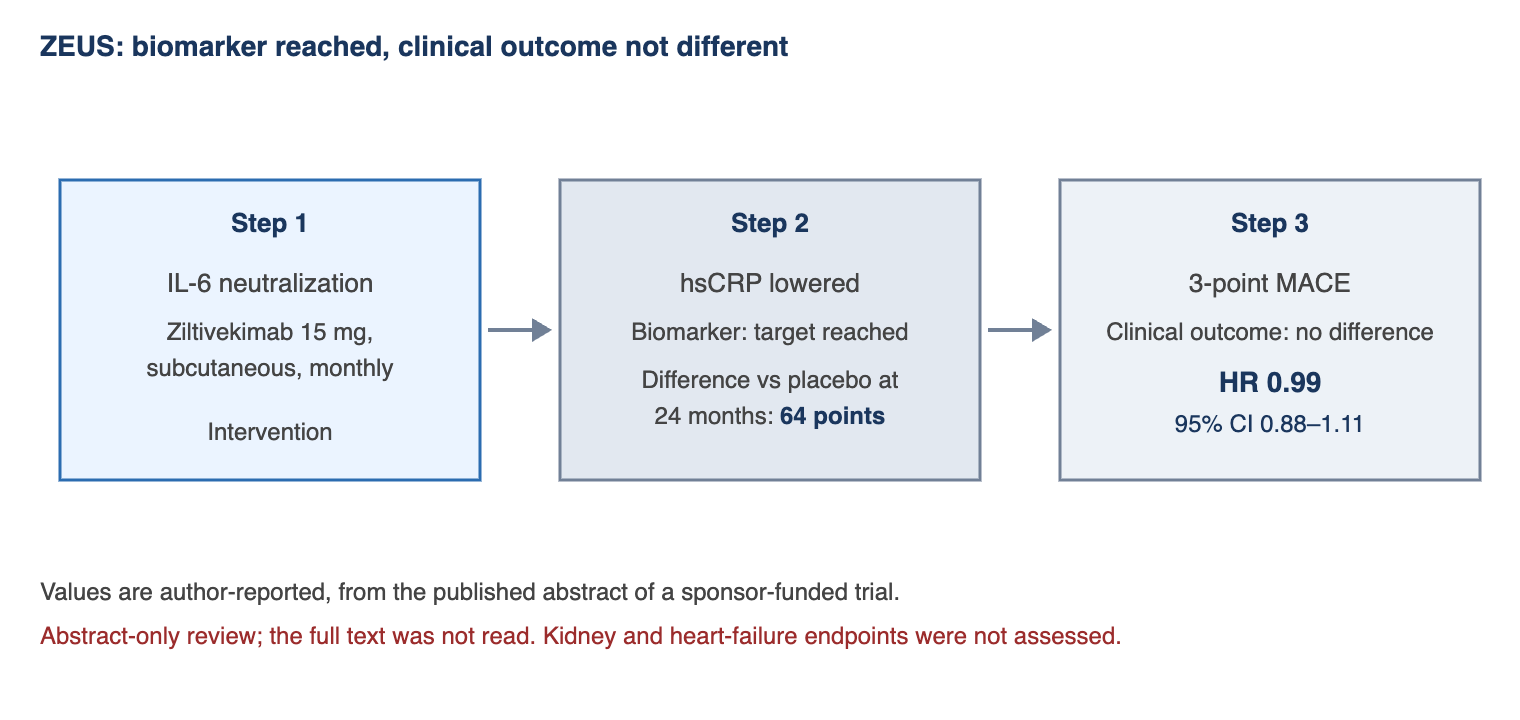
- What: In ZEUS, a randomized, double-blind, placebo-controlled phase 3 trial (6,376 patients with atherosclerotic cardiovascular disease, chronic kidney disease and hsCRP of at least 2 mg/L), monthly ziltivekimab 15 mg lowered free IL-6 and hsCRP substantially, but the primary outcome did not differ: 17.6% vs 17.7% (hazard ratio 0.99; 95% CI 0.88 to 1.11; P=0.84) over a median of 33 months.
- So what: In this population, lowering hsCRP through IL-6 inhibition did not translate into fewer 3-point MACE events. Serious infections were numerically higher with ziltivekimab (20.4% vs 17.9%); the abstract does not report a statistical test for this difference. Secondary endpoints, including kidney and heart-failure outcomes, were not available to us.
- Now what: Read the full paper and any secondary-endpoint publication before drawing conclusions about kidney or heart-failure effects. On ClinicalTrials.gov, the sponsor’s HFpEF trial (HERMES) is listed as terminated without a specific reason; the post-MI trial (ARTEMIS) remains active.
Source note: decisive figures below come from the PubMed structured abstract. Items drawn from secondary reporting or company statements are labeled as such.
5-minute read
What was tested
Elevated hsCRP is a marker of inflammation associated with cardiovascular risk. Interleukin-6 (IL-6) sits upstream of hsCRP production, so IL-6 neutralization was a plausible way to test whether reducing “residual inflammatory risk” lowers cardiovascular events. ZEUS enrolled patients with established atherosclerotic cardiovascular disease, chronic kidney disease (CKD) and hsCRP of at least 2 mg/L, a group for whom some other anti-inflammatory options, such as colchicine, are harder to use (a point made in secondary reporting, not verified here).
Participants (mean age 69.4 years; 27.5% women) were randomized 1:1 to ziltivekimab 15 mg subcutaneously once monthly or placebo. The primary outcome was time to first 3-point MACE (cardiovascular death, nonfatal myocardial infarction, nonfatal stroke).
What was found
The drug engaged its target. At 24 months, the between-group difference in median percent change was reported as 76 percentage points for free IL-6 and 64 percentage points for hsCRP. The clinical outcome did not follow: 561 events (17.6%) with ziltivekimab vs 565 (17.7%) with placebo. The authors reported the hazard ratio as “0.99; 95% confidence interval, 0.88 to 1.11; P = 0.84.”
Serious adverse events were similar overall (54.6% vs 54.8%). Serious infections were 20.4% vs 17.9%. The abstract gives these as percentages without a confidence interval or P value, so we describe the gap as numerical only.
How far the result reaches
The confidence interval excludes neither a modest benefit (down to HR 0.88) nor a modest harm (up to 1.11), so the result is better read as “no clinically meaningful large effect on 3-point MACE” than “exactly zero.” The finding applies to this population (older patients with CKD and established disease, selected by a single hsCRP threshold) and to 3-point MACE. It does not by itself address earlier-stage disease, other IL-6 agents, or kidney and heart-failure endpoints, which we could not assess.
Deep dive
1. Background
The “inflammation hypothesis” of atherosclerosis holds that systemic inflammation, indexed by hsCRP, contributes to cardiovascular risk independently of lipids. Prior trials targeting inflammation include canakinumab (IL-1 beta, CANTOS) and low-dose colchicine (COLCOT, LoDoCo2, with CLEAR SYNERGY reported as neutral in secondary reporting). We cite these trial names as context from the ZEUS commentary we read; we did not re-verify their results against primary publications for this piece. Ziltivekimab is a monoclonal antibody that neutralizes IL-6, developed by Novo Nordisk, which also funded and sponsored ZEUS. Patients with CKD carry elevated cardiovascular risk and elevated hsCRP, and relatively few anti-inflammatory strategies have outcome data in this group, which is the clinical gap ZEUS addressed.
2. What this study adds
Reported in the abstract (Ridker et al., doi:10.1056/NEJMoa2612126):
- A target-engagement result (free IL-6 and hsCRP lowered substantially at 24 months) together with a null primary outcome (HR 0.99).
- A numerical imbalance in serious infections (20.4% vs 17.9%) without a reported test in the abstract.
- Balanced overall serious adverse events and a median follow-up of 33 months.
In our review, we could verify the decisive figures against the PubMed abstract. We could not verify secondary endpoints. The ClinicalTrials.gov record for ZEUS (NCT05021835) lists secondary outcomes (expanded MACE, heart-failure events, a kidney composite, all-cause mortality, UACR and eGFR change) but has no posted results as of 2026-11-16. Kidney outcomes, which matter most from a cardio-renal-metabolic perspective, are therefore unverified here.
Details reported only in secondary coverage (TCTMD, 2026-11-07) and not checked against a primary source: a 29% Lp(a) reduction, cellulitis 2.9% vs 1.0%, and discussants’ interpretations. We treat these as unverified.
3. Strengths and limitations of the method
Strengths: randomized, quadruple-masked per the registry, placebo-controlled, large (6,376 in the full analysis set), and a hard clinical primary endpoint with a pre-registered design. Biomarker data show the intervention reached its target, which makes “insufficient exposure” a less likely explanation. The sponsor-funded trial reported a null result, which is relevant to concerns about selective reporting.
Limitations of the evidence available to us:
- Abstract-only access. The NEJM full text was paywalled and no legal open-access copy was found. Subgroups (eGFR strata, hsCRP strata, background therapy) and secondary endpoints were not read.
- Population specificity. Older, high-risk patients with established disease; the trial cannot speak to earlier-stage disease. Secondary reporting quotes the lead author describing this as late-stage disease; we have not verified the quote.
- Selection by one marker. hsCRP of at least 2 mg/L is a single threshold and may be entangled with kidney function itself in CKD, which can limit how specifically it defines an “inflammatory phenotype.”
- Single decisive source. The primary results rest on one abstract. The company’s press release is from the same sponsor and is not an independent confirmation.
- Safety interpretation. A numerical infection difference is a signal worth tracking, but without a reported interval or test, the abstract does not allow a conclusion about the benefit-risk balance.
4. Connections to neighboring domains
Clinical practice (CKM). Current cardio-renal risk management centers on lipid lowering, blood pressure control, SGLT2 inhibitors, GLP-1 receptor agonists and finerenone. Nothing in the ZEUS abstract adds an anti-inflammatory agent to that list; a discussant quoted in secondary reporting made a similar point. We did not check guideline recommendation wording.
Pattern across programs. Within our own coverage, the mitiperstat program and the Lp(a)HORIZON trial (pelacarsen) also involved a biomarker-directed drug that engaged its target without the expected change in clinical outcomes. The molecules, mechanisms and modalities differ, so we record this as a structural similarity only and do not combine the results.
Patient stratification (open question). Whether computational stratification using multi-omic or immune profiling could identify an IL-6-dependent subgroup is a possible next question. No evidence in the ZEUS abstract addresses it; it is our speculation, not a finding.
5. Commercialization and investment perspective
For information only; not investment advice.
- Developer. Novo Nordisk (publicly listed) develops ziltivekimab and sponsored ZEUS.
- Company statements. In a 2026-07-31 announcement of topline results, the company stated that it expected to record a non-cash impairment in the third quarter of 2026 (company statement, secondary source; we have not examined the filing itself). That announcement also said HERMES and ARTEMIS would continue, a statement that is now out of date for HERMES (see below).
- Registry status (checked 2026-11-16). HERMES (NCT05636176, HFpEF): status TERMINATED, stated reason “No longer looking for participants.”, last update 2026-10-01, 4,874 enrolled. The registry text does not give the substantive reason, and we do not infer one. ARTEMIS (NCT06118281, post-MI): active, not recruiting, about 10,000 participants estimated, primary completion estimated 2027-01-29.
- TRL. ziltivekimab reached phase 3 completion (TRL 7 for this indication). Based on the primary result, the ASCVD-with-CKD pathway does not appear supported by this trial; other indications depend on trials not yet read out.
- Other IL-6 and inflammation programs. Secondary coverage mentions other targets (NLRP3, suPAR); we did not verify the companies or status.
6. Counterpoints and caveats
- The decisive numbers come from one abstract. No full text, no registry results and no independent replication were available. The company press release is not an independent source.
- “Serious infections were higher” refers to a numerical difference (20.4% vs 17.9%); the abstract reports no confidence interval or P value, so we do not characterize it as established.
- The hazard-ratio interval (0.88 to 1.11) leaves room for modest effects in either direction. The result concerns 3-point MACE only. It does not tell us whether kidney, heart-failure or mortality outcomes differ; those are unreported to us.
- The reason HERMES was terminated is not disclosed in the registry. Reports that the sponsor “halted” the trial come from secondary coverage; we do not attribute a cause.
- The biomarker-to-outcome pattern seen here and in other programs is a hypothesis-generating observation, not a general law; surrogate endpoints sometimes do predict outcomes.
- Competing-interest context is listed in the Disclosure below.
7. Indicators to watch
- Full-text publication details: CKD definition, eGFR range, subgroup results, and the kidney composite, heart-failure and all-cause mortality endpoints.
- A statistical test and interval for serious infections, plus infection-related deaths.
- ClinicalTrials.gov results posting for NCT05021835, and any updated status or stated reason for HERMES (NCT05636176).
- ARTEMIS (NCT06118281) readout, currently estimated for 2027 by the registry.
- Whether other anti-inflammatory approaches (IL-1, NLRP3, colchicine) report outcomes in CKD populations.
References
- Ridker, Paul M., A. Michael Lincoff, Nikolaus Marx, …, and Vlado Perkovic; ZEUS Investigators. 2026. “Interleukin-6 Inhibition with Ziltivekimab for Atherosclerotic Disease.” New England Journal of Medicine. https://doi.org/10.1056/NEJMoa2612126 (PubMed PMID 43001751; abstract only).
- ClinicalTrials.gov. NCT05021835 (ZEUS), NCT05636176 (HERMES), NCT06118281 (ARTEMIS). Accessed 2026-11-16. https://clinicaltrials.gov
- Novo Nordisk. 2026. Company announcement, 2026-07-31 (company statement). https://www.novonordisk.com/news-and-media/news-and-ir-materials/news-details.html?id=916587
- TCTMD. 2026. “ZEUS: What Went Awry With Ziltivekimab in Inflammation—and What Now?” Secondary reporting, 2026-11-07. https://www.tctmd.com/news/zeus-what-went-awry-ziltivekimab-inflammation-and-what-now
Disclosure
- This article is provided for information only and is not investment advice.
- The author holds no position in any company named in this post.
- Conflict-of-interest notes. The ZEUS trial was funded by Novo Nordisk (abstract; Crossref funder record; ClinicalTrials.gov lead sponsor). Novo Nordisk is the developer of ziltivekimab. Per-author disclosure forms were not read because the full text is paywalled, and Novo Nordisk employment of later authors is unverified. All quantitative claims above are author-reported values from a sponsor-funded trial, and the company’s announcement is a company statement.
- This piece was written from the abstract and registry records only; the full article was not read.
- The figure in this article is an original drawing; no figure from the source was reproduced.


Leave a Reply