Analysis based on information available as of 2026-11-16.
30-second summary
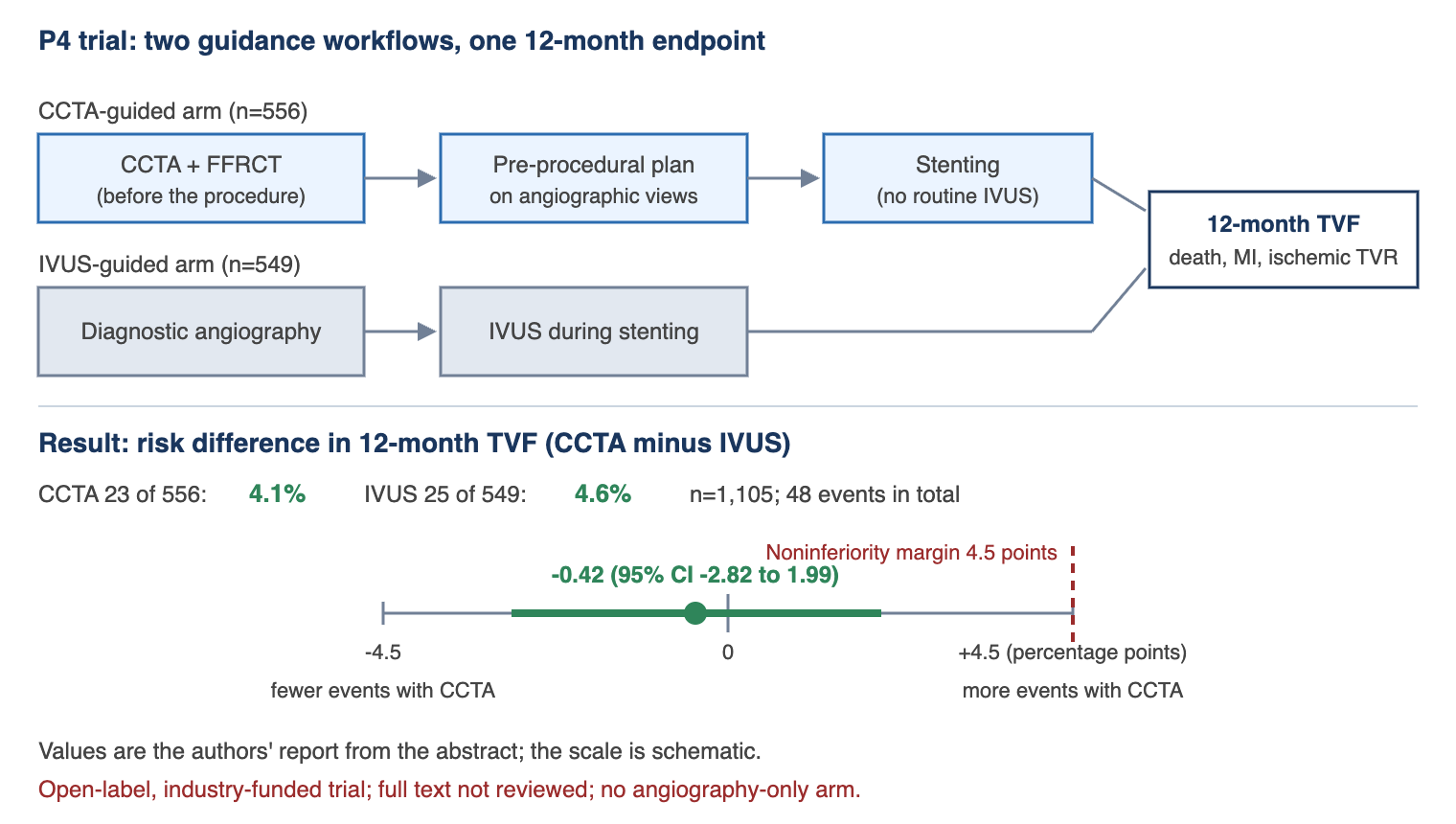
- What: In an open-label, industry-funded noninferiority randomized trial (P4; n=1,105; abstract-only read, full text not reviewed), planning PCI from coronary CT angiography (CCTA) was statistically noninferior to intravascular ultrasound (IVUS) guidance for 12-month target vessel failure (4.1% vs 4.6%; risk difference -0.42 percentage points, 95% CI -2.82 to 1.99).
- So what: The result suggests that imaging guidance might move from inside the cath lab to before the procedure for a selected population. The prespecified noninferiority margin (4.5 percentage points) is about the same size as the observed event rate, and there were only 48 events in total, so the trial rules out a large harm but not a modest one.
- Now what: Treat this as conditional evidence: open-label, selected patients (CT-derived FFR of 0.80 or below), no angiography-only control arm, and no access yet to the full paper. Replication and longer follow-up are what to watch.
5-minute read
What was tested
Intravascular ultrasound guidance during percutaneous coronary intervention (PCI) has accumulated randomized evidence of better outcomes than angiography alone, and it is the comparator that the P4 investigators chose. The question was whether a plan built before the procedure from a coronary CT angiogram, including a CT-derived fractional flow reserve (FFRCT, a computed estimate of lesion-specific blood flow), can match IVUS guidance on hard clinical outcomes. According to the abstract, no clinical-outcome data compared the two approaches before this trial.
Patients had a clinical indication for revascularization, at least one epicardial lesion with diameter stenosis above 70%, and an FFRCT of 0.80 or below. They were randomized 1:1 to CCTA-guided (n=556) or IVUS-guided (n=549) PCI. The primary endpoint was 12-month target vessel failure (TVF): cardiac death, target-vessel myocardial infarction, or ischemia-driven target-vessel revascularization. Endpoint adjudication was blinded; the treating teams were not.
What was found
TVF occurred in 23 patients (4.1%) in the CCTA arm and 25 (4.6%) in the IVUS arm. The abstract reports a risk difference of -0.42 percentage points (95% CI -2.82 to 1.99), P<0.001 for noninferiority and P=0.73 for superiority. Clinical procedural complications were reported in 6 versus 9 patients. These figures are the authors’ reported values from an industry-funded trial, and we verified them against the PubMed abstract only.
How far the result goes
Two features limit the reading. First, the noninferiority margin of 4.5 percentage points is close to the IVUS arm’s own event rate of 4.6%. The upper confidence bound (1.99) sits well inside the margin, which is reassuring against a large difference, but the margin itself is generous, and we have not seen the full-text justification for it. Second, 48 events in total leave little resolution for individual components such as cardiac death. The study also has no angiography-only arm, so a statement that CCTA guidance is better than angiography does not follow directly from this trial; it would rest on an indirect comparison with earlier IVUS trials.
Deep dive
1. Background
PCI for stable coronary disease has moved toward intracoronary imaging. IVUS and optical coherence tomography let the operator size the vessel, characterize plaque, and check stent expansion, and randomized trials comparing IVUS guidance with angiography alone have generally favored IVUS on target-vessel outcomes. The trial registry entry for P4 describes IVUS-guided PCI as recommended by the European Society of Cardiology; we have not checked the guideline wording or class of recommendation directly.
In parallel, CCTA has become a common first-line test for chest pain, and FFRCT, a software device that estimates lesion-specific physiology from CT images using computational fluid dynamics and machine-learning methods, has been used mainly as a gatekeeper for deciding whether invasive angiography is needed. P4 asks whether the same CT dataset can be reused to plan the stent procedure itself.
2. What this study adds
The abstract states that clinical-outcome data comparing CCTA-guided with IVUS-guided PCI were lacking. To our reading of the abstract, P4 is a randomized outcome comparison that addresses this gap directly, although we have not independently searched for other trials and do not claim it is the first. The study design is investigator-initiated per the abstract, multinational, open-label, randomized, and noninferiority; the registry lists masking as none, consistent with the open-label description.
On the endpoint: the registry labels the primary outcome “MACE” at 12 months, while the paper reports TVF. The registry description defines the MACE composite as cardiac death, target-vessel myocardial infarction, and ischemia-driven target-vessel revascularization, the same three components as the published TVF. The label differs, the composition does not, so the registry text gives no sign of an endpoint switch. The registry still shows an estimated enrollment of 1,090 (the paper reports 1,105), an estimated primary completion date of 2026-08-04 that has passed, and no posted results; these look like records not yet updated.
Secondary figures that have appeared in the trade press (TCTMD coverage of the conference presentation, not read in the primary source): median procedure time of 46 versus 63 minutes, contrast volume of 150 versus 170 mL, and a higher use of advanced calcium-modification devices in the CCTA arm (9.2% versus 3.8%). We treat these as press-reported and unverified. The calcium-device difference cuts two ways: it may show that the plan changed what operators did, or it may reflect a difference in procedural intensity that confounds the comparison. The same report states that IVUS was used in a handful of CCTA-arm patients (five, four elective and one bailout); we could not confirm how stent expansion was judged without IVUS.
3. Strengths and limitations of the method
Strengths: randomization, a hard-outcome composite rather than a surrogate, blinded endpoint adjudication, a prespecified noninferiority-then-superiority hierarchy, and a registered protocol whose primary outcome components match the publication.
Limitations, as far as the abstract and registry allow us to judge:
- Wide margin relative to event rate. A 4.5 percentage-point margin is nearly the size of the control-arm TVF rate. In principle, a CCTA-arm rate roughly double the IVUS rate would still fall inside the margin. The margin rationale is not available to us.
- Few events. 48 events in total limit conclusions about any single component.
- Selected population. FFRCT of 0.80 or below, stenosis above 70%, and an existing usable CT scan. How acute coronary syndromes, heavy calcification, and poor CT quality were handled is unknown to us. A discussant quoted in the trade press described the population as not very complex.
- Open-label design at specialized centers. Endpoints were adjudicated blind, but ischemia-driven revascularization involves operator judgment, and CT interpretation skill may not generalize.
- Sponsor and funding structure. The funding statement and the registry sponsor classification are described in the Disclosure below. We could not read the full-text disclosure forms.
Contrast reduction is of particular interest in patients with chronic kidney disease, where contrast exposure relates to the risk of contrast-associated kidney injury. That link is a hypothesis here: we have not seen kidney-function subgroups or acute kidney injury results from P4.
4. Connections to neighboring domains
AI and computational imaging. FFRCT converts an anatomical image into a computed physiological estimate, which then drives a treatment decision, and P4 supplies an outcome-level randomized test of that chain (estimate, decision, outcome). This is the strongest cross-domain link in the study. It is a single trial, however, and the question of whether computed proxies can replace direct invasive measurement should not be generalized from it.
Navigation and image registration. The trial coverage describes synchronizing CT reconstructions with the C-arm projection angles used in the cath lab. Registering a pre-procedural 3D plan to intra-procedural 2D fluoroscopy resembles the registration problem in surgical navigation. This parallel rests on a single press report and is an engineering analogy rather than a finding of the trial.
5. Commercialization and investment perspective
Technology readiness level (TRL): 7 for the strategy; components at 9. CCTA, FFRCT, and IVUS are each commercially available. The strategy of planning PCI from CT and proceeding without IVUS has been tested in a multinational randomized trial in an operational setting, which we place at TRL 7. The registry names the planning software in the CT arm as a research edition of a commercial vendor’s product, so its regulatory status and the degree of integration into routine workflows are unverified.
Timeline: guideline inclusion and reimbursement are the likely gating steps. Without replication and longer follow-up, we would expect a horizon of more than two to four years (our judgment, not a sourced estimate).
Companies in the space, stated neutrally: the CT scanner and FFRCT software vendors named in the funding statement (see Disclosure), the vendor of the research-edition planning software named in the registry, and IVUS device makers whose product served as the comparator. This piece does not assess the effect of the trial on any company’s finances or share price.
6. Our review: points a reader should keep in mind
The following points summarize our review of this item.
- The trial is industry-funded and open-label; the decisive figures were read from the abstract, and the full text has not been reviewed. The registry reports no results yet.
- The noninferiority margin is about the size of the observed event rate, and the total event count is 48.
- There is no angiography-only comparator, so “CCTA guidance is better than angiography” does not follow from this trial directly.
- The relationship between the registry’s industry-classified lead sponsor and the abstract’s “investigator-initiated” wording cannot be resolved without the full-text disclosures.
- Press-reported procedural metrics were not independently confirmed.
- A discussant cited in the trade press raised concerns about population complexity, specialized-center expertise, and the missing angiography-only arm.
The registry-versus-paper endpoint label difference (MACE versus TVF) was checked: the components are the same, so that concern is resolved in the trial’s favor. The remaining uncertainty is about margin, power, and generalizability, not about the endpoint definition.
7. Indicators to watch
- Publication of the full-text methods: margin rationale, handling of calcified lesions and acute presentations, and how stent optimization was judged in the CCTA arm without IVUS.
- Two-year follow-up and component-level outcomes (cardiac death, target-vessel MI, revascularization).
- Any randomized comparison against angiography alone, or an independent replication outside the sponsoring network.
- Kidney outcomes and contrast-volume data in patients with chronic kidney disease.
- Updates to the registry record (results posting, final enrollment) and any change in the regulatory status of the planning software.
- Guideline committee statements on CT-based procedural planning.
References
- Collet, C., et al., and the P4 Trial Investigators. 2026. “Coronary CT Angiography versus Intravascular Ultrasound Guidance for PCI.” New England Journal of Medicine. DOI: 10.1056/NEJMoa2610771 (PubMed PMID 42969897; abstract only was reviewed).
- ClinicalTrials.gov. “Precise Procedural and PCI Plan (P4),” identifier NCT05253677. Accessed 2026-11-16. https://clinicaltrials.gov/study/NCT05253677
- TCTMD. “CCTA Noninferior to IVUS for PCI Guidance: P4 Trial.” Secondary press report, accessed 2026-11-16. https://www.tctmd.com/news/ccta-noninferior-ivus-pci-guidance-p4-trial
Disclosure
- This article is for informational purposes only and is not investment advice.
- The author holds no position in any company named in this post.
- Conflict-of-interest notes. The NEJM abstract states that the trial was funded by GE HealthCare and Heartflow, both publicly listed companies that supply CCTA scanners and FFRCT analysis, respectively; the abstract also describes the trial as investigator-initiated. ClinicalTrials.gov lists CoreAalst BV (class: industry) as lead sponsor and responsible party; the relationship between CoreAalst BV and the authors was not verified. The first author is affiliated with the Cardiovascular Research Foundation (New York) per PubMed and Crossref. We could not access the journal’s individual disclosure forms, so the authors’ personal financial relationships with the funders are unverified. All quantitative claims in this article are author-reported values from an industry-funded trial, and most were read from the abstract only. In our review: P4 is an open-label noninferiority trial funded by GE HealthCare and Heartflow; its noninferiority margin (4.5 percentage points) is similar in size to the observed event rate, and total events were 48. Decisive figures were read from the NEJM abstract, and the full text was not accessed. Because there is no angiography-only control arm, “CCTA is better than angiography” does not follow directly from this trial.
- The figure in this article is an original drawing; no figure from the source was reproduced.


Leave a Reply