Analysis based on information available as of 2026-11-16.
30-second summary
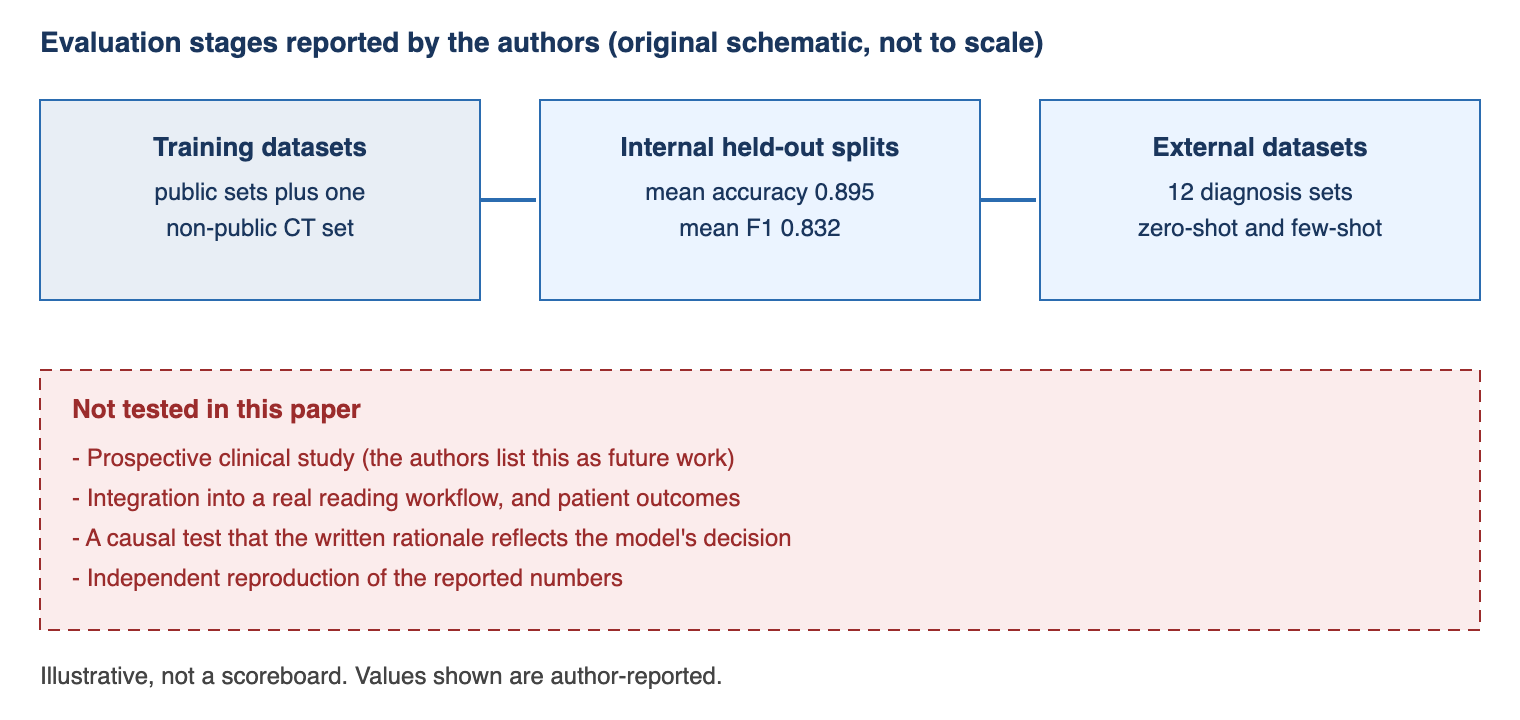
- What: Bai, Cheng, Zhou and colleagues (49 authors; corresponding author Daniel Shu Wei Ting, Duke-NUS) published in Nature Medicine (32(11), online 2026-10-29) EVLF-FM, an approximately 8.4-billion-parameter vision-language model built on InternVL3-8B. It adds two medical image encoders and is trained with supervised fine-tuning followed by reinforcement learning (GRPO), and it outputs a diagnosis, an answer to a question, or a located region together with a written rationale. All results are retrospective, offline benchmarks on public and institutional image datasets. They are not a prospective clinical study, a deployment in a reading workflow, or a patient-outcome evaluation.
- So what: The headline mean accuracy of 0.895 comes from held-out splits of datasets that were also used for training (the authors’ “internal validation”), not from external data. On the same table the specialist foundation model Virchow scores 0.893 in accuracy, and its mean F1 (0.852) is higher than EVLF-FM’s (0.832). The authors state that the model’s accuracy does not yet reach the level typically required for direct clinical deployment (for example, consistently exceeding approximately 90% accuracy across datasets) and that its explanations are post hoc. All figures are author-reported and have not been independently reproduced. The corresponding author reports patents and stock holdings in two companies (see Disclosure).
- Now what: We place the work at about TRL 3 (research model with open weights, our assessment). The useful signals are prospective, multi-centre evaluation, a test of whether the written rationales actually reflect the model’s decision process, and independent reruns of the released weights under the same conditions.
5-minute read
What was built
A vision-language model (VLM) takes an image and a text prompt and produces text. EVLF-FM starts from a general-purpose VLM, InternVL3-8B, and attaches a disease-level image encoder (MedImageInsight) and a pixel-level segmentation encoder (MedSAM). Training has two stages: supervised fine-tuning with low-rank adaptation (about 4% of parameters trainable), then reinforcement learning with Group Relative Policy Optimization (GRPO). The rewards combine a correct diagnosis, overlap with a reference region (intersection over union, IoU), and a sentence-level score that rewards agreement with reference rationale sentences. Those reference sentences were themselves generated by other language models (MedGemma and GPT-5-mini, per the Methods) and then filtered. The authors report training on more than 1.3 million samples across ten imaging modalities and evaluating three tasks: diagnosis, visual question answering and visual grounding.
What the numbers say
On internal held-out splits, averaged over eleven diagnosis columns, EVLF-FM reports accuracy 0.895 and F1 0.832. Virchow reports 0.893 and 0.852, BiomedCLIP 0.883 and 0.824, and the best general-purpose VLM among the comparators (InternVL3-8B) 0.795 and 0.657. The accuracy margin over Virchow is 0.002, and the F1 ordering is reversed. The abstract’s wording about outperforming leading generalist and specialist models therefore holds for mean accuracy, not for mean F1. On external diagnosis datasets used zero-shot, the authors report the highest F1 and accuracy on eight datasets, but F1 is low on several: 0.282 on AMI-Br, 0.200 on BUS-UCLM and 0.379 on RetinalOCT.
The explanation claim
The title emphasises “fine-grain explainability”. The paper itself says the explanations are post hoc. The sentence-level reward measures overlap with reference rationales written by other models, and the supplementary text says it captures clinical-content coverage rather than the validity of each reasoning step. Twelve physicians rated the outputs (mean 4.25 out of 5), but only EVLF-FM outputs were rated, with no comparison model. We found no test, such as removing or perturbing image regions, that checks whether the rationale causally supports the answer.
Deep dive
1. Background
Medical vision-language models are pursued because one model can in principle read several modalities and answer in language, which is how clinicians communicate. Two recurring problems limit their use. First, benchmark gains on in-distribution test splits often shrink under distribution shift, and strong specialist baselines (a model trained for one modality) remain hard to beat on every metric. Second, a free-text rationale looks interpretable but may not reflect what drove the prediction. EVLF-FM targets both: it adds specialist-style encoders to a general VLM, and it adds a training signal for rationales.
2. What this study newly establishes
Design. InternVL3-8B (InternViT-300M plus Qwen3-8B) is extended with a disease-level encoder (MedImageInsight; Codella and colleagues) and a pixel-level encoder (MedSAM; Ma and colleagues, Nature Communications 15). Stage 1 is supervised fine-tuning with low-rank adaptation (about 323 million trainable parameters). Stage 2 is GRPO with group size 8. The authors report that both stages ran on eight NVIDIA H200 GPUs for approximately six hours each. We do not sum these into total GPU-hours because the paper does not.
Data. The abstract reports 18 datasets and more than 1.3 million samples. In the Methods, rationale (chain-of-thought) data came from 26 public classification datasets, generated by MedGemma-1.5 (OCT cases by GPT-5-mini), screened with a filtering step and then scored and refined by GPT-5-mini, leaving 60,455 examples. A non-public CT set from Singapore hospitals (5,323 cases) was also used for training. How the “18” and “26” counts relate is not explained in what we read.
Results (author-reported). Internal diagnosis: accuracy 0.895, F1 0.832. Closed-ended visual question answering: 89.2, 89.6 and 91.3 on VQA-RAD, SLAKE and Path-VQA; open-ended recall 82.5, 87.6 and 21.1. Grounding, averaged over nine modalities: Acc@0.5 of 0.842 and mean IoU of 0.741. External: across 12 diagnosis datasets used zero-shot, the simple mean accuracy from the authors’ table is 0.772 for EVLF-FM versus 0.625 for MedGemma-27B (our calculation, not a figure from the paper). With 64 in-context examples the mean accuracy is 0.845 (our calculation).
Ablation (MedMNIST, 12 datasets, accuracy/F1). Base model 0.766/0.648; adding rationale data 0.811/0.713; adding the pixel encoder 0.812/0.712; adding the disease-level encoder 0.845/0.769; adding GRPO with accuracy rewards 0.858/0.797; adding the rationale-alignment reward (final model) 0.851/0.808. GRPO alone, without the supervised stage, gave 0.676/0.531, below the base model. In our reading, the largest single gain comes from the disease-level encoder, which suggests the result owes more to absorbing a specialist encoder into a general model than to the general model overtaking specialists.
What it does not establish. Clinical benefit, prospective accuracy, behaviour inside a real reading workflow, or that the rationales are faithful to the decision process. The authors describe the model as a backbone rather than a deployment-ready system.
3. Strengths and limitations of the method
Strengths.
- The gain over the same base model (InternVL3-8B) is consistent across internal and external tests as reported, and the ablation shows which component contributes.
- Seventeen external datasets (13,443 cases) and a physician rating study go beyond a single benchmark; code and model weights are public (GitHub, Hugging Face, Zenodo).
- The authors state several limits themselves: not deployment-ready, post hoc explanations, two-dimensional still images only, prospective studies needed.
Limitations.
- Internal validation is in-distribution. The 0.895 comes from held-out splits of training datasets, and one internal column (a non-public CT set) cannot be reproduced with the public weights, which the model card says were trained on publicly available datasets.
- Metric dependence. The accuracy margin over Virchow is 0.002 and the F1 ordering is reversed. Per-dataset results also show the specialist ahead in places, for example RSNA Pneumonia (0.757 for EVLF-FM against 0.825 to 0.845 for specialist baselines) and RAPIER (0.826 against 0.867 for Virchow).
- Text and table disagree in two places. The text says MedGemma-27B outperformed EVLF-FM on APTOS in F1 (0.440), but the extended-data table lists 0.440 as MedGemma-27B’s F1 and 0.558 for EVLF-FM; MedGemma-27B is ahead only in accuracy (0.759 against 0.756). The ablation text describes “consistent directional improvements” from the rationale reward, yet MedMNIST accuracy falls from 0.858 to 0.851 while F1 rises from 0.797 to 0.808. Results come from a single run without confidence intervals.
- External data may overlap training sources. Several external sets come from the authors’ institutional network or consortia, and for public sets we could not confirm from the paper that overlap with training sources (for example, the retinal photograph datasets) was checked. “Zero-shot” here means new datasets, not new tasks or modalities.
- Baseline conditions. The supplement says VLM baselines were adapted with low-rank fine-tuning for one epoch on the same data and specialist backbones were fully fine-tuned for 30 epochs; the training protocols of the specialist foundation models were not visible to us, and prompts and decoding settings for externally compared models were not confirmed.
- Rationale faithfulness. The reference rationales were written by models that had access to the labels, the supplement says the reward measures content coverage rather than step-by-step validity, and the physician ratings include no comparison model. Inter-rater agreement (Gwet AC2) ranges from 0.5 to 0.93, and for pathology it is 0.5 with 42% of ratings within one point. A CT example in the paper shows a specialist noting that a single slice was insufficient for a diagnosis.
- Released weights versus paper numbers. The evaluation file on the model page lists AMI-Br accuracy 0.8065 and F1 0.607, against 0.624 and 0.282 in the paper; the cause (settings or version) is not established.
- Minor inconsistencies. The Methods and supplement expand the filtering acronym differently, and the main text names Virchow where the supplement’s model description names UNI.
4. Connections to neighboring domains
Post-training of generative models. Supervised initialisation followed by reinforcement learning with verifiable rewards (diagnosis correct, IoU) is the same recipe being applied to generative biology models. The ablation here adds a caution: reinforcement learning without the supervised stage was worse than the base model (0.676 against 0.766 accuracy). Where labels are slow or expensive, as in wet-lab tasks, reward design becomes the bottleneck.
Biological foundation models. Our earlier analyses of biological foundation models repeatedly found that a lead over strong specialist baselines depends on the metric and the evaluation controls. The accuracy-versus-F1 reversal against Virchow is another instance of that pattern, in clinical imaging. We treat it as one additional data point, not as a change in that view.
Ophthalmology and cardio-renal-metabolic medicine. The evaluation includes diabetic retinopathy, macular oedema and glaucoma datasets. These are eye-disease classification tasks. The idea that the retina can indicate kidney or cardiovascular risk is not tested in this paper.
Regulation and liability. The authors list prospective studies, including randomised trials, as next steps. The current evidence does not test whether the free-text rationales are reliable in clinical use.
5. Commercialization and investment perspective
TRL. About TRL 3 by our assessment: an open-weight research model with retrospective evaluation, with no information found on a product, an API, regulatory submission or prospective evaluation.
Commercial timeline. We found no basis for a timeline and do not estimate one.
Organisations and companies (facts only). The authors are affiliated with A*STAR (IAIC), Singapore Eye Research Institute and Singapore National Eye Centre, Duke-NUS, and other institutions including Stanford, Harvard, Cleveland Clinic and Oxford. Companies named in the competing-interest statement are EyRIS, aISIGHT and HealthSense. We found no statement in the text we read that links these companies to EVLF-FM as a product or a funder of this work. The model builds on components from OpenGVLab (InternVL3) and Qwen (Qwen3-8B), uses MedGemma (Google) both as a comparator and as a generator of training rationales, and uses GPT-5-mini (OpenAI) for data refinement. No investment inference is drawn. The licence of the released code and weights was not stated in the repository metadata we checked, which matters for any downstream use.
6. Counterarguments
- Accuracy edge is small and metric-specific. A 0.002 accuracy margin over a specialist model, with the specialist ahead in mean F1, supports a reading of “competitive with” rather than “better than” specialists. Without confidence intervals or multiple seeds, the ordering of close entries is uncertain.
- The explainability axis is the least supported. The rationales imitate rationales written by other models, the physician ratings have no comparison arm, and the authors’ own supplement says reasoning validity is not measured. A fluent rationale can accompany a wrong answer, and the paper’s evidence does not rule out rationales that do not reflect the model’s actual decision process.
- Distribution overlap. The paper does not describe a contamination check for external sets that share sources with the training corpus, so the size of the external gain is uncertain.
- Author position. The authors themselves say that accuracy has not reached deployment level and that prospective work is required. Readers should weigh the title and abstract language against those statements.
- Conflicts of interest. The corresponding author reports patents and shareholdings (see Disclosure). No product link to this model was found, but all quantitative claims here are author-reported.
7. Indicators to watch
- Prospective, multi-centre evaluation, including any randomised comparison, of reader performance with and without the model.
- Faithfulness tests: whether removing or altering the image regions named in a rationale changes the answer, and rationale comparisons against other models by blinded physicians.
- Independent reruns of the released weights on the paper’s benchmarks under identical prompts, and reconciliation of the differences seen in the published evaluation files.
- Contamination checks between the training corpus and the external datasets, and results with confidence intervals across several seeds.
- Extension to three-dimensional volumes and time series, which the authors name as a limitation, and a stated licence for code and weights.
- Same-condition comparisons with later versions of general-purpose medical VLMs such as MedGemma.
References
- Bai, Y., H. Cheng, Y. Zhou, et al. (49 authors; Daniel Shu Wei Ting, corresponding author). 2026. “A clinical multimodal vision language foundation model with fine-grain explainability.” Nature Medicine 32 (11): 4208–4220. DOI 10.1038/s41591-026-04655-5. https://www.nature.com/articles/s41591-026-04655-5 (published version read, including Methods, extended data tables and supplementary information; the Reporting Summary was not readable).
- Ma, J., He, Y., Li, F., et al. 2024. “Segment anything in medical images.” Nature Communications 15: 654. DOI 10.1038/s41467-024-44824-z (MedSAM, the pixel-level segmentation encoder used by EVLF-FM; bibliographic details checked against Crossref, paper not re-read by us).
- Codella, N. C. F., Jin, Y., Jain, S., et al. 2024. “MedImageInsight: An Open-Source Embedding Model for General Domain Medical Imaging.” arXiv:2410.06542 (the disease-level encoder used by EVLF-FM; bibliographic details checked against arXiv, paper not re-read by us).
- EVLF code repository: https://github.com/baiyang4/EVLF. Model weights: https://huggingface.co/yangbai123/EVLF-FM. Archive: DOI 10.5281/zenodo.21772695 (as stated in the paper; not opened by us). No licence field was present in the repository or model-card metadata we checked.
- Pre-publication versions were not searched for in this analysis, so we make no statement about whether an earlier preprint exists.
Disclosure
- This article is for informational purposes only and is not investment advice.
- The author holds no position in any company named in this post.
- Conflict-of-interest notes:
- The paper lists 49 authors at institutions including A*STAR, Singapore Eye Research Institute and Singapore National Eye Centre, Duke-NUS, Stanford, Harvard, Cleveland Clinic and Oxford.
- Competing-interest statement of the paper, as published: D.S.W.T. holds a patent on a deep learning system for the detection of retinal diseases (10201706186V) and a computer-implemented method for training an image classifier using weakly annotated training data (10201901083Y), and stocks at EyRIS, Singapore and aISIGHT. A.J.T. has received funding from HealthSense to support research concerning biomedical applications of large language models. The other authors declare no competing interests. D.S.W.T. is the corresponding author. We did not find a stated product or financial relationship between these companies and EVLF-FM in the text we read.
- Funding as listed in the paper includes the Singapore National Medical Research Council, Duke-NUS, A*STAR, Research to Prevent Blindness, the US National Institutes of Health (P30 EY003790) and the UK National Institute for Health and Care Research; the paper states the funders had no role in study design. We did not verify the listing status of EyRIS or aISIGHT.
- Comparator and component models come from other developers (Google’s MedGemma, which also generated training rationales; OpenAI’s GPT-5-mini, used in data refinement). We make no statement about those companies beyond these facts.
- All quantitative claims (0.895, 0.832, 0.842, external and ablation values) are the authors’ reported values; they were checked against the paper’s tables but were not independently reproduced. Means marked as our calculation were computed by us from the paper’s tables.
- The reading that the accuracy edge is small, that the explainability claim is weakly supported, and the cross-domain links are our own interpretation, separate from the authors’ claims.
- The figure in this article is an original drawing; no figure from the source was reproduced.


Leave a Reply