A TMEM119-Tankyrase Axis in Mouse Microglia: Abstract-Level Reading of a Neuron Paper on Phagocytosis and Fear-Memory Stability, With No Human Data
Analysis based on information available as of 2026-11-10. We read the abstract and bibliographic records only; the full text is behind a subscription and we did not read it.
30-second summary
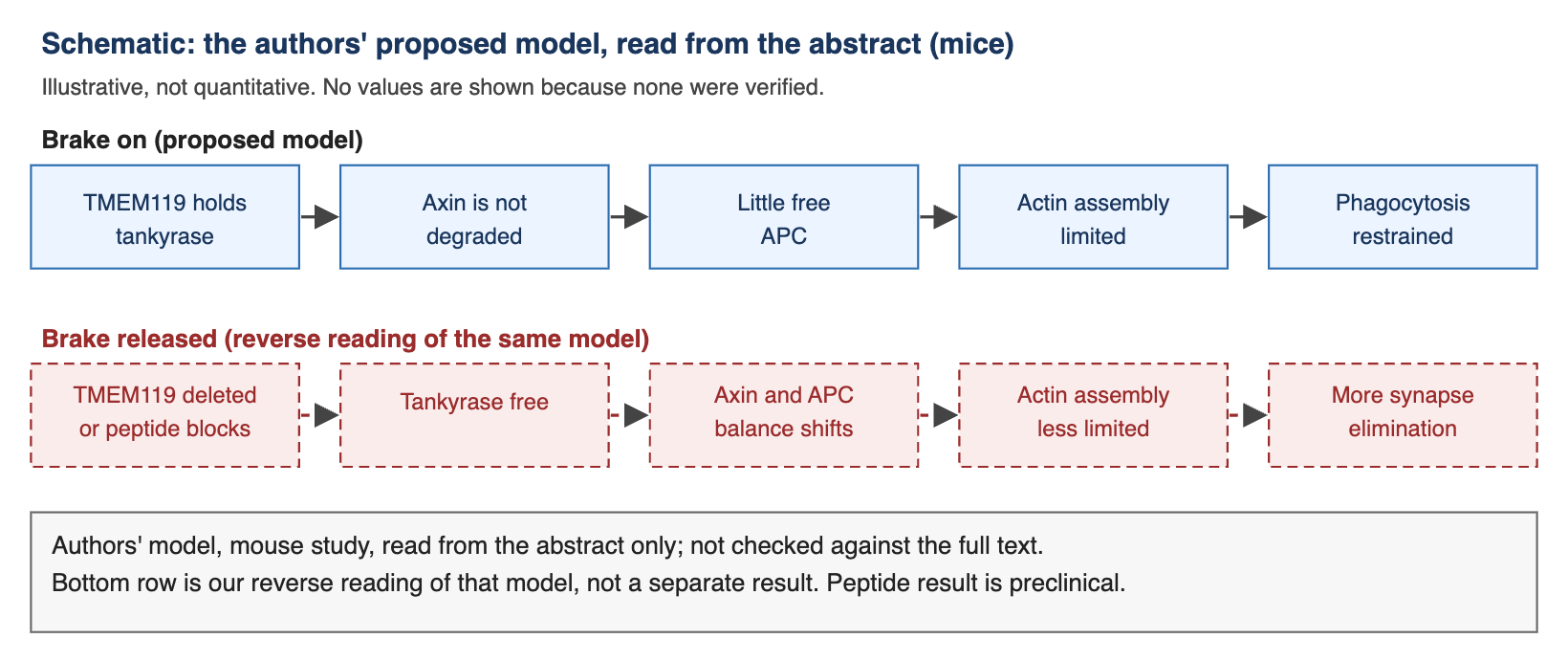
- What: A 13-author paper in Neuron (online 2026-09-30) reports that, in adult mice, the microglial membrane protein TMEM119 restrains phagocytosis. The authors propose that it sequesters tankyrase, which spares axin, which limits the pool of free APC available for actin assembly. In mice, acute deletion of microglial TMEM119 increased synapse elimination and destabilized established fear memories, and an intravenously given membrane-permeable peptide that disrupts the TMEM119-tankyrase interaction reproduced the effect (authors’ abstract).
- So what: This is a mouse preclinical mechanism and pharmacological proof-of-concept. It is not a demonstration of human memory manipulation or of a treatment effect. The abstract reports no numbers, so we verified no effect sizes, group sizes, control peptides or statistics. Whether the effect is specific to memory (rather than general cognitive or sickness-behavior impairment) and whether the peptide acts selectively on microglia are not established in the abstract. The phenomenon that microglial phagocytosis can drive forgetting in mice was reported earlier, and an independent group assigned TMEM119 the opposite sign in an Alzheimer’s disease model.
- Now what: Treat it as a hypothesis-generating mechanism paper (TRL 2-3). The disclosure of a company co-founded by an author and a patent filing on the same class of agents is described in the Disclosure. Watch for full-text control experiments, independent replication, and any human-tissue data.
5-minute read
What was claimed
Microglia are the brain’s resident immune cells, and one of their jobs is to engulf (phagocytose) synaptic material. The paper, titled by its authors “A TMEM119-tankyrase axis restrains microglial phagocytosis to maintain memory and enables pharmacological forgetting”, proposes a molecular brake on that process. According to the abstract, TMEM119 is a constitutive, cell-intrinsic brake on microglial surveillance and phagocytosis. The authors propose that TMEM119 sequesters tankyrase, preventing axin degradation; axin then keeps the pool of free APC small, which limits actin assembly. We could not check this model against the main text.
What the mouse results are, and are not
In adult mice, the abstract reports that acute removal of TMEM119 from microglia increased synapse elimination and destabilized established fear memories. It also reports that a membrane-permeable peptide, given intravenously, disrupts the TMEM119-tankyrase interaction and reproduces the effect. Whether the disruption is competitive is not something we could confirm.
Three limits shape how to read this. First, the abstract contains no quantitative results, so we state none. Second, a drop in fear memory together with more synapse elimination can mean memory-specific forgetting, but it could equally reflect general cognitive, motor or sickness-behavior impairment; the abstract reports no control that separates these. Third, the idea that microglial phagocytosis can drive forgetting in mice was already reported (Wang et al., Science 2020), so the contribution here is a proposed molecular brake and a pharmacological handle, not the existence of the phenomenon. Whether the effect holds in people, or whether human tissue was examined, is unverified.
Deep dive
1. Background
Microglia prune synapses during development and, in adults, contribute to turnover of synaptic contacts. Wang et al. (Science 367:688-694, 2020; PMID 32029629), titled “Microglia mediate forgetting via complement-dependent synaptic elimination”, reported that in healthy adult mice microglial phagocytosis mediates forgetting, and that suppressing it prevents forgetting. We read that work only at the level of its abstract and secondary summaries. TMEM119 was introduced as a microglial marker of then-unknown function; the paper discussed here assigns it a function. That claim is made by the authors in the abstract and we did not verify it against the main text.
2. What this study newly establishes
- Mechanism (authors’ model). TMEM119 sequesters tankyrase, preventing axin degradation, which reduces free APC and limits actin assembly and phagocytosis. We could not check this against the main text.
- Genetic result in mice. Acute deletion of microglial TMEM119 in adult mice increased synapse elimination and destabilized established fear memories (authors’ abstract).
- Pharmacological result in mice. An intravenously given, membrane-permeable peptide that disrupts the TMEM119-tankyrase interaction reproduced the effect (authors’ abstract). The route by which the peptide reaches microglia in the brain, including any passage across the blood-brain barrier, is not described in the abstract and is unverified.
- Species. The abstract says adult mice. Strain, sex, group sizes, behavioral paradigms beyond fear memory, peptide sequence and dose are unverified.
- Quantitative content. None verified. The abstract has no effect sizes or statistics.
3. Strengths and limitations of the method
Strengths.
- The paper links a molecular pathway to a cellular behavior (phagocytosis) and to a behavioral readout (fear memory), and reports a convergent result from two interventions, genetic deletion and a peptide.
- It is peer reviewed (received 2026-04-10, revised 2026-07-30, accepted 2026-09-01) in a major neuroscience journal, and bibliographic records, author list and disclosures could be checked directly.
Limitations.
- Abstract only. We could not read Methods, figures or supplements. Controls (for example a non-binding control peptide, or Cre-inducer-only controls), blinding, group sizes and multiple-comparison handling are all unverified. We also did not obtain the abstract verbatim; the four qualitative claims above rest on two database copies of the same publisher-deposited abstract that agree with one another, which rules out transcription error but is not independent replication.
- Specificity. The abstract reports no test of whether the effect is memory-specific or selective to microglia. Tankyrase is a known regulator of Wnt/axin signalling, so off-target effects of disrupting its interactions are not a priori small.
- Peptide pharmacology. Pharmacokinetics, brain exposure, duration of effect and toxicity are not in the abstract and are unverified.
- No replication. We found no independent replication. We found no earlier preprint version, but this is a failure to find one, not proof that none exists.
4. Connections to neighboring domains
Neuroimmunology and neurodegeneration. This is the substantive link. Liu et al. (Immunity 58(7):1830-1846.e7, 2025; doi:10.1016/j.immuni.2025.04.018), an independent group with no author overlap with this paper, reported that microglial TMEM119 binds amyloid-beta and promotes its clearance in an Alzheimer’s disease mouse model. The two reports are not formally contradictory: the substrates differ (amyloid-beta versus synapses), the proposed layers differ (extracellular binding versus intracellular tankyrase sequestration), and the contexts differ (disease model versus healthy adult). We did not read the full text of either paper. The practical consequence is that “TMEM119 is the brake on microglial phagocytosis” cannot be stated as established; the sign of TMEM119’s function has been reported differently by different groups, and the direction in which a therapeutic would need to push it could reverse between conditions with too much synapse loss and conditions with too little debris clearance.
Ethics (same-domain note). Any agent that alters memory stability raises questions of consent and misuse. We do not know whether the paper discusses these, and the abstract does not address them.
5. Commercialization and investment perspective
TRL 2-3 (our assessment): mouse mechanism and a pharmacological proof-of-concept. Safety, pharmacokinetics and validation of the target in humans cannot be assessed from the abstract. We found no clinical-trial registration or IND information and infer no commercialization timeline.
Related organizations (facts only). The authors’ affiliations include Tsinghua University (several schools and institutes), Changping Laboratory, New Cornerstone Laboratory, the Institute of Molecular Medicine at Peking University, and Shanxi Medical University (the SXMU-Tsinghua Collaborative Innovation Center, listed for the corresponding author). The paper’s disclosure states that a company co-founded by an author exists and that a patent has been filed on agents interfering with TMEM119-tankyrase interactions. The patented subject matter is the same class of agents as the pharmacological tool in this paper, which is why we place this fact in the same paragraph as any therapeutic prospect. We do not name the company here. We could not verify the identity, location, registration or listing status of the company, or the patent applicant, and we draw no link to any listed company. There is nothing in the abstract to value commercially, and we draw no investment inference.
6. Counterarguments
- Not new as a phenomenon. That microglial phagocytosis can drive forgetting in mice was already reported (Wang et al., Science 2020). The advance claimed here is the molecular brake and the pharmacological handle.
- Opposite sign for the same protein. An independent group assigned TMEM119 the opposite role, promoting amyloid-beta clearance (Liu et al., Immunity 2025). The brake framing is therefore context-dependent, and the therapeutic direction may flip between indications.
- Specificity is unestablished. More synapse elimination plus weaker fear memory is compatible with memory-specific forgetting and with general impairment. The abstract reports no test that separates them, nor a test of microglial selectivity for the peptide.
- Hype risk sits in translation. The title phrase “pharmacological forgetting” is the authors’ and the journal’s framing, not ours. We found no press-release amplification. The risk is the step from destabilizing a mouse fear memory to claims about people, which this evidence does not support.
- Nothing to evaluate statistically. With no numbers in the abstract and no full text read, we cannot assess sample sizes, effect sizes, controls or multiple-comparison correction.
Required context: this is a mouse preclinical mechanism and pharmacological proof-of-concept, not a demonstration of human memory manipulation or of a treatment effect. We read one publisher-deposited abstract, so group sizes, effect sizes, control peptides and statistics are not confirmed, and whether the effect is memory-specific and whether the peptide is selective for microglia is unconfirmed. Microglial phagocytosis as a driver of forgetting in mice was previously reported (Wang et al., Science 2020), and an independent group reported the opposite sign for TMEM119, promoting amyloid-beta clearance (Liu et al., Immunity 2025), so the therapeutic direction depends on the indication. The paper discloses that an author is a co-founder of a company, and that a patent has been filed on agents interfering with TMEM119-tankyrase interactions.
7. Indicators to watch
- Full-text controls: non-binding control peptide, inducer-only controls, blinding, group sizes and multiple-comparison handling.
- Tests that separate memory-specific effects from general cognitive or sickness-behavior effects, and evidence of peptide selectivity for microglia.
- Peptide pharmacology: sequence, dose, brain exposure, duration of effect, off-target Wnt/axin effects and toxicity.
- Independent replication of both the deletion and peptide results.
- Reconciliation with the amyloid-beta clearance report for the same protein, ideally in a single experimental system.
- Any human tissue or human cell data on TMEM119-tankyrase, and any trial registration for an agent of this class.
- Assignee and scope of the disclosed patent filing.
References
- Sun, Suhua, Chenfeng Wang, Yang Bian, Ming Hao, Jiacheng Wei, Ronghao Tang, Xi Wu, Huanhuan Wang, Bo Liu, Lisang Zhong, Zhiwei You, Jianbin Wang, and Hai Qi. 2026. “A TMEM119-tankyrase axis restrains microglial phagocytosis to maintain memory and enables pharmacological forgetting.” Neuron, advance online publication, 30 September 2026 (volume and pages not yet assigned). DOI 10.1016/j.neuron.2026.09.001; PMID 42815471 (source of all results in this article; abstract and bibliographic records only).
- Wang et al. 2020. “Microglia mediate forgetting via complement-dependent synaptic elimination.” Science 367: 688-694. PMID 32029629 (prior report of the phenomenon; read at abstract and secondary-summary level only).
- Liu et al. 2025. “Microglial TMEM119 binds to amyloid-beta to promote its clearance in an Abeta-depositing mouse model of Alzheimer’s disease.” Immunity 58 (7): 1830-1846.e7. DOI 10.1016/j.immuni.2025.04.018 (independent report of an opposite sign for TMEM119; bibliographic record checked, full text not read).
Disclosure
- This article is for informational purposes only and is not investment advice.
- The author has no interest in any company discussed in this post. No company is named.
- Conflict-of-interest notes:
- The paper’s disclosure states that an author is a co-founder of a company, and that a patent has been filed on agents interfering with TMEM119-tankyrase interactions. The disclosure identifies the author only by initials, and we do not attribute it to a named person. The patented subject matter is the same class of agents as the pharmacological tool in this paper. We did not find a company record for the disclosed entity and could not verify its location, registration or listing status, or the patent applicant.
- Funding: the publisher’s metadata lists one funder, the Ministry of Education of the People’s Republic of China (publisher-asserted). The grant fields in PubMed and Europe PMC are empty. Grant details and any company funding are unverified.
- All mechanistic and behavioral claims in this article are the authors’ claims from the abstract. We confirmed no quantitative result, and none has been independently reproduced to our knowledge.
- Our reading relied on the PubMed and Europe PMC records and Crossref metadata; the full text is subscription-only, no legal open-access copy was found, and we did not bypass access restrictions. The figure in this article is an original drawing.


Leave a Reply